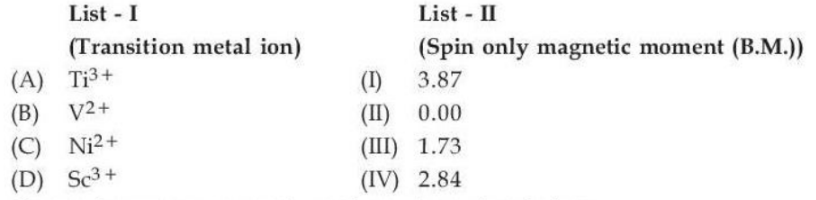
Given below are two statements:
Statement I: The number of pairs, from the following, in which both the ions are coloured in aqueous solution is 3.
$$[Sc^{3+},Ti^{3+}],[Mn^{2+},Cr^{2+}],[Cu^{2+},Zn^{2+}]$$ and $$[Ni^{2+},Ti^{4+}]$$
Statement II: $$Th^{4+}$$ is the strongest reducing agent among $$Th^{4+},Ce^{4+},Gd^{3+}\text{ and }Eu^{2+}$$.
In the light of the above statements, choose the correct answer from the options given below
JEE d and f-Block Elements Questions
We need to evaluate two statements about transition metal ions.
Statement I: The number of pairs in which both ions are coloured in aqueous solution is 3.
The pairs given are:
1. $$[Sc^{3+}, Ti^{3+}]$$: $$Sc^{3+}$$ has configuration $$[Ar]3d^0$$ — colourless (no d-electrons for d-d transition). $$Ti^{3+}$$ has $$[Ar]3d^1$$ — coloured (purple). Not both coloured.
2. $$[Mn^{2+}, Cr^{2+}]$$: $$Mn^{2+}$$ has $$[Ar]3d^5$$ — very faintly pink (spin-forbidden transitions, often considered coloured). $$Cr^{2+}$$ has $$[Ar]3d^4$$ — coloured (blue). Both coloured.
3. $$[Cu^{2+}, Zn^{2+}]$$: $$Cu^{2+}$$ has $$[Ar]3d^9$$ — coloured (blue). $$Zn^{2+}$$ has $$[Ar]3d^{10}$$ — colourless (fully filled d-orbital). Not both coloured.
4. $$[Ni^{2+}, Ti^{4+}]$$: $$Ni^{2+}$$ has $$[Ar]3d^8$$ — coloured (green). $$Ti^{4+}$$ has $$[Ar]3d^0$$ — colourless. Not both coloured.
Only 1 pair ($$Mn^{2+}, Cr^{2+}$$) has both ions coloured. The statement claims 3 pairs, which is false.
Statement II: $$Th^{4+}$$ is the strongest reducing agent among $$Th^{4+}, Ce^{4+}, Gd^{3+}, Eu^{2+}$$.
A reducing agent donates electrons (gets oxidized). Among the given species:
- $$Eu^{2+}$$ can be oxidized to $$Eu^{3+}$$ (gaining the stable $$4f^7$$ half-filled configuration), making it a strong reducing agent.
- $$Ce^{4+}$$ is actually a strong oxidizing agent (tends to gain electrons to become $$Ce^{3+}$$), not a reducing agent.
- $$Th^{4+}$$ has a noble gas core $$[Rn]$$ with no electrons in 5f. It is very stable and has no tendency to be further oxidized. It is a very poor reducing agent.
- $$Gd^{3+}$$ has the stable half-filled $$4f^7$$ configuration and is not easily oxidized.
The strongest reducing agent is $$Eu^{2+}$$, not $$Th^{4+}$$. Statement II is false.
Since both statements are false, the correct answer is Option (4): Both Statement I and Statement II are false.
Pairs of elements with the same number of electrons in their respective 4f orbital are
[Atomic number. Eu-63, Gd-64, Dy-66, Ho-67, Tm-69, Yb-70, Lu-71, Hf-72]
A. (Eu and Gd)
B. (Dy and Ho)
C. (Yb and Hf)
D. (Lu and Tm)
choose the correct answer from the options given below
To decide whether two elements have the same number of $$4f$$ electrons we must write their ground-state electronic configurations in terms of the xenon core $$[Xe]$$ followed by the $$4f$$, $$5d$$ and $$6s$$ subshells.
In the lanthanide series (atomic numbers 57-71) electrons are added mainly to the $$4f$$ subshell. Two useful facts are:
(i) A completely half-filled $$4f$$ subshell contains 7 electrons, i.e. $$4f^7$$.
(ii) A completely filled $$4f$$ subshell contains 14 electrons, i.e. $$4f^{14}$$.
Let us now write the configurations.
Pair (Eu, Gd)
Europium, $$Z = 63$$: $$[Xe]\;4f^7\,6s^2$$ ⇒ $$4f^7$$ (7 electrons).
Gadolinium, $$Z = 64$$: $$[Xe]\;4f^7\,5d^1\,6s^2$$ ⇒ $$4f^7$$ (7 electrons).
Both contain 7 $$4f$$ electrons ⇒ SAME.
Pair (Dy, Ho)
Dysprosium, $$Z = 66$$: $$[Xe]\;4f^{10}\,6s^2$$ ⇒ 10 $$4f$$ electrons.
Holmium, $$Z = 67$$: $$[Xe]\;4f^{11}\,6s^2$$ ⇒ 11 $$4f$$ electrons.
Different numbers ⇒ NOT same.
Pair (Yb, Hf)
Ytterbium, $$Z = 70$$: $$[Xe]\;4f^{14}\,6s^2$$ ⇒ 14 $$4f$$ electrons.
Hafnium, $$Z = 72$$: $$[Xe]\;4f^{14}\,5d^2\,6s^2$$ ⇒ 14 $$4f$$ electrons.
Both contain 14 $$4f$$ electrons ⇒ SAME.
Pair (Lu, Tm)
Thulium, $$Z = 69$$: $$[Xe]\;4f^{13}\,6s^2$$ ⇒ 13 $$4f$$ electrons.
Lutetium, $$Z = 71$$: $$[Xe]\;4f^{14}\,5d^1\,6s^2$$ ⇒ 14 $$4f$$ electrons.
Different numbers ⇒ NOT same.
Therefore the pairs having equal numbers of $$4f$$ electrons are:
(A) (Eu, Gd) and (C) (Yb, Hf).
Option D which is: A, C Only
Given below are two statements :
Statement I : Among Zn, Mn, Sc and Cu, the energy required to remove the third valence electron is highest for Zn and lowest for Sc.
Statement II : The correct order of the following complexes in terms of CFSE is $$[Co(H_2O)_6]^{2+} < [Co(H_2O)_6]^{3+} < [Co(en)_3]^{3+}$$.
In the light of the above statements, choose the correct answer from the options given below:
Checking Statement I
The third ionisation enthalpy corresponds to removing the third valence electron, i.e. the electron that is lost when the neutral atom has already lost its two 4s electrons.
The electronic configurations (ground state) are:
Sc : $$[Ar]\,3d^{1}\,4s^{2}$$
Mn : $$[Ar]\,3d^{5}\,4s^{2}$$
Cu : $$[Ar]\,3d^{10}\,4s^{1}$$
Zn : $$[Ar]\,3d^{10}\,4s^{2}$$
After two electrons are removed (first and second ionisations) the situations are:
Sc $$\rightarrow$$ $$[Ar]\,3d^{1}$$ (third electron will be a 3d electron)
Mn $$\rightarrow$$ $$[Ar]\,3d^{5}$$ (half-filled d5, stable)
Cu $$\rightarrow$$ $$[Ar]\,3d^{10}$$ (completely filled d10, very stable)
Zn $$\rightarrow$$ $$[Ar]\,3d^{10}$$ (completely filled d10, very stable)
The stability of a completely filled d10 subshell is greater than that of a half-filled d5 subshell, which in turn is greater than that of a single 3d electron. Hence
Energy required (IE3): $$\text{Zn} \gt \text{Cu} \gt \text{Mn} \gt \text{Sc}$$
Thus, the highest third ionisation enthalpy is for Zn and the lowest is for Sc. Statement I is true.
Checking Statement II
We compare the crystal-field stabilisation energy (CFSE) of the three octahedral complexes.
1. $$[Co(H_2O)_6]^{2+}$$ : Co(II) is $$3d^{7}$$. With the weak-field ligand H2O, the complex is high-spin:
configuration $$t_{2g}^{5}\,e_g^{2}$$
CFSE $$= (5 \times -0.4\Delta_o) + (2 \times +0.6\Delta_o) = -2.0\Delta_o +1.2\Delta_o = -0.8\Delta_o$$
2. $$[Co(H_2O)_6]^{3+}$$ : Co(III) is $$3d^{6}$$. The oxidation state +3 greatly enlarges $$\Delta_o$$, so the complex becomes low-spin:
configuration $$t_{2g}^{6}\,e_g^{0}$$
CFSE $$= 6 \times -0.4\Delta_o = -2.4\Delta_o$$
3. $$[Co(en)_3]^{3+}$$ : Co(III) is again $$3d^{6}$$, but ethylenediamine (en) is a stronger field ligand than H2O, giving an even larger $$\Delta_o$$ while the electron distribution remains low-spin:
configuration $$t_{2g}^{6}\,e_g^{0}$$
CFSE $$= 6 \times -0.4(\Delta_o') = -2.4\Delta_o'$$ where $$\Delta_o' \gt \Delta_o$$
Because $$\lvert\Delta_o'\rvert \gt \lvert\Delta_o\rvert$$, the numerical magnitude of CFSE is
$$[Co(H_2O)_6]^{2+}\;(\;0.8\Delta_o\;) \lt [Co(H_2O)_6]^{3+}\;(\;2.4\Delta_o\;) \lt [Co(en)_3]^{3+}\;(\;2.4\Delta_o'\;)$$
Therefore Statement II is also true.
Conclusion
Both Statement I and Statement II are true.
Option A which is: Both Statement I and Statement II are true
Given below are two statements :
Statement I : The number of pairs among [Ti$$^{4+}$$, V$$^{2+}$$], [V$$^{2+}$$, Mn$$^{2+}$$], [Mn$$^{2+}$$, Fe$$^{3+}$$] and [V$$^{2+}$$, Cr$$^{2+}$$] in which both ions are coloured is 3.
Statement II : The number of pairs among [La$$^{3+}$$, Yb$$^{2+}$$], [Lu$$^{3+}$$, Ce$$^{4+}$$] and [Ac$$^{3+}$$, Lr$$^{3+}$$] ions in which both are diamagnetic is 3.
In the light of the above statements, choose the correct from the options given below :
Given below are two statements:
$$\textbf{Statement I :}$$ Presence of large number of unpaired electrons in transition metal atoms results in higher enthalpies of their atomisation.
$$\textbf{Statement II :}$$ $$d_{xy} = d_{xz} = d_{yz} < d_{x^2-y^2} = d_{z^2}$$ and $$d_{x^2-y^2} = d_{z^2} < d_{xy} = d_{xz} = d_{yz}$$ are the d-orbital splittings in $$[\text{Fe}(\text{H}_2\text{O})_6]^{3+}$$ and $$[\text{Ni}(\text{Cl})_4]^{2-}$$ complex ions respectively.
In the light of the above statements, choose the correct answer from the options given below:
The correct order of first ($$\Delta_i H_1$$) and second ($$\Delta_i H_2$$) ionisation enthalpy values of Cr and Mn are :
A. $$\Delta_i H_1$$ : Cr > Mn
B. $$\Delta_i H_2$$ : Cr > Mn
C. $$\Delta_i H_1$$ : Mn > Cr
D. $$\Delta_i H_2$$ : Mn > Cr
Choose the correct answer from the options given below :
The correct statements among the following are.
A. Basic vanadium oxide is used in the manufacture of H$$_2$$SO$$_4$$.
B. The spin-only magnetic moment value of the transition metal halide employed in Ziegler-Natta polymerization is 2.84 BM.
C. The p-block metal compound employed in Ziegler-Natta polymerization has the metal in +3 oxidation state.
D. The number of electrons present in the outer most 'd' orbital of metal halide employed in Wacker process is 8.
Choose the correct answer from the options given below:
The correct statements among the following are:
A. Mo(VI) and W(VI) are less stable than Cr(VI).
B. Ce$$^{4+}$$ and Tb$$^{4+}$$ are oxidant while Eu$$^{2+}$$ and Yb$$^{2+}$$ are reductant.
C. Cm and Am have seven unpaired electrons.
D. Actinoid contraction is greater from element to element than lanthanoid contraction.
choose the correct answer from the options given below:
For every statement we first recall the electronic configurations and periodic-trend facts that decide stability, oxidising/reducing behaviour and the magnitude of contraction.
Statement A: “$$\text{Mo(VI)}$$ and $$\text{W(VI)}$$ are less stable than $$\text{Cr(VI)}$$.”
Down group 6 the higher oxidation states become progressively more stable because the larger 4d and 5d orbitals of Mo and W can better accommodate the charge and form stronger $$\pi$$ bonds with oxygen. Thus $$\text{Cr(VI)}$$ compounds (e.g. $$CrO_4^{2-}$$) are powerful oxidants, whereas $$MoO_3$$ and $$WO_3$$ are quite stable and much less oxidising.
Hence statement A is incorrect.
Statement B: “$$Ce^{4+}$$ and $$Tb^{4+}$$ are oxidants while $$Eu^{2+}$$ and $$Yb^{2+}$$ are reductants.”
Lanthanoid ions are most stable in the +3 state. Any ion that lies above +3 tends to gain an electron (acts as an oxidising agent), and any ion below +3 tends to lose an electron (acts as a reducing agent).
• $$Ce^{4+} \rightarrow Ce^{3+}$$ is very favourable ⇒ strong oxidant.
• $$Tb^{4+} \rightarrow Tb^{3+}$$ is also favourable ⇒ oxidant.
• $$Eu^{2+} \rightarrow Eu^{3+}$$ is favourable so $$Eu^{2+}$$ donates an electron ⇒ reductant.
• $$Yb^{2+} \rightarrow Yb^{3+}$$ behaves similarly ⇒ reductant.
Therefore statement B is correct.
Statement C: “Cm and Am have seven unpaired electrons.”
Electronic configurations:
• $$Am (Z=95): [Rn]\,5f^7\,7s^2$$ ⇒ exactly seven 5f electrons, each unpaired ⇒ 7 unpaired electrons.
• $$Cm (Z=96): [Rn]\,5f^7\,6d^1\,7s^2$$ (ground-state) ⇒ the seven 5f electrons plus one unpaired 6d electron ⇒ 8 unpaired electrons.
Since Cm has eight, not seven, unpaired electrons, statement C is incorrect.
Statement D: “Actinoid contraction is greater from element to element than lanthanoid contraction.”
The 5f orbitals in actinoids shield the nuclear charge even less effectively than the 4f orbitals in lanthanoids. Consequently the cumulative decrease in atomic/ionic radii (contraction) per step is larger in the actinoid series. Hence statement D is correct.
Only statements B and D are correct.
Therefore, the correct option is:
Option C which is: B and D Only
Which of the following is NOT a physical or chemical characteristics of interstitial compounds?
Correct statements from the following are:
A. Potassium dichromate is an oxidising agent and it oxidises $$\text{FeSO}_4$$ to $$\text{Fe}_2(\text{SO}_4)_3$$ in acidic medium.
B. Sodium dichromate can be used as primary standard in volumetric estimation.
C. $$\text{CrO}_4^{2-}$$ and $$\text{Cr}_2\text{O}_7^{2-}$$ are interconvertible in aqueous solution by varying the pH of the solution.
D. Cr-O-Cr bond angle in $$\text{Cr}_2\text{O}_7^{2-}$$ is 126°.
choose the correct answer from the options given below
We examine each statement one by one and decide its truth value.
Statement A: Potassium dichromate ($$K_2Cr_2O_7$$) is a strong oxidising agent in acidic medium.
Balanced redox reaction with ferrous sulphate: $$6\,FeSO_4 + K_2Cr_2O_7 + 7\,H_2SO_4 \rightarrow 3\,Fe_2(SO_4)_3 + K_2SO_4 + Cr_2(SO_4)_3 + 7\,H_2O$$.
$$Fe^{2+}$$ is oxidised to $$Fe^{3+}$$, confirming the statement.
Hence A is correct.
Statement B: A primary standard must be highly pure, stable, non-hygroscopic and of high molar mass. $$Na_2Cr_2O_7 \cdot 2H_2O$$ is distinctly hygroscopic and absorbs moisture, so its exact mass cannot be obtained without error. Therefore it is not suitable as a primary standard.
Hence B is incorrect.
Statement C: In aqueous solution the equilibrium
$$2\,CrO_4^{2-} + 2\,H^+ \;\rightleftharpoons\; Cr_2O_7^{2-} + H_2O$$
shows that increasing $$[H^+]$$ (acidic medium) shifts the equilibrium to the right (dichromate), while adding base shifts it to the left (chromate). Thus chromate and dichromate ions are interconvertible by changing pH.
Hence C is correct.
Statement D: In the $$Cr_2O_7^{2-}$$ ion, two $$CrO_4$$ tetrahedra share one common oxygen. X-ray studies give the $$Cr{-}O{-}Cr$$ (bridging) bond angle as approximately $$126^\circ$$.
Hence D is correct.
Therefore the correct statements are A, C and D.
Option B which is: A, C and D Only
Given below are two statements for catalytic properties of transition metals.
Statement I : First row transition metals which act as catalyst utilise their 3d electrons only for formation of bonds between reactant molecules and atoms on the surface of catalyst.
Statement II : There is increase in the concentration of reactants on the surface of catalyst which strengthens the bonds in reacting molecules.
In the light of the above statements, choose the correct answer from the options given below :
The correct statements about metal carbonyls are
A. The metal-carbon bonds in metal carbonyls possess both $$\sigma$$ and $$\pi$$-character.
B. Due to synergic bonding interactions between metal and CO ligand, the metal-carbon bond becomes weak.
C. The metal-carbon $$\sigma$$ bond is formed by the donation of lone pair of electrons on the carbonyl carbon into a vacant orbital of metal.
D. The metal-carbon $$\pi$$ bond is formed by the donation of electrons from filled d-orbital of metal into vacant $$\pi^*$$ orbital of CO.
Choose the correct answer from the options given below:
Consider $$|x|$$ is the difference in oxidation states of Mn in highest manganese fluoride and highest manganese oxide. The ions with $$|x|$$ number of unpaired electrons from the following are:
A. Sc$$^{3+}$$
B. Zn$$^{2+}$$
C. V$$^{2+}$$
D. Fe$$^{2+}$$
E. Co$$^{2+}$$
choose the correct answer from the options given below :
Manganese lies in group 7 of the periodic table, so its maximum oxidation number is $$+7$$ when it can lose all seven valence electrons.
Highest fluoride of Mn
Fluorine is the most electronegative element, yet only $$\mathrm{MnF_4}$$ is well-established. In it
$$\mathrm{Mn}^{+4} + 4\,\mathrm{F}^- \rightarrow \mathrm{MnF_4}$$
Therefore the highest confirmed oxidation state of Mn in a fluoride is $$+4$$.
Highest oxide of Mn
In $$\mathrm{Mn_2O_7}$$ the oxidation state is
$$2(\text{Mn}) + 7(-2) = 0 \;\Rightarrow\; \text{Mn} = +7$$
Hence the required difference is
$$|x| = |(+7) - (+4)| = 3$$
We now need the given metal ions that possess exactly $$3$$ unpaired electrons.
Electronic configurations and unpaired electrons
(A) Sc$$^{3+}$$ : Sc (21) is $$[\mathrm{Ar}]\,3d^1 4s^2$$; removing three electrons gives $$[\mathrm{Ar}]$$, i.e. $$3d^0$$ ⟹ 0 unpaired.
(B) Zn$$^{2+}$$ : Zn (30) is $$[\mathrm{Ar}]\,3d^{10} 4s^2$$; Zn$$^{2+}$$ is $$[\mathrm{Ar}]\,3d^{10}$$ ⟹ 0 unpaired.
(C) V$$^{2+}$$ : V (23) is $$[\mathrm{Ar}]\,3d^{3}4s^{2}$$; V$$^{2+}$$ loses the two 4s electrons → $$[\mathrm{Ar}]\,3d^{3}$$.
A $$d^{3}$$ set has one electron in each of three different d-orbitals ⟹ 3 unpaired.
(D) Fe$$^{2+}$$ : Fe (26) is $$[\mathrm{Ar}]\,3d^{6}4s^{2}$$; Fe$$^{2+}$$ is $$[\mathrm{Ar}]\,3d^{6}$$.
For a free (high-spin) $$d^{6}$$ ion the distribution is ↑↓ ↑ ↑ ↑ ↑ giving 4 unpaired.
(E) Co$$^{2+}$$ : Co (27) is $$[\mathrm{Ar}]\,3d^{7}4s^{2}$$; Co$$^{2+}$$ is $$[\mathrm{Ar}]\,3d^{7}$$.
A high-spin $$d^{7}$$ arrangement (↑↓ ↑↓ ↑ ↑ ↑) contains 3 unpaired electrons.
The ions with exactly three unpaired electrons are V$$^{2+}$$ and Co$$^{2+}$$, i.e. Option C.
Final Answer: Option C which is: C, E Only
Given below are two statements :
Statement I : The first ionization enthalpy of Cr is lower than that of Mn.
Statement II : The second and third ionization enthalpies of Cr are higher than those of Mn. In the light of the above statements, choose the correct answer from the options given below :
We need to evaluate two statements about the ionization enthalpies of chromium (Cr, Z=24) and manganese (Mn, Z=25).
The electronic configurations are: Cr = [Ar] 3d$$^5$$ 4s$$^1$$ and Mn = [Ar] 3d$$^5$$ 4s$$^2$$.
Statement I: The first ionization enthalpy of Cr is lower than that of Mn.
For Cr, the first electron removed is the lone 4s$$^1$$ electron. For Mn, one of the paired 4s$$^2$$ electrons is removed. Although Mn has one more proton, Cr has a half-filled 4s subshell making removal relatively easier, while Mn has a fully filled 4s$$^2$$. The actual values are: IE$$_1$$(Cr) = 652.9 kJ/mol and IE$$_1$$(Mn) = 717.3 kJ/mol. So IE$$_1$$(Cr) < IE$$_1$$(Mn). Statement I is TRUE.
Statement II: The second and third ionization enthalpies of Cr are higher than those of Mn.
After losing one electron: Cr$$^+$$ = [Ar] 3d$$^5$$ (stable half-filled) and Mn$$^+$$ = [Ar] 3d$$^5$$ 4s$$^1$$.
The second ionization removes an electron from the very stable half-filled 3d$$^5$$ configuration in Cr$$^+$$, while for Mn$$^+$$ it removes the 4s$$^1$$ electron. So IE$$_2$$(Cr) > IE$$_2$$(Mn). This part is true.
After losing two electrons: Cr$$^{2+}$$ = [Ar] 3d$$^4$$ and Mn$$^{2+}$$ = [Ar] 3d$$^5$$ (half-filled, extra stable).
The third ionization removes from 3d$$^4$$ in Cr$$^{2+}$$ versus from the highly stable half-filled 3d$$^5$$ in Mn$$^{2+}$$. Therefore IE$$_3$$(Mn) > IE$$_3$$(Cr), meaning the third IE of Cr is lower than that of Mn.
Since the statement claims both second AND third IEs of Cr are higher than Mn, but only the second IE is higher (not the third), Statement II is FALSE.
Statement I is true and Statement II is false. The answer is Option C.
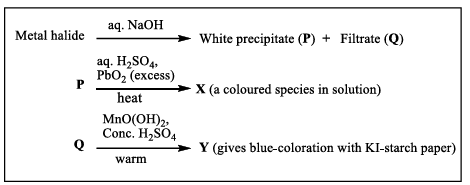
Among $$Fe^{2+}$$, $$Fe^{3+}$$, $$Cr^{2+}$$ and $$Zn^{2+}$$, the ion that shows positive borax bead test and with highest ionisation enthalpy is :
Electronic configurations of the given ions:
$$\begin{aligned} Fe^{2+}&: [Ar]\;3d^{6} \\ Fe^{3+}&: [Ar]\;3d^{5} \\ Cr^{2+}&: [Ar]\;3d^{4} \\ Zn^{2+}&: [Ar]\;3d^{10} \end{aligned}$$
(i) Borax bead test
The coloured borax bead arises when the cation possesses partially filled $$d$$-orbitals; the colour is due to $$d$$→$$d$$ transitions. An ion with a completely filled $$d$$-sub-shell gives either a colourless bead or no distinct colour.
• $$Fe^{2+},\;Fe^{3+},\;Cr^{2+}$$ all have partially filled $$d$$-orbitals ⇒ positive borax bead test.
• $$Zn^{2+}$$ has the completely filled configuration $$3d^{10}$$ ⇒ no (or colourless) borax bead; hence it is treated as a negative test.
(ii) Highest ionisation enthalpy among the ions that give the positive test
Ionisation enthalpy for an ion refers to the energy needed to remove one more electron from that ion. The higher the stability of the electronic configuration, the larger this value.
• $$Fe^{3+}$$ has the exactly half-filled, highly stable $$3d^{5}$$ configuration.
• $$Cr^{2+}$$ is $$3d^{4}$$ (one electron short of half-filled).
• $$Fe^{2+}$$ is $$3d^{6}$$ (one electron more than half-filled).
The most stable (half-filled) arrangement resists further ionisation the most, so $$Fe^{3+}$$ has the greatest ionisation enthalpy among the three.
Therefore, the ion that both shows a positive borax bead test and possesses the highest ionisation enthalpy is $$Fe^{3+}$$.
Option D which is: $$Fe^{3+}$$
Among the following oxides of 3d elements, the number of mixed oxides are ___________.
$$Ti_{2}O_{3}$$, $$V_{2}O_{4}$$, $$Cr_{2}O_{3}$$, $$Mn_{3}O_{4}$$, $$Fe_{3}O_{4}$$, $$Fe_{2}O_{3}$$, $$Co_{3}O_{4}$$
We need to identify how many of the given oxides of 3d elements are mixed oxides. A mixed oxide behaves as if it is a combination of two different oxides of the same element, meaning that the metal exists in two different oxidation states within the compound and can be thought of as a stoichiometric mixture of two simpler oxides.
For $$Ti_2O_3$$, titanium is solely in the +3 oxidation state, so this compound is a simple oxide rather than a mixed oxide.
Considering $$V_2O_4$$, it can be written as $$2VO_2$$ with vanadium uniformly in the +4 oxidation state, which also classifies it as a simple oxide.
Likewise, $$Cr_2O_3$$ features chromium exclusively in the +3 state, confirming its status as a simple oxide.
In contrast, $$Mn_3O_4$$ is a mixed oxide since it can be expressed as $$MnO \cdot Mn_2O_3$$ and contains manganese in both the +2 and +3 oxidation states.
Similarly, $$Fe_3O_4$$ is mixed because it corresponds to $$FeO \cdot Fe_2O_3$$, with iron present in both +2 and +3 states.
On the other hand, $$Fe_2O_3$$ has iron only in the +3 oxidation state, making it a simple oxide.
Finally, $$Co_3O_4$$ qualifies as a mixed oxide because it is equivalent to $$CoO \cdot Co_2O_3$$, where cobalt exists in +2 and +3 oxidation states.
Therefore, the mixed oxides among the list are $$Mn_3O_4$$, $$Fe_3O_4$$ and $$Co_3O_4$$, giving a total count of 3.
The answer is 3.
Number of paramagnetic ions among the following d- and f-block metal ions is _________.
$$Mn^{2+}$$, $$Cu^{2+}$$, $$Zn^{2+}$$, $$Yb^{2+}$$, $$Sc^{3+}$$, $$La^{3+}$$, $$Gd^{3+}$$, $$Lu^{3+}$$, $$Ti^{4+}$$, $$Ce^{4+}$$
(Atomic number of Mn = 25, Cu = 29, Zn = 30, Yb = 70, Sc = 21, La = 57, Gd = 64, Lu = 71, Ti = 22, Ce = 58)
For a metal ion to be paramagnetic, its valence subshell (mainly $$3d$$, $$4d$$, $$5d$$ or $$4f$$, $$5f$$) must contain at least one unpaired electron. Hence we must:
1. Write the ground-state electronic configuration of the neutral atom.
2. Remove the required number of electrons to get the configuration of the ion (electrons are lost first from the $$ns$$ subshell, then from $$n(d/f)$$).
3. Check for unpaired electrons.
Electronic configurations (noble-gas core shown in brackets):
$$Mn\;(Z = 25):\; [Ar]\,3d^{5}\,4s^{2}$$
$$Mn^{2+}:\; [Ar]\,3d^{5}$$ (half-filled $$d^{5}$$, 5 unpaired e⁻) ⇒ paramagnetic.
$$Cu\;(Z = 29):\; [Ar]\,3d^{10}\,4s^{1}$$
$$Cu^{2+}:\; [Ar]\,3d^{9}$$ (one unpaired e⁻) ⇒ paramagnetic.
$$Zn\;(Z = 30):\; [Ar]\,3d^{10}\,4s^{2}$$
$$Zn^{2+}:\; [Ar]\,3d^{10}$$ (fully filled, all electrons paired) ⇒ diamagnetic.
$$Yb\;(Z = 70):\; [Xe]\,4f^{14}\,6s^{2}$$
$$Yb^{2+}:\; [Xe]\,4f^{14}$$ (fully filled $$4f^{14}$$) ⇒ diamagnetic.
$$Sc\;(Z = 21):\; [Ar]\,3d^{1}\,4s^{2}$$
$$Sc^{3+}:\; [Ar]$$ (no $$d$$ electrons) ⇒ diamagnetic.
$$La\;(Z = 57):\; [Xe]\,5d^{1}\,6s^{2}$$
$$La^{3+}:\; [Xe]$$ (no $$f$$ or $$d$$ electrons) ⇒ diamagnetic.
$$Gd\;(Z = 64):\; [Xe]\,4f^{7}\,5d^{1}\,6s^{2}$$
$$Gd^{3+}:\; [Xe]\,4f^{7}$$ (half-filled $$4f^{7}$$ with 7 unpaired e⁻) ⇒ paramagnetic.
$$Lu\;(Z = 71):\; [Xe]\,4f^{14}\,5d^{1}\,6s^{2}$$
$$Lu^{3+}:\; [Xe]\,4f^{14}$$ (fully filled $$4f^{14}$$) ⇒ diamagnetic.
$$Ti\;(Z = 22):\; [Ar]\,3d^{2}\,4s^{2}$$
$$Ti^{4+}:\; [Ar]$$ (no $$d$$ electrons) ⇒ diamagnetic.
$$Ce\;(Z = 58):\; [Xe]\,4f^{1}\,5d^{1}\,6s^{2}$$
$$Ce^{4+}:\; [Xe]$$ (no $$f$$ or $$d$$ electrons) ⇒ diamagnetic.
The ions that contain unpaired electrons are:
$$Mn^{2+},\;Cu^{2+},\;Gd^{3+}$$
Therefore, the number of paramagnetic ions is $$3$$.
Consider the following reactions $$K_{2}Cr_{2}O_{7}\xrightarrow[-H_{2}O]{KOH}[A]\xrightarrow[-H_{2}O]{H_{2}SO_{4}}[B]+K_{2}SO_{4}$$ The products [A] and [B], respectively are :
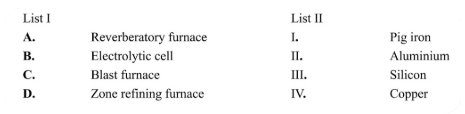
Match List - I with List - II.
Choose the correct answer from the options given below :
The metal ions that have the calculated spin only magnetic moment value of 4.9 B.M. are
A. $$Cr^{2+}$$
B. $$Fe^{2+}$$
C. $$Fe^{3+}$$
D. $$Co^{2+}$$
E. $$Mn^{3+}$$
Choose the correct answer from the options given below
Lanthanoid ions with $$4f^{7} configuration are : $$(A)Eu^{2+}$$\text{ }$$ (B)Gd^{3+}$$\text{ }$$ (C)Eu^{3+}$$\text{ }$$ (D)Tb^{3+}$$\text{ }$$ (E)Sm^{3+}$$ Choose the correct answer from the options given below :
We need to identify lanthanoid ions with $$4f^7$$ configuration because the lanthanoids fill the 4f orbitals, so we examine which ions have exactly 7 electrons in the 4f subshell.
- (A) Eu²⁺: Eu (Z=63) has configuration [Xe] 4f⁷ 6s². Eu²⁺ loses two 6s electrons: [Xe] 4f⁷. This has 4f⁷ configuration.
- (B) Gd³⁺: Gd (Z=64) has configuration [Xe] 4f⁷ 5d¹ 6s². Gd³⁺ loses 6s² and 5d¹: [Xe] 4f⁷. This has 4f⁷ configuration.
- (C) Eu³⁺: Eu (Z=63) has [Xe] 4f⁷ 6s². Eu³⁺ loses 6s² and one 4f: [Xe] 4f⁶. This does NOT have 4f⁷.
- (D) Tb³⁺: Tb (Z=65) has [Xe] 4f⁹ 6s². Tb³⁺ loses 6s² and one 4f: [Xe] 4f⁸. This does NOT have 4f⁷.
- (E) Sm³⁺: Sm (Z=62) has [Xe] 4f⁶ 6s². Sm³⁺ loses 6s² and one 4f: [Xe] 4f⁵. This does NOT have 4f⁷.
The ions with 4f⁷ configuration are (A) Eu²⁺ and (B) Gd³⁺, so the correct answer is Option 3: (A) and (B) only.
The amphoteric oxide among $$V_{2}O_{3}$$ and $$V_{2}O_{5}$$ , upon reaction with alkali leads to formation of an oxide anion. The oxidation state of V in the oxide anion is :
We need to identify the amphoteric oxide between $$V_2O_3$$ and $$V_2O_5$$, and find the oxidation state of V in the oxide anion formed with alkali.
In vanadium oxides, the nature changes with oxidation state: $$V_2O_3$$ (V in +3 state) is a basic oxide because lower oxidation state oxides of transition metals tend to be basic, whereas $$V_2O_5$$ (V in +5 state) is an amphoteric oxide that can react with both acids and bases.
When $$V_2O_5$$ reacts with NaOH (alkali), it forms the metavanadate ion according to $$V_2O_5 + 2NaOH \rightarrow 2NaVO_3 + H_2O$$. The oxide anion formed is $$VO_3^-$$.
To calculate the oxidation state of vanadium in $$VO_3^-$$, let the oxidation state of V be $$x$$; each oxygen contributes $$-2$$ and the overall charge is $$-1$$, so $$x + 3(-2) = -1$$, which simplifies to $$x - 6 = -1$$ and thus $$x = +5$$.
The correct answer is Option D: +5.
The correct set of ions (aqueous solution) with same colour from the following is:
Which of the following ions is the strongest oxidizing agent? (Atomic Number of $$Ce = 58,\; Eu = 63,\; Tb = 65,\; Lu = 71$$)
We need to identify the strongest oxidising agent among the given lanthanide/actinide ions.
Key Concept: An oxidising agent gains electrons (gets reduced). The stronger the tendency to gain electrons, the stronger the oxidising agent. For lanthanide ions, unusual oxidation states are strongly driven towards the most stable +3 state, and ions that strongly want to reach a stable electronic configuration make the best oxidising agents.
Analysing each ion:
Option 1: $$Eu^{2+}$$ (Z = 63)
$$Eu^{2+}$$: [Xe] 4f$$^7$$. This has a half-filled 4f shell, which is very stable. $$Eu^{2+}$$ is actually relatively stable and is a reducing agent (it wants to lose an electron to form $$Eu^{3+}$$ [Xe]4f$$^6$$, but the half-filled stability resists this). It is not a strong oxidising agent.
Option 2: $$Tb^{4+}$$ (Z = 65)
$$Tb^{4+}$$: [Xe] 4f$$^7$$. Terbium in the +4 state also has a half-filled 4f$$^7$$ configuration. However, $$Tb^{4+}$$ strongly tends to gain an electron to become $$Tb^{3+}$$ [Xe]4f$$^8$$, because the +3 state is the most common and stable oxidation state for lanthanides. The high charge (+4) combined with the strong drive to reach +3 makes $$Tb^{4+}$$ a very strong oxidising agent.
Option 3: $$Lu^{3+}$$ (Z = 71)
$$Lu^{3+}$$: [Xe] 4f$$^{14}$$. This has a completely filled 4f shell and is already in the most stable +3 oxidation state. It has no tendency to gain or lose electrons easily. It is not an oxidising agent.
Option 4: $$Ce^{3+}$$ (Z = 58)
$$Ce^{3+}$$: [Xe] 4f$$^1$$. Cerium in the +3 state has one 4f electron. While $$Ce^{4+}$$ (4f$$^0$$, noble gas configuration) is a good oxidising agent, $$Ce^{3+}$$ itself is stable and not an oxidising agent.
Conclusion: $$Tb^{4+}$$ is the strongest oxidising agent because it has the strongest tendency to gain an electron to achieve the stable +3 state.
The correct answer is Option 2: $$Tb^{4+}$$.
The correct decreasing order of spin only magnetic moment values (BM) of $$Cu^+$$, $$Cu^{2+}$$, $$Cr^{2+}$$ and $$Cr^{3+}$$ ions is :
The spin-only magnetic moment of a transition-metal ion is calculated from
$$\mu_{s.o.}= \sqrt{n(n+2)}\;\text{BM}$$
where $$n$$ is the number of unpaired electrons in the ion.
First write the electronic configuration of each ion and count $$n$$.
Case 1: $$Cu^{+}\;(Z=29)$$
Neutral Cu : $$[Ar]\,3d^{10}\,4s^{1}$$
Removing one electron (from $$4s$$) gives $$Cu^{+} : [Ar]\,3d^{10}$$
All $$3d$$ electrons are paired ⇒ $$n = 0$$
$$\mu = \sqrt{0(0+2)} = 0\;\text{BM}$$
Case 2: $$Cu^{2+}$$
Remove one more electron (from $$3d$$) → $$Cu^{2+} : [Ar]\,3d^{9}$$
Configuration $$3d^{9} = 3d^{\uparrow\downarrow\,\uparrow\downarrow\,\uparrow\downarrow\,\uparrow\downarrow\,\uparrow}$$ ⇒ $$n = 1$$
$$\mu = \sqrt{1(1+2)} = \sqrt{3} \approx 1.73\;\text{BM}$$
Case 3: $$Cr^{2+}\;(Z = 24)$$
Neutral Cr : $$[Ar]\,3d^{5}\,4s^{1}$$
Removing two electrons (one from $$4s$$ and one from $$3d$$) gives
$$Cr^{2+} : [Ar]\,3d^{4}$$
All four $$3d$$ electrons are unpaired ⇒ $$n = 4$$
$$\mu = \sqrt{4(4+2)} = \sqrt{24} \approx 4.90\;\text{BM}$$
Case 4: $$Cr^{3+}$$
Remove one more electron from $$3d$$ → $$Cr^{3+} : [Ar]\,3d^{3}$$
All three $$3d$$ electrons are unpaired ⇒ $$n = 3$$
$$\mu = \sqrt{3(3+2)} = \sqrt{15} \approx 3.87\;\text{BM}$$
Arrange the magnetic moments in decreasing order:
$$Cr^{2+}\;(4.90\;{\rm BM}) \gt Cr^{3+}\;(3.87\;{\rm BM}) \gt Cu^{2+}\;(1.73\;{\rm BM}) \gt Cu^{+}\;(0\;{\rm BM})$$
Therefore the correct decreasing order is
$$Cr^{2+} \gt Cr^{3+} \gt Cu^{2+} \gt Cu^{+}$$
Matching with the given options, this is Option C.
Given below are two statements:
Statement I: $$CrO_3$$ is a stronger oxidizing agent than $$MoO_3$$.
Statement II: Cr(VI) is more stable than Mo(VI).
In the light of above statements, Choose the correct answer from the options given below :
The elements chromium (Cr) and molybdenum (Mo) belong to Group 6 of the periodic table. They show their highest oxidation state of $$+6$$ in compounds such as $$CrO_3$$ and $$MoO_3$$.
Case 1: Relative oxidising power of $$CrO_3$$ and $$MoO_3$$
Within a group, the stability of the highest oxidation state generally increases down the group because the heavier element’s larger size and greater ability to delocalise charge stabilise the high oxidation state.
Hence, $$Mo(VI)$$ is more stable than $$Cr(VI)$$.
Less-stable high oxidation states have a stronger tendency to gain electrons (that is, to get reduced to a lower oxidation state). Therefore they behave as stronger oxidising agents.
Since $$Cr(VI)$$ is less stable, $$CrO_3$$ wants to get reduced more readily than $$MoO_3$$. Thus $$CrO_3$$ is the stronger oxidising agent.
Case 2: Comparative stability of $$Cr(VI)$$ and $$Mo(VI)$$
As argued above, the stability of the $$+6$$ state increases from Cr to Mo. Consequently, $$Mo(VI)$$ is more stable while $$Cr(VI)$$ is less stable.
Evaluation of the statements
• Statement I: “$$CrO_3$$ is a stronger oxidising agent than $$MoO_3$$.” - True.
• Statement II: “Cr(VI) is more stable than Mo(VI).” - False (the reverse is correct).
Therefore, Statement I is true but Statement II is false. The correct choice is Option B.
Match List - I with List - II.

Choose the correct answer from the options given below :
'X' is the number of electrons in $$t_{2g}$$ orbitals of the most stable complex ion among $$[Fe(NH_3)_6]^{3+}$$, $$[Fe(Cl)_6]^{3-}$$, $$[Fe(C_2O_4)_3]^{3-}$$ and $$[Fe(H_2O)_6]^{3+}$$. The nature of oxide of vanadium of the type $$V_2O_x$$ is:
All the four complexes contain iron in the $$+3$$ oxidation state, so the metal ion is $$Fe^{3+}$$ having the electronic configuration $$[Ar]\,3d^5$$.
Case 1: $$[Fe(NH_3)_6]^{3+}$$ and $$[Fe(H_2O)_6]^{3+}$$ Both $$NH_3$$ and $$H_2O$$ are monodentate ligands of only moderate field strength. For a $$d^5$$ ion with such ligands, the complex is high-spin: $$t_{2g}^3\,e_g^2$$ — CFSE $$=0$$.
Case 2: $$[Fe(Cl)_6]^{3-}$$ $$Cl^-$$ is a very weak-field ligand, so the complex is again high-spin: $$t_{2g}^3\,e_g^2$$ — CFSE $$=0$$.
Case 3: $$[Fe(C_2O_4)_3]^{3-}$$ Oxalate $$(C_2O_4^{2-})$$ is a bidentate ligand. Although its crystal-field strength is similar to $$H_2O$$, the chelate effect gives this complex a much larger overall (stepwise) stability constant. With a moderate field ligand, $$Fe^{3+}$$ again remains high-spin: $$t_{2g}^3\,e_g^2$$.
Because of the pronounced chelate effect, $$[Fe(C_2O_4)_3]^{3-}$$ possesses the greatest thermodynamic stability among the four. Hence the most stable complex ion is $$[Fe(C_2O_4)_3]^{3-}$$.
The number of electrons occupying the $$t_{2g}$$ set in this ion is therefore $$X = 3$$.
The oxide of vanadium corresponding to $$V_2O_X$$ with $$X = 3$$ is $$V_2O_3$$. Vanadium(III) oxide behaves like aluminium(III) oxide and chromium(III) oxide: it dissolves both in acids (forming $$V^{3+}$$ salts) and in strong bases (forming vanadates of lower oxidation state after air-oxidation). Such behaviour is termed amphoteric.
Hence, the nature of $$V_2O_3$$ is amphoteric ⇒ Option D.
The correct option with order of melting points of the pairs (Mn, Fe), (Tc, Ru) and (Re, Os) is :
Pair of transition metal ions having the same number of unpaired electrons is:
First list the atomic numbers and ground-state electronic configurations of the elements involved (outer part only).
Ti (22): $$3d^2\,4s^2$$ V (23): $$3d^3\,4s^2$$ Cr (24): $$3d^5\,4s^1$$ Mn (25): $$3d^5\,4s^2$$ Fe (26): $$3d^6\,4s^2$$ Co (27): $$3d^7\,4s^2$$
When a transition metal forms a positive ion, electrons are removed first from the $$4s$$ orbital and then from $$3d$$.
Case 1: $$V^{2+}$$ and $$Co^{2+}$$
$$V^{2+}:$$ remove two $$4s$$ electrons ⇒ $$3d^3$$ Number of unpaired $$d$$ electrons = 3 (one in each of the first three $$d$$ orbitals).
$$Co^{2+}:$$ remove two $$4s$$ electrons ⇒ $$3d^7$$ High-spin $$d^7$$ distribution: $$t_{2g}^{5}\,e_g^{2}$$ ⇒ 3 unpaired electrons.
Both ions have 3 unpaired electrons.
Case 2: $$Ti^{2+}$$ and $$Co^{2+}$$
$$Ti^{2+}:$$ $$3d^2$$ ⇒ 2 unpaired electrons.
$$Co^{2+}:$$ 3 unpaired electrons. ⇒ Not equal.
Case 3: $$Fe^{3+}$$ and $$Cr^{2+}$$
$$Fe^{3+}:$$ remove two $$4s$$ and one $$3d$$ ⇒ $$3d^5$$ (high spin) ⇒ 5 unpaired electrons.
$$Cr^{2+}:$$ remove two $$4s$$ ⇒ $$3d^4$$ ⇒ 4 unpaired electrons. ⇒ Not equal.
Case 4: $$Ti^{3+}$$ and $$Mn^{2+}$$
$$Ti^{3+}:$$ $$3d^1$$ ⇒ 1 unpaired electron.
$$Mn^{2+}:$$ $$3d^5$$ (high spin) ⇒ 5 unpaired electrons. ⇒ Not equal.
The only pair with the same number of unpaired electrons is $$V^{2+}$$ and $$Co^{2+}$$.
Hence, the correct option is Option A.
A transition metal $$(M)$$ among $$Mn, Cr, Co$$ and $$Fe$$ has the highest standard electrode potential ($$M^{3+}/M^{2+}$$). It forms a metal complex of the type $$[M(CN)_6]^{4-}$$. The number of electrons present in the $$e_g$$ orbital of the complex is ______.
The standard electrode potentials $$E^\circ(M^{3+}/M^{2+})$$ for the given metals are approximately:
$$Cr^{3+}/Cr^{2+}: -0.41\ \text{V},\; Fe^{3+}/Fe^{2+}: +0.77\ \text{V},\; Mn^{3+}/Mn^{2+}: +1.51\ \text{V},\; Co^{3+}/Co^{2+}: +1.82\ \text{V}$$
A higher $$E^\circ$$ value means the $$M^{3+}$$ ion is a stronger oxidising agent and more readily gains an electron to become $$M^{2+}$$. Hence the highest potential belongs to cobalt, so $$M = Co$$.
The complex is $$[M(CN)_6]^{4-}$$. Let the oxidation state of $$M$$ be $$x$$.
Each $$CN^-$$ ligand carries charge $$-1$$. Therefore:
$$x + 6(-1) = -4 \;\; \Rightarrow \;\; x = +2$$
Thus the metal is $$Co^{2+}$$.
Electronic configuration of neutral cobalt: $$[Ar]\;3d^7\,4s^2$$.
For $$Co^{2+}$$ (lose the two $$4s$$ electrons): $$[Ar]\;3d^7$$.
$$CN^-$$ is a strong-field ligand, so the octahedral complex $$[Co(CN)_6]^{4-}$$ will be low-spin. In an octahedral field the five $$d$$ orbitals split into:
lower set $$t_{2g}$$ (3 orbitals) and upper set $$e_g$$ (2 orbitals).
Low-spin distribution for a $$d^7$$ ion:
$$t_{2g}^6\,e_g^1$$
Hence the number of electrons occupying the $$e_g$$ orbitals is $$1$$.
Final answer: $$1$$ electron.
The molar mass of the water insoluble product formed from the fusion of chromite ore $$(FeCr_{2}O_{4})$$ with $$Na_{2}CO_{3}$$ in presence of $$O_{2}$$ is_______$$gmol^{-1}$$.
The chromite ore is given as $$FeCr_{2}O_{4}$$. When fused with $$Na_{2}CO_{3}$$ in the presence of oxygen $$(O_{2})$$, the reaction occurs as follows:
The balanced chemical equation is:
$$4FeCr_{2}O_{4} + 8Na_{2}CO_{3} + 7O_{2} \rightarrow 8Na_{2}CrO_{4} + 2Fe_{2}O_{3} + 8CO_{2}$$
The products are sodium chromate $$(Na_{2}CrO_{4})$$, ferric oxide $$(Fe_{2}O_{3})$$, and carbon dioxide $$(CO_{2})$$.
Among these:
- Sodium chromate $$(Na_{2}CrO_{4})$$ is soluble in water.
- Carbon dioxide $$(CO_{2})$$ is a gas and soluble in water to some extent, but it is not a solid insoluble product.
- Ferric oxide $$(Fe_{2}O_{3})$$ is insoluble in water and remains as a solid.
Thus, the water-insoluble product is ferric oxide $$(Fe_{2}O_{3})$$.
To find the molar mass of $$Fe_{2}O_{3}$$:
Atomic mass of iron $$(Fe) = 56$$ g/mol.
Atomic mass of oxygen $$(O) = 16$$ g/mol.
Molar mass of $$Fe_{2}O_{3} = (2 \times 56) + (3 \times 16) = 112 + 48 = 160$$ g/mol.
Therefore, the molar mass of the water-insoluble product is 160 g mol⁻¹.
Among Sc, Mn, Co and Cu, identify the element with highest enthalpy of atomisation. The spin only magnetic moment value of that element in its +2 oxidation state is ________ BM (in nearest integer).
The enthalpy of atomisation ($$ΔH_\text{atom}$$) of the 3d transition elements first rises from Sc to about Ni and then falls towards Cu and Zn. This behaviour is linked to the strength of metallic bonding, which in turn depends mainly on the number of 3d electrons available for delocalised metallic bonding.
Approximate experimental values (kJ mol−1) illustrate the trend: Sc ≈ 330, Mn ≈ 280, Co ≈ 425, Cu ≈ 335. Hence, Co exhibits the largest enthalpy of atomisation among Sc, Mn, Co and Cu.
For the magnetic moment we consider Co in its +2 oxidation state.
Atomic number of Co = 27, so neutral Co is $$[Ar]\,3d^7\,4s^2$$.
Co2+ is formed by losing the two 4s electrons: $$[Ar]\,3d^7$$.
In an aqueous or other weak-field environment the 3d orbitals remain high-spin. A 3d7 high-spin configuration has the distribution $$t_{2g}^5\,e_g^2$$, giving
Number of unpaired electrons, $$n = 3$$.
The spin-only formula is $$\mu_\text{so} = \sqrt{n(n+2)}\; \text{BM}$$.
Substituting $$n = 3$$:
$$\mu_\text{so} = \sqrt{3(3+2)} = \sqrt{15} \approx 3.87 \text{ BM} \approx 4 \text{ BM (nearest integer)}.$$
Therefore, the element is Co and its spin-only magnetic moment in the +2 state is 4 BM.
Consider the following reactions
$$A + NaCl + H_2SO_4 \to CrO_2Cl_2 + \text{Side Products}$$ (Little amount)
$$CrO_2Cl_{2(Vapour)} + NaOH \to B + NaCl + H_2O$$
$$B + H^+ \to C + H_2O$$
The number of terminal 'O' present in the compound 'C' is _________.
First write the usual laboratory method for making chromyl chloride.
When a dichromate such as $$K_2Cr_2O_7$$ is heated with solid $$NaCl$$ and concentrated $$H_2SO_4$$, deep-red vapours of chromyl chloride are obtained.
Balanced form: $$K_2Cr_2O_7 + 4\,NaCl + 3\,H_2SO_4 \rightarrow 2\,CrO_2Cl_2 + 2\,KHSO_4 + 2\,NaHSO_4 + 3\,H_2O$$
Hence compound $$A$$ is $$K_2Cr_2O_7$$, and the first product of interest is $$CrO_2Cl_2$$ (chromyl chloride).
Next, chromyl chloride undergoes alkaline hydrolysis:
$$CrO_2Cl_2 + 4\,NaOH \rightarrow Na_2CrO_4 + 2\,NaCl + 2\,H_2O$$
Thus compound $$B$$ is $$Na_2CrO_4$$, which contains the chromate ion $$CrO_4^{2-}$$.
On acidifying chromate we get dichromate:
$$2\,CrO_4^{2-} + 2\,H^+ \rightarrow Cr_2O_7^{2-} + H_2O$$
Therefore compound $$C$$ is the dichromate ion $$Cr_2O_7^{2-}$$.
Structure of $$Cr_2O_7^{2-}$$: it consists of two $$CrO_4$$ tetrahedra sharing one oxygen atom (bridging O).
Total O atoms = 7.
Bridging O atoms = 1.
Terminal O atoms = $$7 - 1 = 6$$.
Hence the number of terminal oxygen atoms present in compound $$C$$ is $$6$$.
Niobium ( Nb ) and ruthenium (Ru) have "x" and "y" number of electrons in their respective 4 d orbitals The value of x+y is _______.
Electronic Configurations
- Niobium (Nb, $$Z=41$$): Instead of the expected $$[Kr] 4d^3 5s^2$$, the experimental configuration is $$[Kr] 4d^4 5s^1$$
- Number of electrons in the $$4d$$ orbital ($$x$$) = $$4$$
- Ruthenium (Ru, $$Z=44$$): Instead of the expected $$[Kr] 4d^6 5s^2$$, the experimental configuration is $$[Kr] 4d^7 5s^1$$.
- Number of electrons in the $$4d$$ orbital ($$y$$) = $$7$$
Calculation
Using the values identified above: $$x + y = 4 + 7 = 11$$
Final Answer: The value of $$x + y$$ is $$11$$.
This exception occurs because the energy gap between the $$4d$$ and $$5s$$ orbitals is very small, allowing for electron shifts that minimize inter-electronic repulsions or provide stability through specific exchange energies.
The spin only magnetic moment ( $$\mu$$) value (B.M.) of the compound with strongest oxidising power among $$Mn_{2}O_{3},$$ TiO and VO is ____ B.M. (Nearest integer).
We need to find the spin-only magnetic moment of the compound with the strongest oxidising power among $$Mn_2O_3$$, TiO, and VO.
In $$Mn_2O_3$$, Mn is in the +3 oxidation state as shown by $$2x + 3(-2) = 0 \Rightarrow x = +3$$, while in TiO and VO, Ti and V are both in the +2 oxidation state.
$$Mn^{3+}$$ in $$Mn_2O_3$$ is the strongest oxidising agent because it has the highest reduction potential among the three. It readily accepts an electron to become the stable $$Mn^{2+}$$ (d$$^5$$, half-filled), whereas $$Ti^{2+}$$ and $$V^{2+}$$ act as better reducing agents.
The electronic configuration of Mn is [Ar] 3d$$^5$$ 4s$$^2$$, so for $$Mn^{3+}$$ it becomes [Ar] 3d$$^4$$.
Because the oxide ion ($$O^{2-}$$) is a weak-field ligand, $$Mn^{3+}$$ in $$Mn_2O_3$$ remains high-spin. A high-spin d$$^4$$ configuration has all four electrons unpaired by Hund’s rule, giving $$n = 4$$ unpaired electrons.
The spin-only magnetic moment is given by the formula
$$ \mu = \sqrt{n(n+2)} \text{ BM} $$
where $$n$$ is the number of unpaired electrons. Substituting $$n = 4$$ yields
$$ \mu = \sqrt{4(4+2)} = \sqrt{24} = 2\sqrt{6} \approx 4.90 \text{ BM} $$
Nearest integer: 5 BM.
The answer is 5.
The spin-only magnetic moment value of $$M^{n+}$$ ion formed among Ni, Zn, Mn and Cu that has the least enthalpy of atomisation is _________. (in nearest integer)
Here n is equal to the number of diamagnetic complexes among $$K_2[NiCl_4]$$, $$[Zn(H_2O)_6]Cl_2$$, $$K_3[Mn(CN)_6]$$ and $$[Cu(PPh_3)_3I]$$
The four complexes given are:
(i) $$K_2[NiCl_4]$$ (ii) $$[Zn(H_2O)_6]Cl_2$$ (iii) $$K_3[Mn(CN)_6]$$ (iv) $$[Cu(PPh_3)_3I]$$
Step 1 : Identify which of them are diamagnetic.
Case 1: $$[NiCl_4]^{2-}$$ (in $$K_2[NiCl_4]$$)
Ni oxidation state: $$x+4(-1) = -2 \Rightarrow x = +2$$, so $$Ni^{2+}$$ is $$3d^8$$.
In a tetrahedral $$Cl^-$$ field (weak field) the ion is high spin with two unpaired electrons ⇒ paramagnetic.
Case 2: $$[Zn(H_2O)_6]^{2+}$$ (in $$[Zn(H_2O)_6]Cl_2$$)
$$Zn^{2+}$$ is $$3d^{10}$$, all electrons paired ⇒ diamagnetic.
Case 3: $$[Mn(CN)_6]^{3-}$$ (in $$K_3[Mn(CN)_6]$$)
$$x+6(-1)=-3 \Rightarrow x = +3$$, so $$Mn^{3+}$$ is $$3d^4$$.
$$CN^-$$ is a strong‐field ligand giving a low-spin configuration $$t_{2g}^4e_g^0$$ with two unpaired electrons ⇒ paramagnetic.
Case 4: $$[Cu(PPh_3)_3I]$$ (neutral complex)
Oxidation state: $$Cu + (-1) = 0 \Rightarrow Cu = +1$$, so $$Cu^{+}$$ is $$3d^{10}$$ ⇒ diamagnetic.
Thus the diamagnetic complexes are Case 2 and Case 4. Number of diamagnetic complexes $$= 2$$, hence $$n = 2$$.
Step 2 : Among the elements Ni, Zn, Mn and Cu, compare enthalpies of atomisation.
For 3d metals: $$\Delta H_{atom}$$ rises to a maximum near the middle of the series (Cr, Mn, Fe, Co) and then falls, being minimum for Zn.
Approximate values (kJ mol$$^{-1}$$): $$Zn \approx 120$$, $$Cu \approx 330$$, $$Mn \approx 280$$, $$Ni \approx 420$$.
Therefore the element with the least enthalpy of atomisation is $$Zn$$.
So the required ion is $$Zn^{n+} = Zn^{2+}$$.
Step 3 : Calculate its spin-only magnetic moment.
For an ion with $$n_u$$ unpaired electrons,
$$\mu_{spin} = \sqrt{n_u(n_u+2)}\; \text{BM}$$.
For $$Zn^{2+}$$, electronic configuration $$3d^{10}$$ ⇒ $$n_u = 0$$.
Hence $$\mu_{spin} = \sqrt{0(0+2)} = 0\; \text{BM}$$.
The spin-only magnetic moment, to the nearest integer, is 0.
Which of the following electronic configuration would be associated with the highest magnetic moment?
The magnetic moment is given by $$\mu = \sqrt{n(n+2)}$$ BM, where $$n$$ is the number of unpaired electrons. Higher $$n$$ gives higher magnetic moment.
Counting unpaired electrons for each configuration:
- $$[Ar] \; 3d^7$$: $$\uparrow\downarrow \; \uparrow\downarrow \; \uparrow \; \uparrow \; \uparrow$$ = 3 unpaired
- $$[Ar] \; 3d^8$$: $$\uparrow\downarrow \; \uparrow\downarrow \; \uparrow\downarrow \; \uparrow \; \uparrow$$ = 2 unpaired
- $$[Ar] \; 3d^3$$: $$\uparrow \; \uparrow \; \uparrow \; \_ \; \_$$ = 3 unpaired
- $$[Ar] \; 3d^6$$: $$\uparrow\downarrow \; \uparrow \; \uparrow \; \uparrow \; \uparrow$$ = 4 unpaired
$$[Ar] \; 3d^6$$ has the maximum number of unpaired electrons (4), giving the highest magnetic moment:
$$\mu = \sqrt{4(4+2)} = \sqrt{24} = 2\sqrt{6}$$ BM
The answer corresponds to Option (4).
$$KMnO_4$$ decomposes on heating at $$513$$ K to form $$O_2$$ along with
We need to identify the products formed when $$KMnO_4$$ is heated at 513 K (along with $$O_2$$).
Write the thermal decomposition reaction.
When potassium permanganate is heated, it undergoes the following decomposition:
$$2KMnO_4 \xrightarrow{\Delta} K_2MnO_4 + MnO_2 + O_2$$
Verify the balancing.
Left side: K: 2, Mn: 2, O: 8
Right side: K: 2, Mn: 1+1=2, O: 4+2+2=8. Balanced.
Understand the chemistry.
In $$KMnO_4$$, manganese is in the +7 oxidation state. During thermal decomposition:
- One Mn goes from +7 to +6 in $$K_2MnO_4$$ (potassium manganate) - this is a reduction
- Another Mn goes from +7 to +4 in $$MnO_2$$ (manganese dioxide) - this is also a reduction
- Oxygen goes from -2 to 0 in $$O_2$$ - this is an oxidation
This is a disproportionation-type reaction where the oxygen is oxidised while manganese is reduced to two different lower oxidation states.
The products (along with $$O_2$$) are $$K_2MnO_4$$ and $$MnO_2$$.
The correct answer is Option (4): $$K_2MnO_4$$ and $$MnO_2$$.
Which of the following acts as a strong reducing agent? (Atomic number: Ce = 58, Eu = 63, Gd = 64, Lu = 71)
We need to identify which species acts as a strong reducing agent among the given lanthanide ions.
Analysing each option:
Lu$$^{3+}$$ (Z = 71): Lu has the configuration $$[Xe]\, 4f^{14}\, 5d^1\, 6s^2$$. Lu$$^{3+}$$ has a completely filled 4f shell ($$4f^{14}$$), which is very stable. It has no tendency to be further oxidized or reduced. It is not a reducing agent.
Gd$$^{3+}$$ (Z = 64): Gd has the configuration $$[Xe]\, 4f^7\, 5d^1\, 6s^2$$. Gd$$^{3+}$$ has a half-filled 4f shell ($$4f^7$$), which is very stable. It has no tendency to lose or gain electrons easily. It is not a strong reducing agent.
Eu$$^{2+}$$ (Z = 63): Eu has the configuration $$[Xe]\, 4f^7\, 6s^2$$. Eu$$^{2+}$$ has the configuration $$[Xe]\, 4f^7$$, which is a half-filled 4f shell. However, the common and stable oxidation state of lanthanides is $$+3$$. Eu$$^{2+}$$ readily loses one more electron to become Eu$$^{3+}$$ ($$4f^6$$), acting as a strong reducing agent.
Ce$$^{4+}$$ (Z = 58): Ce has the configuration $$[Xe]\, 4f^1\, 5d^1\, 6s^2$$. Ce$$^{4+}$$ has the noble gas configuration $$[Xe]$$, which is stable. Ce$$^{4+}$$ tends to gain an electron to become Ce$$^{3+}$$, making it an oxidizing agent, not a reducing agent.
Eu$$^{2+}$$ is a strong reducing agent because it is readily oxidized to the more stable Eu$$^{3+}$$ state.
The correct answer is Option 3: Eu$$^{2+}$$.
Choose the correct option having all the elements with $$d^{10}$$ electronic configuration from the following:
We need to find the option where all elements have a $$d^{10}$$ electronic configuration (in their ground state). First, recall that an element exhibits a $$d^{10}$$ configuration when its d-subshell is completely filled, which typically occurs near the end of a transition series because the fully filled d-subshell provides exceptional stability.
To identify such elements, we write the electronic configurations of the listed species and inspect their d-subshell. For $$_{24}Cr$$ the configuration is [Ar] 3d$$^5$$ 4s$$^1$$, which corresponds to $$d^5$$ rather than $$d^{10}$$. Similarly, $$_{26}Fe$$ is [Ar] 3d$$^6$$ 4s$$^2$$ (giving $$d^6$$), $$_{27}Co$$ is [Ar] 3d$$^7$$ 4s$$^2$$ (giving $$d^7$$), and $$_{28}Ni$$ is [Ar] 3d$$^8$$ 4s$$^2$$ (giving $$d^8$$). In contrast, $$_{29}Cu$$ has [Ar] 3d$$^{10}$$ 4s$$^1$$, $$_{30}Zn$$ has [Ar] 3d$$^{10}$$ 4s$$^2$$, $$_{46}Pd$$ has [Kr] 4d$$^{10}$$, $$_{47}Ag$$ has [Kr] 4d$$^{10}$$ 5s$$^1$$, and $$_{48}Cd$$ has [Kr] 4d$$^{10}$$ 5s$$^2$$, each of which possesses the fully filled d-subshell.
Next, we examine the given options to see which one consists exclusively of elements with a $$d^{10}$$ configuration. Option (1) contains Co, Ni, Fe, and Cr, none of which achieve $$d^{10}$$, so it is excluded. Option (2) lists Cu, Zn, Cd, and Ag, all of which have a complete $$d^{10}$$ subshell. Options (3) and (4) include only one such element each. The correct answer is Option (2): $$_{29}Cu$$, $$_{30}Zn$$, $$_{48}Cd$$, $$_{47}Ag$$.
Diamagnetic Lanthanoid ions are:
We need to identify which pair of lanthanoid ions are diamagnetic. A species is diamagnetic if it has no unpaired electrons, i.e., all electrons are paired. For lanthanoid ions, this means the 4f subshell must be either completely empty ($$4f^0$$) or completely filled ($$4f^{14}$$).
Lanthanoids have the general configuration $$[Xe] 4f^n$$. When they form $$3+$$ or $$4+$$ ions, electrons are removed first from the 6s and 5d shells, and then from the 4f subshell.
For $$La^{3+}$$, lanthanum (Z = 57) has the configuration $$[Xe] 5d^1 6s^2$$. Removing three electrons yields $$[Xe] = 4f^0$$, which has no unpaired electrons and is therefore diamagnetic.
Cerium (Z = 58) in $$Ce^{4+}$$ has the configuration $$[Xe] 4f^1 5d^1 6s^2$$. Removing four electrons gives $$[Xe] = 4f^0$$, again with no unpaired electrons, so this ion is also diamagnetic.
Neodymium (Z = 60) in $$Nd^{3+}$$ starts from $$[Xe] 4f^4 6s^2$$. After removing three electrons, the configuration becomes $$[Xe] 4f^3$$, which has three unpaired electrons and is paramagnetic. Europium (Z = 63) in $$Eu^{3+}$$ has $$[Xe] 4f^7 6s^2$$ to start, and removing three electrons gives $$[Xe] 4f^6$$. By Hund’s rule, the six electrons occupy six of the seven 4f orbitals singly, resulting in six unpaired electrons and a paramagnetic species.
Lutetium (Z = 71) in $$Lu^{3+}$$ is described by $$[Xe] 4f^{14} 5d^1 6s^2$$ in the neutral atom. Removing three electrons leaves $$[Xe] 4f^{14}$$, which is completely filled and therefore diamagnetic.
Only $$La^{3+}$$, $$Ce^{4+}$$, and $$Lu^{3+}$$ are diamagnetic, but the pair consisting of $$La^{3+}$$ and $$Ce^{4+}$$ (both $$4f^0$$) matches one of the given options.
Answer: Option 2 — $$La^{3+}$$ and $$Ce^{4+}$$
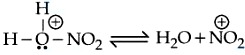
Given below are two statements: Statement I : Nitration of benzene involves the following step
Statement II : Use of Lewis base promotes the electrophilic substitution of benzene. In the light of the above statements, choose the most appropriate answer from the options given below :
Which of the following statements are correct about Zn, Cd and Hg?
A. They exhibit high enthalpy of atomization as the d-subshell is full.
B. Zn and Cd do not show variable oxidation state while Hg shows +I and +II.
C. Compounds of Zn, Cd and Hg are paramagnetic in nature.
D. Zn, Cd and Hg are called soft metals.
Choose the most appropriate from the options given below:
We need to evaluate each statement about Zn, Cd, and Hg (Group 12 elements with completely filled d-orbitals).
Statement A: They exhibit high enthalpy of atomization as the d-subshell is full.
This is incorrect. Zn, Cd, and Hg have low enthalpies of atomization. In these elements, the d-subshell is completely filled ($$d^{10}$$), so the d-electrons do not participate in metallic bonding. The metallic bonding is weaker, resulting in low atomization enthalpies.
Statement B: Zn and Cd do not show variable oxidation state while Hg shows +I and +II.
This is correct. Zn and Cd predominantly show only the +2 oxidation state. Mercury, however, shows both +1 (as $$Hg_2^{2+}$$) and +2 oxidation states.
Statement C: Compounds of Zn, Cd and Hg are paramagnetic in nature.
This is incorrect. Zn$$^{2+}$$, Cd$$^{2+}$$, and Hg$$^{2+}$$ all have $$d^{10}$$ configuration with no unpaired electrons. Their compounds are diamagnetic, not paramagnetic.
Statement D: Zn, Cd and Hg are called soft metals.
This is correct. Due to weak metallic bonding (d-electrons do not participate in bonding), these metals are soft with low melting and boiling points.
The correct statements are B and D.
The correct answer is Option 1: B, D only.
Given below are two statements:
Statement (I) : In the Lanthanoids, the formation of $$Ce^{+4}$$ is favoured by its noble gas configuration.
Statement (II) : $$Ce^{+4}$$ is a strong oxidant reverting to the common +3 state.
In the light of the above statements, choose the most appropriate answer from the options given below:
Statement I: Formation of $$Ce^{4+}$$ is favoured by its noble gas configuration. $$Ce$$ has atomic number 58: $$[Xe]4f^15d^16s^2$$. Losing 4 electrons gives $$Ce^{4+}$$: $$[Xe]$$ — noble gas configuration. True.
Statement II: $$Ce^{4+}$$ is a strong oxidant reverting to the common +3 state. True — the +3 state is more stable for lanthanides, so $$Ce^{4+}$$ readily accepts an electron to become $$Ce^{3+}$$.
Both statements are true. The answer corresponds to Option (2).
Given below are two statements: Statement I : The higher oxidation states are more stable down the group among transition elements unlike p-block elements. Statement II : Copper can not liberate hydrogen from weak acids. In the light of the above statements, choose the correct answer from the options given below :
We need to evaluate the truth of two statements about transition elements.
Statement I: "The higher oxidation states are more stable down the group among transition elements unlike p-block elements."
This statement is true. Here is why:
In transition elements, as we go down a group, the higher oxidation states become increasingly stable. This is because:
- The ionisation enthalpies of 4d and 5d elements are comparable (and sometimes lower than expected) due to poor shielding by intervening electron shells.
- The greater spatial extension of 4d and 5d orbitals compared to 3d orbitals allows better orbital overlap, which stabilises higher oxidation states through stronger bonding.
- For example, in Group 6: Cr commonly shows +3 and +6, but Mo and W preferentially show +6. In Group 8: Fe shows +2 and +3, while Os readily shows +8 (as in $$OsO_4$$).
This is opposite to p-block elements, where the lower oxidation states become more stable down the group due to the inert pair effect.
Statement II: "Copper cannot liberate hydrogen from weak acids."
This statement is true. Here is why:
The ability of a metal to liberate hydrogen from acids depends on its standard electrode potential. A metal can liberate $$H_2$$ only if its standard reduction potential is less than that of the $$H^+/H_2$$ couple ($$E° = 0.00$$ V).
Copper has a positive standard reduction potential: $$E°(Cu^{2+}/Cu) = +0.34$$ V.
Since $$E°_{Cu} > E°_{H^+/H_2}$$, copper is a less reactive (more noble) metal than hydrogen. Therefore, copper cannot reduce $$H^+$$ ions to $$H_2$$ gas, even from dilute strong acids, let alone from weak acids (which have even lower $$H^+$$ concentration). The reaction is thermodynamically unfavourable (positive $$\Delta G$$).
Since both statements are true, the correct answer is Option 1: Both Statement I and Statement II are true.
The orange colour of $$K_2Cr_2O_7$$ and purple colour of $$KMnO_4$$ is due to
In $$K_2Cr_2O_7$$: Cr is in +6 oxidation state with electronic configuration $$d^0$$. Since there are no d-electrons, d-d transitions are impossible. The orange color arises from charge transfer transitions (ligand-to-metal charge transfer, LMCT), where electrons from oxygen ligands are transferred to empty d-orbitals of Cr$$^{6+}$$.
In $$KMnO_4$$: Mn is in +7 oxidation state with electronic configuration $$d^0$$. Again, no d-electrons means no d-d transitions. The intense purple color is due to charge transfer transitions (LMCT from oxygen to Mn$$^{7+}$$).
Both colors are due to charge transfer transitions, not d-d transitions.
The correct answer is Option 1: Charge transfer transition in both.
$$A$$ and $$B$$ formed in the following reactions are:
$$CrO_2Cl_2 + 4NaOH \rightarrow A + 2NaCl + 2H_2O$$
$$A + 2HCl + 2H_2O_2 \rightarrow B + 3H_2O$$
Chromyl chloride $$CrO_2Cl_2$$ contains chromium in the $$+6$$ oxidation state. In alkaline medium chloride ions are replaced by oxide ions, converting the molecule into the chromate ion $$CrO_4^{2-}$$.
Writing the reaction with hydroxide ions first:
$$CrO_2Cl_2 + 4OH^- \rightarrow CrO_4^{2-} + 2Cl^- + 2H_2O$$
On adding sodium ions to both sides, the molecular equation becomes
$$CrO_2Cl_2 + 4NaOH \rightarrow Na_2CrO_4 + 2NaCl + 2H_2O$$
Thus, $$A = Na_2CrO_4$$ (sodium chromate).
Next, sodium chromate reacts with dilute acid and hydrogen peroxide. Under mildly acidic conditions the chromate ion forms a blue peroxo complex, commonly written as $$CrO_5$$ (chromium(VI) peroxide):
Ionic form of the reaction:
$$CrO_4^{2-} + 2H^+ + 2H_2O_2 \rightarrow CrO_5 + 3H_2O$$
Adding the spectator sodium and chloride ions gives the required molecular
equation:
$$Na_2CrO_4 + 2HCl + 2H_2O_2 \rightarrow CrO_5 + 2NaCl + 3H_2O$$
Hence, $$B = CrO_5$$.
Therefore
$$A = Na_2CrO_4,\qquad B = CrO_5$$, which corresponds to Option A.
Choose the correct statements from the following:
A. $$Mn_2O_7$$ is an oil at room temperature
B. $$V_2O_4$$ reacts with acid to give $$VO_2^{2+}$$
C. CrO is a basic oxide
D. $$V_2O_5$$ does not react with acid
Choose the correct answer from the options given below:
We need to identify the correct statements about transition metal oxides.
Statement A: $$Mn_2O_7$$ is an oil at room temperature.
$$Mn_2O_7$$ (dimanganese heptoxide) is indeed a dark green oily liquid at room temperature. It is the anhydride of permanganic acid ($$HMnO_4$$). Statement A is CORRECT.
Statement B: $$V_2O_4$$ reacts with acid to give $$VO_2^{2+}$$.
$$V_2O_4$$ is essentially $$VO_2$$ (vanadium(IV) oxide). When $$VO_2$$ reacts with acid, it forms the vanadyl ion $$VO^{2+}$$, not $$VO_2^{2+}$$. The reaction is: $$VO_2 + 2H^+ \rightarrow VO^{2+} + H_2O$$. Statement B is INCORRECT.
Statement C: CrO is a basic oxide.
CrO (chromium(II) oxide) is a basic oxide. In general, lower oxidation state oxides of transition metals are basic. CrO dissolves in acids to form $$Cr^{2+}$$ salts: $$CrO + 2HCl \rightarrow CrCl_2 + H_2O$$. Statement C is CORRECT.
Statement D: $$V_2O_5$$ does not react with acid.
$$V_2O_5$$ (vanadium(V) oxide) is amphoteric. It reacts with both acids and bases. With acid: $$V_2O_5 + 6HCl \rightarrow 2VOCl_3 + 3H_2O$$. Statement D is INCORRECT.
The correct statements are A and C only.
The correct answer is Option 2: A and C only.
Identity the incorrect pair from the following:
Checking each pair:
- Photography - AgBr: Correct. Silver bromide is used in photographic films.
- Polythene preparation - $$TiCl_4$$, $$Al(CH_3)_3$$: Correct. These are Ziegler-Natta catalysts.
- Haber process - Iron: Correct. Iron is the catalyst in the Haber process.
- Wacker process - $$PtCl_2$$: Incorrect. The Wacker process uses $$PdCl_2$$ (palladium chloride), not $$PtCl_2$$.
The incorrect pair corresponds to Option (4).
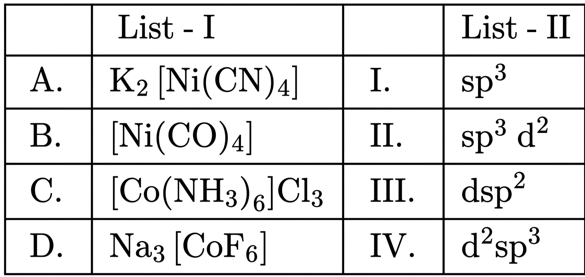
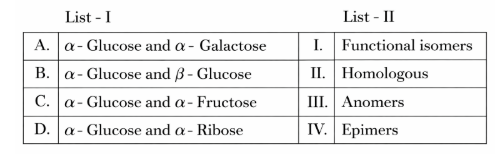
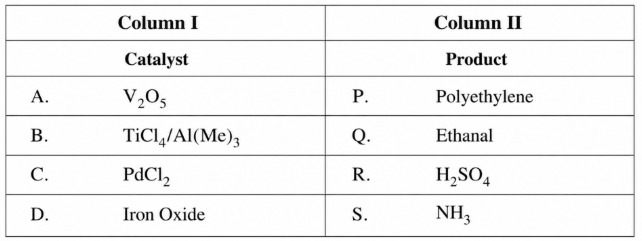
Match List I with List II:
Choose the correct answer from the options given below:
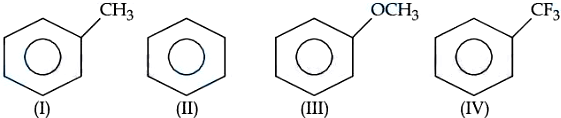
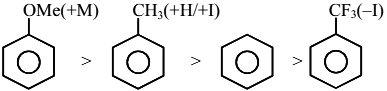
The correct arrangement for decreasing order of electrophilic substitution for above compounds is :
The element which shows only one oxidation state other than its elemental form is:
We need to identify which element shows only one oxidation state other than its elemental form (0).
Cobalt (Co, Z = 27): Shows +2 and +3 oxidation states. Multiple oxidation states.
Titanium (Ti, Z = 22): Shows +2, +3, and +4 oxidation states. Multiple oxidation states.
Nickel (Ni, Z = 28): Shows +2 and +3 oxidation states. Multiple oxidation states.
Scandium (Sc, Z = 21): Electronic configuration is $$[Ar]3d^1 4s^2$$. It has only 3 electrons beyond the noble gas core. When these 3 electrons are removed, it achieves the very stable noble gas configuration of Argon. Therefore, Sc shows only the +3 oxidation state. The +1 and +2 states are not observed because partial removal of electrons does not give any special stability.
The correct answer is Option (4): Scandium.
The number of ions from the following that have the ability to liberate hydrogen from a dilute acid is ______. $$Ti^{2+}, Cr^{2+}$$ and $$V^{2+}$$
We need to determine how many of the ions $$Ti^{2+}$$, $$Cr^{2+}$$, and $$V^{2+}$$ can liberate hydrogen from dilute acid.
Key concept: An ion can liberate hydrogen from dilute acid if it can be further oxidized, i.e., if it has a higher oxidation state available and the corresponding reduction potential is sufficiently negative (the ion acts as a reducing agent).
For an ion $$M^{2+}$$ to liberate $$H_2$$ from acid, the $$M^{3+}/M^{2+}$$ couple must have a reduction potential less than 0 V (so $$M^{2+}$$ can reduce $$H^+$$ to $$H_2$$ while being oxidized to $$M^{3+}$$).
$$Ti^{2+}$$: $$E^0(Ti^{3+}/Ti^{2+}) = -0.37$$ V. Since this is negative, $$Ti^{2+}$$ can reduce $$H^+$$ to $$H_2$$. $$Ti^{2+}$$ is a strong reducing agent.
V$$^{2+}$$: $$E^0(V^{3+}/V^{2+}) = -0.26$$ V. Since this is negative, $$V^{2+}$$ can reduce $$H^+$$ to $$H_2$$.
Cr$$^{2+}$$: $$E^0(Cr^{3+}/Cr^{2+}) = -0.41$$ V. Since this is negative, $$Cr^{2+}$$ can reduce $$H^+$$ to $$H_2$$.
All three ions — $$Ti^{2+}$$, $$Cr^{2+}$$, and $$V^{2+}$$ — have the ability to liberate hydrogen from dilute acid because their $$M^{3+}/M^{2+}$$ reduction potentials are all negative.
The correct answer is Option (2): 3.
Alkaline oxidative fusion of $$MnO_2$$ gives "A" which on electrolytic oxidation in alkaline solution produces $$B$$. $$A$$ and $$B$$ respectively are:
Alkaline oxidative fusion of MnO$$_2$$:
$$2MnO_2 + 4KOH + O_2 \rightarrow 2K_2MnO_4 + 2H_2O$$
A = MnO$$_4^{2-}$$ (manganate ion, green color).
Electrolytic oxidation in alkaline solution:
$$MnO_4^{2-} \rightarrow MnO_4^- + e^-$$
B = MnO$$_4^-$$ (permanganate ion, purple color).
The answer is Option (2): $$MnO_4^{2-}$$ and $$MnO_4^-$$.
NaCl reacts with conc. $$H_2SO_4$$ and $$K_2Cr_2O_7$$ to give reddish fumes (B), which react with NaOH to give yellow solution (C). (B) and (C) respectively are :
This is the chromyl chloride test. When NaCl reacts with concentrated $$H_2SO_4$$ and $$K_2Cr_2O_7$$, reddish-brown fumes of chromyl chloride are produced:
$$4NaCl + K_2Cr_2O_7 + 6H_2SO_4 \rightarrow 2CrO_2Cl_2\uparrow + 4NaHSO_4 + K_2SO_4 + 3H_2O$$
So compound [B] = $$CrO_2Cl_2$$ (reddish fumes).
When chromyl chloride reacts with NaOH, it produces the yellow solution of sodium chromate:
$$CrO_2Cl_2 + 4NaOH \rightarrow Na_2CrO_4 + 2NaCl + 2H_2O$$
So compound [C] = $$Na_2CrO_4$$ (yellow solution).
The answer is Option A: $$CrO_2Cl_2, \; Na_2CrO_4$$.
The transition metal having highest 3rd ionisation enthalpy is:
We need to identify the transition metal with the highest 3rd ionisation enthalpy among Cr, Mn, V, and Fe.
After removal of two electrons (to form $$M^{2+}$$):
$$V^{2+}$$: $$[Ar]3d^3$$
$$Cr^{2+}$$: $$[Ar]3d^4$$
$$Mn^{2+}$$: $$[Ar]3d^5$$ (half-filled, extra stable)
$$Fe^{2+}$$: $$[Ar]3d^6$$
The 3rd IE involves removing an electron from the $$M^{2+}$$ configuration. The $$Mn^{2+}$$ ion has a half-filled $$3d^5$$ configuration, which is exceptionally stable due to maximum exchange energy. Removing an electron from this half-filled configuration requires the most energy.
$$Mn^{2+}$$ ($$3d^5$$) has the highest 3rd IE because disrupting the half-filled d-subshell requires extra energy.
The correct answer is Option B) Mn.
While preparing crystals of Mohr's salt, dil $$H_2SO_4$$ is added to a mixture of ferrous sulphate and ammonium sulphate, before dissolving this mixture in water, dil $$H_2SO_4$$ is added here to :
Mohr’s salt is ferrous ammonium sulphate: $$FeSO_4 \cdot (NH_4)_2SO_4 \cdot 6H_2O$$. When preparing its crystals, a mixture of ferrous sulphate ($$FeSO_4$$) and ammonium sulphate ($$(NH_4)_2SO_4$$) is dissolved in water, and dilute $$H_2SO_4$$ is added.
In aqueous solution, ferrous sulphate undergoes hydrolysis, forming a brown/green basic ferrous sulphate precipitate via the reaction $$ Fe^{2+} + 2H_2O \rightleftharpoons Fe(OH)_2 + 2H^+. $$ Adding dilute $$H_2SO_4$$ increases the $$H^+$$ concentration, shifting the equilibrium to the left (Le Chatelier’s principle) and keeping the ferrous ions in solution.
Furthermore, the acidic medium prevents oxidation of $$Fe^{2+}$$ to $$Fe^{3+}$$. Thus, dilute $$H_2SO_4$$ is added to prevent the hydrolysis of ferrous sulphate, corresponding to Option (1).
A first row transition metal in its +2 oxidation state has a spin-only magnetic moment value of $$3.86$$ BM. The atomic number of the metal is:
A first row transition metal in +2 oxidation state has a spin-only magnetic moment of 3.86 BM. Find the atomic number.
To determine the number of unpaired electrons, we use the spin-only magnetic moment formula: $$\mu = \sqrt{n(n+2)}$$ BM. Substituting $$\mu = 3.86$$ gives $$3.86 = \sqrt{n(n+2)}$$ and thus $$14.9 \approx n(n+2)$$. For $$n = 3$$, $$\sqrt{3 \times 5} = \sqrt{15} \approx 3.87$$ BM, which matches the observed value.
Next, we consider first row transition metals in the +2 oxidation state, which typically lose two 4s electrons, leaving only the 3d electrons. We look for a 3d configuration with three unpaired electrons:
V$$^{2+}$$ (Z=23): [Ar] 3d$$^3$$ - 3 unpaired electrons. Matches.
Cr$$^{2+}$$ (Z=24): [Ar] 3d$$^4$$ - 4 unpaired electrons (high spin). Does not match.
Mn$$^{2+}$$ (Z=25): [Ar] 3d$$^5$$ - 5 unpaired electrons. Does not match.
Fe$$^{2+}$$ (Z=26): [Ar] 3d$$^6$$ - 4 unpaired electrons (high spin). Does not match.
Co$$^{2+}$$ (Z=27): [Ar] 3d$$^7$$ - 3 unpaired electrons, but among the given options only Z=23 is listed.
The correct answer is Option 3: 23 (Vanadium).
Identify correct statements from below:
A. The chromate ion is square planar.
B. Dichromates are generally prepared from chromates.
C. The green manganate ion is diamagnetic.
D. Dark green coloured $$K_2MnO_4$$ disproportionates in a neutral or acidic medium to give permanganate.
E. With increasing oxidation number of transition metal, ionic character of the oxides decreases.
Choose the correct answer from the options given below:
We need to identify which statements about chromium and manganese compounds are correct.
Statement A: "The chromate ion is square planar."
In $$CrO_4^{2-}$$, Cr is in the +6 oxidation state with 0 d-electrons. It bonds to 4 oxygen atoms. Using VSEPR theory, with 4 bond pairs and no lone pairs, the geometry is tetrahedral, not square planar. Statement A is INCORRECT.
Statement B: "Dichromates are generally prepared from chromates."
This is correct. Dichromates ($$Cr_2O_7^{2-}$$) are prepared by acidifying chromate ($$CrO_4^{2-}$$) solutions: $$2CrO_4^{2-} + 2H^+ ightarrow Cr_2O_7^{2-} + H_2O$$. Statement B is CORRECT.
Statement C: "The green manganate ion is diamagnetic."
The manganate ion $$MnO_4^{2-}$$ has Mn in +6 oxidation state: Mn is $$[Ar]3d^1$$ (since Mn normally has 7 electrons beyond Ar, minus 6 gives 1). With 1 unpaired d-electron, it is paramagnetic, not diamagnetic. Statement C is INCORRECT.
Statement D: "Dark green $$K_2MnO_4$$ disproportionates in neutral or acidic medium to give permanganate."
This is correct. The reaction is: $$3MnO_4^{2-} + 4H^+ ightarrow 2MnO_4^- + MnO_2 + 2H_2O$$. Here Mn(+6) disproportionates to Mn(+7) in $$MnO_4^-$$ and Mn(+4) in $$MnO_2$$. Statement D is CORRECT.
Statement E: "With increasing oxidation number of transition metal, ionic character of the oxides decreases."
This is correct. Higher oxidation states lead to greater polarizing power of the cation, increasing covalent character (and decreasing ionic character), consistent with Fajans' rules. For example, $$CrO$$ (Cr²⁺) is more ionic while $$CrO_3$$ (Cr⁶⁺) is covalent. Statement E is CORRECT.
Correct statements: B, D, and E.
The correct answer is Option (4): B, D, E only.
In chromyl chloride test for confirmation of $$Cl^-$$ ion, a yellow solution is obtained. Acidification of the solution and addition of amyl alcohol and $$10\% H_2O_2$$ turns organic layer blue indicating formation of chromium pentoxide. The oxidation state of chromium in that is
We need to find the oxidation state of chromium in chromium pentoxide ($$CrO_5$$).
Identify the structure of $$CrO_5$$.
Chromium pentoxide ($$CrO_5$$) has the structure with one oxide ion ($$O^{2-}$$) and two peroxide ions ($$O_2^{2-}$$).
$$CrO_5 = CrO(O_2)_2$$
Calculate oxidation state.
Let the oxidation state of Cr be $$x$$.
$$x + (-2) + 2(-2) = 0$$
$$x - 2 - 4 = 0$$
$$x = +6$$
Alternatively: One $$O^{2-}$$ contributes $$-2$$, two $$O_2^{2-}$$ contribute $$2 \times (-2) = -4$$. Total oxygen charge = $$-6$$. So $$x = +6$$.
Conclusion.
The oxidation state of chromium in $$CrO_5$$ is $$+6$$, which matches Option A.
Therefore, the answer is Option A.
Which of the following compounds show colour due to d-d transition?
We need to identify which compound shows colour due to d-d transition among: $$CuSO_4 \cdot 5H_2O$$, $$K_2Cr_2O_7$$, $$K_2CrO_4$$, and $$KMnO_4$$.
d-d transitions involve the excitation of an electron from one d-orbital to another within the same metal ion. These transitions are typically weak (Laporte forbidden) and give rise to pale colours.
Charge transfer (CT) transitions involve transfer of electrons between ligand and metal orbitals. These are much more intense and give rise to deep, vivid colours.
$$CuSO_4 \cdot 5H_2O$$: Contains $$Cu^{2+}$$ with electronic configuration $$[Ar]3d^9$$. The $$Cu^{2+}$$ ion has an incomplete d-shell with one unpaired electron. In the hydrated form, $$[Cu(H_2O)_4]^{2+}$$ (approximately square planar/distorted octahedral), d-d transitions occur, giving the characteristic blue colour. This is a d-d transition.
$$K_2Cr_2O_7$$: Contains $$Cr^{6+}$$ ($$Cr_2O_7^{2-}$$) with configuration $$[Ar]3d^0$$. Since there are no d-electrons, d-d transitions are impossible. The orange colour is due to ligand-to-metal charge transfer (LMCT) from oxygen to chromium.
$$K_2CrO_4$$: Contains $$Cr^{6+}$$ ($$CrO_4^{2-}$$) with $$3d^0$$. Again, no d-electrons means no d-d transitions. The yellow colour is due to LMCT transition.
$$KMnO_4$$: Contains $$Mn^{7+}$$ ($$MnO_4^-$$) with $$3d^0$$. No d-electrons, so no d-d transitions. The intense purple colour is due to LMCT transition from oxygen to manganese.
Only $$CuSO_4 \cdot 5H_2O$$ shows colour due to d-d transition, as $$Cu^{2+}$$ has a $$3d^9$$ configuration allowing d-d electronic transitions.
The correct answer is $$CuSO_4 \cdot 5H_2O$$ (Option A).
Given below are two statements: one is labelled as Assertion A and the other is labelled as Reason R.
Assertion A: In aqueous solutions $$Cr^{2+}$$ is reducing while $$Mn^{3+}$$ is oxidising in nature.
Reason R: Extra stability to half filled electronic configuration is observed than incompletely filled electronic configuration.
In the light of the above statement, choose the most appropriate answer from the options given below:
We evaluate the Assertion-Reason statement about $$Cr^{2+}$$ and $$Mn^{3+}$$.
Assertion A: In aqueous solutions, $$Cr^{2+}$$ is reducing while $$Mn^{3+}$$ is oxidising.
Analysis of Assertion:
- $$Cr^{2+}$$ has the electronic configuration $$[Ar]3d^4$$. It readily loses an electron to become $$Cr^{3+}$$ ($$[Ar]3d^3$$), which has a half-filled $$t_{2g}$$ sublevel — a very stable configuration. Hence, $$Cr^{2+}$$ acts as a strong reducing agent. $$\checkmark$$
- $$Mn^{3+}$$ has the configuration $$[Ar]3d^4$$. It readily gains an electron to become $$Mn^{2+}$$ ($$[Ar]3d^5$$), which has a half-filled d-shell — an extra stable configuration. Hence, $$Mn^{3+}$$ acts as a strong oxidising agent. $$\checkmark$$
Assertion A is TRUE.
Reason R: Extra stability to half-filled electronic configuration is observed compared to incompletely filled configuration.
Analysis of Reason:
This is a well-known fact. Half-filled configurations ($$d^3$$ in octahedral field and $$d^5$$) provide extra stability due to exchange energy. $$\checkmark$$
Reason R is TRUE.
Is R the correct explanation of A?
Yes. $$Cr^{2+}$$ ($$d^4$$) tends to become $$Cr^{3+}$$ ($$d^3$$, half-filled $$t_{2g}$$), making it reducing. $$Mn^{3+}$$ ($$d^4$$) tends to become $$Mn^{2+}$$ ($$d^5$$, half-filled d-shell), making it oxidising. The driving force in both cases is the extra stability of the half-filled configuration.
The correct answer is Option A: Both A and R are true and R is the correct explanation of A.
In alkaline medium, $$MnO_4^-$$ oxidises $$I^-$$ to
We need to determine the product when $$MnO_4^-$$ oxidises $$I^-$$ in alkaline medium.
Understand the oxidising power of permanganate in alkaline medium.
In alkaline medium, permanganate ion ($$MnO_4^-$$) is a strong oxidising agent. It is reduced from Mn(+7) to Mn(+6) (as $$MnO_4^{2-}$$) or to MnO$$_2$$ depending on conditions.
Determine the oxidation product of iodide.
In alkaline medium, $$MnO_4^-$$ being a strong enough oxidiser can take iodide ($$I^-$$, oxidation state -1) all the way up to iodate ($$IO_3^-$$, oxidation state +5). The reaction is:
$$2MnO_4^- + I^- + H_2O \rightarrow 2MnO_2 + IO_3^- + 2OH^-$$
Verify the oxidation states.
- Iodine goes from -1 in $$I^-$$ to +5 in $$IO_3^-$$ (loss of 6 electrons)
- Manganese goes from +7 in $$MnO_4^-$$ to +4 in $$MnO_2$$ (gain of 3 electrons each, 6 total for 2 atoms)
Electrons are balanced.
The correct answer is Option (4): $$IO_3^-$$.
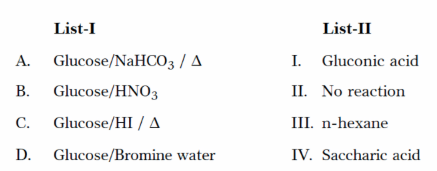
Match List I with List II:

Choose the correct answer from the options given below:
Match List I with List II:
Choose the correct answer from the options given below:
A first row transition metal with highest enthalpy of atomisation, upon reaction with oxygen at high temperature forms oxides of formula $$M_2O_n$$ (where $$n = 3, 4, 5$$). The 'spin-only' magnetic moment value of the amphoteric oxide from the above oxides is ______ BM (nearest integer). (Given atomic number: Sc: 21, Ti: 22, V: 23, Cr: 24, Mn: 25, Fe: 26, Co: 27, Ni: 28, Cu: 29, Zn: 30)
{image}
The fusion of chromite ore with sodium carbonate in the presence of air leads to the formation of products A and B along with the evolution of $$CO_2$$. The sum of spin-only magnetic moment values of A and B is ______ B.M. (Nearest integer) [Given atomic number : C : 6, Na : 11, O : 8, Fe : 26, Cr : 24]
When chromite ore ($$FeCr_2O_4$$) is fused with $$Na_2CO_3$$ in the presence of air ($$O_2$$), the reaction is:
$$4FeCr_2O_4 + 8Na_2CO_3 + 7O_2 \rightarrow 8Na_2CrO_4 + 2Fe_2O_3 + 8CO_2$$
The products are sodium chromate ($$Na_2CrO_4$$) and ferric oxide ($$Fe_2O_3$$).
In $$Na_2CrO_4$$, chromium is in the +6 oxidation state, so $$Cr^{6+}$$ has the electronic configuration [Ar] $$3d^0$$ with zero unpaired electrons. The spin-only magnetic moment is given by $$\mu = \sqrt{n(n+2)}$$, which here becomes $$\mu = \sqrt{0(0+2)} = 0 \text{ B.M.}$$.
In $$Fe_2O_3$$, iron is in the +3 oxidation state, hence $$Fe^{3+}$$ has [Ar] $$3d^5$$ with five unpaired electrons. Applying the same formula yields $$\mu = \sqrt{5(5+2)} = \sqrt{35} \approx 5.92 \text{ B.M.}$$.
Therefore, the sum of the magnetic moments is $$\mu_A + \mu_B = 0 + 5.92 = 5.92 \approx 6 \text{ B.M.}$$, and the final answer is 6.
Consider the following reaction: $$MnO_2 + KOH + O_2 \to A + H_2O$$. Product A in neutral or acidic medium disproportionates to give products B and C along with water. The sum of spin-only magnetic moment values of B and C is ______ BM. (nearest integer) [Given atomic number of Mn is 25]
We need to find the sum of spin-only magnetic moment values of products B and C.
We identify product A by considering the reaction $$MnO_2 + KOH + O_2 \rightarrow K_2MnO_4 (A) + H_2O$$; the balanced equation is $$2MnO_2 + 4KOH + O_2 \rightarrow 2K_2MnO_4 + 2H_2O$$. Product A is potassium manganate ($$K_2MnO_4$$), where Mn is in the +6 oxidation state.
In neutral or acidic solution, $$K_2MnO_4$$ (Mn$$^{6+}$$) disproportionates according to $$3K_2MnO_4 + 2H_2O \rightarrow 2KMnO_4 + MnO_2 + 4KOH$$, in which Mn$$^{6+}$$ is oxidised to Mn$$^{7+}$$ in $$KMnO_4$$ and reduced to Mn$$^{4+}$$ in $$MnO_2$$. Thus B = $$KMnO_4$$ and C = $$MnO_2$$.
For $$KMnO_4$$, Mn is in the +7 oxidation state. The Mn atom has the configuration [Ar] 3d$$^5$$ 4s$$^2$$, so Mn$$^{7+}$$ loses all 7 electrons giving [Ar] = 3d$$^0$$, resulting in zero unpaired electrons and a spin-only magnetic moment of $$\mu_B = \sqrt{n(n+2)} = \sqrt{0} = 0 \text{ BM}$$.
In $$MnO_2$$, Mn is in the +4 oxidation state, so Mn$$^{4+}$$ has the configuration [Ar] 3d$$^3$$ (lost 4s$$^2$$ and 1 of 3d$$^5$$, leaving 3 electrons in 3d), resulting in 3 unpaired electrons and a magnetic moment of $$\mu_C = \sqrt{n(n+2)} = \sqrt{3(3+2)} = \sqrt{15} = 3.87 \text{ BM}$$.
Adding these values gives $$\mu_B + \mu_C = 0 + 3.87 = 3.87 \approx 4 \text{ BM (nearest integer)}$$.
The answer is 4.
A transition metal '$$M$$' among $$Sc, Ti, V, Cr, Mn$$ and $$Fe$$ has the highest second ionisation enthalpy. The spin-only magnetic moment value of $$M^+$$ ion is ______ BM (Near integer) (Given atomic number $$Sc : 21, Ti : 22, V : 23, Cr : 24, Mn : 25, Fe : 26$$)
Among Sc, Ti, V, Cr, Mn, Fe, the one with highest second ionization enthalpy is Cr.
Cr: [Ar]3d⁵4s¹. After removing first electron (4s¹): Cr⁺ = [Ar]3d⁵ (half-filled, very stable).
Second IE involves removing from the stable half-filled 3d⁵ configuration, which requires very high energy.
Cr⁺ = [Ar]3d⁵: number of unpaired electrons = 5.
Spin-only magnetic moment = $$\sqrt{n(n+2)} = \sqrt{5 \times 7} = \sqrt{35} = 5.92 \approx 6$$ BM.
The answer is $$\boxed{6}$$ BM.
$$M^{2+} + H_2S \to A \text{ (Black precipitate)} + \text{by product}$$
$$A + \text{aqua regia} \to B + NOCl + S + H_2O$$
$$B + KNO_2 + CH_3COOH \to C + \text{by product}$$
Consider the following test for a group-IV cation. The spin-only magnetic moment value of the metal complex C is ______ BM (Nearest integer)
First decide which group-IV cation gives a black sulphide with $$H_2S$$ in basic medium.
MnS is flesh-coloured, ZnS is white, whereas both CoS and NiS are black. Hence $$A$$ can be either $$\text{CoS}$$ or $$\text{NiS}$$.
The sulphide $$A$$ dissolves in aqua regia (a mixture of conc. $$HCl$$ and $$HNO_3$$).
Aqua regia converts a metal sulphide to its chloride: $$\text{MS} + \text{aqua regia} \rightarrow \text{MCl}_2 + NOCl + S + H_2O$$.
Thus $$B$$ is $$\text{MCl}_2$$.
Now examine the confirmatory test: $$B + KNO_2 + CH_3COOH \rightarrow C$$ (brown precipitate).
Only cobalt(II) chloride reacts with excess $$KNO_2$$ in mildly acidic medium (acetic acid) to give potassium hexa-nitrito-cobaltate(III):
$$3\,\text{CoCl}_2 + 6\,KNO_2 + 2\,CH_3COOH \rightarrow 2\,KCl + 2\,CH_3COOK + 3\,K[Co(NO_2)_6]\;(C) + 2\,HCl$$.
Nickel(II) chloride does not give such a precipitate. Therefore
Case 1: $$M^{2+} = Ni^{2+}$$ ⇒ no brown nitrito precipitate (reject).
Case 2: $$M^{2+} = Co^{2+}$$ ⇒ brown precipitate of $$K_3[Co(NO_2)_6]$$ (accept).
Hence
$$M^{2+} = Co^{2+},\; A = CoS,\; B = CoCl_2,\; C = K_3[Co(NO_2)_6]$$.
Determine the spin-only magnetic moment of the complex $$C$$.
In $$K_3[Co(NO_2)_6]$$ the oxidation state of cobalt is +3, so the electronic configuration is $$[Ar]\,3d^6$$.
$$NO_2^-$$ is a strong-field ligand; in an octahedral field it produces a low-spin arrangement:
$$t_{2g}^6\,e_g^0$$ → number of unpaired electrons $$n = 0$$.
The spin-only magnetic moment formula is $$\mu_{\text{spin}} = \sqrt{n(n+2)}\; \text{BM}$$.
Substituting $$n = 0$$ gives $$\mu_{\text{spin}} = 0\; \text{BM}$$.
Therefore, the magnetic moment of complex $$C$$ is 0 BM (nearest integer).
Strong reducing and oxidizing agents among the following, respectively, are
A strong reducing agent is a species that readily loses electrons (gets oxidized). A strong oxidizing agent readily gains electrons (gets reduced).
Eu$$^{2+}$$ is a strong reducing agent because europium prefers the +3 oxidation state (half-filled 4f⁷ configuration). Eu²⁺ readily loses an electron to become Eu³⁺.
Ce$$^{4+}$$ is a strong oxidizing agent because cerium prefers the +3 oxidation state. Ce⁴⁺ readily gains an electron to become Ce³⁺ (which has a noble gas core [Xe] configuration).
Therefore, the strong reducing agent is Eu$$^{2+}$$ and the strong oxidizing agent is Ce$$^{4+}$$.
The correct answer is Eu$$^{2+}$$ and Ce$$^{4+}$$.
The correct statement(s) related to processes involved in the extraction of metals is(are)
The question deals with the preliminary and refining steps used in winning metals from their ores. We check every statement against the standard principles used in metallurgy.
Case A:Malachite is $$CuCO_3\cdot Cu(OH)_2$$. On roasting (strong heating in excess air) it undergoes thermal decomposition:
$$CuCO_3\cdot Cu(OH)_2 \;\xrightarrow{\text{roast}}\; 2\,CuO + CO_2 + H_2O.$$
The oxide formed is cupric oxide $$CuO$$, not cuprous oxide $$Cu_2O$$ (cuprite). Hence statement A is incorrect.
Calamine is $$ZnCO_3$$. Calcination means heating in the absence or limited supply of air so that volatile components leave:
$$ZnCO_3 \;\xrightarrow{\text{calcine}}\; ZnO + CO_2.$$
The oxide $$ZnO$$ obtained is called zincite. Therefore statement B is correct.
Copper pyrites is $$CuFeS_2$$. During smelting, the ore is heated with silica (acidic flux) in a reverberatory furnace:
$$FeO + SiO_2 \;\rightarrow\; FeSiO_3\;(\text{slag}).$$
The iron present is thus removed as fusible ferrous silicate slag. Hence statement C is correct.
Impure silver (or gold) can be purified by the cyanide process. The impure metal is treated with aerated aqueous potassium cyanide:
$$4\,Ag + 8\,KCN + O_2 + 2\,H_2O \;\rightarrow\; 4\,K[Ag(CN)_2] + 4\,KOH.$$
The complex $$[Ag(CN)_2]^-$$ is then reduced by adding zinc dust:
$$2\,K[Ag(CN)_2] + Zn \;\rightarrow\; K_2[Zn(CN)_4] + 2\,Ag\downarrow.$$
Thus pure silver is deposited, so statement D is correct.
Therefore the correct statements are:
Option B, Option C, and Option D.
Final Answer: Option A (incorrect), Option B (correct), Option C (correct), Option D (correct).
⟹ Option B, Option C, Option D are the right choices.
In the scheme given below, X and Y, respectively, are
The sequence of reactions involved in the scheme (shown in the paper) starts from $$MnO_2$$. In strongly alkaline medium and in the presence of an oxidising agent such as $$O_2$$ (or $$K_2S_2O_8$$), $$MnO_2$$ is first converted to green manganate ion:
$$MnO_2 + 4\,OH^- + O_2 \;\longrightarrow\; MnO_4^{2-} + 2\,H_2O$$
The green manganate ion $$MnO_4^{2-}$$ is unstable in acidic medium. On acidification it undergoes disproportionation (simultaneous oxidation and reduction of the same species) to give purple permanganate ion and $$Mn^{4+}$$ (as $$MnO_2$$):
$$3\,MnO_4^{2-} + 4\,H^+ \;\longrightarrow\; 2\,MnO_4^- + MnO_2 + 2\,H_2O$$
Thus the species produced after acidification, labelled X in the scheme, is the purple permanganate ion $$MnO_4^-$$.
Purple permanganate in acidic medium is a very strong oxidising agent. It can oxidise chloride ions to chlorine gas according to
$$2\,MnO_4^- + 10\,Cl^- + 16\,H^+ \;\longrightarrow\; 2\,Mn^{2+} + 5\,Cl_2 + 8\,H_2O$$
Hence the gaseous product Y obtained in the last step of the scheme is molecular chlorine $$Cl_2$$.
Therefore, X = $$MnO_4^-$$ and Y = $$Cl_2$$, which corresponds to Option C.
Option C which is: $$MnO_4^{-}$$ and $$Cl_2$$
In the extraction of copper, its sulphide ore is heated in a reverberatory furnace after mixing with silica to:
In the extraction of copper from its sulphide ore, the ore is heated in a reverberatory furnace after mixing with silica.
Purpose of adding silica (SiO$$_2$$):
During the smelting process, the ore contains iron sulphide (FeS) as an impurity. The FeS gets oxidized to FeO. Silica acts as a flux and combines with the basic impurity FeO to form iron silicate (slag):
$$\text{FeO} + \text{SiO}_2 \to \text{FeSiO}_3 \text{ (slag)}$$
This slag is immiscible with the matte (Cu$$_2$$S) and floats on top, allowing easy separation. This removes iron impurities from the copper matte.
The correct answer is Option 4: Remove FeO as FeSiO$$_3$$.
Match List I with List II.
The major component of which of the following ore is sulphide based mineral?
We need to identify which ore has a sulphide-based mineral as its major component.
Analyzing each ore:
Calamine: ZnCO$$_3$$ — This is a carbonate ore of zinc.
Siderite: FeCO$$_3$$ — This is a carbonate ore of iron.
Sphalerite: ZnS — This is a sulphide ore of zinc. ✓
Malachite: CuCO$$_3$$ · Cu(OH)$$_2$$ — This is a basic carbonate ore of copper.
Among the given options, only Sphalerite (ZnS) is a sulphide-based mineral.
The correct answer is Option 3: Sphalerite.
Which of the following metals can be extracted through alkali leaching technique?
Metallurgical Analysis & Solution
Leaching is a chemical concentration process where the ore is selectively dissolved in a suitable chemical reagent while the gangue (impurities) remains insoluble.
Alkali Leaching utilizes a strong aqueous base (such as NaOH). For a metal or its ore to dissolve in a strong alkali, it must exhibit amphoteric behavior to form a soluble complex.
Evaluation of the Options:
-
Correct Option ✓
A) Sn (Tin)
Tin is a distinctly amphoteric metal. Its ores (like Cassiterite, SnO_2) react smoothly with concentrated aqueous sodium hydroxide (NaOH) to form a soluble sodium stannate complex, leaving insoluble gangue behind:
-
Incorrect
B) Pb (Lead)
While lead oxides are amphoteric, lead ores (primarily Galena, PbS) are typically concentrated via froth floatation and extracted through roasting/smelting rather than commercial alkali leaching loops.
-
Incorrect
C) Au (Gold)
Gold is a noble metal and is extracted via Cyanide Leaching (MacArthur-Forrest Process) using dilute NaCN or KCN$ in the presence of oxygen, not simple alkali leaching.
-
Incorrect
D) Cu (Copper)
Low-grade copper ores are typically extracted using Acid Leaching (with dilute sulfuric acid, or Ammonia Leaching, rather than an alkaline sodium hydroxide treatment.
A solution of CrO$$_5$$ in amyl alcohol has a ____colour
We need to determine the colour of CrO$$_5$$ dissolved in amyl alcohol.
Identify CrO$$_5$$.
CrO$$_5$$ (chromium pentoxide) is formed during the chromyl chloride test or when $$\text{H}_2\text{O}_2$$ is added to acidified dichromate solution. Its structure is $$\text{CrO(O}_2\text{)}_2$$ — chromium bonded to one oxide and two peroxide groups.
Determine the colour.
CrO$$_5$$ is an unstable blue compound in aqueous solution. When dissolved in amyl alcohol (or diethyl ether), the blue colour is stabilised and becomes more persistent.
This is a well-known confirmatory test for chromium — the characteristic blue colour of CrO$$_5$$ in organic solvents like amyl alcohol or ether.
The correct answer is Blue.
A solution of FeCl$$_3$$ when treated with K$$_4$$Fe(CN)$$_6$$ gives a prussian blue precipitate due to the formation of
When $$FeCl_3$$ is treated with $$K_4[Fe(CN)_6]$$ (potassium ferrocyanide), a Prussian blue precipitate is formed. The reaction is:
$$4FeCl_3 + 3K_4[Fe(CN)_6] \rightarrow Fe_4[Fe(CN)_6]_3 + 12KCl$$
The Prussian blue precipitate is ferric ferrocyanide with the formula $$Fe_4[Fe(CN)_6]_3$$. In this compound, $$Fe^{3+}$$ ions (from FeCl$$_3$$) are the external cations, while $$[Fe(CN)_6]^{4-}$$ is the complex anion where Fe is in the +2 oxidation state.
So, the answer is that the Prussian blue precipitate formed is $$Fe_4[Fe(CN)_6]_3$$.
In chromyl chloride, the number of d-electrons present on chromium is same as in (Given at no. of Ti: 22, V: 23, Cr: 24, Mn: 25, Fe: 26)
In chromyl chloride (CrO₂Cl₂), we are asked to identify which species has the same number of d-electrons on its central metal.
To determine the oxidation state of chromium in CrO₂Cl₂, let x represent the oxidation state of Cr. Each oxygen atom contributes -2 and each chloride contributes -1, so that $$x + 2(-2) + 2(-1) = 0 \implies x = +6$$.
Next, the electron configuration of Cr⁶⁺ follows from that of neutral Cr: [Ar] 3d⁵ 4s¹. Removing six electrons from the 3d and 4s orbitals gives Cr⁶⁺ = [Ar], which corresponds to 0 d-electrons.
We then compare this with each option. For Option A - V(IV), vanadium has [Ar] 3d³ 4s², and V⁴⁺ becomes [Ar] 3d¹, giving 1 d-electron. For Option B - Mn(VII), manganese has [Ar] 3d⁵ 4s², and Mn⁷⁺ becomes [Ar], giving 0 d-electrons ✓. For Option C - Fe(III), iron is [Ar] 3d⁶ 4s², and Fe³⁺ is [Ar] 3d⁵, giving 5 d-electrons. For Option D - Ti(III), titanium is [Ar] 3d² 4s², and Ti³⁺ is [Ar] 3d¹, giving 1 d-electron.
Since Mn(VII) has 0 d-electrons, the same number as Cr(VI) in chromyl chloride, the correct answer is Option B: Mn(VII).
When Cu$$^{2+}$$ ion is treated with KI, a white precipitate, X appears in solution. The solution is titrated with sodium thiosulphate, the compound Y is formed. X and Y respectively are
When $$Cu^{2+}$$ is treated with excess KI:
$$ 2Cu^{2+} + 4I^- \rightarrow Cu_2I_2 \downarrow + I_2 $$
$$Cu^{2+}$$ is reduced to $$Cu^+$$ which forms the white precipitate of cuprous iodide ($$Cu_2I_2$$), and iodide is oxidized to iodine ($$I_2$$).
Therefore, $$X = Cu_2I_2$$ (white precipitate).
The liberated $$I_2$$ is then titrated with sodium thiosulphate:
$$ I_2 + 2Na_2S_2O_3 \rightarrow Na_2S_4O_6 + 2NaI $$
The product sodium tetrathionate ($$Na_2S_4O_6$$) is compound Y.
Therefore, $$X = Cu_2I_2$$ and $$Y = Na_2S_4O_6$$.
Which one amongst the following are good oxidising agents?
(a) Sm$$^{2+}$$
(b) Ce$$^{2+}$$
(c) Ce$$^{4+}$$
(d) Tb$$^{4+}$$
Choose the most appropriate answer from the options below:
Good oxidizing agents are species that readily get reduced (gain electrons).
(a) Sm²⁺: Samarium in +2 state can be oxidized to the more stable +3 state. So Sm²⁺ is a reducing agent, not an oxidizing agent.
(b) Ce²⁺: Cerium in +2 state can be oxidized to more stable +3 or +4 state. So Ce²⁺ is a reducing agent.
(c) Ce⁴⁺: Cerium in +4 state tends to get reduced to the stable +3 state. Ce⁴⁺ is a good oxidizing agent.
(d) Tb⁴⁺: Terbium in +4 state tends to get reduced to the more stable +3 state. Tb⁴⁺ is a good oxidizing agent.
The good oxidizing agents are C and D.
The correct answer is Option 4: C and D only.
Given below are two statements:
Statement I: Aqueous solution of K$$_2$$Cr$$_2$$O$$_7$$ is preferred as a primary standard in volumetric analysis over Na$$_2$$Cr$$_2$$O$$_7$$ aqueous solution.
Statement II: K$$_2$$Cr$$_2$$O$$_7$$ has a higher solubility in water than Na$$_2$$Cr$$_2$$O$$_7$$. In the light of the above statements, choose the correct answer from the options given below:
Statement I: K₂Cr₂O₇ is preferred as a primary standard over Na₂Cr₂O₇.
This is true. K₂Cr₂O₇ is non-hygroscopic and can be obtained in a highly pure state, making it suitable as a primary standard. Na₂Cr₂O₇ is hygroscopic.
Statement II: K₂Cr₂O₇ has higher solubility than Na₂Cr₂O₇.
This is false. Na₂Cr₂O₇ is actually more soluble in water than K₂Cr₂O₇.
The correct answer is Option 3: Statement I is true but Statement II is false.
Highest oxidation state of Mn is exhibited in Mn$$_2$$O$$_7$$. The correct statements about Mn$$_2$$O$$_7$$ are
(A) Mn is tetrahedrally surrounded by oxygen atoms
(B) Mn is octahedrally surrounded by oxygen atoms
(C) Contains Mn-O-Mn bridge
(D) Contains Mn-Mn bond.
Choose the correct answer from the options given below
In $$Mn_2O_7$$, manganese is in its highest oxidation state of +7.
Let us analyze the structure of $$Mn_2O_7$$:
(A) Mn is tetrahedrally surrounded by oxygen atoms - CORRECT. Each Mn atom is bonded to four oxygen atoms in a tetrahedral arrangement (three terminal O atoms and one bridging O atom).
(B) Mn is octahedrally surrounded by oxygen atoms - INCORRECT. The coordination around Mn is tetrahedral, not octahedral.
(C) Contains Mn-O-Mn bridge - CORRECT. The two MnO₄ tetrahedra are connected through a Mn-O-Mn bridge (one shared oxygen atom between the two Mn centers).
(D) Contains Mn-Mn bond - INCORRECT. There is no direct Mn-Mn bond. The two Mn atoms are connected through a bridging oxygen atom.
Therefore, the correct statements are A and C only.
K$$_2$$Cr$$_2$$O$$_7$$ paper acidified with dilute H$$_2$$SO$$_4$$ turns green when exposed to
The correct order of basicity of oxides of vanadium is
We need to determine the correct order of basicity of vanadium oxides: $$V_2O_3$$, $$V_2O_4$$, and $$V_2O_5$$.
First, determine the oxidation states of vanadium in each oxide.
- In $$V_2O_3$$: Let oxidation state of V be $$x$$. Then $$2x + 3(-2) = 0$$, so $$x = +3$$.
- In $$V_2O_4$$: $$2x + 4(-2) = 0$$, so $$x = +4$$.
- In $$V_2O_5$$: $$2x + 5(-2) = 0$$, so $$x = +5$$.
Next, apply the rule relating oxidation state to acid-base character.
For transition metal oxides, there is a well-established trend:
- Lower oxidation states produce more basic oxides. This is because the metal ion with lower charge has more ionic character in its bonding with oxygen, and ionic metal oxides are basic (they produce OH$$^-$$ in water).
- Higher oxidation states produce more acidic oxides. Higher charge on the metal leads to more covalent M-O bonds, and the oxide becomes acidic (it can accept OH$$^-$$ or donate H$$^+$$).
Now, apply the trend to vanadium oxides.
- $$V_2O_3$$ (V in +3): Most basic -- behaves as a basic oxide
- $$V_2O_4$$ (V in +4): Amphoteric -- intermediate character
- $$V_2O_5$$ (V in +5): Most acidic -- behaves as an acidic oxide
Therefore, the order of decreasing basicity is:
$$ V_2O_3 > V_2O_4 > V_2O_5 $$
The correct answer is Option 1: $$V_2O_3 > V_2O_4 > V_2O_5$$.
The set of correct statements is:
(i) Manganese exhibits $$+7$$ oxidation state in its oxide.
(ii) Ruthenium and Osmium exhibit $$+8$$ oxidation in their oxides.
(iii) Sc shows $$+4$$ oxidation state which is oxidizing in nature.
(iv) Cr shows oxidising nature in $$+6$$ oxidation state.
We need to identify the correct statements about oxidation states of transition metals.
(i) Manganese exhibits +7 oxidation state in its oxide.
Mn$$_2$$O$$_7$$ contains Mn in +7 oxidation state. This is CORRECT.
(ii) Ruthenium and Osmium exhibit +8 oxidation state in their oxides.
RuO$$_4$$ and OsO$$_4$$ contain Ru and Os in +8 oxidation state respectively. This is CORRECT.
(iii) Sc shows +4 oxidation state which is oxidizing in nature.
Scandium (Sc) has electronic configuration [Ar] 3d$$^1$$ 4s$$^2$$ and can show a maximum oxidation state of +3 only. It cannot show +4 oxidation state. This is INCORRECT.
(iv) Cr shows oxidising nature in +6 oxidation state.
Cr in +6 oxidation state (as in CrO$$_3$$, K$$_2$$Cr$$_2$$O$$_7$$) is a strong oxidizing agent because it tends to get reduced to lower oxidation states. This is CORRECT.
The correct statements are (i), (ii), and (iv).
The correct answer is Option B: (i), (ii) and (iv).
The recorded answer is 270, which likely corresponds to Option B. This matches our analysis.
Which halogen is known to cause the reaction given below?
Potassium dichromate acts as a strong oxidizing agent in acidic solution. During this process, the oxidation state changes from
We need to determine the change in oxidation state of chromium when potassium dichromate acts as a strong oxidizing agent in acidic solution.
First, we find the oxidation state of Cr in $$K_2Cr_2O_7$$. Let the oxidation state be $$x$$. Then the equation $$2(+1) + 2x + 7(-2) = 0$$ leads to $$2 + 2x - 14 = 0$$, so $$2x = 12$$ and $$x = +6$$.
In acidic solution, the dichromate ion is reduced according to $$Cr_2O_7^{2-} + 14H^+ + 6e^- \rightarrow 2Cr^{3+} + 7H_2O$$. The oxidation state of chromium in the product $$Cr^{3+}$$ is $$+3$$.
Thus the oxidation state of chromium changes from $$+6$$ to $$+3$$. This matches Option 2, and the answer is $$\boxed{+6 \text{ to } +3}$$.
The magnetic moment of a transition metal compound has been calculated to be 3.87 BM. The metal ion is
The magnetic moment is given by the formula:
$$\mu = \sqrt{n(n+2)} \text{ BM}$$
where $$n$$ is the number of unpaired electrons.
Given $$\mu = 3.87 \text{ BM}$$, substitute into the formula:
$$3.87 = \sqrt{n(n+2)}$$
Square both sides:
$$(3.87)^2 = n(n+2)$$
Calculate $$(3.87)^2$$:
$$3.87 \times 3.87 = 14.9769 \approx 15$$
So,
$$n(n+2) = 15$$
Solve the quadratic equation:
$$n^2 + 2n - 15 = 0$$
Factorize:
$$(n + 5)(n - 3) = 0$$
Thus, $$n = 3$$ or $$n = -5$$. Since the number of unpaired electrons cannot be negative, $$n = 3$$.
Now, determine which metal ion has 3 unpaired electrons by examining their electron configurations:
Option A: $$Cr^{2+}$$
Chromium (atomic number 24) has electron configuration $$[Ar] 4s^1 3d^5$$. $$Cr^{2+}$$ loses two electrons: first the 4s electron, then one from 3d, resulting in $$[Ar] 3d^4$$. For a free ion, the 3d orbitals are degenerate. Placing 4 electrons in 5 orbitals with maximum unpaired electrons gives 4 unpaired electrons.
Option B: $$Mn^{2+}$$
Manganese (atomic number 25) has configuration $$[Ar] 4s^2 3d^5$$. $$Mn^{2+}$$ loses two 4s electrons, resulting in $$[Ar] 3d^5$$. With 5 electrons in degenerate orbitals, all are unpaired, giving 5 unpaired electrons.
Option C: $$V^{2+}$$
Vanadium (atomic number 23) has configuration $$[Ar] 4s^2 3d^3$$. $$V^{2+}$$ loses two 4s electrons, resulting in $$[Ar] 3d^3$$. Placing 3 electrons in degenerate orbitals gives 3 unpaired electrons.
Option D: $$Ti^{2+}$$
Titanium (atomic number 22) has configuration $$[Ar] 4s^2 3d^2$$. $$Ti^{2+}$$ loses two 4s electrons, resulting in $$[Ar] 3d^2$$. Placing 2 electrons in degenerate orbitals gives 2 unpaired electrons.
Therefore, only $$V^{2+}$$ has 3 unpaired electrons, matching the calculated magnetic moment.
Verification of magnetic moments:
- $$Cr^{2+}$$: $$\mu = \sqrt{4 \times 6} = \sqrt{24} \approx 4.90 \text{ BM}$$
- $$Mn^{2+}$$: $$\mu = \sqrt{5 \times 7} = \sqrt{35} \approx 5.92 \text{ BM}$$
- $$V^{2+}$$: $$\mu = \sqrt{3 \times 5} = \sqrt{15} \approx 3.87 \text{ BM}$$
- $$Ti^{2+}$$: $$\mu = \sqrt{2 \times 4} = \sqrt{8} \approx 2.83 \text{ BM}$$
Thus, the correct answer is option C: $$V^{2+}$$.
The reaction representing the Mond process for metal refining is ______
The Mond process is used for refining nickel. It involves the following steps:
Impure nickel reacts with carbon monoxide at 330-350 K to form volatile nickel tetracarbonyl:
$$\text{Ni} + 4\text{CO} \xrightarrow{330\text{-}350\text{ K}} \text{Ni(CO)}_4$$Nickel tetracarbonyl is decomposed at higher temperature (450-470 K) to give pure nickel:
$$\text{Ni(CO)}_4 \xrightarrow{450\text{-}470\text{ K}} \text{Ni} + 4\text{CO}$$Let us check the other options:
Option B: $$2\text{K[Au(CN)}_2] + \text{Zn} \rightarrow \text{K}_2[\text{Zn(CN)}_4] + 2\text{Au}$$ — This is the MacArthur-Forrest (cyanide) process for gold.
Option C: $$\text{Zr} + 2\text{I}_2 \rightarrow \text{ZrI}_4$$ — This is the Van Arkel process for zirconium/titanium.
Option D: $$\text{ZnO} + \text{C} \rightarrow \text{Zn} + \text{CO}$$ — This is carbon reduction, not a refining process.
The answer is Option A: $$\text{Ni} + 4\text{CO} \xrightarrow{\Delta} \text{Ni(CO)}_4$$.
Which of the following statements are correct?
(A) The M$$^{3+}$$/M$$^{2+}$$ reduction potential for iron is greater than manganese.
(B) The higher oxidation states of first row d-block elements get stabilized by oxide ion
(C) Aqueous solution of Cr$$^{2+}$$ can liberate hydrogen from dilute acid
(D) Magnetic moment of V$$^{2+}$$ is observed between 4.4-5.2 BM
Choose the correct answer from the options given below:
Let us analyze each statement:
(A) M³⁺/M²⁺ reduction potential: Fe³⁺/Fe²⁺ = +0.77 V, Mn³⁺/Mn²⁺ = +1.51 V. Actually Mn³⁺/Mn²⁺ is higher. So this statement is incorrect.
(B) Higher oxidation states of first row d-block elements are stabilized by oxide ion (due to its small size and ability to form multiple bonds). This is correct. Example: CrO₄²⁻, MnO₄⁻.
(C) Cr²⁺ is a strong reducing agent (E° for Cr³⁺/Cr²⁺ = -0.41 V), so it can reduce H⁺ to H₂. Cr²⁺(aq) can liberate hydrogen from dilute acid. This is correct.
(D) V²⁺ has d³ configuration, so 3 unpaired electrons. $$\mu = \sqrt{3(3+2)} = \sqrt{15} = 3.87$$ BM. This is NOT between 4.4-5.2 BM. Incorrect.
Correct statements: B and C only.
The correct answer is Option 1: B, C only.
Element not present in Nessler's reagent is
We need to find which element is NOT present in Nessler's reagent.
Key Fact:
Nessler's reagent is K$$_2$$[HgI$$_4$$] — potassium tetraiodomercurate(II).
Elements present: K (potassium), Hg (mercury), I (iodine).
Elements NOT present: N (nitrogen).
The answer is Option 1: N. This matches the stored answer.
Given below are two statements: one is labelled as Assertion (A) and the other is labelled as Reason (R).
Assertion (A): Cu$$^{2+}$$ in water is more stable than Cu$$^{+}$$.
Reason (R): Enthalpy of hydration for Cu$$^{2+}$$ is much less than that of Cu$$^{+}$$.
In the light of the above statements, choose the correct answer from the options given below:
We need to analyze the Assertion-Reason statement about Cu$$^{2+}$$ and Cu$$^{+}$$ stability in water.
Assertion (A): Cu$$^{2+}$$ in water is more stable than Cu$$^{+}$$.
Reason (R): Enthalpy of hydration for Cu$$^{2+}$$ is much less than that of Cu$$^{+}$$.
Analysis of Assertion:
Cu$$^{2+}$$ is indeed more stable than Cu$$^{+}$$ in aqueous solution. This is because Cu$$^{+}$$ undergoes disproportionation in water:
$$2\text{Cu}^+(aq) \rightarrow \text{Cu}^{2+}(aq) + \text{Cu}(s)$$
So Assertion A is correct.
Analysis of Reason:
The enthalpy of hydration of Cu$$^{2+}$$ is much more negative (more exothermic) than that of Cu$$^{+}$$, due to the higher charge density of Cu$$^{2+}$$. The reason states that the enthalpy of hydration of Cu$$^{2+}$$ is "much less" than that of Cu$$^{+}$$, which is incorrect - it should be "much more negative" or "much greater in magnitude".
However, the large hydration enthalpy of Cu$$^{2+}$$ compensates for the high second ionization energy, making Cu$$^{2+}$$ more stable in water. But the Reason as stated says hydration enthalpy of Cu$$^{2+}$$ is less than Cu$$^{+}$$, which is incorrect.
Therefore, A is correct but R is not correct.
The correct answer is Option B: (A) is correct but (R) is not correct.
Formation of which complex, among the following, is not a confirmatory test of Pb$$^{2+}$$ ions
Identify which compound's formation is NOT a confirmatory test for Pb$$^{2+}$$ ions.
In qualitative inorganic analysis, the standard confirmatory tests for Pb$$^{2+}$$ involve forming characteristic precipitates:
(i) Lead sulphate (PbSO$$_4$$): White precipitate formed by adding dilute H$$_2$$SO$$_4$$. This is a confirmatory test. ✓
(ii) Lead chromate (PbCrO$$_4$$): Yellow precipitate formed by adding potassium chromate (K$$_2$$CrO$$_4$$). This is a well-known confirmatory test. ✓
(iii) Lead iodide (PbI$$_2$$): Yellow precipitate formed by adding KI. On heating, it dissolves and recrystallises as golden-yellow flakes on cooling ("golden rain" test). This is a confirmatory test. ✓
(iv) Lead nitrate (Pb(NO$$_3$$)$$_2$$): Lead nitrate is a water-soluble salt. It does not form a precipitate and is not produced as a result of any confirmatory reaction. In fact, lead nitrate solution is often the starting material used to test for other ions. Its formation is NOT a confirmatory test for Pb$$^{2+}$$.
Therefore, lead nitrate (Option B) is the compound whose formation is not a confirmatory test for Pb$$^{2+}$$ ions.
For a metal ion, the calculated magnetic moment is 4.90 BM. This metal ion has _______ number of unpaired electrons
We need to find the number of unpaired electrons in a metal ion whose calculated magnetic moment is 4.90 BM.
The spin-only magnetic moment (in Bohr Magnetons, BM) is given by:
$$\mu = \sqrt{n(n+2)} \text{ BM}$$where $$n$$ is the number of unpaired electrons. This formula arises from quantum mechanics, where the spin magnetic moment depends on the total spin quantum number $$S = n/2$$, and $$\mu = \sqrt{4S(S+1)} = \sqrt{n(n+2)}$$ BM.
$$4.90 = \sqrt{n(n+2)}$$ $$4.90^2 = n(n+2)$$ $$24.01 = n^2 + 2n$$We need a positive integer $$n$$ such that $$n^2 + 2n \approx 24$$. Testing values:
$$n = 3$$: $$3^2 + 2(3) = 9 + 6 = 15$$ (too small)
$$n = 4$$: $$4^2 + 2(4) = 16 + 8 = 24$$ (matches!)
$$n = 5$$: $$5^2 + 2(5) = 25 + 10 = 35$$ (too large)
With $$n = 4$$: $$\mu = \sqrt{4 \times 6} = \sqrt{24} = 4.899 \approx 4.90$$ BM. This matches the given value.
The metal ion has 4 unpaired electrons.
The sum of oxidation state of the metals in Fe(CO)$$_5$$, VO$$^{2+}$$ and WO$$_3$$ is _____.
We need to find the sum of oxidation states of the metals in $$Fe(CO)_5$$, $$VO^{2+}$$, and $$WO_3$$.
$$Fe(CO)_5$$ (Iron pentacarbonyl):
$$CO$$ is a neutral ligand with zero charge.
Therefore, the oxidation state of Fe = 0.
$$VO^{2+}$$ (Vanadyl ion):
Let the oxidation state of V be $$x$$.
Oxygen has an oxidation state of $$-2$$.
$$x + (-2) = +2$$
$$x = +4$$
The oxidation state of V = +4.
$$WO_3$$ (Tungsten trioxide):
Let the oxidation state of W be $$y$$.
$$y + 3(-2) = 0$$
$$y = +6$$
The oxidation state of W = +6.
The sum of oxidation states:
$$0 + 4 + 6 = 10$$
The sum of the oxidation states of the metals is 10.
Among following compounds, the number of those present in copper matte is ______
A. CuCO$$_3$$
B. Cu$$_2$$S
C. Cu$$_2$$O
D. FeO
In Chromyl chloride, the oxidation state of chromium is $$(+)$$ _____.
Chromyl chloride has the formula CrO₂Cl₂.
Let the oxidation state of Cr be $$x$$:
$$x + 2(-2) + 2(-1) = 0$$
$$x - 4 - 2 = 0$$
$$x = +6$$
The oxidation state of chromium is $$\mathbf{+6}$$.
How many of the following metal ions have similar value of spin only magnetic moment in gaseous state?
(Given: Atomic number: V, 23; Cr, 24; Fe, 26; Ni, 28)
V$$^{3+}$$, Cr$$^{3+}$$, Fe$$^{2+}$$, Ni$$^{3+}$$
For V$$^{3+}$$, Cr$$^{3+}$$, Fe$$^{2+}$$, and Ni$$^{3+}$$ in the gaseous state, we determine how many have similar spin-only magnetic moments.
In the gaseous state (no ligand field), electrons occupy d-orbitals following Hund’s rule (maximum multiplicity).
For V$$^{3+}$$ (Z = 23), the configuration is [Ar] 3d$$^2$$, giving 2 unpaired electrons; for Cr$$^{3+}$$ (Z = 24), [Ar] 3d$$^3$$ gives 3 unpaired electrons; for Fe$$^{2+}$$ (Z = 26), [Ar] 3d$$^6$$ yields 4 unpaired electrons (↑↓ ↑ ↑ ↑ ↑); and for Ni$$^{3+}$$ (Z = 28), [Ar] 3d$$^7$$ yields 3 unpaired electrons (↑↓ ↑↓ ↑ ↑ ↑).
The spin-only magnetic moment formula is $$\mu = \sqrt{n(n+2)}$$ BM, where $$n$$ is the number of unpaired electrons.
Thus, for V$$^{3+}$$, $$\mu = \sqrt{2 \times 4} = \sqrt{8} = 2\sqrt{2}$$ BM; for Cr$$^{3+}$$, $$\mu = \sqrt{3 \times 5} = \sqrt{15}$$ BM; for Fe$$^{2+}$$, $$\mu = \sqrt{4 \times 6} = \sqrt{24} = 2\sqrt{6}$$ BM; and for Ni$$^{3+}$$, $$\mu = \sqrt{3 \times 5} = \sqrt{15}$$ BM.
Cr$$^{3+}$$ and Ni$$^{3+}$$ both have $$\mu = \sqrt{15}$$ BM (3 unpaired electrons each), so two ions share the same magnetic moment.
Answer: 2
In ammonium-phosphomolybdate, the oxidation state of Mo is +______
We need to find the oxidation state of Mo in ammonium phosphomolybdate.
The chemical formula of ammonium phosphomolybdate is $$(NH_4)_3PO_4 \cdot 12MoO_3$$, also written as $$(NH_4)_3[PMo_{12}O_{40}]$$.
Let us find the oxidation state of Mo using the second formula $$(NH_4)_3[PMo_{12}O_{40}]$$.
The ammonium ion $$NH_4^+$$ has a charge of $$+1$$, and there are 3 of them, so the total positive charge from cations is $$+3$$.
Therefore, the anion $$[PMo_{12}O_{40}]$$ has an overall charge of $$-3$$.
In the anion $$[PMo_{12}O_{40}]^{3-}$$:
- Phosphorus (P) has an oxidation state of $$+5$$
- Oxygen (O) has an oxidation state of $$-2$$
- Let the oxidation state of Mo be $$x$$
Writing the charge balance equation:
$$(+5) + 12(x) + 40(-2) = -3$$
$$5 + 12x - 80 = -3$$
$$12x - 75 = -3$$
$$12x = 72$$
$$x = +6$$
Therefore, the oxidation state of Mo in ammonium phosphomolybdate is $$+6$$.
The answer is 6.
Which of the following pair is not isoelectronic species?
(Atomic numbers Sm=62; Er=68; Yb=70; Lu=71; Eu=63; Tb=65; Tm=69)
Given are two statements one is labelled as Assertion and other is labelled as Reason.
Assertion: Magnesium can reduce $$Al_2O_3$$ at a temperature below $$1350°$$C, while above $$1350°$$C aluminium can reduce MgO.
Reason: The melting and boiling points of magnesium are lower than those of aluminium.
We need to evaluate both the Assertion and Reason about the reduction of metal oxides.
Assertion: Magnesium can reduce $$Al_2O_3$$ at a temperature below $$1350°C$$, while above $$1350°C$$ aluminium can reduce MgO.
Analysis of Assertion:
This can be understood from the Ellingham diagram. At temperatures below about $$1350°C$$, the line for MgO formation lies below the $$Al_2O_3$$ line, meaning Mg has a more negative $$\Delta G$$ for oxide formation, so Mg can reduce $$Al_2O_3$$.
Above $$1350°C$$, the $$Al_2O_3$$ line crosses below the MgO line (because Mg boils around $$1090°C$$ and its oxide becomes less stable at higher temperatures). This means Al can now reduce MgO.
The Assertion is correct.
Reason: The melting and boiling points of magnesium are lower than those of aluminium.
Analysis of Reason:
Magnesium: Melting point = $$650°C$$, Boiling point = $$1090°C$$
Aluminium: Melting point = $$660°C$$, Boiling point = $$2519°C$$
Indeed, the melting and boiling points of Mg are lower than those of Al. The Reason is correct.
Is the Reason the correct explanation of the Assertion?
The crossover in the Ellingham diagram at $$1350°C$$ is primarily due to the increase in entropy when Mg boils (at $$1090°C$$), which makes the $$\Delta G$$ for MgO formation less negative. However, the Reason only states that Mg has lower melting and boiling points than Al — while this is related, it does not directly explain the thermodynamic crossover in the Ellingham diagram. The actual explanation involves the change in slope of the $$\Delta G$$ vs $$T$$ line due to the phase transition (boiling) of Mg.
Therefore, both statements are correct, but the Reason is not the correct explanation of the Assertion.
Hence, the correct answer is Option B: Both Assertion and Reason are correct, but Reason is NOT the correct explanation of Assertion.
In 3d series, the metal having the highest $$M^{2+}/M$$ standard electrode potential is
We need to find the 3d series metal with the highest (most positive) $$M^{2+}/M$$ standard electrode potential. The standard reduction potentials $$E°(M^{2+}/M)$$ for some 3d metals are:
$$Cr: -0.91$$ V
$$Fe: -0.44$$ V
$$Cu: +0.34$$ V
$$Zn: -0.76$$ V
Among these, copper (Cu) has the highest (most positive) standard electrode potential at $$+0.34$$ V. In fact, Cu is the only 3d metal with a positive $$E°(M^{2+}/M)$$ value, which means $$Cu^{2+}$$ ions are relatively easy to reduce to Cu metal.
This is because copper has high atomization enthalpy, high ionization enthalpy, and low hydration enthalpy for $$Cu^{2+}$$, making the overall reduction favorable.
The answer is $$\boxed{\text{Option C: Cu}}$$.
Statement I: Leaching of gold with cyanide ion in absence of air/$$O_2$$ leads to cyano complex of Au(III).
Statement II: Zinc is oxidized during the displacement reaction carried out for gold extraction.
In the light of the above statements, choose the correct answer from the options given below
Statement I says: Leaching of gold with cyanide ion in absence of air/$$O_2$$ leads to cyano complex of Au(III). The actual cyanide leaching process (MacArthur-Forrest process) requires oxygen: $$4Au + 8CN^- + 2H_2O + O_2 \rightarrow 4[Au(CN)_2]^- + 4OH^-$$. This produces $$[Au(CN)_2]^-$$, which is a complex of Au(I), not Au(III). Moreover, the reaction requires air/$$O_2$$ as an oxidizing agent. In the absence of air/$$O_2$$, gold cannot be oxidized and leaching does not occur effectively. Therefore, Statement I is incorrect on two counts: it claims Au(III) is formed (actually Au(I)), and it claims the reaction works without air (it requires $$O_2$$).
Statement II says: Zinc is oxidized during the displacement reaction for gold extraction. In the displacement step, zinc dust is added to the gold cyanide solution: $$2[Au(CN)_2]^- + Zn \rightarrow [Zn(CN)_4]^{2-} + 2Au$$. Here, Zn is oxidized from Zn(0) to Zn(II), and Au(I) is reduced to Au(0). Therefore, Statement II is correct.
The answer is $$\boxed{\text{Option D}}$$.
In metallurgy the term "gangue" is used for
In metallurgy, when an ore is mined from the earth, it is not pure — it comes mixed with various impurities. The term "gangue" (also called matrix) refers specifically to the undesired earthy materials such as sand, clay, mud, limestone, and other rocky substances that are found associated with the ore.
We should distinguish gangue from other types of impurities. Gangue is not about contamination by other metals (that would be a different kind of impurity), nor does it refer to minerals in pure form, nor is it limited to magnetic impurities. Gangue specifically refers to the commercially worthless earthy material surrounding the valuable mineral in an ore deposit.
The process of removing gangue from the ore is called concentration of ore (or ore dressing/beneficiation), and various methods like hydraulic washing, magnetic separation, and froth flotation are used depending on the nature of the gangue and the ore.
Hence, the correct answer is Option A: Contamination of undesired earthy materials.
Match List - I with List - II :
| List-I | List-II | ||
|---|---|---|---|
| (A) | Sphalerite | (I) | FeCO$$_3$$ |
| (B) | Calamine | (II) | PbS |
| (C) | Galena | (III) | ZnCO$$_3$$ |
| (D) | Siderite | (IV) | ZnS |
Choose the most appropriate answer from the options given below :
We need to match the ores in List-I with their chemical formulas in List-II.
(A) Sphalerite: Sphalerite is the chief ore of zinc. Its chemical formula is ZnS, which matches with (IV).
(B) Calamine: Calamine is a carbonate ore of zinc. Its chemical formula is ZnCO$$_3$$, which matches with (III).
(C) Galena: Galena is the principal ore of lead. Its chemical formula is PbS, which matches with (II).
(D) Siderite: Siderite is a carbonate ore of iron. Its chemical formula is FeCO$$_3$$, which matches with (I).
Summary of matching:
(A) - (IV) ZnS
(B) - (III) ZnCO$$_3$$
(C) - (II) PbS
(D) - (I) FeCO$$_3$$
The correct answer is Option B: (A) - (IV), (B) - (III), (C) - (II), (D) - (I).
Given below are two statements.
Statement I: During electrolytic refining, blister copper deposits precious metals.
Statement II: In the process of obtaining pure copper by electrolysis method, copper blister is used to make the anode.
In the light of the above statements, choose the correct answer from the options given below.
We need to evaluate both statements about electrolytic refining of copper.
Evaluating Statement I:
During electrolytic refining, impure blister copper is used as the anode. When the anode dissolves, less reactive precious metals like gold (Au) and silver (Ag) do not dissolve and settle at the bottom as anode mud. Thus, blister copper effectively deposits (releases) precious metals during the refining process.
Statement I is true.
Evaluating Statement II:
In the electrolytic purification of copper, blister copper (impure copper, ~98-99% pure) is indeed used as the anode. A thin strip of pure copper is used as the cathode, and an acidified copper sulphate solution serves as the electrolyte. At the anode, copper dissolves as $$Cu^{2+}$$, and at the cathode, pure copper is deposited.
Statement II is true.
Both Statement I and Statement II are true.
The correct answer is Option A.
In following pairs, the one in which both transition metal ions are colourless is
We need to find the pair where both transition metal ions are colourless. The colour of a transition metal ion arises from d-d electronic transitions. An ion will be colourless if it has either a $$d^0$$ (empty d-orbitals) or $$d^{10}$$ (completely filled d-orbitals) configuration, because in either case no d-d transition is possible.
Let us examine each option:
Option A: $$Sc^{3+}$$ and $$Zn^{2+}$$
Scandium (Sc) has atomic number 21 with configuration $$[Ar]\,3d^1\,4s^2$$. So $$Sc^{3+}$$ has configuration $$[Ar]$$ — that is $$3d^0$$. With no d-electrons, no d-d transition is possible, so $$Sc^{3+}$$ is colourless.
Zinc (Zn) has atomic number 30 with configuration $$[Ar]\,3d^{10}\,4s^2$$. So $$Zn^{2+}$$ has configuration $$[Ar]\,3d^{10}$$. With completely filled d-orbitals, no d-d transition is possible, so $$Zn^{2+}$$ is colourless.
Both ions are colourless.
Option B: $$Ti^{4+}$$ and $$Cu^{2+}$$
$$Ti^{4+}$$ is $$3d^0$$ (colourless), but $$Cu^{2+}$$ is $$3d^9$$ which allows d-d transitions, making it blue/coloured. Not both colourless.
Option C: $$V^{2+}$$ and $$Ti^{3+}$$
$$V^{2+}$$ is $$3d^3$$ and $$Ti^{3+}$$ is $$3d^1$$. Both have partially filled d-orbitals, so both are coloured.
Option D: $$Zn^{2+}$$ and $$Mn^{2+}$$
$$Zn^{2+}$$ is $$3d^{10}$$ (colourless), but $$Mn^{2+}$$ is $$3d^5$$. Although $$Mn^{2+}$$ is only faintly coloured (all transitions are spin-forbidden), it is still not truly colourless. Moreover, strictly speaking it has partially filled d-orbitals.
Hence, the correct answer is Option A: $$Sc^{3+}, Zn^{2+}$$.
Leaching of gold with dilute aqueous solution of NaCN in presence of oxygen gives complex A, which on reaction with zinc forms the elemental gold and another complex B. A and B, respectively are
This question is about the MacArthur-Forrest cyanide process for gold extraction.
Leaching reaction (formation of complex A): Gold reacts with dilute NaCN solution in the presence of oxygen:
$$4Au(s) + 8NaCN(aq) + O_2(g) + 2H_2O(l) \rightarrow 4Na[Au(CN)_2](aq) + 4NaOH(aq)$$
The gold complex formed is $$[Au(CN)_2]^-$$ (dicyanoaurate(I) ion). So complex A = $$[Au(CN)_2]^-$$.
Recovery with zinc (formation of complex B): Zinc displaces gold from the cyanide complex:
$$2[Au(CN)_2]^-(aq) + Zn(s) \rightarrow 2Au(s) + [Zn(CN)_4]^{2-}(aq)$$
The zinc complex formed is $$[Zn(CN)_4]^{2-}$$ (tetracyanozincate(II) ion). So complex B = $$[Zn(CN)_4]^{2-}$$.
Match with options: Option A: $$[Au(CN)_2]^-$$ and $$[Zn(CN)_4]^{2-}$$ — Matches both A and B. Correct.
Option B: $$[Au(CN)_4]^-$$ and $$[Zn(CN)_2(OH)_2]^{2+}$$ — Incorrect coordination numbers and charges.
Option C: $$[Au(CN)_2]^-$$ and $$[Zn(OH)_4]^{2-}$$ — Complex B is wrong.
Option D: $$[Au(CN)_4]^{2-}$$ and $$[Zn(CN)_6]^{4-}$$ — Both are incorrect.
The correct answer is Option A: $$[Au(CN)_2]^-$$ and $$[Zn(CN)_4]^{2-}$$.
Match List - I with List - II.
| List-I | List-II |
|---|---|
| A Concentration of gold ore | I Aniline |
| B Leaching of alumina | II NaOH |
| C Froth stabiliser | III $$SO_2$$ |
| D Blister copper | IV NaCN |
Choose the correct answer from the options given below
Let us match each item in List-I with the correct item in List-II.
A. Concentration of gold ore → IV (NaCN)
Gold ore is concentrated by the cyanide leaching process (MacArthur-Forrest process). Gold reacts with dilute NaCN solution in the presence of air to form a soluble gold cyanide complex:
$$4Au + 8NaCN + 2H_2O + O_2 \rightarrow 4Na[Au(CN)_2] + 4NaOH$$
B. Leaching of alumina → II (NaOH)
In Bayer's process, bauxite ore (containing $$Al_2O_3$$) is leached with concentrated NaOH solution. Alumina dissolves as sodium aluminate:
$$Al_2O_3 + 2NaOH \rightarrow 2NaAlO_2 + H_2O$$
C. Froth stabiliser → I (Aniline)
In the froth floatation process, froth stabilisers like aniline or cresol are added to stabilise the froth so that the ore particles can be collected effectively.
D. Blister copper → III ($$SO_2$$)
Blister copper gets its name from the blisters formed on its surface due to the evolution of $$SO_2$$ gas during the solidification of molten copper. The $$SO_2$$ is produced during the bessemerisation process:
$$Cu_2S + 3O_2 \rightarrow 2Cu_2O + 2SO_2$$
$$2Cu_2O + Cu_2S \rightarrow 6Cu + SO_2$$
The correct matching is: A-(IV), B-(II), C-(I), D-(III)
Hence, the correct answer is Option B.
The role of depressants in 'Froth Floation method' is to
In the Froth Floatation method, depressants are chemicals that are added to selectively prevent certain mineral particles from forming froth, thereby allowing separation of different sulfide ores.
The froth floatation process is used for the concentration of sulfide ores. The ore is mixed with water and a frothing agent (like pine oil). Air is blown through the mixture, and the sulfide ore particles (which are preferentially wetted by oil) rise with the froth, while the gangue (which is preferentially wetted by water) settles down.
When an ore contains two or more sulfide minerals (e.g., ZnS and PbS), depressants are used to selectively prevent one of the sulfide ores from coming to the froth. For example, NaCN is used as a depressant for ZnS when separating it from PbS. NaCN forms a layer of zinc cyanide on ZnS particles, preventing them from coming to the froth while PbS floats.
Option A: Selectively prevent one component of the ore from coming to the froth — this is correct and describes the exact role of depressants.
Option B: Reduce oil consumption — this is not the role of depressants.
Option C: Stabilize the froth — this is the role of froth stabilizers, not depressants.
Option D: Enhance non-wettability — this is the role of collectors, not depressants.
Therefore, the correct answer is Option A.
Cerium IV has a noble gas configuration. Which of the following is the correct statement about it?
Cerium(IV), i.e., $$Ce^{4+}$$, has the electronic configuration $$[Xe]$$, which is a noble gas configuration.
Electronic configuration of Cerium: Cerium (Ce) has atomic number 58. Its ground state configuration is $$[Xe] 4f^1 5d^1 6s^2$$.
When Ce loses 4 electrons to form $$Ce^{4+}$$, it achieves the configuration $$[Xe]$$ — a noble gas configuration.
Predicting the chemical behavior of $$Ce^{4+}$$: Although $$Ce^{4+}$$ has achieved a stable noble gas configuration, the +4 oxidation state represents a very high charge density on the cerium ion. This makes $$Ce^{4+}$$ a strong oxidizing agent because:
$$\bullet$$ It has a strong tendency to gain an electron (get reduced) to form $$Ce^{3+}$$.
$$\bullet$$ The standard reduction potential $$E^\circ(Ce^{4+}/Ce^{3+}) = +1.74$$ V is very high, confirming its strong oxidizing power.
$$\bullet$$ In aqueous solution, $$Ce^{4+}$$ readily accepts electrons from reducing agents.
Evaluate the options: Option A: It will prefer to gain electron and act as an oxidizing agent — Correct. $$Ce^{4+}$$ is a well-known strong oxidizing agent in analytical chemistry (ceric ammonium nitrate is widely used as an oxidant).
Option B: It will prefer to give away an electron and behave as reducing agent — Incorrect. $$Ce^{4+}$$ does not lose electrons easily.
Option C: It will not prefer to undergo redox reactions — Incorrect. $$Ce^{4+}$$ readily participates in redox reactions as an oxidant.
Option D: It acts as both, oxidizing and reducing agent — Incorrect. It predominantly acts as an oxidizing agent.
The correct answer is Option A: It will prefer to gain electron and act as an oxidizing agent.
In liquation process used for tin (Sn), the metal
We are asked about the liquation process used for refining tin (Sn).
Liquation is a metallurgical purification method that exploits the difference in melting points between a metal and its impurities. Tin has a relatively low melting point of about 232°C, whereas many of its common impurities have much higher melting points.
In this process, the impure tin ore is placed on the top of a sloping surface (hearth) and heated gently. Since tin melts at a lower temperature than its impurities, the tin melts and flows down the slope under gravity, leaving behind the higher-melting-point impurities on the hearth. The molten tin is collected at the bottom in a pure form.
Now let us check the options. Option A (reacted with acid) describes acid leaching, not liquation. Option B (dissolved in water) is irrelevant since metals like tin do not dissolve in water. Option D (fused with NaOH) describes a fusion process for dissolving amphoteric ores, not liquation. Option C correctly states that the metal is brought to molten form and made to flow on a slope, which is precisely what happens in liquation.
Hence, the correct answer is Option C.
The compound(s) that is(are) removed as slag during the extraction of copper is:
(1) CaO
(2) FeO
(3) Al₂O₃
(4) ZnO
(5) NiO
Choose the correct answer from the options given below
We need to identify which compound(s) are removed as slag during copper extraction.
In the extraction of copper from copper pyrites ($$CuFeS_2$$), the ore is roasted and then smelted in a blast furnace or reverberatory furnace.
During smelting, silica ($$SiO_2$$) is added as a flux and the iron impurity in the form of $$FeO$$ reacts with silica via the reaction $$FeO + SiO_2 \rightarrow FeSiO_3 \text{ (ferrous silicate - slag)}$$ to form the slag.
When evaluating the options, CaO is not a typical impurity in copper pyrites extraction; FeO is removed as iron silicate slag ($$FeSiO_3$$); $$Al_2O_3$$ is not typically removed as slag in copper extraction; ZnO is not a primary slag component in copper extraction; and NiO is not typically removed as slag in copper extraction.
The main slag formed during copper extraction is ferrous silicate ($$FeSiO_3$$), formed from FeO.
Hence, the correct answer is Option B.
The metal ion (in gaseous state) with lowest spin-only magnetic moment value is
We need to find the metal ion (in gaseous state) with the lowest spin-only magnetic moment.
$$V^{2+}$$: $$[Ar] 3d^3$$ — 3 unpaired electrons
$$Ni^{2+}$$: $$[Ar] 3d^8$$ — 2 unpaired electrons
$$Cr^{2+}$$: $$[Ar] 3d^4$$ — 4 unpaired electrons
$$Fe^{2+}$$: $$[Ar] 3d^6$$ — 4 unpaired electrons
$$V^{2+}$$: $$\mu = \sqrt{3(3+2)} = \sqrt{15} = 3.87$$ B.M.
$$Ni^{2+}$$: $$\mu = \sqrt{2(2+2)} = \sqrt{8} = 2.83$$ B.M.
$$Cr^{2+}$$: $$\mu = \sqrt{4(4+2)} = \sqrt{24} = 4.90$$ B.M.
$$Fe^{2+}$$: $$\mu = \sqrt{4(4+2)} = \sqrt{24} = 4.90$$ B.M.
$$Ni^{2+}$$ has the lowest spin-only magnetic moment of $$2.83$$ B.M. with only 2 unpaired electrons.
The correct answer is Option B.
The most common oxidation state of Lanthanoid elements is $$+3$$. Which of the following is likely to deviate easily from $$+3$$ oxidation state?
We need to identify which lanthanoid element most easily deviates from the common +3 oxidation state.
The electronic configurations of the lanthanoids are:
Ce (Z = 58): [Xe] 4f$$^1$$ 5d$$^1$$ 6s$$^2$$
La (Z = 57): [Xe] 5d$$^1$$ 6s$$^2$$ (no 4f electrons)
Lu (Z = 71): [Xe] 4f$$^{14}$$ 5d$$^1$$ 6s$$^2$$
Gd (Z = 64): [Xe] 4f$$^7$$ 5d$$^1$$ 6s$$^2$$
Lanthanoids tend to show +3 as the most stable oxidation state. However, deviation occurs when attaining a particularly stable electronic configuration (empty, half-filled, or fully filled 4f orbitals).
Ce$$^{3+}$$: [Xe] 4f$$^1$$ — By losing one more electron, Ce$$^{4+}$$: [Xe] 4f$$^0$$ achieves a noble gas configuration (empty 4f). This makes Ce$$^{4+}$$ quite stable, so Ce easily deviates to +4 oxidation state.
La$$^{3+}$$: [Xe] 4f$$^0$$ — already has empty 4f, so +3 is very stable. No easy deviation.
Lu$$^{3+}$$: [Xe] 4f$$^{14}$$ — fully filled 4f, so +3 is very stable. No easy deviation.
Gd$$^{3+}$$: [Xe] 4f$$^7$$ — half-filled 4f, so +3 is very stable. No easy deviation.
Cerium (Ce) most easily deviates from the +3 oxidation state because Ce$$^{4+}$$ achieves the very stable empty 4f configuration [Xe] 4f$$^0$$.
Therefore, the correct answer is Option A.
Which of the following methods are not used to refine any metal?
(A) Liquation
(B) Calcination
(C) Electrolysis
(D) Leaching
(E) Distillation
Choose the correct answer from the options given below
We need to identify which of the given methods are not used for refining metals.
We classify each method as follows. (A) Liquation: This is a refining method. It is used to refine metals with low melting points (like tin, lead, bismuth). The impure metal is heated on a sloped surface; the pure metal melts and flows away from the higher melting impurities.
(B) Calcination: This is a concentration/extraction method, NOT a refining method. Calcination involves heating the ore below its melting point in the absence of air to remove moisture, CO$$_2$$, and other volatile impurities from the ore. It is used in the early stages of extraction.
(C) Electrolysis: This is a refining method. Electrolytic refining is used for metals like copper, zinc, nickel, silver, and gold. The impure metal is made the anode and pure metal is deposited at the cathode.
(D) Leaching: This is a concentration method, NOT a refining method. Leaching involves selectively dissolving the ore in a suitable solvent (like NaOH for bauxite in Bayer's process) to separate it from impurities.
(E) Distillation: This is a refining method. Distillation refining is used for metals with low boiling points (like zinc and mercury). The impure metal is evaporated and then condensed to get pure metal.
Among these methods, calcination (B) and leaching (D) are concentration/extraction methods, not refining methods.
The correct answer is Option A: B and D only.
Which one of the lanthanoids given below is the most stable in divalent form?
We need to determine which lanthanoid is most stable in the divalent ($$Ln^{2+}$$) form. Lanthanoids are most stable in the +3 oxidation state. However, some lanthanoids can exhibit the +2 oxidation state, and the stability of the +2 state depends on the electronic configuration of the resulting ion. Ions with empty ($$4f^0$$), half-filled ($$4f^7$$), or completely filled ($$4f^{14}$$) configurations are exceptionally stable.
Option A: Yb (Z = 70) Yb atom: $$[Xe] 4f^{14} 6s^2$$, so $$Yb^{2+}$$ is $$[Xe] 4f^{14}$$ — completely filled 4f shell.
Option B: Sm (Z = 62) Sm atom: $$[Xe] 4f^6 6s^2$$, so $$Sm^{2+}$$ is $$[Xe] 4f^6$$ — neither half-filled nor completely filled.
Option C: Eu (Z = 63) Eu atom: $$[Xe] 4f^7 6s^2$$, thus $$Eu^{2+}$$ has $$[Xe] 4f^7$$ — exactly half-filled 4f shell.
Option D: Ce (Z = 58) Ce atom: $$[Xe] 4f^1 5d^1 6s^2$$, giving $$Ce^{2+}$$ as $$[Xe] 4f^1 5d^1$$ — neither half-filled nor completely filled.
Both $$Eu^{2+}$$ ($$4f^7$$, half-filled) and $$Yb^{2+}$$ ($$4f^{14}$$, completely filled) have stable configurations. However, $$Eu^{2+}$$ is considered the most stable divalent lanthanoid because the half-filled $$4f^7$$ configuration provides exceptional stability due to maximum exchange energy, and europium has the strongest tendency among all lanthanoids to form the +2 state, as evidenced by its highly negative reduction potential for the $$Eu^{3+}/Eu^{2+}$$ couple ($$-0.36$$ V), meaning $$Eu^{2+}$$ strongly resists oxidation to $$Eu^{3+}$$.
The correct answer is Option C: Eu (Atomic Number 63).
Among the following, which is the strongest oxidizing agent?
We need to identify the strongest oxidizing agent among $$Mn^{3+}$$, $$Ti^{3+}$$, $$Fe^{3+}$$, and $$Cr^{3+}$$.
Understand what makes a strong oxidizing agent: A strong oxidizing agent has a high tendency to gain electrons (get reduced). This corresponds to a high standard reduction potential for the $$M^{3+}/M^{2+}$$ couple.
Analyze the electronic configurations: $$\bullet$$ $$Mn^{3+}$$: $$[Ar] 3d^4$$. On gaining an electron, it becomes $$Mn^{2+}$$: $$[Ar] 3d^5$$ (half-filled, extra stable).
$$\bullet$$ $$Ti^{3+}$$: $$[Ar] 3d^1$$. On gaining an electron, $$Ti^{2+}$$: $$[Ar] 3d^2$$ (no special stability).
$$\bullet$$ $$Fe^{3+}$$: $$[Ar] 3d^5$$ (already half-filled, stable). On gaining an electron, $$Fe^{2+}$$: $$[Ar] 3d^6$$ (no special stability).
$$\bullet$$ $$Cr^{3+}$$: $$[Ar] 3d^3$$ (half-filled $$t_{2g}$$, stable). On gaining an electron, $$Cr^{2+}$$: $$[Ar] 3d^4$$ (no special stability).
Compare reduction potentials: The standard reduction potentials ($$E^\circ$$ for $$M^{3+}/M^{2+}$$) are:
$$\bullet$$ $$Mn^{3+}/Mn^{2+}$$: $$E^\circ = +1.51$$ V (very high, due to extra stability of half-filled $$d^5$$)
$$\bullet$$ $$Fe^{3+}/Fe^{2+}$$: $$E^\circ = +0.77$$ V
$$\bullet$$ $$Cr^{3+}/Cr^{2+}$$: $$E^\circ = -0.41$$ V
$$\bullet$$ $$Ti^{3+}/Ti^{2+}$$: $$E^\circ = -0.37$$ V
$$Mn^{3+}$$ has the highest reduction potential because its reduction product $$Mn^{2+}$$ ($$d^5$$) has the extra stability associated with the half-filled d subshell.
The correct answer is Option A: $$Mn^{3+}$$.
Given below are two statements.
Statement I: Pig iron is obtained by heating cast iron with scrap iron.
Statement II: Pig iron has a relatively lower carbon content than that of cast iron.
In the light of the above statements, choose the correct answer from the options given below.
We need to evaluate two statements about pig iron and cast iron.
Assessing the claim that "Pig iron is obtained by heating cast iron with scrap iron" reveals that it is incorrect. The correct facts are as follows:
- Pig iron is obtained directly from the blast furnace by smelting iron ore. It contains about 4% carbon.
- Wrought iron (not pig iron) is obtained by heating cast iron/pig iron with scrap iron and haematite in a reverberatory furnace (pudding process).
- Cast iron is obtained by melting pig iron with scrap iron and coke in a cupola furnace.
Turning to the second statement—that "Pig iron has a relatively lower carbon content than that of cast iron"—we again find it to be incorrect. Pig iron has about 4% carbon, while cast iron has about 3%, indicating that pig iron actually has a higher carbon content.
Thus, the correct choice is Option B.
Refining using liquation method is the most suitable for metals with
We need to identify which property makes a metal most suitable for refining by the liquation method.
Liquation is a metallurgical method used to refine metals. In this method, the impure metal is placed on the sloping hearth of a reverberatory furnace and heated gently. The metal with a low melting point melts and flows down the slope, leaving behind the higher-melting impurities on the hearth.
The essential condition for liquation to work is that the metal must have a low melting point compared to its impurities. This way, the metal melts at a relatively low temperature while the impurities remain solid.
Liquation is commonly used for refining metals like Tin (Sn) with melting point $$232°C$$, Bismuth (Bi) with melting point $$271°C$$, and Lead (Pb) with melting point $$327°C$$. All these metals have relatively low melting points.
Option A: Low melting point — Correct. This is the key requirement for liquation.
Option B: High boiling point — Not specifically relevant to liquation.
Option C: High electrical conductivity — This is relevant to electrolytic refining, not liquation.
Option D: Less tendency to be soluble in melts than impurities — This is not the correct description of liquation.
Hence, the correct answer is Option A: Low melting point.
The 'f' orbitals are half and completely filled, respectively in lanthanide ions [Given : Atomic no. Eu, 63 : Sm, 62 : Tm, 69; Tb, 65; Yb, 70; Dy, 66]
We need to find lanthanide ions where the f orbitals are half-filled and completely filled, respectively.
The 4f subshell can hold a maximum of 14 electrons. It is half-filled at 7 electrons and completely filled at 14 electrons.
Determine the electron configuration of each ion in Option C.
Tb (Z = 65): Ground state configuration is $$[Xe] 4f^9 6s^2$$.
For $$Tb^{4+}$$, we remove 4 electrons (2 from 6s, 1 from 5d if present, and remaining from 4f):
$$Tb^{4+}: [Xe] 4f^7$$
This gives 7 electrons in 4f, which is a half-filled configuration.
Yb (Z = 70): Ground state configuration is $$[Xe] 4f^{14} 6s^2$$.
For $$Yb^{2+}$$, we remove 2 electrons (both from 6s):
$$Yb^{2+}: [Xe] 4f^{14}$$
This gives 14 electrons in 4f, which is a completely filled configuration.
Verify other options are incorrect.
Option A: $$Eu^{2+}$$: Eu (Z = 63) has $$[Xe] 4f^7 6s^2$$. $$Eu^{2+}: [Xe] 4f^7$$ (half-filled). $$Tm^{3+}$$: Tm (Z = 69) has $$[Xe] 4f^{13} 6s^2$$. $$Tm^{3+}: [Xe] 4f^{12}$$ (neither half nor completely filled). So this pair does not satisfy the condition.
Option B: $$Sm^{2+}$$: Sm (Z = 62) has $$[Xe] 4f^6 6s^2$$. $$Sm^{2+}: [Xe] 4f^6$$ (not half-filled). This fails.
Option D: $$Dy^{3+}$$: Dy (Z = 66) has $$[Xe] 4f^{10} 6s^2$$. $$Dy^{3+}: [Xe] 4f^9$$ (not half-filled). This fails.
Therefore, Option C is correct: $$Tb^{4+}$$ has half-filled 4f orbitals ($$4f^7$$) and $$Yb^{2+}$$ has completely filled 4f orbitals ($$4f^{14}$$).
The metal that is not extracted from its sulphide ore is
We need to identify which metal is not extracted from its sulphide ore.
Let us examine each option:
Option A: Aluminium
Aluminium is primarily extracted from bauxite ($$Al_2O_3 \cdot 2H_2O$$), which is an oxide ore, not a sulphide ore. The extraction is done by the Bayer's process followed by the Hall-Heroult electrolytic process.
Option B: Iron
While iron is commonly extracted from oxide ores like haematite ($$Fe_2O_3$$), iron pyrite ($$FeS_2$$) is a sulphide ore of iron. However, iron pyrite is mainly used for making sulphuric acid rather than extracting iron. Nevertheless, iron can be associated with sulphide ores.
Option C: Lead
Lead is extracted from its sulphide ore galena ($$PbS$$). The ore is roasted to convert it to $$PbO$$ and then reduced with carbon.
Option D: Zinc
Zinc is extracted from its sulphide ore zinc blende ($$ZnS$$). The ore is roasted to form $$ZnO$$ and then reduced with carbon.
Aluminium does not have any commercially important sulphide ore. It is always extracted from its oxide ore (bauxite).
Therefore, the correct answer is Option A: Aluminium.
Which of the following chemical reactions represents Hall-Heroult Process?
The Hall-Heroult process is the industrial method used for the extraction of aluminium from its ore (alumina, $$Al_2O_3$$).
Let us examine each option:
Option A: $$Cr_2O_3 + 2Al \to Al_2O_3 + 2Cr$$ - This is the thermite reaction (aluminothermic process) used for the reduction of chromium oxide.
Option B: $$2Al_2O_3 + 3C \to 4Al + 3CO_2$$ - This represents the Hall-Heroult process. In this process, purified alumina ($$Al_2O_3$$) is dissolved in molten cryolite ($$Na_3AlF_6$$) and electrolyzed using carbon electrodes. At the cathode, aluminium is deposited, and at the carbon anode, oxygen is released which reacts with the carbon anode to form $$CO_2$$. The overall reaction is as shown.
Option C: $$FeO + CO \to Fe + CO_2$$ - This is the reduction of iron oxide in the blast furnace during iron extraction.
Option D: $$2[Au(CN)_2]^-(aq) + Zn(s) \to 2Au(s) + [Zn(CN)_4]^{2-}$$ - This is the MacArthur-Forrest process (cyanide process) used for gold extraction.
The correct answer is Option B: $$2Al_2O_3 + 3C \to 4Al + 3CO_2$$.
Which of the reaction is suitable for concentrating ore by leaching process?
Leaching is a chemical method of concentration of ore where the ore is selectively dissolved in a suitable reagent, leaving behind impurities.
Let us examine each reaction:
Option A: $$2Cu_2S + 3O_2 \to 2Cu_2O + 2SO_2$$
This is a roasting reaction (heating a sulphide ore in the presence of air), not leaching.
Option B: $$Fe_3O_4 + CO \to 3FeO + CO_2$$
This is a reduction reaction in a blast furnace, not leaching.
Option C: $$Al_2O_3 + 2NaOH + 3H_2O \to 2Na[Al(OH)_4]$$
This is the Bayer's process, where bauxite ($$Al_2O_3$$) is dissolved in hot concentrated NaOH solution. The alumina dissolves to form soluble sodium aluminate $$Na[Al(OH)_4]$$, while impurities like $$Fe_2O_3$$, $$SiO_2$$, and $$TiO_2$$ remain undissolved. This is a classic example of leaching.
Option D: $$Al_2O_3 + 6Mg \to 6MgO + 4Al$$
This is a thermite-type reduction reaction, not leaching.
Therefore, the correct answer is Option C.
Given below are two statements:
Statement I: Iron (III) catalyst, acidified $$K_2Cr_2O_7$$ and neutral $$KMnO_4$$ have the ability to oxidise $$I^-$$ to $$I_2$$ independently.
Statement II: Manganate ion is paramagnetic in nature and involves $$p\pi - p\pi$$ bonding.
In the light of the above statements, choose the correct answer from the options.
We need to evaluate both statements about d-block element chemistry.
The first statement asserts that "Iron (III) catalyst, acidified $$K_2Cr_2O_7$$ and neutral $$KMnO_4$$ have the ability to oxidise $$I^-$$ to $$I_2$$ independently." In this context, $$Fe^{3+}$$ can oxidise $$I^-$$ to $$I_2$$, as shown by the reaction:
$$ 2Fe^{3+} + 2I^- \rightarrow 2Fe^{2+} + I_2 $$
This is correct since $$E^\circ(Fe^{3+}/Fe^{2+}) = +0.77$$ V and $$E^\circ(I_2/I^-) = +0.54$$ V. Similarly, dichromate in acidic medium is a strong oxidising agent and can oxidise $$I^-$$ to $$I_2$$:
$$ Cr_2O_7^{2-} + 6I^- + 14H^+ \rightarrow 2Cr^{3+} + 3I_2 + 7H_2O $$
This reaction is also correct. In a neutral medium, $$KMnO_4$$ acts as a moderate oxidiser ($$MnO_4^- \rightarrow MnO_2$$) and oxidises $$I^-$$ to $$I_2$$:
$$ 2MnO_4^- + 6I^- + 4H_2O \rightarrow 2MnO_2 + 3I_2 + 8OH^- $$
Thus each oxidising agent can convert iodide to iodine. However, the term "Iron (III) catalyst" is misleading: $$Fe^{3+}$$ functions as an oxidising agent rather than a catalyst because it is reduced to $$Fe^{2+}$$ in the process. Therefore, the first statement is false.
The second statement claims that the manganate ion is paramagnetic and involves $$p\pi - p\pi$$ bonding. The manganate ion, $$MnO_4^{2-}$$, has manganese in the +6 oxidation state with the electronic configuration $$[Ar] 3d^1$$, which indeed gives one unpaired electron and makes it paramagnetic. However, the bonding in $$MnO_4^{2-}$$ involves $$d\pi - p\pi$$ overlap between Mn d-orbitals and O p-orbitals, not $$p\pi - p\pi$$ bonding. Since this description is incorrect, the second statement is also false.
Consequently, both statements are false, so the correct answer is Option B: Both Statement I and Statement II are false.
Which of the following 3d-metal ion will give the lowest enthalpy of hydration $$\Delta_{hyd}H$$ when dissolved in water?
We are asked which 3d-metal ion among $$Cr^{2+}$$, $$Mn^{2+}$$, $$Fe^{2+}$$, and $$Co^{2+}$$ has the lowest (least negative) enthalpy of hydration.
The enthalpy of hydration of transition metal ions generally increases (becomes more negative) across the 3d series due to increasing nuclear charge and decreasing ionic radius. However, this trend is not smooth — it follows a double-humped curve explained by Crystal Field Stabilisation Energy (CFSE).
In an octahedral field of water ligands, each d-electron in the $$t_{2g}$$ set contributes $$-0.4\Delta_o$$ and each electron in the $$e_g$$ set contributes $$+0.6\Delta_o$$ to the CFSE. The electronic configurations and CFSE values for the given ions are:
Case 1: $$Cr^{2+}$$ has the configuration $$d^4$$ ($$t_{2g}^3 e_g^1$$), giving CFSE = $$3(-0.4) + 1(0.6) = -0.6\Delta_o$$.
Case 2: $$Mn^{2+}$$ has the configuration $$d^5$$ ($$t_{2g}^3 e_g^2$$), giving CFSE = $$3(-0.4) + 2(0.6) = 0$$. Since water is a weak field ligand, the high-spin configuration is adopted, and $$Mn^{2+}$$ has zero CFSE.
Case 3: $$Fe^{2+}$$ has the configuration $$d^6$$ ($$t_{2g}^4 e_g^2$$), giving CFSE = $$4(-0.4) + 2(0.6) = -0.4\Delta_o$$.
Case 4: $$Co^{2+}$$ has the configuration $$d^7$$ ($$t_{2g}^5 e_g^2$$), giving CFSE = $$5(-0.4) + 2(0.6) = -0.8\Delta_o$$.
Since $$Mn^{2+}$$ has zero CFSE, it receives no extra stabilisation from crystal field effects during hydration. This means it falls on the baseline of the double-humped curve and has the lowest (least negative) enthalpy of hydration among the given ions.
Hence, the correct answer is Option B.
The total number of $$Mn = O$$ bonds in $$Mn_2O_7$$ is
We need to find the total number of $$Mn=O$$ bonds in $$Mn_2O_7$$ (dimanganese heptoxide). To determine the structure of $$Mn_2O_7$$, note that $$Mn_2O_7$$ is the anhydride of permanganic acid ($$HMnO_4$$). In its structure:
- Two $$MnO_3$$ units are linked by a bridging oxygen atom (Mn-O-Mn).
- Each Mn atom is in the +7 oxidation state.
- Each Mn is tetrahedrally coordinated with 4 oxygen atoms.
Identifying the types of Mn-O bonds, for each Mn atom:
- One oxygen is the bridging oxygen (Mn-O-Mn) — a single bond (Mn-O) shared between both Mn atoms.
- Three oxygen atoms are terminal — these form $$Mn=O$$ double bonds.
Counting the total $$Mn=O$$ bonds, each Mn has three terminal $$Mn=O$$ bonds. With two Mn atoms, the total $$Mn=O$$ bonds = $$3 \times 2 = 6$$.
The structure can be represented as:
$$ O=Mn(=O)(=O)-O-Mn(=O)(=O)=O $$
The correct answer is Option C: 6.
Which of the following has least tendency to liberate $$H_2$$ from mineral acids?
The ability of a metal to liberate $$H_2$$ from mineral acids depends on its reduction potential. A metal can liberate hydrogen from acids only if its standard reduction potential is less than that of hydrogen ($$E^\circ = 0$$ V).
The standard reduction potentials of the given metals are:
- $$Zn^{2+}/Zn$$: $$E^\circ = -0.76$$ V
- $$Mn^{2+}/Mn$$: $$E^\circ = -1.18$$ V
- $$Ni^{2+}/Ni$$: $$E^\circ = -0.25$$ V
- $$Cu^{2+}/Cu$$: $$E^\circ = +0.34$$ V
Among these, Cu has a positive standard reduction potential, meaning it is a weaker reducing agent than hydrogen. Copper cannot displace hydrogen from dilute mineral acids like $$HCl$$ or dilute $$H_2SO_4$$.
All the other metals (Mn, Ni, Zn) have negative reduction potentials and can liberate $$H_2$$ from mineral acids.
Therefore, Cu has the least tendency to liberate $$H_2$$ from mineral acids.
The correct answer is Option A.
The correct option(s) related to the extraction of iron from its ore in the blast furnace operating in the temperature range 900 - 1500 K is(are)
In a blast furnace the charge contains iron ore ($$Fe_2O_3$$ / $$Fe_3O_4$$), coke ($$C$$) and limestone ($$CaCO_3$$). The principal reactions that occur between $$900 - 1500 \text{ K}$$ are summarised below, followed by the assessment of each option.
Reaction of limestone and removal of silica
$$CaCO_3 \;\xrightarrow{\,T\,}\; CaO + CO_2$$
$$CaO + SiO_2 \;\rightarrow\; CaSiO_3$$ (fusible slag)
Thus limestone supplies $$CaO$$ which combines with the acidic impurity $$SiO_2$$ to give calcium silicate slag.
Reactions involving coke
(i) $$C + O_2 \;\rightarrow\; CO_2 + \text{heat}$$
(ii) $$C + CO_2 \;\rightarrow\; 2\,CO$$ (Boudouard reaction)
The carbon monoxide produced in (ii) rises up and reduces the iron oxides.
Composition of molten iron (pig iron)
The iron tapped at the bottom (pig iron) dissolves a considerable amount of carbon along with traces of $$Si, P, S$$ etc. The carbon content is roughly $$3 - 5\%$$, the textbook average being $$\approx 4\%$$.
Nature of exhaust (top) gas
The gases leaving the throat mainly contain $$CO$$ (≈ 30-35 %), $$N_2$$ (from blast air, ≈ 60-65 %) and a small amount of $$CO_2$$. Oxides of nitrogen such as $$NO_2$$ are not produced in any significant amount under the strongly reducing conditions of the furnace.
Option-wise verification
Option A: Limestone is used to remove silicate impurity.
Correct, because $$CaO$$ formed from limestone reacts with $$SiO_2$$ to give slag $$CaSiO_3$$.
Option B: Pig iron obtained from blast furnace contains about 4 % carbon.
Correct; the molten iron indeed contains roughly $$3 - 5\%$$ carbon.
Option C: Coke ($$C$$) converts $$CO_2$$ to $$CO$$.
Correct, via the Boudouard reaction $$C + CO_2 \rightarrow 2\,CO$$ which predominates between $$900 - 1500 \text{ K}$$.
Option D: Exhaust gases consist of $$NO_2$$ and $$CO$$.
Incorrect; the main constituents are $$CO$$ and $$N_2$$, not $$NO_2$$.
Hence the correct choices are
Option A (Limestone removes silicate impurity),
Option B (Pig iron contains ≈ 4 % C) and
Option C (Coke converts $$CO_2$$ to $$CO$$).
Option A, Option B and Option C are correct.
The spin-only magnetic moment value of the compound with strongest oxidizing ability among $$MnF_4$$, $$MnF_3$$ and $$MnF_2$$ is ______ B.M. (nearest integer)
We need to find the spin-only magnetic moment of the compound with the strongest oxidizing ability among $$MnF_4$$, $$MnF_3$$, and $$MnF_2$$.
Since fluorine is always -1, in $$MnF_2$$ manganese is in the +2 oxidation state ($$3d^5$$ configuration), in $$MnF_3$$ it is in the +3 oxidation state ($$3d^4$$ configuration), and in $$MnF_4$$ it is in the +4 oxidation state ($$3d^3$$ configuration).
Among these, $$MnF_3$$ is the strongest oxidizing agent because $$Mn^{3+}$$ ($$3d^4$$) has a very strong tendency to gain one electron and form $$Mn^{2+}$$ ($$3d^5$$), which has the exceptionally stable half‐filled $$d$$‐subshell configuration. The large $$Mn^{3+}/Mn^{2+}$$ reduction potential ($$E^\circ = +1.51$$ V) confirms this.
Manganese (Z = 25) in its ground state is $$[Ar]\,3d^5\,4s^2$$.
Removing two electrons from 4s and one from 3d gives $$Mn^{3+} = [Ar]\,3d^4$$.
Because fluoride ($$F^-$$) is a weak field ligand, it does not cause pairing of electrons, so the $$3d^4$$ configuration remains high spin:
$$\uparrow\;|\;\uparrow\;|\;\uparrow\;|\;\uparrow\;|\;\_$$
Thus the number of unpaired electrons is $$n = 4$$.
The spin‐only magnetic moment is given by $$\mu_s = \sqrt{n(n+2)}\text{ B.M.}$$
Substituting $$n=4$$ gives $$\mu_s = \sqrt{4(4+2)} = \sqrt{24} = 2\sqrt{6} = 4.899\text{ B.M.}$$
Rounding to the nearest integer yields $$\mu_s \approx 5\text{ B.M.}$$
Therefore, the spin‐only magnetic moment of the strongest oxidizing compound is $$\boxed{5}$$ B.M.
(a) Baryte, (b) Galena, (c) Zinc blende and (d) Copper pyrites. How many of these minerals are sulphide based? ______
We need to identify which of the given minerals are sulphide-based.
(a) Baryte: The chemical formula of baryte is $$BaSO_4$$ (barium sulphate). This is a sulphate mineral, not a sulphide mineral.
(b) Galena: The chemical formula of galena is $$PbS$$ (lead sulphide). This is a sulphide mineral.
(c) Zinc blende: The chemical formula of zinc blende is $$ZnS$$ (zinc sulphide). This is a sulphide mineral.
(d) Copper pyrites: The chemical formula of copper pyrites is $$CuFeS_2$$ (copper iron sulphide). This is a sulphide mineral.
Therefore, among the four minerals, 3 are sulphide-based (galena, zinc blende, and copper pyrites).
Among $$Co^{3+}$$, $$Ti^{2+}$$, $$V^{2+}$$ and $$Cr^{2+}$$ ions, one if used as a reagent cannot liberate $$H_2$$ from dilute mineral acid solution, its spin-only magnetic moment in gaseous state is ______ B.M. (Nearest integer)
We need to identify which ion among $$ Co^{3+} $$, $$ Ti^{2+} $$, $$ V^{2+} $$, and $$ Cr^{2+} $$ cannot liberate $$ H_2 $$ from dilute mineral acid, and then find its spin-only magnetic moment in the gaseous state.
To liberate $$ H_2 $$ from acid, the ion must be a reducing agent (must be oxidized). The standard reduction potentials are:
$$ Ti^{2+} $$, $$ V^{2+} $$, and $$ Cr^{2+} $$ are all good reducing agents that can reduce $$ H^+ $$ to $$ H_2 $$.
However, $$ Co^{3+} $$ is a strong oxidizing agent ($$ E^\circ_{Co^{3+}/Co^{2+}} = +1.82 \text{ V} $$). It will oxidize water rather than liberate $$ H_2 $$. Therefore, $$ Co^{3+} $$ cannot be used to liberate $$ H_2 $$ from dilute acid.
Cobalt (Co) has atomic number 27. Its electronic configuration is $$ [Ar] 3d^7 4s^2 $$.
For $$ Co^{3+} $$: remove 2 electrons from 4s and 1 from 3d, giving $$ [Ar] 3d^6 $$.
In the gaseous state (no ligand field), the $$ 3d^6 $$ configuration follows Hund's rule:
$$\uparrow\downarrow \quad \uparrow \quad \uparrow \quad \uparrow \quad \uparrow$$
This gives 4 unpaired electrons.
$$\mu = \sqrt{n(n+2)} = \sqrt{4(4+2)} = \sqrt{24} = 2\sqrt{6} \approx 4.9 \text{ B.M.}$$
Rounding to the nearest integer:
$$\mu \approx 5 \text{ B.M.}$$
The spin-only magnetic moment is 5 B.M.
Among the following ores Bauxite, Siderite, Cuprite, Calamine, Haematite, Kaolinite, Malachite, Magnetite, Sphalerite, Limonite, Cryolite, the number of principal ores of iron is
We need to identify the principal ores of iron from the given list of ores.
Let us analyze each ore:
1. Bauxite ($$Al_2O_3 \cdot 2H_2O$$): Principal ore of Aluminium, not iron.
2. Siderite ($$FeCO_3$$): This is an ore of iron. $$\checkmark$$
3. Cuprite ($$Cu_2O$$): Principal ore of Copper, not iron.
4. Calamine ($$ZnCO_3$$): Principal ore of Zinc, not iron.
5. Haematite ($$Fe_2O_3$$): This is a principal ore of iron. $$\checkmark$$
6. Kaolinite ($$Al_2Si_2O_5(OH)_4$$): This is an ore of Aluminium (a clay mineral), not iron.
7. Malachite ($$Cu(OH)_2 \cdot CuCO_3$$): Principal ore of Copper, not iron.
8. Magnetite ($$Fe_3O_4$$): This is a principal ore of iron. $$\checkmark$$
9. Sphalerite ($$ZnS$$): Principal ore of Zinc, not iron.
10. Limonite ($$2Fe_2O_3 \cdot 3H_2O$$): This is an ore of iron. $$\checkmark$$
11. Cryolite ($$Na_3AlF_6$$): Used in extraction of Aluminium, not iron.
Iron ores identified: Siderite, Haematite, Magnetite, Limonite = 4
Hence, the answer is 4.
The disproportionation of $$MnO_4^{2-}$$ in acidic medium resulted in the formation of two manganese compounds A and B. If the oxidation state of Mn in B is smaller than that of A, then the spin-only magnetic moment $$\mu$$ value of B in BM is _____ (Nearest integer)
To solve this problem, we first need to determine the oxidation state of manganese in the initial reactant, the manganate ion ($MnO_4^{2-}$). By setting up a simple equation where the sum of oxidation states equals the ion's overall charge, we find that manganese has an oxidation state of +6. When placed in an acidic medium, this manganate ion undergoes disproportionation, meaning it is simultaneously oxidized and reduced. This reaction produces two new manganese compounds: the permanganate ion ($MnO_4^-$) and manganese dioxide ($MnO_2$).
Next, we must find the oxidation states of manganese in these two products to identify compounds A and B. In the permanganate ion, manganese has an oxidation state of +7, while in manganese dioxide, it has an oxidation state of +4. The problem specifies that the oxidation state of manganese in compound B is smaller than that in compound A. Since +4 is less than +7, compound B must be manganese dioxide.
Finally, we calculate the spin-only magnetic moment for compound B. In manganese dioxide, manganese exists as a +4 ion ($Mn^{4+}$). A neutral manganese atom has an electron configuration ending in $4s^2 3d^5$. To form the +4 ion, it loses the two $4s$ electrons and two of the $3d$ electrons, leaving a $3d^3$ configuration. This indicates there are exactly 3 unpaired electrons. Plugging this into the spin-only magnetic moment formula, $\mu = \sqrt{n(n+2)}$, yields $\mu = \sqrt{3(3+2)} = \sqrt{15}$. This results in approximately 3.87 Bohr Magnetons, which rounds to the nearest integer as 4.
The number of statement(s) correct from the following for Copper is/are
(A) Cu(II) complexes are always paramagnetic
(B) Cu(I) complexes are generally colourless
(C) Cu(I) is easily oxidized
(D) In Fehling solution, the active reagent has Cu(I)
Let us analyze each statement about Copper:
Statement (A): Cu(II) complexes are always paramagnetic
Cu(II) has the electronic configuration [Ar] 3d$$^9$$. With 9 electrons in the d-orbitals, there is always one unpaired electron regardless of the geometry or ligand field strength (whether the complex is octahedral, tetrahedral, or square planar).
Therefore, Cu(II) complexes are always paramagnetic. This statement is correct.
Statement (B): Cu(I) complexes are generally colourless
Cu(I) has the electronic configuration [Ar] 3d$$^{10}$$. Since all d-orbitals are completely filled, there are no d-d transitions possible. The colour of transition metal complexes arises from d-d electronic transitions, and since these cannot occur in a completely filled d-subshell, Cu(I) complexes are generally colourless.
This statement is correct.
Statement (C): Cu(I) is easily oxidized
Cu(I) with d$$^{10}$$ configuration is not very stable in aqueous solution and readily undergoes disproportionation or oxidation to Cu(II). The standard reduction potential $$E^\circ(Cu^{2+}/Cu^{+}) = +0.15$$ V indicates Cu(I) can be easily oxidized to Cu(II).
This statement is correct.
Statement (D): In Fehling solution, the active reagent has Cu(I)
Fehling's solution contains Cu(II) ions complexed with sodium potassium tartrate (Rochelle salt). The deep blue colour of Fehling's solution is due to the Cu(II)-tartrate complex. During the reaction with reducing sugars, Cu(II) gets reduced to Cu(I) as Cu$$_2$$O (red precipitate), but the active reagent itself contains Cu(II), not Cu(I).
This statement is incorrect.
The correct statements are (A), (B), and (C).
Therefore, the number of correct statements is 3.
The spin-only magnetic moment value of $$M^{3+}$$ ion (in gaseous state) from the pairs $$Cr^{3+}/Cr^{2+}$$, $$Mn^{3+}/Mn^{2+}$$, $$Fe^{3+}/Fe^{2+}$$ and $$Co^{3+}/Co^{2+}$$ that has negative standard electrode potential, is ______ B.M.
We need to find the spin-only magnetic moment of the $$M^{3+}$$ ion (from the given pairs) that has a negative standard electrode potential for the $$M^{3+}/M^{2+}$$ couple.
Identify the standard electrode potentials of the given pairs
The standard electrode potentials $$E°(M^{3+}/M^{2+})$$ are:
- $$Cr^{3+}/Cr^{2+}$$: $$E° = -0.41 \text{ V}$$ (negative)
- $$Mn^{3+}/Mn^{2+}$$: $$E° = +1.51 \text{ V}$$ (positive)
- $$Fe^{3+}/Fe^{2+}$$: $$E° = +0.77 \text{ V}$$ (positive)
- $$Co^{3+}/Co^{2+}$$: $$E° = +1.81 \text{ V}$$ (positive)
Identify the ion with negative $$E°$$
Only $$Cr^{3+}/Cr^{2+}$$ has a negative standard electrode potential. So we need the magnetic moment of $$Cr^{3+}$$.
Find the electronic configuration of $$Cr^{3+}$$
$$Cr$$: $$[Ar] 3d^5 4s^1$$ (anomalous configuration)
$$Cr^{3+}$$: $$[Ar] 3d^3$$ (3 unpaired electrons)
Calculate the spin-only magnetic moment
$$\mu = \sqrt{n(n+2)} \text{ B.M.}$$
where $$n$$ = number of unpaired electrons = 3
$$\mu = \sqrt{3(3+2)} = \sqrt{15} = 3.87 \text{ B.M.}$$
Round to the nearest integer
$$\mu \approx 4 \text{ B.M.}$$
The answer is 4 B.M.
Acidified potassium permanganate solution oxidises oxalic acid. The spin-only magnetic moment of the mangenese product formed from the above reaction is ______ B.M. (Nearest Integer)
When acidified potassium permanganate ($$KMnO_4$$) oxidises oxalic acid ($$H_2C_2O_4$$), the balanced reaction is:
$$2KMnO_4 + 3H_2SO_4 + 5H_2C_2O_4 \to 2MnSO_4 + K_2SO_4 + 10CO_2 + 8H_2O$$
In this reaction, manganese goes from +7 oxidation state (in $$KMnO_4$$) to +2 oxidation state (in $$MnSO_4$$).
The manganese product is $$Mn^{2+}$$.
Electronic configuration of $$Mn^{2+}$$:
Mn has atomic number 25. Its electronic configuration is [Ar] 3d$$^5$$ 4s$$^2$$.
$$Mn^{2+}$$ loses 2 electrons from 4s: [Ar] 3d$$^5$$
With 5 electrons in the 3d subshell, each orbital gets one electron (by Hund's rule):
$$d_{xy}^1 \; d_{xz}^1 \; d_{yz}^1 \; d_{x^2-y^2}^1 \; d_{z^2}^1$$
Number of unpaired electrons ($$n$$) = 5
The spin-only magnetic moment formula is:
$$\mu = \sqrt{n(n+2)} \text{ B.M.}$$
Substituting $$n = 5$$:
$$\mu = \sqrt{5(5+2)}$$
$$= \sqrt{5 \times 7}$$
$$= \sqrt{35}$$
$$= 5.916 \text{ B.M.}$$
Rounding to the nearest integer:
$$\mu \approx$$ 6 B.M.
The spin only magnetic moments (in BM) for free Ti$$^{3+}$$, V$$^{2+}$$ and Sc$$^{3+}$$ ions respectively are (At.No. Sc : 21, Ti : 22, V : 23)
For transition-metal ions the spin-only magnetic moment $$\mu_{\text{spin}}$$ (in Bohr Magnetons, BM) is obtained from the well-known formula
$$\mu_{\text{spin}}=\sqrt{n\,(n+2)}\;\text{BM},$$
where $$n$$ is the number of unpaired electrons present in the ion. We must therefore write the electronic configuration of each ion, count the unpaired electrons, and then substitute the value of $$n$$ in the above expression.
Ion 1 : Ti$$^{3+}$$
Neutral titanium (Ti, $$Z=22$$) has the configuration
$$\text{Ti} : [\text{Ar}]\,3d^{2}\,4s^{2}.$$
For the $$+3$$ oxidation state we remove two electrons first from the $$4s$$ orbital and one electron from the $$3d$$ orbital:
$$\text{Ti}^{3+} : [\text{Ar}]\,3d^{1}.$$
This single $$3d$$ electron is unpaired, so $$n=1$$. Substituting in the formula,
$$\mu_{\text{spin}}=\sqrt{1\,(1+2)}=\sqrt{3}=1.732\;\text{BM}\;(\text{≈}1.73\;\text{BM}).$$
Ion 2 : V$$^{2+}$$
Neutral vanadium (V, $$Z=23$$) has the configuration
$$\text{V} : [\text{Ar}]\,3d^{3}\,4s^{2}.$$
In the $$+2$$ state we remove the two $$4s$$ electrons:
$$\text{V}^{2+} : [\text{Ar}]\,3d^{3}.$$
The three $$3d$$ electrons occupy different orbitals with parallel spins (Hund’s rule), so all three are unpaired. Thus $$n=3$$. Putting this into the formula,
$$\mu_{\text{spin}}=\sqrt{3\,(3+2)}=\sqrt{15}=3.873\;\text{BM}\;(\text{≈}3.87\;\text{BM}).$$
Ion 3 : Sc$$^{3+}$$
Neutral scandium (Sc, $$Z=21$$) has the configuration
$$\text{Sc} : [\text{Ar}]\,3d^{1}\,4s^{2}.$$
Removing three electrons (two from $$4s$$ and one from $$3d$$) for the $$+3$$ state gives
$$\text{Sc}^{3+} : [\text{Ar}],$$
which is a noble-gas core with no electrons in the valence shell. Therefore $$n=0$$ and
$$\mu_{\text{spin}}=\sqrt{0\,(0+2)}=0\;\text{BM}.$$
Collecting the results in the same order as asked (Ti$$^{3+}$$, V$$^{2+}$$, Sc$$^{3+}$$):
$$1.73\;\text{BM},\;3.87\;\text{BM},\;0\;\text{BM}.$$
These values match exactly with the entries of Option B.
Hence, the correct answer is Option B.
Cu$$^{2+}$$ salt reacts with potassium iodide to give:
When $$Cu^{2+}$$ salt reacts with potassium iodide (KI), a redox reaction takes place. $$Cu^{2+}$$ is a sufficiently strong oxidising agent to oxidise $$I^-$$ to $$I_2$$, while being itself reduced to $$Cu^+$$.
The reaction is:
$$2Cu^{2+} + 4I^- \rightarrow 2CuI + I_2$$
The $$Cu^+$$ ions combine with $$I^-$$ to form cuprous iodide ($$Cu_2I_2$$), which is a white precipitate. This can also be written as $$2CuI$$, but the formula of cuprous iodide in its crystal form is $$Cu_2I_2$$.
Therefore, the product is $$Cu_2I_2$$.
Given below are two statements:
Statement I: The E° value of $$Ce^{4+}/Ce^{3+}$$ is +1.74 V.
Statement II: Ce is more stable in $$Ce^{4+}$$ state than $$Ce^{3+}$$ state.
In the light of the above statements, choose the most appropriate answer from the options given below:
Statement I says the $$E°$$ value of $$Ce^{4+}/Ce^{3+}$$ is $$+1.74$$ V. This is a well-known standard reduction potential value and is correct. The high positive value indicates that $$Ce^{4+}$$ is a strong oxidising agent, meaning it readily gets reduced to $$Ce^{3+}$$.
Statement II says Ce is more stable in the $$Ce^{4+}$$ state than in the $$Ce^{3+}$$ state. This is incorrect. The high positive $$E°$$ value of $$+1.74$$ V for the $$Ce^{4+}/Ce^{3+}$$ couple means that $$Ce^{4+}$$ has a strong tendency to get reduced to $$Ce^{3+}$$. This indicates that $$Ce^{3+}$$ is actually the more stable oxidation state. Although $$Ce^{4+}$$ achieves a noble gas core configuration ($$[Xe]$$), in aqueous solution $$Ce^{3+}$$ is thermodynamically more stable, and $$Ce^{4+}$$ acts as a powerful oxidant precisely because it readily converts to $$Ce^{3+}$$.
Therefore, Statement I is correct but Statement II is incorrect. The correct answer is Option (4).
Match List-I with List-II.
| List-I (Ore) | List-II (Metal) |
|---|---|
| (a) Siderite | (i) Cu |
| (b) Calamine | (ii) Ca |
| (c) Malachite | (iii) Fe |
| (d) Cryolite | (iv) Al |
| (v) Zn |
Choose the correct answer from the options given below:
We need to match each ore with the metal it contains.
Siderite is $$FeCO_3$$, which is an ore of iron (Fe). So (a) matches with (iii).
Calamine is $$ZnCO_3$$, which is an ore of zinc (Zn). So (b) matches with (v).
Malachite is $$Cu_2(OH)_2CO_3$$ (basic copper carbonate), which is an ore of copper (Cu). So (c) matches with (i).
Cryolite is $$Na_3AlF_6$$, which is an ore of aluminium (Al). So (d) matches with (iv).
Therefore the correct matching is: (a)$$\rightarrow$$(iii), (b)$$\rightarrow$$(v), (c)$$\rightarrow$$(i), (d)$$\rightarrow$$(iv).
Potassium permanganate on heating at 513 K gives a product which is:
We have to analyse what happens when solid potassium permanganate, whose formula is $$KMnO_4$$, is heated to about $$513\;{\rm K}$$. Potassium permanganate is well known to undergo thermal decomposition. First, let us write the balanced thermal decomposition reaction that is found experimentally:
$$2\,KMnO_4 \;\xrightarrow{513\;{\rm K}}\; K_2MnO_4 \;+\; MnO_2 \;+\; O_2$$
Now we look at the individual products one by one. The first product on the right‐hand side is $$K_2MnO_4$$, which is called potassium manganate. The second is $$MnO_2$$ (manganese dioxide) and the third is molecular oxygen $$O_2$$.
The question asks about “the product”, and in the context of colour and magnetism the visually dominant solid that forms is $$K_2MnO_4$$, because $$MnO_2$$ is a dark brown or black solid that often masks nothing, while $$K_2MnO_4$$ imparts a distinct green colour in the melt or in aqueous solution. So we examine the properties of $$K_2MnO_4$$ in detail.
First, let us determine the oxidation state of manganese in $$K_2MnO_4$$. We know the rule:
Sum of oxidation states in a neutral compound $$= 0.$$
In $$K_2MnO_4$$:
$$2\,(+1)\;+\; x\;+\;4\,(-2)\;=\;0,$$
where $$x$$ is the oxidation state of Mn. Simplifying step by step,
$$+2 \;+\; x \;-\; 8 \;=\; 0,$$
$$x \;-\; 6 \;=\; 0,$$
$$x \;=\; +6.$$
So manganese is in the $$+6$$ oxidation state in $$K_2MnO_4$$.
Next we need its magnetic behaviour. For that we recall the electronic configuration concept. The ground-state electronic configuration of a neutral manganese atom (atomic number $$25$$) is
$$[Ar]\,3d^5\,4s^2.$$
If six electrons are removed (because the oxidation state is $$+6$$), we remove the two $$4s$$ electrons first and four of the $$3d$$ electrons afterwards, giving
$$[Ar]\,3d^1.$$
There is one unpaired $$d$$ electron present. A substance having one or more unpaired electrons shows paramagnetism. Therefore $$K_2MnO_4$$ is paramagnetic.
Finally, the colour. Textbook data and laboratory observation both state that potassium manganate is green. The presence of the $$MnO_4^{2-}$$ ion (manganate ion) is responsible for this green colour.
Putting together the two properties we have just derived, $$K_2MnO_4$$ is paramagnetic (because of the single unpaired electron) and green (because of the electronic transitions within $$MnO_4^{2-}$$).
Among the four options supplied, the only one that matches “paramagnetic and green” is:
Option D.
Hence, the correct answer is Option D.
The correct order of following 3d metal oxides, according to their oxidation numbers is:
(a) CrO$$_3$$ (b) Fe$$_2$$O$$_3$$ (c) MnO$$_2$$ (d) V$$_2$$O$$_5$$ (e) Cu$$_2$$O
We have five neutral oxides of 3d-series metals and we must compare the oxidation numbers of the metal atoms present in them. The basic rule to be used is that, for a neutral compound, the algebraic sum of the oxidation numbers of all the atoms equals zero. In almost every oxide, oxygen has the common oxidation number $$-2$$.
Now we determine the oxidation number of each metal one by one, writing an equation for every compound and solving it.
For $$\text{CrO}_3$$ we let the oxidation number of chromium be $$x$$. We write the equation
$$x + 3(-2) = 0$$
because there is one chromium atom and three oxygen atoms. Simplifying, we have
$$x - 6 = 0$$
so
$$x = +6$$.
For $$\text{V}_2\text{O}_5$$ let the oxidation number of vanadium be $$x$$. There are two vanadium atoms and five oxygen atoms, hence
$$2x + 5(-2) = 0$$
which gives
$$2x - 10 = 0$$
and therefore
$$2x = +10 \quad\Rightarrow\quad x = +5.$$
For $$\text{MnO}_2$$ let manganese have oxidation number $$x$$. With one manganese atom and two oxygen atoms we write
$$x + 2(-2) = 0,$$
so
$$x - 4 = 0$$
and hence
$$x = +4.$$
For $$\text{Fe}_2\text{O}_3$$ let iron possess oxidation number $$x$$. Using two iron atoms and three oxygen atoms:
$$2x + 3(-2) = 0$$
gives
$$2x - 6 = 0,$$
so
$$2x = +6 \quad\Rightarrow\quad x = +3.$$
For $$\text{Cu}_2\text{O}$$ let copper have oxidation number $$x$$. With two copper atoms and one oxygen atom the equation is
$$2x + (-2) = 0,$$
leading to
$$2x - 2 = 0,$$
thus
$$2x = +2 \quad\Rightarrow\quad x = +1.$$
We have now obtained all five oxidation numbers:
$$\text{Cr in CrO}_3 = +6,$$
$$\text{V in V}_2\text{O}_5 = +5,$$
$$\text{Mn in MnO}_2 = +4,$$
$$\text{Fe in Fe}_2\text{O}_3 = +3,$$
$$\text{Cu in Cu}_2\text{O} = +1.$$
To arrange them in decreasing order we simply list the metals in the sequence of their positive oxidation numbers:
$$+6 > +5 > +4 > +3 > +1.$$
Translating back to the actual oxides, the order becomes
$$\text{CrO}_3 \;>\; \text{V}_2\text{O}_5 \;>\; \text{MnO}_2 \;>\; \text{Fe}_2\text{O}_3 \;>\; \text{Cu}_2\text{O}.$$
This order matches exactly with choice (a) > (d) > (c) > (b) > (e), which is listed as Option C in the question.
Hence, the correct answer is Option C.
The oxide that shows magnetic property is:
Among the given oxides, we identify which shows magnetic properties. $$\text{SiO}_2$$ is a covalent network solid and is diamagnetic. $$\text{Na}_2\text{O}$$ and $$\text{MgO}$$ are ionic compounds with all electrons paired, making them diamagnetic.
$$\text{Mn}_3\text{O}_4$$ (hausmannite) is a mixed-valence oxide containing $$\text{Mn}^{2+}$$ and $$\text{Mn}^{3+}$$ ions, both of which possess unpaired d-electrons. It adopts a spinel structure and exhibits ferrimagnetic behaviour, giving it a net magnetic moment.
The correct answer is option (2): $$\text{Mn}_3\text{O}_4$$.
$$FeX_2$$ and $$FeY_3$$ are known when $$x$$ and $$y$$ are:
Iron forms two types of halides: $$FeX_2$$ (ferrous halides, where Fe is in +2 state) and $$FeY_3$$ (ferric halides, where Fe is in +3 state).
For $$FeX_2$$ (iron(II) halides): All four ferrous halides are known — $$FeF_2$$, $$FeCl_2$$, $$FeBr_2$$, and $$FeI_2$$. Iron in the +2 state is not a strong enough oxidising agent to oxidise any of the halide ions, so all halides are stable.
For $$FeY_3$$ (iron(III) halides): $$FeF_3$$, $$FeCl_3$$, and $$FeBr_3$$ are known, but $$FeI_3$$ does not exist. This is because $$Fe^{3+}$$ is a sufficiently strong oxidising agent to oxidise $$I^-$$ to $$I_2$$ (since the reduction potential of $$Fe^{3+}/Fe^{2+}$$ is +0.77 V, which is greater than that of $$I_2/I^-$$ at +0.54 V). So $$Fe^{3+}$$ oxidises $$I^-$$ to $$I_2$$ and gets reduced to $$Fe^{2+}$$, making $$FeI_3$$ unstable.
Therefore, $$x$$ = F, Cl, Br, I and $$y$$ = F, Cl, Br, which corresponds to option (1).
Given below are two statements:
Statement I : Sphalerite is a sulphide ore of zinc and copper glance is a sulphide ore of copper.
Statement II : It is possible to separate two sulphide ores by adjusting proportion of oil to water or by using depressants in a froth flotation method.
Choose the most appropriate answer from the options given below:
We first examine Statement I. Sphalerite is another name for zinc blende, whose chemical formula is $$\text{ZnS}$$. Because the anion is $$\text{S}^{2-}$$, zinc blende is unambiguously a sulphide ore. It supplies the metal zinc, and it contains no copper. Copper glance, on the other hand, has the formula $$\text{Cu}_2\text{S}$$; the suffix “glance” is traditionally used for certain sulphide minerals. Again, the anion present is $$\text{S}^{2-}$$, so copper glance is a sulphide ore which yields copper. Thus both parts of Statement I agree with standard mineralogy. So Statement I is true.
Now we analyse Statement II. The froth-flotation process is based on the principle that different sulphide particles can be rendered either hydrophobic or hydrophilic by suitable reagents. The general rule used in froth flotation is stated as follows:
“If oil-water proportion or specific depressants/activators are adjusted appropriately, then even two sulphide ores present in the same mixture can be separated because only the hydrophobic particles preferentially attach to air bubbles and rise in the froth.”
For example, in an ore containing $$\text{PbS}$$ (galena) and $$\text{ZnS}$$ (sphalerite), sodium cyanide $$(\text{NaCN})$$ is employed as a depressant for $$\text{ZnS}$$. The cyanide forms a complex with zinc, $$\text{[Zn(CN)}_4]^{2-}$$, making the zinc compound hydrophilic, while $$\text{PbS}$$ remains hydrophobic and floats. By merely varying the proportion of oil to water or by adding a depressant such as $$\text{NaCN}$$, we successfully separate the two sulphide minerals. This practical example directly verifies the claim made in Statement II. Therefore Statement II is also true.
Since we have found Statement I to be true and Statement II to be true, the option that matches this situation is “Both Statement I and Statement II are true,” which is Option B in the list provided.
Hence, the correct answer is Option B.
In the structure of the dichromate ion, there is a:
We begin by recalling the actual connectivity of the dichromate ion, whose molecular formula is $$Cr_{2}O_{7}^{2-}.$$ The ion is made by joining two tetrahedral $$CrO_{4}^{2-}$$ units through one common oxygen atom. Symbolically we may write it as
$$O\_3Cr-O-CrO\_3^{2-},$$
where the oxygen shown in the middle is the bridging atom that links the two chromium centres. Each chromium keeps its own four oxygen neighbours, so around every $$Cr$$ the local shape remains approximately tetrahedral. Now, in a perfect tetrahedron the bond angles are $$109.5^{\circ},$$ and therefore the two $$Cr-O$$ bonds that meet at the bridging oxygen cannot possibly extend in a straight line; instead they open out to an angle a little larger than $$120^{\circ}$$ but certainly less than $$180^{\circ}\,. $$
Because both chromium atoms are equivalent (they possess the same oxidation state $$+6$$ and the same immediate set of four oxygens), the environment on the left of the bridge is identical to the environment on the right. Thus whatever bond length or bond angle we measure for the left side must be reproduced on the right side. This perfect mirror-like matching of the two halves of the ion is what chemists describe as a symmetrical $$Cr-O-Cr$$ bridge.
Summarising these two deductions:
1. The $$Cr-O-Cr$$ angle is definitely not $$180^{\circ}$$, so the bridge is non-linear.
2. The two halves of the ion are identical, hence the bridge is symmetrical.
Putting the two descriptors together, the $$Cr-O-Cr$$ bond in $$Cr_{2}O_{7}^{2-}$$ is non-linear and symmetrical.
Hence, the correct answer is Option C.
The major components in "Gun Metal" are:
We need to identify the major components of "Gun Metal."
Gun metal is a well-known alloy that was historically used for making guns. It is a type of bronze alloy. The major components of gun metal are copper (Cu), tin (Sn), and zinc (Zn), typically in the approximate ratio of 88% Cu, 10% Sn, and 2% Zn.
Now let us check the other options. Duralumin contains Al, Cu, Mg, and Mn. German silver contains Cu, Zn, and Ni. Stainless steel contains Fe, Cr, and Ni.
Hence, the correct answer is Option A.
The nature of oxides V$$_2$$O$$_3$$ and CrO is indexed as 'X' and 'Y' type respectively. The correct set of X and Y is:
First, we recall a general rule about the acid-base character of transition-metal oxides. An oxide in a
• low oxidation state of the metal is usually basic,
• intermediate oxidation state is often amphoteric,
• high oxidation state is typically acidic.
Now, we determine the oxidation state in each oxide.
For $$\mathrm{V_2O_3}$$, let the oxidation state of vanadium be $$x$$.
We have $$2x + 3(-2) = 0 \; \Longrightarrow \; 2x - 6 = 0 \; \Longrightarrow \; x = +3.$$ So vanadium is in the $$+3$$ state, which is a low oxidation state. Hence $$\mathrm{V_2O_3}$$ is expected to be basic.
For $$\mathrm{CrO}$$, let the oxidation state of chromium be $$y$$.
We have $$y + (-2) = 0 \; \Longrightarrow \; y = +2.$$ So chromium is in the $$+2$$ state, which is also a low oxidation state. Hence $$\mathrm{CrO}$$ is likewise expected to be basic.
Therefore, in the pair $$\mathrm{V_2O_3}$$ and $$\mathrm{CrO}$$, the oxide $$\mathrm{V_2O_3}$$ (indexed as X) is basic and the oxide $$\mathrm{CrO}$$ (indexed as Y) is also basic.
Hence, the correct answer is Option C.
Arrange the following metal complex/compounds in the increasing order of spin only magnetic moment. Presume all the three, high spin system.
(Atomic numbers Ce = 58, Gd = 64 and Eu = 63.)
(a) $$(NH_4)_2[Ce(NO_3)_6]$$
(b) $$Gd(NO_3)_3$$
(c) $$Eu(NO_3)_3$$
We need to find the number of unpaired electrons in each species to determine the spin-only magnetic moment $$\mu = \sqrt{n(n+2)}$$ BM, where $$n$$ is the number of unpaired electrons.
For $$(NH_4)_2[Ce(NO_3)_6]$$, cerium is in the +4 oxidation state. Cerium has atomic number 58 with electronic configuration $$[Xe]4f^1 5d^1 6s^2$$. Removing 4 electrons gives $$Ce^{4+}: [Xe]4f^0$$, which has $$n = 0$$ unpaired electrons. Therefore $$\mu = 0$$ BM.
For $$Gd(NO_3)_3$$, gadolinium is in the +3 oxidation state. Gadolinium has atomic number 64 with electronic configuration $$[Xe]4f^7 5d^1 6s^2$$. Removing 3 electrons gives $$Gd^{3+}: [Xe]4f^7$$, which has $$n = 7$$ unpaired electrons. Therefore $$\mu = \sqrt{7 \times 9} = \sqrt{63} \approx 7.94$$ BM.
For $$Eu(NO_3)_3$$, europium is in the +3 oxidation state. Europium has atomic number 63 with electronic configuration $$[Xe]4f^7 6s^2$$. Removing 3 electrons gives $$Eu^{3+}: [Xe]4f^6$$, which has $$n = 6$$ unpaired electrons (high spin). Therefore $$\mu = \sqrt{6 \times 8} = \sqrt{48} \approx 6.93$$ BM.
The increasing order of spin-only magnetic moment is: $$(a)$$ $$(NH_4)_2[Ce(NO_3)_6]$$ (0 BM) $$<$$ $$(c)$$ $$Eu(NO_3)_3$$ (6.93 BM) $$<$$ $$(b)$$ $$Gd(NO_3)_3$$ (7.94 BM), which gives the order $$(a) < (c) < (b)$$.
Given below are two statements.
Statement I: The choice of reducing agents for metals extraction can be made by using the Ellingham diagram, a plot of $$\Delta G$$ vs temperature.
Statement II: The value of $$\Delta S$$ increases from left to right in the Ellingham diagram.
In the light of the above statements, choose the most appropriate answer from the options given below:
We recall the basic thermodynamic relation for any chemical reaction
$$\Delta G^\circ = \Delta H^\circ - T\,\Delta S^\circ$$
If we plot $$\Delta G^\circ$$ on the vertical axis and temperature $$T$$ on the horizontal axis, the above linear equation tells us that
• the intercept on the $$\Delta G^\circ$$ axis is $$\Delta H^\circ$$,
• the slope of the straight line is $$-\Delta S^\circ$$.
Such a plot for the oxidation reactions of different metals is known as the Ellingham diagram. It contains a family of straight lines, one for each metal, and is extensively used to decide which metal can reduce the oxide of another metal. The criterion is very simple: at a particular temperature the metal whose line lies lower (has more negative $$\Delta G^\circ$$) will serve as an effective reducing agent for the oxide represented by the higher line. Hence the choice of reducing agent during metal extraction can indeed be made by consulting the Ellingham diagram.
Thus, Statement I – “The choice of reducing agents for metals extraction can be made by using the Ellingham diagram, a plot of $$\Delta G$$ vs temperature” – is true.
Now we analyse Statement II. For a given oxidation reaction such as
$$\mathrm{M\,(s) + \dfrac{1}{2}O_2\,(g) \longrightarrow MO\,(s)}$$
the change in entropy $$\Delta S^\circ$$ is practically independent of temperature over a wide range and has a negative value because one mole of gaseous $$O_2$$ is consumed and only solids remain. Hence each individual line in the Ellingham diagram possesses a fixed negative $$\Delta S^\circ$$, and consequently a fixed positive slope $$\bigl(-\Delta S^\circ\bigr)$$. As we move to the right (towards higher temperatures) along any line, the value of $$\Delta S^\circ$$ itself does not change; only the product $$T\Delta S^\circ$$ changes. Therefore it is incorrect to say that “the value of $$\Delta S$$ increases from left to right in the Ellingham diagram.”
So, Statement II is false.
Combining the conclusions, Statement I is true while Statement II is false. This matches Option C, the third option in the list.
Hence, the correct answer is Option C.
In the given chemical reaction, colors of the Fe$$^{2+}$$ and Fe$$^{3+}$$ ions, are respectively:
$$5Fe^{2+} + MnO_4^- + 8H^+ \rightarrow Mn^{2+} + 4H_2O + 5Fe^{3+}$$
We look at the reaction
$$5\,\text{Fe}^{2+} + \text{MnO}_4^- + 8\text{H}^+ \rightarrow \text{Mn}^{2+} + 4\text{H}_2\text{O} + 5\,\text{Fe}^{3+}$$
This is a redox change in which iron is present in the $$+2$$ and $$+3$$ oxidation states. To answer the question we only need to recall the characteristic solution colours of these two oxidation states of iron.
In aqueous solution the $$\text{Fe}^{2+}$$ ion forms the hexaaqua complex $$[\text{Fe(H}_2\text{O)}_6]^{2+}$$. The transition-metal d-d electronic transitions in this $$d^6$$ ion give a pale green appearance; many standard qualitative-analysis charts describe the colour simply as “green”.
Similarly, the $$\text{Fe}^{3+}$$ ion forms $$[\text{Fe(H}_2\text{O)}_6]^{3+}$$. Because the vacant $$d$$ orbitals lie lower in energy, the absorbed wavelengths shift, and the transmitted light is yellow to brown. In dilute solution the colour is usually noted as “yellow”; in more concentrated solutions it darkens toward brown. For examination purposes “yellow” is the accepted answer.
So the $$\text{Fe}^{2+}$$ ion is green, while the $$\text{Fe}^{3+}$$ ion is yellow.
Looking at the options, option D states “Green, Yellow”, which matches our conclusion.
Hence, the correct answer is Option D.
The addition of dilute NaOH to Cr$$^{3+}$$ salt solution will give:
First, remember the common precipitation rule for metal ions: a metal ion of charge $$n+$$ combines with $$n$$ hydroxide ions to give its hydroxide as a solid.
$$\text{M}^{\,n+}+n\,\text{OH}^- \;\longrightarrow\; \text{M(OH)}_n\downarrow$$
Applying this rule to chromium(III) ion, which carries a charge of $$3+$$, we write
$$\text{Cr}^{\,3+}+3\,\text{OH}^- \;\longrightarrow\; \text{Cr(OH)}_3\downarrow$$
Because the NaOH is only dilute, the solution supplies just enough $$\text{OH}^-$$ ions to reach the point of precipitation; there is no large excess present that could dissolve the precipitate and form the soluble complex $$[\text{Cr(OH)}_6]^{3-}$$. At this stage we therefore obtain a green, gelatinous solid.
Chromium(III) hydroxide is amphoteric and tends to polymerise by losing water. The solid actually separates in a hydrated, polymeric form that can be represented as hydrated chromium(III) oxide:
$$2\,\text{Cr}^{\,3+}+6\,\text{OH}^-+3\,\text{H}_2\text{O}\;\longrightarrow\;\text{Cr}_2\text{O}_3(\text{H}_2\text{O})_3\downarrow$$
Since the precise number of water molecules is variable, we usually write the product in the more general form $$\text{Cr}_2\text{O}_3(\text{H}_2\text{O})_n$$, emphasising that it is a hydrated oxide rather than the simple monomer $$\text{Cr(OH)}_3$$.
Thus, on adding only dilute NaOH to a solution of $$\text{Cr}^{\,3+}$$ ions, the immediate product is a precipitate of hydrated chromium(III) oxide.
Among the listed options, this matches “precipitate of $$\text{Cr}_2\text{O}_3(\text{H}_2\text{O})_n$$”.
Hence, the correct answer is Option C.
The addition of silica during the extraction of copper from its sulphide ore:-
In the metallurgy of copper, the chief ore is copper pyrite, written as $$\mathrm{CuFeS_2}$$. During the process of extraction, the concentrated ore is first subjected to roasting. We have
$$\mathrm{2\,CuFeS_2 + O_2 \;\longrightarrow\; Cu_2S + 2\,FeS + SO_2}$$
The iron present in $$\mathrm{FeS}$$ is then partially oxidised further when more air is blown through the roaster:
$$\mathrm{2\,FeS + 3\,O_2 \;\longrightarrow\; 2\,FeO + 2\,SO_2}$$
Now the roasted mass contains mainly $$\mathrm{Cu_2S}$$, $$\mathrm{FeO}$$ and some unchanged $$\mathrm{SiO_2}$$ which was originally present as an earthy impurity in the ore. If no extra silica were added, the $$\mathrm{FeO}$$ would stay in the mixture and contaminate the molten copper.
To remove this $$\mathrm{FeO}$$ impurity, we deliberately add more silica (sand) as a flux. A flux is a substance that reacts with an impurity to form an easily fusible slag. Stating the general idea first:
Flux principle: “Acidic flux removes basic impurity, and basic flux removes acidic impurity.”
Because $$\mathrm{FeO}$$ is basic in nature, we choose an acidic flux, namely silica $$\mathrm{SiO_2}$$. The two react according to the following chemical equation:
$$\mathrm{FeO + SiO_2 \;\longrightarrow\; FeSiO_3}$$
The product $$\mathrm{FeSiO_3}$$ is called ferrous silicate. It is a molten slag, lighter than the molten copper matte, so it floats on top and can be skimmed off easily. In this way the iron impurity is removed from the system.
Observe that silica does not react with copper sulphide, nor does it directly reduce anything. Its sole purpose here is to convert the basic oxide of iron into a fusible silicate slag. Therefore, among the given options, only the statement “converts iron oxide into iron silicate” correctly describes the role of silica.
Hence, the correct answer is Option B.
The incorrect statement among the following is:
Let us examine each statement to identify the incorrect one.
$$Cr_2O_3$$ is indeed an amphoteric oxide. It reacts with both acids and bases. For example, it dissolves in acid to give $$Cr^{3+}$$ salts and fuses with alkali to give chromites. So statement (1) is correct.
$$VOSO_4$$ contains vanadium in the +4 oxidation state (as $$VO^{2+}$$). Since vanadium can exist in the +5 state, $$V^{4+}$$ can be oxidised to $$V^{5+}$$, making $$VOSO_4$$ a reducing agent. So statement (2) is correct.
$$RuO_4$$ contains ruthenium in the +8 oxidation state, which is a very high oxidation state. This makes $$RuO_4$$ a powerful oxidizing agent, similar to $$OsO_4$$. So statement (3) is correct.
The red colour of ruby is due to the presence of $$Cr^{3+}$$ ions replacing some $$Al^{3+}$$ ions in the alumina ($$Al_2O_3$$) crystal lattice, not due to $$Co^{3+}$$. So statement (4) is incorrect.
The correct answer is Option (4).
The statement that is INCORRECT about Ellingham diagram is
To decide which statement about the Ellingham diagram is incorrect, we first recall what an Ellingham diagram actually represents. The Ellingham diagram is a plot of the standard Gibbs free-energy change $$\Delta G^{\circ}$$ for various oxidation (or reduction) reactions versus temperature $$T$$. Its abscissa (horizontal axis) is temperature and its ordinate (vertical axis) is $$\Delta G^{\circ}$$, usually expressed in $$\text{kJ mol}^{-1}$$.
Because of its construction, the Ellingham diagram directly relates to the thermodynamic feasibility of reduction or oxidation processes. We have the fundamental thermodynamic relation
$$\Delta G^{\circ} = \Delta H^{\circ} - T\Delta S^{\circ},$$
which tells us whether a given reaction is spontaneous (when $$\Delta G^{\circ} < 0$$), at equilibrium (when $$\Delta G^{\circ} = 0$$) or non-spontaneous (when $$\Delta G^{\circ} > 0$$). The Ellingham lines show how $$\Delta G^{\circ}$$ changes with temperature, so they immediately give information about the temperature above which a metal oxide can be reduced by another reducing agent whose $$\Delta G^{\circ}$$ line lies below.
Thus, from the diagram we can clearly obtain:
1. Information about the free-energy change of reactions (because each line is literally a plot of $$\Delta G^{\circ}$$).
2. Information about the reduction of metal oxides (because comparison of two lines tells whether the reducing agent can reduce the oxide).
3. Some insight into phase changes during the reaction if the slope or position of a line changes abruptly; such kinks generally correspond to a change in the phase of reactants or products, for example from solid to liquid.
However, one must remember that thermodynamics and kinetics are separate subjects. Thermodynamics tells us whether a reaction is possible, whereas kinetics tells us how fast it proceeds. The Ellingham diagram is purely thermodynamic; it says nothing about activation energy, mechanism, or the rate at which the reduction or oxidation actually occurs.
Therefore, the statement saying the Ellingham diagram “provides idea about the reaction rate” is incorrect because reaction rate is a kinetic concept, not described by $$\Delta G^{\circ}$$ versus $$T$$ plots.
So, among the given options:
Option A (provides idea about the reaction rate) is the incorrect statement.
Hence, the correct answer is Option A.
Which one of the following lanthanides exhibits +2 oxidation state with diamagnetic nature? (Given Z for Nd = 60, Yb = 70, La = 57, Ce = 58)
We begin by recalling that the magnetic character of an ion depends on the number of unpaired electrons present. The spin-only magnetic moment of any ion is given by the formula
$$\mu=\sqrt{n(n+2)}\;\text{BM}$$
where $$n$$ represents the number of unpaired electrons. If $$n=0$$, then $$\mu=0$$ and the species is diamagnetic. Hence, to obtain a diamagnetic lanthanide in the $$+2$$ oxidation state we must look for a completely filled 4f subshell (i.e. $$4f^{14}$$) or a completely empty 4f subshell (i.e. $$4f^{0}$$). A fully filled subshell is especially stable and gives $$n=0$$, leading to diamagnetism.
Next, let us write the ground-state electronic configurations of the given lanthanide atoms (using the xenon core $$[\,\text{Xe}\,]$$ for convenience):
$$\text{La (Z = 57)} : [\,\text{Xe}\,]\,5d^{1}6s^{2}$$
$$\text{Ce (Z = 58)} : [\,\text{Xe}\,]\,4f^{1}5d^{1}6s^{2}$$
$$\text{Nd (Z = 60)} : [\,\text{Xe}\,]\,4f^{4}6s^{2}$$
$$\text{Yb (Z = 70)} : [\,\text{Xe}\,]\,4f^{14}6s^{2}$$
When these atoms form the $$+2$$ oxidation state, the two $$6s$$ electrons are removed first (because they are the outermost and highest in energy). We therefore obtain:
$$\text{La}^{2+} : [\,\text{Xe}\,]\,5d^{1}$$
$$\text{Ce}^{2+} : [\,\text{Xe}\,]\,4f^{1}5d^{1}$$
$$\text{Nd}^{2+} : [\,\text{Xe}\,]\,4f^{4}$$
$$\text{Yb}^{2+} : [\,\text{Xe}\,]\,4f^{14}$$
Now we count the unpaired electrons $$n$$ in each case:
• $$\text{La}^{2+}$$ has the configuration $$5d^{1}$$. The single electron in a d-orbital is unpaired, so $$n = 1$$, giving $$\mu = \sqrt{1(1+2)} = \sqrt{3} \ne 0$$. Hence La2+ is paramagnetic.
• $$\text{Ce}^{2+}$$ has one electron in 4f and one in 5d, i.e. $$4f^{1}5d^{1}$$. Thus $$n = 2$$, so $$\mu = \sqrt{2(2+2)} = \sqrt{8} \ne 0$$. Ce2+ is paramagnetic.
• $$\text{Nd}^{2+}$$ possesses the configuration $$4f^{4}$$. Four unpaired electrons give $$n = 4$$, and $$\mu = \sqrt{4(4+2)} = \sqrt{24} \ne 0$$, making Nd2+ paramagnetic.
• $$\text{Yb}^{2+}$$, however, has $$4f^{14}$$, a completely filled 4f subshell. All electrons are paired, so $$n = 0$$ and consequently $$\mu = 0$$. Therefore Yb2+ is diamagnetic.
Comparing all four species, only ytterbium in the $$+2$$ oxidation state satisfies both required conditions: existence of the $$+2$$ oxidation state and diamagnetic behaviour.
Hence, the correct answer is Option B.
Given below are two statements:
Statement I: Potassium permanganate on heating at 573 K forms potassium manganate.
Statement II: Both potassium permanganate and potassium manganate are tetrahedral and paramagnetic in nature.
In the light of the above statements, choose the most appropriate answer from the options given below:
Statement I says that potassium permanganate ($$KMnO_4$$) on heating at 573 K forms potassium manganate ($$K_2MnO_4$$). The thermal decomposition of $$KMnO_4$$ proceeds as $$2KMnO_4 \xrightarrow{573\,K} K_2MnO_4 + MnO_2 + O_2$$, so Statement I is true.
Statement II claims both $$KMnO_4$$ and $$K_2MnO_4$$ are tetrahedral and paramagnetic. In $$KMnO_4$$, the permanganate ion $$MnO_4^-$$ has Mn in the +7 oxidation state with configuration $$3d^0$$, so it is tetrahedral but diamagnetic (zero unpaired electrons). In $$K_2MnO_4$$, the manganate ion $$MnO_4^{2-}$$ has Mn in the +6 state with configuration $$3d^1$$, making it tetrahedral and paramagnetic (one unpaired electron). Since $$KMnO_4$$ is diamagnetic, the claim that both are paramagnetic is false, making Statement II false.
Therefore, Statement I is true but Statement II is false, which corresponds to option (1).
Identify the element for which electronic configuration in +3 oxidation state is [Ar]3d$$^5$$:
We have to find that element whose electronic configuration, after it has lost three electrons (that is, in the $$+3$$ oxidation state), becomes $$[Ar]\,3d^{5}$$.
First, recall the ground-state electronic configurations of the first-row transition elements. They all possess the $$[Ar]$$ core, followed by a certain number of $$3d$$ electrons and then the $$4s$$ electrons. In general the pattern is
$$$\text{Element (Z)}:\;[Ar]\,3d^{n}\,4s^{2}\quad\text{(with an occasional }4s^{1}\text{ for Cr and Cu)}.$$$
Next, remember the rule for removing electrons to form cations. We always state this rule explicitly:
Electrons are removed first from the outermost shell, so the order of removal for these elements is
$$4s \longrightarrow 3d.$$
Now, let the neutral atom of our unknown element have the configuration
$$[Ar]\,3d^{n}\,4s^{2}.$$
In forming the $$+3$$ ion, we must remove three electrons. Because the two $$4s$$ electrons are higher in energy, they come out first, and one more electron must then be removed from the $$3d$$ subshell. So after ionization the configuration will be
$$[Ar]\,3d^{\,n-1}.$$
We are told that this final configuration must equal $$[Ar]\,3d^{5}.$$ Hence we can equate the exponents:
$$n-1 = 5.$$
Solving for $$n$$ gives
$$n = 6.$$
So the neutral atom must originally contain $$6$$ electrons in the $$3d$$ subshell and $$2$$ electrons in the $$4s$$ subshell. Its ground-state configuration is therefore
$$[Ar]\,3d^{6}\,4s^{2}.$$
Now we consult the periodic table or simply recall that the element with atomic number $$26$$, iron, Fe, has exactly this configuration. Let us verify:
$$\text{Fe (Z = 26)}: [Ar]\,3d^{6}\,4s^{2}.$$
Removing the two $$4s$$ electrons and one $$3d$$ electron gives
$$\text{Fe}^{3+}: [Ar]\,3d^{5},$$
which matches the required configuration.
For completeness we can briefly check the other listed elements:
Ru (Z = 44) lies in the 4d series and would not give a 3d configuration after ionization. Mn (Z = 25) is $$[Ar]\,3d^{5}\,4s^{2}$$; its $$+3$$ state becomes $$[Ar]\,3d^{4}$$, not $$3d^{5}$$. Co (Z = 27) is $$[Ar]\,3d^{7}\,4s^{2}$$; its $$+3$$ state becomes $$[Ar]\,3d^{6}$$. Only Fe (Z = 26) satisfies the condition.
Hence, the correct answer is Option D.
The Eu$$^{2+}$$ ion is a strong reducing agent in spite of its ground state electronic configuration (outermost):
[Atomic number of Eu = 63]
For europium the atomic number is given as $$Z = 63$$, which means a neutral Eu atom possesses 63 electrons.
First we recall the Aufbau order of filling: $$1s < 2s < 2p < 3s < 3p < 4s < 3d < 4p < 5s < 4d < 5p < 6s < 4f < 5d < 6p \dots$$
Up to xenon we have 54 electrons, so we may write the xenon core as $$[\,\text{Xe}\,]$$. The remaining electrons for Eu are $$63-54 = 9$$.
According to the order shown above, after $$[\,\text{Xe}\,]$$ the subshells are filled in the sequence $$6s \rightarrow 4f \rightarrow 5d$$. Thus
$$[\,\text{Xe}\,]\,6s^2$$ accounts for 2 electrons, leaving $$9-2=7$$ electrons still to be placed.
Those 7 electrons enter the $$4f$$ subshell:
$$[\,\text{Xe}\,]\,6s^2\,4f^7$$
(The next subshell, $$5d$$, remains empty for Eu.) So the outer-shell electronic configuration of the neutral atom is
$$4f^7\,6s^2$$
Now we pass to the divalent ion $$\text{Eu}^{2+}$$. For any metal ion the electrons are removed first from the subshell with the highest principal quantum number $$n$$. Here the highest $$n$$ is $$6$$ for the $$6s$$ electrons. Removing two electrons from $$6s^2$$ we obtain
$$\text{Eu}^{2+}: \; [\,\text{Xe}\,]\,4f^7$$
Hence the outermost (valence-shell) configuration of the $$\text{Eu}^{2+}$$ ion is simply
$$4f^7$$
This corresponds to a half-filled $$f$$ subshell, which is specially stable; nonetheless, $$\text{Eu}^{2+}$$ is a strong reducing agent because it can still be oxidised to the even more common $$\text{Eu}^{3+}$$ state in aqueous solution.
Comparing with the alternatives, only option B matches the configuration $$4f^7$$.
Hence, the correct answer is Option B.
What is the correct order of the following elements with respect to their density?
We need to arrange the given first-row transition metals in increasing order of their densities.
The approximate densities of the given elements are: Zn = 7.13 g/cm³, Cr = 7.19 g/cm³, Fe = 7.87 g/cm³, Co = 8.90 g/cm³, and Cu = 8.96 g/cm³.
Arranging these in increasing order of density: $$Zn < Cr < Fe < Co < Cu$$.
This matches Option (3).
The correct answer is Option (3).
Given below are two statements: one is labelled as Assertion A and the other is labelled as Reason R:
Assertion A: Size of $$Bk^{3+}$$ ion is less than $$Np^{3+}$$ ion.
Reason R: The above is a consequence of the lanthanide contraction.
In the light of the above statements, choose the correct answer from the options given below:
Assertion A states that the size of $$Bk^{3+}$$ (Berkelium) ion is less than $$Np^{3+}$$ (Neptunium) ion. In the actinide series, $$Np$$ (atomic number 93) comes before $$Bk$$ (atomic number 97). As we move across the actinide series from left to right, the ionic radii decrease due to the poor shielding effect of $$5f$$ electrons, similar to the lanthanide contraction but in the actinide series. Since $$Bk$$ is further along the actinide series than $$Np$$, $$Bk^{3+}$$ is indeed smaller than $$Np^{3+}$$. So Assertion A is true.
Reason R states that this is a consequence of the lanthanide contraction. This is incorrect. The lanthanide contraction refers to the steady decrease in ionic radii across the lanthanide series ($$4f$$ elements from La to Lu). The decrease in size from $$Np^{3+}$$ to $$Bk^{3+}$$ is a consequence of the actinide contraction (poor shielding by $$5f$$ electrons), not the lanthanide contraction. While the phenomenon is analogous, it is technically the actinide contraction, not the lanthanide contraction.
Therefore, A is true but R is false. The correct answer is Option (3).
Given below are two statements:
Statement I: $$CeO_2$$ can be used for oxidation of aldehydes and ketones.
Statement II: Aqueous solution of $$EuSO_4$$ is a strong reducing agent.
In the light of the above statements, choose the correct answer from the options given below:
We need to evaluate both statements about lanthanoid chemistry.
For Statement I, $$CeO_2$$ contains cerium in the +4 oxidation state. Since the most stable oxidation state of cerium is +3, $$Ce^{4+}$$ readily accepts an electron to become $$Ce^{3+}$$, making $$CeO_2$$ a good oxidising agent. It is indeed used for the oxidation of aldehydes and ketones. So Statement I is true.
For Statement II, $$EuSO_4$$ contains europium in the +2 oxidation state. The most stable oxidation state of europium is +3 (due to the half-filled $$4f^7$$ configuration of $$Eu^{3+}$$). Therefore, $$Eu^{2+}$$ readily loses an electron to become $$Eu^{3+}$$, making $$EuSO_4$$ in aqueous solution a strong reducing agent. So Statement II is also true.
Since both Statement I and Statement II are true, the correct answer is Option 1: Both Statement I and Statement II are true.
The common positive oxidation states for an element with atomic number 24, are:
The element with atomic number 24 is chromium (Cr), which has the electronic configuration $$[Ar]\, 3d^5\, 4s^1$$. This is a special half-filled configuration where one electron from the $$4s$$ orbital moves to the $$3d$$ orbital for extra stability.
Chromium commonly exhibits oxidation states of $$+2, +3, +4, +5,$$ and $$+6$$. The $$+2$$ state arises by losing the single $$4s$$ electron and one $$3d$$ electron, the $$+3$$ state (as in $$\text{Cr}^{3+}$$, which is very stable with a half-filled $$t_{2g}$$ level) by losing three electrons, and so on up to $$+6$$ where all six electrons (one $$4s$$ and five $$3d$$) are lost or shared, as in $$\text{CrO}_3$$ and $$\text{K}_2\text{Cr}_2\text{O}_7$$.
The $$+1$$ oxidation state is not common for chromium because removing just one electron does not lead to a particularly stable configuration, and Cr(I) compounds are extremely rare. Therefore, the common positive oxidation states of chromium range from $$+2$$ to $$+6$$.
The correct answer is Option A: $$+2$$ to $$+6$$.
The major components of German Silver are:
German Silver is an alloy that, despite its name, contains no silver at all. It is composed of copper (Cu), zinc (Zn), and nickel (Ni), typically in the approximate ratio of 60:20:20 by weight.
The presence of nickel gives the alloy a silvery-white appearance, which is why it is called "German Silver." It is widely used in making utensils, decorative items, and electrical components.
Among the given options, the correct composition is Cu, Zn, and Ni, which corresponds to option (2).
What is the spin-only magnetic moment value (B.M.) of a divalent metal ion with atomic number 25, in its aqueous solution?
The element with atomic number 25 is manganese (Mn), which has the electronic configuration $$[Ar]\,3d^5\,4s^2$$. A divalent metal ion $$Mn^{2+}$$ loses the two 4s electrons, giving the configuration $$[Ar]\,3d^5$$ with 5 unpaired electrons.
The spin-only magnetic moment is given by $$\mu = \sqrt{n(n+2)}$$ B.M., where $$n$$ is the number of unpaired electrons. Substituting $$n = 5$$, we get $$\mu = \sqrt{5 \times 7} = \sqrt{35} = 5.92$$ B.M.
In aqueous solution, $$Mn^{2+}$$ forms the high-spin complex $$[Mn(H_2O)_6]^{2+}$$ since water is a weak-field ligand, so all five 3d electrons remain unpaired. The answer is 5.92 B.M., which is option (1).
Which one of the following when dissolved in water gives coloured solution in nitrogen atmosphere?
We are asked: “Which one of the following when dissolved in water gives coloured solution in nitrogen atmosphere?” The four chlorides given are $$\text{Cu}_2\text{Cl}_2$$, $$\text{ZnCl}_2$$, $$\text{CuCl}_2$$ and $$\text{AgCl}$$. We must remember that the colour of an aqueous solution generally arises from the presence of ions capable of $$d$$-$$d$$ electronic transitions.
First, let us recall the electronic configurations of the relevant metal ions formed in water.
When $$\text{CuCl}_2$$ dissolves, it furnishes $$\text{Cu}^{2+}$$ ions. Copper in the +2 oxidation state has electronic configuration $$[ \text{Ar} ]\,3d^{9}$$. Because the $$3d$$ subshell is partly filled, the $$d$$-$$d$$ transitions fall in the visible region, and these transitions absorb certain wavelengths of light while transmitting the complementary colour, giving the solution its characteristic blue-green appearance.
Next, consider $$\text{Cu}_2\text{Cl}_2$$, commonly written as $$\text{CuCl}$$ (cuprous chloride). In aqueous medium, cuprous chloride tends to undergo disproportionation as per the reaction
$$2\,\text{Cu}^{+}\;(aq) \;\longrightarrow\; \text{Cu}^{2+}\;(aq) + \text{Cu}\;(s)$$
However, this reaction requires dissolved oxygen. The question specifically mentions a nitrogen atmosphere, that is, an oxygen-free environment. In the absence of oxygen the $$\text{Cu}^{+}$$ ion remains, and $$\text{Cu}^{+}$$ has configuration $$[ \text{Ar} ]\,3d^{10}$$, a completely filled $$d$$ subshell. Because there are no vacant $$d$$ levels with the proper energy gap for visible-light absorption, the solution of $$\text{Cu}^{+}$$ is colourless.
Now look at $$\text{ZnCl}_2$$. Dissolution yields $$\text{Zn}^{2+}$$ ions whose configuration is $$[ \text{Ar} ]\,3d^{10}$$. Again, the filled $$d$$ subshell precludes $$d$$-$$d$$ transitions in the visible range, so the solution is colourless.
Finally, $$\text{AgCl}$$ is practically insoluble in water, so it cannot give any appreciable ionic solution, coloured or otherwise.
Summarising, only $$\text{CuCl}_2$$ gives $$\text{Cu}^{2+}$$ ions with a partly filled $$d$$ subshell, leading to a distinctly coloured (blue-green) aqueous solution even when oxygen is excluded by a nitrogen atmosphere.
Hence, the correct answer is Option C.
In which of the following pairs, the outermost electronic configuration will be the same?
We need to find which pair of ions has the same outermost electronic configuration by writing the configurations for each ion.
For Option 1: Chromium (Z = 24) has the neutral configuration $$[Ar]\,3d^5\,4s^1$$ (anomalous due to half-filled d-orbital stability). Removing one electron from the 4s orbital gives $$Cr^+ = [Ar]\,3d^5$$. Manganese (Z = 25) has the neutral configuration $$[Ar]\,3d^5\,4s^2$$. Removing two electrons (both from 4s) gives $$Mn^{2+} = [Ar]\,3d^5$$. Both ions have identical $$3d^5$$ configurations.
For Option 2: Nickel (Z = 28) gives $$Ni^{2+} = [Ar]\,3d^8$$ (removing two 4s electrons from $$[Ar]\,3d^8\,4s^2$$). Copper (Z = 29) has the neutral configuration $$[Ar]\,3d^{10}\,4s^1$$. Removing the 4s electron gives $$Cu^+ = [Ar]\,3d^{10}$$. Since $$3d^8 \neq 3d^{10}$$, these do not match.
For Option 3: Iron (Z = 26) gives $$Fe^{2+} = [Ar]\,3d^6$$. Cobalt (Z = 27) has the neutral configuration $$[Ar]\,3d^7\,4s^2$$. Removing one electron from 4s gives $$Co^+ = [Ar]\,3d^7\,4s^1$$. Since $$3d^6 \neq 3d^7\,4s^1$$, these do not match.
For Option 4: Vanadium (Z = 23) gives $$V^{2+} = [Ar]\,3d^3$$. We already found $$Cr^+ = [Ar]\,3d^5$$. Since $$3d^3 \neq 3d^5$$, these do not match.
Therefore, the correct answer is Option 1: $$Cr^+$$ and $$Mn^{2+}$$, both having the outermost electronic configuration $$3d^5$$.
The set having ions which are coloured and paramagnetic both is -
For a transition-metal ion to be both coloured and paramagnetic, it must have unpaired d-electrons. Ions with a $$d^0$$ or $$d^{10}$$ configuration are generally colourless and diamagnetic.
Option (1): $$\text{Cu}^{2+}$$ has the configuration $$[\text{Ar}]\,3d^9$$ — one unpaired electron, so it is paramagnetic and coloured (blue/green). $$\text{Cr}^{3+}$$ has $$[\text{Ar}]\,3d^3$$ — three unpaired electrons, paramagnetic and coloured (green/violet). $$\text{Sc}^{+}$$ has $$[\text{Ar}]\,3d^1\,4s^1$$ — unpaired electrons present, so it is paramagnetic and can exhibit colour due to partially filled d-orbitals. All three ions in this set satisfy both conditions.
Option (2): $$\text{Zn}^{2+}$$ is $$3d^{10}$$ — fully filled, diamagnetic and colourless. This set fails.
Option (3): $$\text{Sc}^{3+}$$ is $$3d^0$$, $$\text{V}^{5+}$$ is $$3d^0$$, $$\text{Ti}^{4+}$$ is $$3d^0$$ — all are diamagnetic and colourless. This set fails.
Option (4): $$\text{Mn}^{7+}$$ is $$3d^0$$ (diamagnetic, colourless) and $$\text{Hg}^{2+}$$ is $$5d^{10}$$ (diamagnetic, colourless). This set fails.
The answer is option (1).
The ratio of number of water molecules in Mohr's salt and potash alum is _________ $$\times 10^{-1}$$. (Integer answer)
First, we recall the chemical formulas of the two hydrated salts involved.
Mohr’s salt is written as $$\text{FeSO}_4\cdot(\text{NH}_4)_2\text{SO}_4\cdot6\text{H}_2\text{O}$$, so it contains $$6$$ molecules of water of crystallisation.
Potash alum (also called potassium alum) is denoted by $$\text{KAl(SO}_4)_2\cdot12\text{H}_2\text{O}$$, which means it contains $$12$$ molecules of water of crystallisation.
We want the ratio of the number of water molecules in Mohr’s salt to those in potash alum. Writing this ratio explicitly, we have
$$ \text{Ratio} \;=\;\frac{\text{Number of } \text{H}_2\text{O molecules in Mohr's salt}}{\text{Number of } \text{H}_2\text{O molecules in potash alum}} \;=\; \frac{6}{12}. $$
Now, dividing the numerator and the denominator by $$6$$ gives
$$ \frac{6}{12}=\frac{1}{2}=0.5. $$
We note that $$0.5$$ can be expressed in scientific notation as
$$ 0.5 \;=\;5\times10^{-1}. $$
Thus, when the ratio is written in the form $$\text{integer}\times10^{-1}$$, the integer required is clearly $$5$$.
Hence, the correct answer is Option 5.
In the ground state of atomic Fe (Z = 26), the spin-only magnetic moment is ________ $$\times 10^{-1}$$ BM. (Round off to the Nearest Integer).
[Given: $$\sqrt{3} = 1.73, \sqrt{2} = 1.41$$]
Iron has atomic number $$Z = 26$$, and its ground state electronic configuration is $$[\text{Ar}]\, 3d^6\, 4s^2$$.
To find the number of unpaired electrons, we look at the $$3d$$ subshell which has 6 electrons distributed among 5 orbitals. By Hund's rule, the electrons fill singly first: the first five electrons go into the five $$3d$$ orbitals (one each), and the sixth electron pairs up with one of them. This gives 4 unpaired electrons.
The spin-only magnetic moment formula is $$\mu = \sqrt{n(n+2)}$$ BM, where $$n$$ is the number of unpaired electrons. Substituting $$n = 4$$:
$$\mu = \sqrt{4(4+2)} = \sqrt{4 \times 6} = \sqrt{24} = \sqrt{4 \times 6} = 2\sqrt{6}$$
Computing the value: $$\sqrt{6} = \sqrt{2} \times \sqrt{3} = 1.41 \times 1.73 = 2.4393$$
$$\mu = 2 \times 2.4393 = 4.8786 \text{ BM}$$
Expressing this as $$\_\_ \times 10^{-1}$$ BM: $$\mu = 48.786 \times 10^{-1}$$ BM. Rounding to the nearest integer gives $$49 \times 10^{-1}$$ BM.
The answer is 49.
The number of 4f electrons in the ground state electronic configuration of Gd$$^{2+}$$ is _________ [Atomic number of Gd = 64]
We have that the atomic number of gadolinium is $$64$$. In the ground state, a neutral gadolinium atom possesses $$64$$ electrons.
To write the electronic configuration, we first recall the sequence in which orbitals are filled (Aufbau principle): $$1s,\, 2s,\, 2p,\, 3s$$, $$3p,\, 4s,\, 3d,\, 4p$$, $$5s,\, 4d,\, 5p,\, 6s$$, $$4f,\, 5d,\, 6p\dots$$
Filling up to $$64$$ electrons according to this order gives the ground-state configuration of neutral Gd as $$[Xe]\,4f^7\,5d^1\,6s^2.$$ Here $$[Xe]$$ represents the complete configuration of xenon (atomic number $$54$$). Thus the distribution beyond xenon is $$4f^7 5d^1 6s^2$$.
Now we need the configuration of the divalent ion $$\text{Gd}^{2+}$$. To obtain a $$+2$$ charge, we remove two electrons from the neutral atom. According to the rule for removal of electrons, electrons are taken first from the subshell having the largest principal quantum number $$n$$, and if two subshells have the same $$n$$, then from the one with the larger azimuthal quantum number $$\ell$$.
Comparing the outer subshells: $$$6s \;(n=6,\ \ell=0), \qquad 5d \;(n=5,\ \ell=2), \qquad 4f \;(n=4,\ \ell=3).$$$ Clearly, $$n=6$$ is the highest, so the two electrons are removed from the $$6s$$ subshell.
Therefore, after ejecting those two $$6s$$ electrons, the configuration for $$\text{Gd}^{2+}$$ is $$[Xe]\,4f^7\,5d^1.$$
In this configuration, the $$4f$$ subshell still contains $$7$$ electrons, while the $$5d$$ subshell contains $$1$$ electron.
Hence, the number of $$4f$$ electrons present in the ground-state electronic configuration of $$\text{Gd}^{2+}$$ is $$7.$$
So, the answer is $$7$$.
The spin only magnetic moment of a divalent ion in aqueous solution (atomic number 29) is ______ BM.
The element with atomic number 29 is copper (Cu), which has the electronic configuration $$[Ar]3d^{10}4s^1$$ (note the exceptional configuration due to the stability of a completely filled d-subshell).
The divalent ion $$Cu^{2+}$$ is formed by removing two electrons. The $$4s^1$$ electron is removed first, followed by one $$3d$$ electron, giving the configuration $$[Ar]3d^9$$.
With 9 electrons in the 3d subshell, there is 1 unpaired electron (since 4 orbitals are fully paired and 1 orbital has a single electron).
The spin-only magnetic moment is calculated using $$\mu = \sqrt{n(n+2)}$$ BM, where $$n$$ is the number of unpaired electrons. Substituting $$n = 1$$: $$\mu = \sqrt{1(1+2)} = \sqrt{3} = 1.73$$ BM.
Rounding to the nearest integer, the spin-only magnetic moment is $$\boxed{2}$$ BM.
Number of electrons present in 4f orbital of Ho$$^{3+}$$ ion is _________ (Given Atomic No. of Ho = 67)
We have Atomic Number $$Z = 67$$ for holmium (Ho). For a neutral atom, the number of electrons equals the atomic number, so a Ho atom contains $$67$$ electrons.
First, we recall the order in which subshells are filled, which is dictated by the $$(n+\ell)$$ rule. The sequence immediately after the xenon core $$[Xe]$$ (which accounts for $$54$$ electrons) is: $$6s \rightarrow 4f \rightarrow 5d$$.
Subtracting the core electrons from the total gives the electrons still to be placed: $$67 - 54 = 13$$ electrons.
By the filling order:
• The $$6s$$ subshell can accommodate $$2$$ electrons, so we put $$2$$ there, leaving $$13 - 2 = 11$$ electrons.
• These remaining $$11$$ electrons now enter the $$4f$$ subshell (which can hold up to $$14$$), giving $$4f^{11}$$.
So the ground-state electron configuration of neutral holmium is
$$[Xe]\;4f^{11}\,6s^{2}.$$
Now we consider the triply-charged ion $$\text{Ho}^{3+}$$. When positive ions are formed, electrons are removed first from the subshell having the highest principal quantum number $$n$$. Here, $$n=6$$ for the $$6s$$ electrons and $$n=4$$ for the $$4f$$ electrons, so:
• Remove both $$6s$$ electrons: $$6s^{2} \longrightarrow 6s^{0}$$ (this uses up two charges).
• One more electron must be removed; the next highest-energy electrons come from the $$4f$$ subshell. Thus $$4f^{11} \longrightarrow 4f^{10}$$.
Therefore, the electron configuration of $$\text{Ho}^{3+}$$ is
$$[Xe]\;4f^{10}.$$
The number of electrons present in the $$4f$$ orbital of $$\text{Ho}^{3+}$$ is simply the exponent on $$4f$$, namely $$10$$.
So, the answer is $$10$$.
The third ionization enthalpy is minimum for:
The third ionization enthalpy is the energy needed to pull out the third electron from a gaseous neutral atom. Symbolically we write the three successive steps as
$$\text{M}(g) \xrightarrow{\Delta_iH_1} \text{M}^+(g) + e^-,$$
$$\text{M}^+(g) \xrightarrow{\Delta_iH_2} \text{M}^{2+}(g) + e^-,$$
$$\text{M}^{2+}(g) \xrightarrow{\Delta_iH_3} \text{M}^{3+}(g) + e^-.$$
Here $$\Delta_iH_3$$ is the quantity we are comparing for Co, Fe, Ni and Mn.
Electrons are always removed first from the higher-energy $$4s$$ subshell and only afterwards from the $$3d$$ subshell. So, for any first-row transition element, the first two ionizations take away the two $$4s$$ electrons, and the third ionization removes the first $$3d$$ electron.
Let us write the ground-state electronic configurations (in the compact form using the argon core $$[\,\text{Ar}\,]$$):
Co : $$[\,\text{Ar}\,]\,3d^7\,4s^2$$
Fe : $$[\,\text{Ar}\,]\,3d^6\,4s^2$$
Ni : $$[\,\text{Ar}\,]\,3d^8\,4s^2$$
Mn : $$[\,\text{Ar}\,]\,3d^5\,4s^2$$
Now we remove electrons step by step.
Cobalt
First electron: $$[\,\text{Ar}\,]\,3d^7\,4s^2 \longrightarrow [\,\text{Ar}\,]\,3d^7\,4s^1$$
Second electron: $$[\,\text{Ar}\,]\,3d^7\,4s^1 \longrightarrow [\,\text{Ar}\,]\,3d^7$$
Third electron (from $$3d$$): $$[\,\text{Ar}\,]\,3d^7 \longrightarrow [\,\text{Ar}\,]\,3d^6$$
The resulting $$\text{Co}^{3+}$$ ion has configuration $$3d^6$$, which is neither half-filled ($$3d^5$$) nor fully filled ($$3d^{10}$$). Therefore no extra stability is gained, so $$\Delta_iH_3$$ is not especially low.
Iron
First electron: $$[\,\text{Ar}\,]\,3d^6\,4s^2 \longrightarrow [\,\text{Ar}\,]\,3d^6\,4s^1$$
Second electron: $$[\,\text{Ar}\,]\,3d^6\,4s^1 \longrightarrow [\,\text{Ar}\,]\,3d^6$$
Third electron (from $$3d$$): $$[\,\text{Ar}\,]\,3d^6 \longrightarrow [\,\text{Ar}\,]\,3d^5$$
Now the $$\text{Fe}^{3+}$$ ion possesses the exactly half-filled configuration $$3d^5$$. A half-filled subshell enjoys extra exchange-energy stabilization; hence the energy needed to reach this state (the third ionization enthalpy) is markedly lower than for neighbouring elements.
Nickel
First electron: $$[\,\text{Ar}\,]\,3d^8\,4s^2 \longrightarrow [\,\text{Ar}\,]\,3d^8\,4s^1$$
Second electron: $$[\,\text{Ar}\,]\,3d^8\,4s^1 \longrightarrow [\,\text{Ar}\,]\,3d^8$$
Third electron: $$[\,\text{Ar}\,]\,3d^8 \longrightarrow [\,\text{Ar}\,]\,3d^7$$
The $$3d^7$$ configuration is not especially stable, so $$\Delta_iH_3$$ remains comparatively high.
Manganese
First electron: $$[\,\text{Ar}\,]\,3d^5\,4s^2 \longrightarrow [\,\text{Ar}\,]\,3d^5\,4s^1$$
Second electron: $$[\,\text{Ar}\,]\,3d^5\,4s^1 \longrightarrow [\,\text{Ar}\,]\,3d^5$$
Third electron: $$[\,\text{Ar}\,]\,3d^5 \longrightarrow [\,\text{Ar}\,]\,3d^4$$
Here we destroy a half-filled subshell, so the third ionization enthalpy is actually very high, the opposite of what we want.
Among the four elements considered, only iron attains the extra-stable $$3d^5$$ arrangement after losing its third electron. This additional stability lowers the required energy, making $$\Delta_iH_3$$ minimal for iron.
Hence, the correct answer is Option B.
Among the reactions (a) - (d), the reaction(s) that does/do not occur in the blast furnace during the extraction of iron is/are:
(a) CaO + SiO$$_2$$ $$\rightarrow$$ CaSiO$$_3$$
(b) 3Fe$$_2$$O$$_3$$ + CO $$\rightarrow$$ 2Fe$$_3$$O$$_4$$ + CO$$_2$$
(c) FeO + SiO$$_2$$ $$\rightarrow$$ FeSiO$$_3$$
(d) FeO $$\rightarrow$$ Fe + $$\frac{1}{2}$$O$$_2$$
In the blast-furnace process the chief aim is to reduce the iron oxides present in the ore to metallic iron. Simultaneously we have to remove the acidic impurity $$\text{SiO}_2$$ with the help of a basic flux $$\text{CaO}$$ to form a fusible slag. Let us examine each of the four reactions one by one and verify whether it can actually take place inside the furnace.
We start with reaction (a):
$$\text{CaO}+\text{SiO}_2 \;\longrightarrow\; \text{CaSiO}_3$$
$$\text{CaO}$$ is a basic oxide obtained by the decomposition of limestone. $$\text{SiO}_2$$ is an acidic oxide present as gangue. A rule from elementary inorganic chemistry states that a basic oxide reacts with an acidic oxide to give a salt (slag). Therefore this reaction indeed occurs in the slag zone of the furnace and is essential for removing silica impurity.
Next we look at reaction (b):
$$3\,\text{Fe}_2\text{O}_3 + \text{CO} \;\longrightarrow\; 2\,\text{Fe}_3\text{O}_4 + \text{CO}_2$$
In the upper part of the furnace the temperature is comparatively low. Under such conditions carbon monoxide is not strong enough to reduce $$\text{Fe}_2\text{O}_3$$ completely to Fe, but it can carry out a partial reduction converting $$\text{Fe}_2\text{O}_3$$ to $$\text{Fe}_3\text{O}_4$$. Hence this reaction is also a legitimate step of the overall reduction sequence $$\text{Fe}_2\text{O}_3 \rightarrow \text{Fe}_3\text{O}_4 \rightarrow \text{FeO} \rightarrow \text{Fe}$$ inside the furnace.
Now consider reaction (c):
$$\text{FeO}+\text{SiO}_2 \;\longrightarrow\; \text{FeSiO}_3$$
Although $$\text{FeO}$$ is basic in nature, inside the furnace it is present only transiently and is immediately reduced further to metallic iron by CO according to
$$\text{FeO}+\text{CO}\;\longrightarrow\;\text{Fe}+\text{CO}_2.$$
At the operating temperatures of the furnace the equilibrium is overwhelmingly shifted toward the right in the above reduction step, so $$\text{FeO}$$ is not allowed to persist long enough to react with silica. Moreover the plant operator deliberately adds excess lime ($$\text{CaO}$$) as the preferred basic oxide for combining with $$\text{SiO}_2$$ because the product $$\text{CaSiO}_3$$ is lighter, more fusible and can be tapped off easily. Therefore the formation of $$\text{FeSiO}_3$$ is not observed in practice. Reaction (c) is thus absent from the blast furnace.
Finally we analyse reaction (d):
$$\text{FeO}\;\longrightarrow\;\text{Fe}+\dfrac12\,\text{O}_2$$
This step represents a thermal decomposition (an oxidation of iron) and would require the liberation of free oxygen gas. The interior of a blast furnace is a strongly reducing atmosphere filled with excess carbon monoxide and almost no molecular oxygen. Under such reducing conditions $$\text{FeO}$$ simply cannot supply $$\text{O}_2$$; instead, as already mentioned, it is reduced by CO to yield iron metal. Hence reaction (d) certainly does not occur in the process.
Summarising the discussion:
• Reactions (a) and (b) do take place.
• Reactions (c) and (d) do not take place.
Therefore the reactions that do not occur in the blast furnace are (c) and (d).
Hence, the correct answer is Option C.
The incorrect statement is:
Let us examine each statement one by one, keeping in mind the electronic configurations of the ions that actually decide their magnetic behaviour.
The atomic number of manganese is $$25$$, so in the ground state the electronic configuration of the neutral atom is
$$\text{Mn : }[\,\text{Ar}\,]\,3d^{5}\,4s^{2}.$$
Statement A says that manganate and permanganate ions are tetrahedral. Both ions contain the central manganese atom surrounded by four oxygen atoms and the steric number is $$4$$, giving a tetrahedral geometry. Hence Statement A is correct.
Statement B talks about $$\pi$$-bonding. In these oxyanions, after the $$\sigma$$-framework is formed with $$sp^{3}$$ hybrid orbitals on oxygen, the remaining unhybridised $$p$$-orbitals of oxygen overlap sideways with empty or half-filled $$d$$-orbitals of manganese, giving $$p\!-\!d$$ $$\pi$$-bonding. Thus the statement is in accordance with molecular orbital considerations and is also correct.
Statement C claims that both manganate and permanganate ions are paramagnetic. To verify this we must calculate the number of $$d$$-electrons present in each oxidation state.
1. For the manganate ion, $$\mathrm{MnO_4^{2-}}$$, the oxidation state of manganese is found by writing
$$x + 4(-2) = -2 \;\;\Longrightarrow\;\; x = +6.$$
So manganese is in the $$+6$$ state. We remove six electrons from the neutral atom:
First $$2$$ electrons come out of the $$4s$$ orbital and the next $$4$$ from the $$3d$$ orbitals:
$$[\,\text{Ar}\,]\,3d^{5}\,4s^{2} \xrightarrow{\;-\;2e^-} [\,\text{Ar}\,]\,3d^{5}$$
$$[\,\text{Ar}\,]\,3d^{5} \xrightarrow{\;-\;4e^-} [\,\text{Ar}\,]\,3d^{1}.$$
Thus, in $$\mathrm{MnO_4^{2-}}$$ we have $$3d^{1}$$, i.e. one unpaired electron, so the ion is paramagnetic.
2. For the permanganate ion, $$\mathrm{MnO_4^-}$$, the oxidation state is
$$x + 4(-2) = -1 \;\;\Longrightarrow\;\; x = +7.$$
Now seven electrons are removed from the neutral atom:
$$[\,\text{Ar}\,]\,3d^{5}\,4s^{2} \xrightarrow{\;-\;2e^-} [\,\text{Ar}\,]\,3d^{5}$$
$$[\,\text{Ar}\,]\,3d^{5} \xrightarrow{\;-\;5e^-} [\,\text{Ar}\,]\,3d^{0}.$$
The $$3d$$ subshell is now empty, so no unpaired electrons are present; hence $$\mathrm{MnO_4^-}$$ is diamagnetic.
Therefore, although the manganate ion is paramagnetic, the permanganate ion is diamagnetic. The assertion that both ions are paramagnetic is false.
Statement D saying that the manganate ion is green and the permanganate ion is purple is a well-known experimental fact from qualitative inorganic analysis, so it is correct.
Only Statement C is incorrect.
Hence, the correct answer is Option C.
The element that can be refined by distillation is:
The refining method used when the metal and the impurities have low and high melting temperatures, respectively, is
We start by recalling the basic principle involved in the choice of a refining method. When a crude metal contains impurities whose melting point is much higher than that of the metal itself, we prefer a method in which the metal is gently melted so that it flows away from the still-solid impurities. Mathematically, we can express the condition as $$T_{\text{m,\,metal}} < T_{\text{m,\,impurity}}$$ where $$T_{\text{m}}$$ denotes the melting temperature.
The technique that exactly uses this inequality is called liquation. In liquation, the impure solid is placed on the sloping hearth of a reverberatory furnace and is heated to a temperature $$T$$ such that $$T_{\text{m,\,metal}} < T < T_{\text{m,\,impurity}}$$. Because the chosen temperature $$T$$ lies between the two melting points, only the metal melts, while the high-melting impurities stay solid. The molten metal then flows down the slope and is collected separately, leaving the impurities behind.
Other listed techniques are ruled out once we match their operating principles with the given temperature condition:
• Vapour-phase refining demands that the metal form a volatile compound or itself be volatile, which is not stated here.
• Zone refining relies on repeated melting-solidification of a narrow zone and is typically used when both metal and impurity have close melting points but different distribution coefficients.
• Distillation is for metals that are already volatile at moderate temperatures relative to impurities, again not the criterion described.
Therefore, the process that satisfies the requirement of “metal has low melting temperature, impurities have high melting temperature” is liquation.
Hence, the correct answer is Option A.
Among statements (a) - (d), the correct ones are:
(a) Lime stone is decomposed to CaO during the extraction of iron from its oxides.
(b) In the extraction of silver, silver is extracted as an anionic complex.
(c) Nickel is purified by Mond's process.
(d) Zr and Ti are purified by Van Arkel method.
We begin by recalling the basic facts connected with the common metallurgical processes mentioned in the four statements, then we check each one.
First, consider statement (a). In the blast-furnace extraction of iron, limestone, whose formula is $$\text{CaCO}_3$$, is added as a flux. Inside the furnace the temperature gradually rises beyond $$\approx 800^{\circ}\text{C}$$, and at that point limestone undergoes thermal decomposition. The decomposition reaction is stated as
$$\text{CaCO}_3 \;\xrightarrow{\ \Delta\ }\; \text{CaO} + \text{CO}_2 \uparrow.$$
This freshly formed $$\text{CaO}$$ then reacts with the gangue (mainly $$\text{SiO}_2$$) to produce the fusible slag $$\text{CaSiO}_3$$. Because the first step definitely is the conversion of $$\text{CaCO}_3$$ to $$\text{CaO}$$, we see that statement (a) is correct.
Now we look at statement (b). Silver is commonly extracted from its sulphide ore (argentite, $$\text{Ag}_2\text{S}$$) by the cyanide, or Mac-Arthur Forest, process. The key chemical step is the formation of a soluble anionic complex of silver with the cyanide ion. We write the balanced reaction in two stages.
First, the sulphide ore reacts with aqueous sodium cyanide and atmospheric oxygen (or hydrogen peroxide added in practice) to give the soluble complex:
$$\text{Ag}_2\text{S} + 4\,\text{NaCN} + \tfrac{1}{2}\,\text{O}_2 + \text{H}_2\text{O} \;\longrightarrow\; 2\,\text{Na[Ag(CN)}_2] + \text{Na}_2\text{S} + 2\,\text{OH}^-.$$
The species $$\text{[Ag(CN)}_2]^-$$ is clearly an anionic complex of silver. Silver is later recovered from this solution by displacement with zinc, but the extraction indeed proceeds through an anionic complex. Hence statement (b) is also correct.
Next, examine statement (c). Mond’s process, also called the carbonyl process, is employed for the purification of nickel. The principle is the formation and subsequent decomposition of volatile nickel tetracarbonyl. We state the two crucial reactions.
Formation of the carbonyl at about $$320\ \text{K}:$$
$$\text{Ni}(s) + 4\,\text{CO}(g) \;\rightleftharpoons\; \text{Ni(CO)}_4(g).$$
Thermal decomposition of the carbonyl at about $$450\ \text{K}:$$
$$\text{Ni(CO)}_4(g) \;\xrightarrow{\ 450\ \text{K}\ }\; \text{Ni}(s) + 4\,\text{CO}(g).$$
This sequence removes almost all impurities and gives extremely pure nickel, verifying that statement (c) is right.
Finally, consider statement (d). The Van Arkel (or iodide) method purifies certain transition metals that form volatile iodides and then revert to the pure metal on a hot filament. For titanium we write
$$\text{Ti}(impure) + 2\,\text{I}_2 \;\xrightarrow{\ 500\ \text{K}\ }\; \text{TiI}_4(g),$$
followed by
$$\text{TiI}_4(g) \;\xrightarrow{\ 1800\ \text{K}\ on\ hot\ W\ or\ Ti\ filament }\; \text{Ti}(pure) + 2\,\text{I}_2.$$
An analogous pair of reactions holds for zirconium:
$$\text{Zr}(impure) + 2\,\text{I}_2 \;\xrightarrow{\ 500\ \text{K}\ }\; \text{ZrI}_4(g),$$
$$\text{ZrI}_4(g) \;\xrightarrow{\ 1800\ \text{K} }\; \text{Zr}(pure) + 2\,\text{I}_2.$$
Because both Ti and Zr are indeed purified by this iodide route, statement (d) is correct.
We have now checked every statement, and all four—(a), (b), (c) and (d)—are correct.
Hence, the correct answer is Option A.
Cast iron is used for the manufacture of:
We recall the basic sequence of iron-making operations. In a blast furnace the first solid metallic product obtained from iron ore is called $$\text{pig iron}$$. When this pig iron is remelted in a cupola or induction furnace, with only slight refining, we obtain what is commercially termed $$\text{cast iron}$$. Because cast iron still contains a high percentage of carbon (roughly $$2\% - 4\%$$) together with silicon, sulphur, phosphorus and manganese, it can easily serve as the raw stock for further refining.
Now, if we remove almost the entire carbon content from cast iron by oxidative refining (for example in a puddling furnace), we obtain a product that is very low in carbon, fibrous in structure and highly malleable; this product is called $$\text{wrought iron}$$. Thus cast iron is a starting material for the manufacture of wrought iron.
Next, by controlled partial removal of carbon—so that the final carbon content lies between roughly $$0.1\%$$ and $$1.5\%$$—cast iron can be converted into $$\text{steel}$$. Processes such as the Bessemer, open-hearth or basic oxygen convertor all begin with molten cast (or pig) iron and end with steel, showing that cast iron is also a direct raw material for steel.
Finally, by suitable mixing of fresh iron ore, coke and limestone with returns of already produced cast iron, the same blast-furnace route can regenerate $$\text{pig iron}$$ once again. In actual foundry practice a portion of pig iron charge may itself originate from remelted cast iron scrap. Hence cast iron can legitimately be regarded as a constituent in the manufacture of pig iron too.
Putting these observations together we see that cast iron is utilised in the making of $$\text{wrought iron}$$, $$\text{pig iron}$$ and $$\text{steel}$$.
Therefore, among the given alternatives, the description that fits is:
Option C: wrought iron, pig iron and steel.
Hence, the correct answer is Option 3.
The incorrect statement(s) among (a) - (c) is (are):
(a) W(VI) is more stable than Cr(VI).
(b) in the presence of HCl, permanganate titrations provide satisfactory results.
(c) some lanthanoid oxides can be used as phosphors.
We begin by examining statement (a). Chromium, molybdenum and tungsten all belong to Group 6. A well-known periodic trend says that higher oxidation states become more stable as we move down a group. The reason is that the heavier atoms have larger, more diffuse d-orbitals and a higher effective nuclear charge, so they can better accommodate loss of more electrons. Hence the $$+6$$ oxidation state of tungsten, $$\text{W(VI)},$$ is expected to be more stable than the $$+6$$ state of chromium, $$\text{Cr(VI)}.$$ So statement (a) is correct, and therefore it is not an incorrect statement.
Next we consider statement (b). In a typical redox titration using permanganate $$\left(\mathrm{MnO_4^-}\right),$$ we want only the principal reaction
$$\mathrm{MnO_4^- + 8\,H^+ + 5\,e^- \;\longrightarrow\; Mn^{2+} + 4\,H_2O}$$
to occur. For that reason the titration is carried out in a moderately strong but non-reducing acid, most commonly dilute $$\mathrm{H_2SO_4}$$. If we use dilute $$\mathrm{HCl}$$ instead, the chloride ions act as a reducing agent and side reactions take place, e.g.
$$\mathrm{2\,Cl^- \;\longrightarrow\; Cl_2 + 2\,e^-}$$
and simultaneously
$$\mathrm{MnO_4^- + 8\,H^+ + 5\,e^- \;\longrightarrow\; Mn^{2+} + 4\,H_2O}.$$
The liberated $$\mathrm{Cl_2}$$ not only consumes MnO$$_4^-$$ but also escapes as a gas, giving an indeterminate end point. Because these side reactions spoil the accuracy of the titration, we say that permanganate titrations in the presence of $$\mathrm{HCl}$$ do not give satisfactory results. Thus statement (b) is incorrect.
Finally we look at statement (c). Certain oxides of lanthanoids (also called lanthanides) such as $$\mathrm{Y_2O_3:Eu^{3+}}, \; \mathrm{LaPO_4:Ce^{3+},Tb^{3+}}$$ and $$\mathrm{Y_2O_3:Tb^{3+},Eu^{3+}}$$ emit visible light when excited by ultraviolet or cathode-ray radiation. These materials are widely used as phosphors in fluorescent lamps, television and computer display screens. Because such practical applications exist, statement (c) is correct, and hence it is not an incorrect statement.
Collecting our results, we observe that only statement (b) is wrong. Therefore the list of incorrect statements is simply $$\{(b)\}.$$ So, among the options provided, the choice that mentions (b) only is Option C.
Hence, the correct answer is Option C.
The purest form of commercial iron is:
Iron obtained from its ores always contains some percentage of carbon and other impurities such as silicon, phosphorus, sulphur, etc. The various commercial forms of iron differ mainly in the amount of these impurities present.
We have the first variety, pig iron. It contains roughly $$3\% - 4\%$$ carbon along with appreciable amounts of silicon, phosphorus and sulphur. Because of such a high impurity content, pig iron is the crudest form and certainly not the purest.
Next comes cast iron. Cast iron is produced by remelting pig iron along with scrap iron and coke. Although the remelting removes a little carbon, cast iron still carries about $$2\% - 3\%$$ carbon and other impurities. Therefore, it is purer than pig iron but still far from being the purest.
Now consider wrought iron, sometimes called malleable iron. Wrought iron is prepared by oxidising molten pig iron in a reverberatory furnace lined with haematite. During this refining process most of the carbon, silicon, phosphorus and sulphur are oxidised away as their respective oxides and are removed in the slag. Because of this thorough oxidation, the final product contains only about $$0.1\% - 0.2\%$$ carbon and the total impurity content drops to a very low level. In terms of purity it attains nearly $$99.5\%$$ iron, making it the cleanest commercial form.
Finally, the combination “scrap iron and pig iron” is not a distinct refined form; it is merely a mixture used as a feed in some furnaces and therefore cannot qualify as a purer variety.
Comparing all four options, wrought iron clearly possesses the least percentage of carbon and other impurities and is therefore the purest form of commercial iron.
Hence, the correct answer is Option B.
Mischmetal is an alloy consisting mainly of:
We begin by recalling the definition of the alloy named “mischmetal.” Mischmetal (from the German word for “mixed metal”) is prepared during the electrolytic reduction of molten lanthanide chlorides obtained from monazite sand. Because the reduction vessel contains only the chlorides of the lanthanoid elements, the metal obtained on electrolysis must necessarily consist of the same lanthanoid elements in their metallic form.
Typical analytical data show that mischmetal contains approximately $$45\%$$ cerium, $$25\%$$ lanthanum, $$17\%$$ neodymium, with smaller amounts of praseodymium and samarium. These percentages together account for practically the whole composition, and every constituent listed belongs to the lanthanoid (4f-series) family of the periodic table.
Now we compare this factual composition with the four options given in the question:
Option A mentions only lanthanoid metals. This matches the list just discussed (Ce, La, Nd, etc.).
Option B refers to “actinoid and transition metals,” but mischmetal is known to contain neither actinoid nor transition metals in any significant amount.
Option C suggests “lanthanoid and actinoid metals.” Again, no actinoid element (Th, U, Pu, etc.) is present in mischmetal.
Option D speaks solely of “actinoid metals,” which clearly contradicts the observed composition.
Consequently, the only statement that correctly describes mischmetal is the one that limits its composition mainly to the lanthanoid metals.
Hence, the correct answer is Option A.
The atomic radius of Ag is closest to
We first recall that the metallic (atomic) radius is the distance from the centre of an atom’s nucleus to the point where its outermost electrons spend most of their time in the metallic lattice. Numerical values for commonly-quoted metallic radii are:
$$r_{\text{Ni}} \approx 124\ \text{pm},\qquad r_{\text{Cu}} \approx 128\ \text{pm},\qquad r_{\text{Ag}} \approx 144\ \text{pm},\qquad r_{\text{Au}} \approx 144\ \text{pm},\qquad r_{\text{Hg}} \approx 150\ \text{pm}$$
Now we compare each option with the given radius of silver, $$r_{\text{Ag}} \approx 144\ \text{pm}.$$
For nickel, $$|r_{\text{Ag}}-r_{\text{Ni}}| = 144\ \text{pm}-124\ \text{pm}=20\ \text{pm},$$ a noticeable difference.
For copper, $$|r_{\text{Ag}}-r_{\text{Cu}}| = 144\ \text{pm}-128\ \text{pm}=16\ \text{pm},$$ still significant.
For gold, $$|r_{\text{Ag}}-r_{\text{Au}}| = 144\ \text{pm}-144\ \text{pm}=0\ \text{pm},$$ practically identical.
For mercury, $$|r_{\text{Ag}}-r_{\text{Hg}}| = 150\ \text{pm}-144\ \text{pm}=6\ \text{pm},$$ closer than Ni or Cu but not as close as Au.
Thus the element whose atomic radius is closest to that of silver is gold. This agreement is also expected from periodic trends because Ag and Au lie directly beneath each other in Group 11; the lanthanide contraction keeps Au’s radius from becoming much larger than Ag’s.
Hence, the correct answer is Option A.
The correct electronic configuration and spin-only magnetic moment (BM) of $$\text{Gd}^{3+}$$ ($$Z = 64$$), respectively, are:
For gadolinium the atomic number is given as $$Z = 64$$, so the ground-state electronic configuration of a neutral atom is
$$\text{Gd} : [\text{Xe}]\,4f^{\,7}\,5d^{\,1}\,6s^{\,2}.$$
We are interested in the triply charged ion $$\text{Gd}^{3+}$$. Whenever electrons are removed to form a positive ion, we first remove them from the subshell having the highest principal quantum number $$n$$, and within that same $$n$$ value we follow the order $$s \rightarrow p \rightarrow d \rightarrow f$$. Hence we take away the two $$6s$$ electrons (because $$n = 6$$ is the outermost shell) and then one of the $$5d$$ electrons. No electrons are taken from the $$4f$$ subshell because it has a lower principal quantum number.
So, after removing three electrons we obtain
$$\text{Gd}^{3+} : [\text{Xe}]\,4f^{\,7}.$$
Next, we calculate the spin-only magnetic moment. The formula for the spin-only magnetic moment (in Bohr magnetons, BM) is
$$\mu_\text{spin} = \sqrt{n(n+2)}\;\text{BM},$$
where $$n$$ is the number of unpaired electrons present in the ion.
In the half-filled $$4f^{\,7}$$ subshell each of the seven $$f$$ orbitals contains exactly one electron, so all seven electrons are unpaired. Therefore,
$$n = 7.$$
Substituting this value into the formula, we have
$$\mu_\text{spin} = \sqrt{7(7+2)}\;\text{BM} = \sqrt{7 \times 9}\;\text{BM} = \sqrt{63}\;\text{BM}.$$
Evaluating the square root,
$$\sqrt{63} \approx 7.94\;\text{BM},$$
which we round off to $$7.9\;\text{BM}$$ for practical purposes.
Putting the electronic configuration and the calculated magnetic moment together, the correct pair is
$$[\text{Xe}]\,4f^{\,7} \quad\text{and}\quad 7.9\;\text{BM}.$$
This matches Option B.
Hence, the correct answer is Option B.
The electronic configurations of bivalent europium and trivalent cerium are:
(atomic number: Xe = 54, Ce = 58, Eu = 63)
We begin with the fact that xenon has the atomic number $$54$$, so its electronic configuration is taken as the core $$[Xe]$$.
Step 1 - Neutral cerium. Cerium has atomic number $$58$$, i.e. $$58-54=4$$ electrons must be placed beyond xenon. According to the Aufbau order (sub-shells are filled in increasing $$n+\ell$$ value and, for equal $$n+\ell$$, lower $$n$$ first), the order after $$6s$$ goes $$4f$$ then $$5d$$.
So, adding the four electrons one by one gives $$[Xe]6s^2\,4f^1\,5d^1.$$ This is the accepted ground-state arrangement for neutral Ce.
Step 2 - Trivalent cerium. To obtain $$\text{Ce}^{3+}$$ we must remove three electrons, and the rule is: electrons are lost first from the sub-shell having the highest principal quantum number $$n$$. Hence, the sequence of removal is $$6s$$ $$\rightarrow$$ $$5d$$ $$\rightarrow$$ $$4f$$.
Removing the two $$6s$$ electrons and the one $$5d$$ electron gives $$[Xe]4f^1.$$ Thus, $$\displaystyle \text{Ce}^{3+}: [Xe]4f^{\,1}.$$
Step 3 - Neutral europium. Europium has atomic number $$63$$, so $$63-54=9$$ electrons are to be placed after xenon. The Aufbau filling continues to load the $$4f$$ sub-shell:
$$[Xe]6s^2\,4f^7$$ provides precisely the nine additional electrons (2 in $$6s$$ and 7 in $$4f$$), giving a half-filled $$4f$$ sub-shell, which is energetically favourable. Hence neutral Eu is $$[Xe]4f^7 6s^2.$$
Step 4 - Bivalent europium. For $$\text{Eu}^{2+}$$ two electrons must be removed. Again, electrons are taken first from the highest $$n$$ level, i.e. the outer $$6s$$ sub-shell:
$$[Xe]4f^7 6s^2 \;\longrightarrow\; [Xe]4f^7.$$
Therefore, $$\displaystyle \text{Eu}^{2+}: [Xe]4f^{\,7}.$$
Step 5 - Matching with the options. Summarising, we have $$\text{Eu}^{2+}: [Xe]4f^{\,7},\qquad \text{Ce}^{3+}: [Xe]4f^{\,1}.$$ Option B lists exactly these configurations.
Hence, the correct answer is Option B.
The INCORRECT statement is:
We begin by recalling some basic facts about common engineering alloys. An alloy is a homogeneous mixture of two or more metals (or a metal and a non-metal) whose overall properties differ from those of its constituents. Knowing the standard compositions allows us to test each statement one by one.
First, let us examine bronze. By definition, bronze is the mixture $$\text{Cu} + \text{Sn}$$, that is, copper combined with tin. Because this matches the wording “bronze is an alloy of copper and tin,” we see that statement A is factually correct.
Next, we consider cast iron and wrought iron. Industrially, cast iron contains a relatively high percentage of carbon (about $$2.0 \%$$ to $$4.5 \%$$). To obtain wrought iron, which has a very low carbon content (usually $$\lt 0.1 \%$$), cast iron is subjected to a refining process known as puddling or an equivalent decarburisation step. Hence, the route $$\text{cast iron} \longrightarrow \text{wrought iron}$$ is indeed standard practice, so statement B is also correct.
Now let us look at german silver, also called nickel silver. Its usual composition is approximately $$\text{Cu} : 60\% ,\; \text{Zn} : 20\% ,\; \text{Ni} : 20\%.$$ Thus it truly is an alloy of zinc, copper and nickel, and statement C agrees with this fact.
Finally, we evaluate brass. Textbook metallurgy tells us that brass is the binary alloy $$\text{Cu} + \text{Zn}$$ (copper and zinc). There is no nickel in ordinary brass; alloys of copper and nickel are instead called cupro-nickel or nickel silver (distinct from brass). Therefore the claim that “brass is an alloy of copper and nickel” is erroneous.
Summarising, statements A, B and C are correct, while statement D is incorrect.
Hence, the correct answer is Option D.
The set that contains atomic numbers of only transition elements, is:
For any element to be called a transition element, it must belong to the d-block of the periodic table. In precise terms, a transition element is one whose atom in the ground state or in any of its common oxidation states possesses an incompletely filled $$ (n-1)d $$ subshell. Thus the elements of groups $$3$$ to $$12$$—with atomic numbers from $$21$$ to $$30$$, $$39$$ to $$48$$ and $$57$$/$$72$$ to $$80$$ (excluding the atypical fully-d10 pair Zn, Cd, Hg)—qualify as transition elements. We now examine each option one by one, checking every atomic number against this definition.
Option A: The set is $$\{37,\;42,\;50,\;64\}$$. We have $$37$$ (Rb, an alkali metal, s-block), $$42$$ (Mo, group 6 d-block, transition), $$50$$ (Sn, p-block), and $$64$$ (Gd, a lanthanide, f-block). Because three of the four members lie outside the d-block, this set does not consist solely of transition elements.
Option B: The set is $$\{21,\;25,\;42,\;72\}$$. Checking each member:
$$21 \rightarrow \text{Sc}$$ lies in group 3 and clearly has the configuration $$[Ar]\;3d^{1}4s^{2}$$ with an incompletely filled $$3d$$ subshell, so it is a transition element.
$$25 \rightarrow \text{Mn}$$ lies in group 7 with configuration $$[Ar]\;3d^{5}4s^{2}$$—again a typical d-block, hence a transition element.
$$42 \rightarrow \text{Mo}$$ lies in group 6; its configuration $$[Kr]\;4d^{5}5s^{1}$$ shows an incomplete $$4d$$ subshell, so it is a transition element.
$$72 \rightarrow \text{Hf}$$ lies just below Zr in group 4 with configuration $$[Xe]\;4f^{14}5d^{2}6s^{2}$$, possessing two electrons in $$5d$$. Therefore, it is also a transition element.
Since every atomic number in this option corresponds to a d-block element meeting the definition, Option B indeed contains only transition elements.
Option C: $$\{9,\;17,\;34,\;38\}$$ includes F, Cl, Se, and Sr—respectively p-block, p-block, p-block, and s-block—hence fails the criterion.
Option D: $$\{21,\;32,\;53,\;64\}$$ has Sc (transition), but Ge, I, and Gd are p-block or f-block, so the set is mixed and therefore unsuitable.
On comparing all four sets, only the second set meets the requirement completely.
Hence, the correct answer is Option 2.
The lanthanoid that does NOT show +4 oxidation state is:
For the following Assertion and Reason, the correct option is:
Assertion: For hydrogenation reactions, the catalytic activity increases from Group 5 to Group 11 metals with maximum activity shown by Group 7-9 elements.
Reason: The reactants are most strongly adsorbed on group 7-9 elements.
We start by reading the assertion carefully. It states that during catalytic hydrogenation the activity of transition-metal catalysts increases steadily from the metals of Group 5 to the metals of Group 11, and that the highest activity is observed for the centre of this block, namely the metals of Groups 7, 8 and 9. Experimental data from industrial hydrogenation processes (for example, the high activity of $$\text{Fe},\ \text{Co},\ \text{Ni}$$ compared to $$\text{V}$$ or $$\text{Cu}$$) fully support this statement. Therefore, the assertion is true.
Now we examine the reason. The reason claims that “the reactants are most strongly adsorbed on Group 7-9 elements.” In heterogeneous catalysis we recall the fundamental principle known as Sabatier’s principle: a good catalyst must adsorb reactant molecules neither too weakly nor too strongly; instead, an intermediate strength of adsorption is required so that the reactants are activated on the surface but the products can still desorb. If adsorption is too strong, the surface becomes poisoned because the products or reactants refuse to leave; catalytic turnover then falls.
Hence, what actually gives Group 7-9 metals their maximum catalytic activity is that they provide this optimum, moderate adsorption energy, not the strongest adsorption energy. The wording “most strongly adsorbed” contradicts Sabatier’s principle and the observed behaviour of early transition metals (Groups 4-6) that indeed adsorb too strongly and therefore show lower hydrogenation activity. Consequently, the reason is false.
We therefore have:
$$\text{Assertion: True}, \quad \text{Reason: False}$$
So the combination that matches is “The assertion is true, but the reason is false,” which corresponds to Option A.
Hence, the correct answer is Option A.
Consider the following reactions:
NaCl + K$$_2$$Cr$$_2$$O$$_7$$ + H$$_2$$SO$$_4$$ (Conc.) $$\rightarrow$$ (A) + side products
(A) + NaOH $$\rightarrow$$ (B) + side products
(B) + H$$_2$$SO$$_4$$ + H$$_2$$O$$_2$$ (dilute) $$\rightarrow$$ (C) + side products
The sum of the total number of atoms in one molecule each of (A), (B) and (C) is
We have first reaction involving common salt, sodium chloride, with potassium dichromate and concentrated sulphuric acid.
From qualitative inorganic analysis it is well-known that $$\text{Cl}^-$$ in the presence of $$\text{K}_2\text{Cr}_2\text{O}_7$$ and conc. $$\text{H}_2\text{SO}_4$$ produces deep-red vapours of chromyl chloride. Writing the balanced equation,
$$4\,\text{NaCl}+\,\text{K}_2\text{Cr}_2\text{O}_7+3\,\text{H}_2\text{SO}_4 \;\longrightarrow\;2\,\text{CrO}_2\text{Cl}_2+\,\text{K}_2\text{SO}_4+2\,\text{Na}_2\text{SO}_4+3\,\text{H}_2\text{O}$$
The substance asked for is the red vapour $$\text{CrO}_2\text{Cl}_2$$, so
$$(A)=\text{CrO}_2\text{Cl}_2\;(\text{chromyl chloride}).$$
Counting the atoms present in one molecule of (A):
$$\text{Cr}=1,\;\text{O}=2,\;\text{Cl}=2\;\Longrightarrow\;1+2+2=5\text{ atoms.}$$
Now (A) is treated with aqueous sodium hydroxide. The standard reaction is
$$\text{CrO}_2\text{Cl}_2+4\,\text{NaOH}\;\longrightarrow\;\text{Na}_2\text{CrO}_4+2\,\text{NaCl}+2\,\text{H}_2\text{O}.$$
The yellow compound obtained is sodium chromate, therefore
$$(B)=\text{Na}_2\text{CrO}_4\;(\text{sodium chromate}).$$
Next, (B) is treated with dilute $$\text{H}_2\text{SO}_4$$ and hydrogen peroxide. In acidic medium the chromate ion $$\text{CrO}_4^{2-}$$ reacts with $$\text{H}_2\text{O}_2$$ to give the deep-blue peroxo compound generally written as $$\text{CrO}_5$$. A simplified ionic equation is
$$\text{CrO}_4^{2-}+4\,\text{H}^++\text{H}_2\text{O}_2\;\longrightarrow\;\text{CrO}_5+3\,\text{H}_2\text{O}.$$
Because the sodium ions become spectator ions after acidification, the substance actually isolated is
$$(C)=\text{CrO}_5\;(\text{peroxochromic acid, transient}).$$
Counting atoms in one molecule of (B):
$$\text{Na}=2,\;\text{Cr}=1,\;\text{O}=4\;\Longrightarrow\;2+1+4=7\text{ atoms.}$$
Counting atoms in one molecule of (C):
$$\text{Cr}=1,\;\text{O}=5\;\Longrightarrow\;1+5=6\text{ atoms.}$$
Finally, summing the total number of atoms contained in one molecule each of (A), (B) and (C):
$$5\;(\text{from }A)+7\;(\text{from }B)+6\;(\text{from }C)=18.$$
So, the answer is $$18$$.
The oxidation states of transition metal atoms in $$K_2Cr_2O_7$$, $$KMnO_4$$ and $$K_2FeO_4$$, respectively, are x, y and z. The sum of x, y and z is ___________.
First, we examine the compound $$K_2Cr_2O_7$$ (potassium dichromate). According to the common oxidation-state rules, each potassium atom carries an oxidation state of $$+1$$ and each oxygen atom carries an oxidation state of $$-2$$. Let the oxidation state of each chromium atom be $$x$$.
Because the molecule is electrically neutral, the algebraic sum of all oxidation states must be zero. We therefore write
$$2(+1) \;+\; 2(x) \;+\; 7(-2) \;=\; 0.$$
Simplifying term by term gives
$$+2 \;+\; 2x \;-\; 14 \;=\; 0.$$
Combining the constant numbers, we get
$$2x \;-\; 12 \;=\; 0.$$
Adding $$12$$ to both sides yields
$$2x \;=\; 12,$$
and dividing by $$2$$ finally gives
$$x \;=\; +6.$$
Next, consider $$KMnO_4$$ (potassium permanganate). Potassium again is $$+1$$ and oxygen is $$-2$$. Let the oxidation state of manganese be $$y$$. Setting up the neutrality condition, we have
$$1(+1) \;+\; y \;+\; 4(-2) \;=\; 0.$$
This expands to
$$+1 \;+\; y \;-\; 8 \;=\; 0.$$
Combining the constants gives
$$y \;-\; 7 \;=\; 0.$$
Adding $$7$$ to both sides, we get
$$y \;=\; +7.$$
Finally, we analyze $$K_2FeO_4$$ (potassium ferrate). As before, potassium is $$+1$$ and oxygen is $$-2$$. Let the oxidation state of iron be $$z$$. Writing the charge-balance equation, we have
$$2(+1) \;+\; z \;+\; 4(-2) \;=\; 0.$$
This simplifies to
$$+2 \;+\; z \;-\; 8 \;=\; 0.$$
Combining constants gives
$$z \;-\; 6 \;=\; 0.$$
Adding $$6$$ to both sides yields
$$z \;=\; +6.$$
We now have the individual oxidation states:
$$x = +6,\;\; y = +7,\;\; z = +6.$$
The question asks for the sum $$x + y + z$$. Substituting the values we found,
$$x + y + z = 6 + 7 + 6 = 19.$$
So, the answer is $$19$$.
The correct order of atomic radii is:
First, let us recall the general rule for atomic size: as we move from left to right in a period of the periodic table, effective nuclear charge increases, so atomic radius decreases; as we move down a group, addition of extra shells makes the radius increase. Mathematically we write this qualitative relationship as $$r \propto \dfrac{1}{Z_{\text{eff}}}$$ where $$r$$ is the atomic radius and $$Z_{\text{eff}}$$ is the effective nuclear charge experienced by the outer-most electrons.
Now we examine the four elements appearing in the options.
$$\text{Ce (Z = 58)},\; \text{Eu (Z = 63)},\; \text{Ho (Z = 67)}$$ all belong to the lanthanide series (4f-block). Inside that series, as the atomic number increases, the outer electrons are added to the 4f subshell. The 4f electrons shield nuclear charge very poorly. Hence, with increasing $$Z$$ the effective nuclear charge $$Z_{\text{eff}}$$ rises appreciably and the radius should normally shrink; this slow but steady shrinkage is called the lanthanide contraction.
However, the experimental data show two noticeable bulges in the contraction curve: one at europium (Eu) and another at ytterbium (Yb). The reason is the unusual stability of a half-filled 4f7 configuration (Eu) and a completely filled 4f14 configuration (Yb). The stability reduces the tendency of the 4f electrons to penetrate closer to the nucleus, so the shrinkage momentarily slows down. Stated algebraically, for Eu we find a larger metallic radius:
$$r_{\text{Eu}} \approx 199\ \text{pm}, \qquad r_{\text{Ce}} \approx 182\ \text{pm}, \qquad r_{\text{Ho}} \approx 178\ \text{pm}.$$
Thus within the lanthanides quoted we have the relation
$$r_{\text{Eu}} > r_{\text{Ce}} > r_{\text{Ho}}.$$
Next, compare any of these radii to that of nitrogen, $$\text{N (Z = 7)}$$. Nitrogen lies in the second period, p-block, with only two principal shells (K and L). Because there are so few shells, the distance of the valence electrons from the nucleus is very small. Its covalent (atomic) radius is about $$r_{\text{N}} \approx 70\ \text{pm}$$, far smaller than any of the metallic radii listed for the lanthanides.
Hence, when nitrogen is included, the complete decreasing-size order becomes
$$r_{\text{Eu}} > r_{\text{Ce}} > r_{\text{Ho}} > r_{\text{N}}.$$
This sequence matches exactly the arrangement given in Option D.
Hence, the correct answer is Option D.
The maximum number of possible oxidation states of actinoids are shown by:
We recall the basic fact that the number of different oxidation states an element can show depends on the availability and comparable energies of its outer-shell electrons. For the actinoids, the relevant subshells are $$5f,\;6d,\;\text{and}\;7s,$$ so the middle members, where all three subshells are partly filled, usually exhibit the greatest variety of oxidation states. We now examine each option in turn, explicitly listing every oxidation state reported in the literature for the pair of elements mentioned.
For Option A, nobelium (No) and lawrencium (Lr):
• Nobelium: experimentally verified oxidation states $$+2$$ and $$+3.$$
• Lawrencium: essentially confined to the oxidation state $$+3.$$
Thus the total count for each is only two or one.
For Option B, berkelium (Bk) and californium (Cf):
• Berkelium: shows $$+3$$ and $$+4$$ (rare).
• Californium: shows $$+2$$ and $$+3,$$ with $$+4$$ being extremely uncertain.
Again, the maximum for either of them does not exceed three.
For Option C, actinium (Ac) and thorium (Th):
• Actinium: essentially fixed at $$+3.$$
• Thorium: mainly $$+4,$$ occasionally $$+3$$ and $$+2$$ under highly reducing conditions, so at best three.
For Option D, neptunium (Np) and plutonium (Pu):
• Neptunium: stable aqueous oxidation states $$+3,\; +4,\; +5,\; +6,\; +7,$$ and even $$+2$$ in some solid complexes, giving at least six.
• Plutonium: well-characterised oxidation states $$+3,\; +4,\; +5,\; +6$$ in solution, with $$+7$$ and $$+2$$ observed in specialised conditions, again yielding six or more.
Comparing the counts, neptunium and plutonium clearly exhibit the maximum number of different oxidation states among all actinoids listed. None of the other pairs approach this breadth.
Hence, the correct answer is Option D.
The Mond process is used for the:
The question is asking, “The Mond process is used for the …” and then gives us four possibilities. We need to recall exactly what the Mond process is and which metal it is connected with.
The Mond process is a well-known metallurgical technique in which impure nickel metal reacts with carbon monoxide gas at a temperature of about $$50\,^{\circ}\mathrm{C}$$ to form a volatile complex, nickel tetracarbonyl. The key reversible chemical step is
$$\mathrm{Ni(s)} + 4\,\mathrm{CO(g)} \;\;\longrightarrow\;\; \mathrm{Ni(CO)_4(g)}$$
This gaseous complex can be separated from the solid impurities that do not form similar carbonyls. After the separation, the gas is heated to approximately $$200\,^{\circ}\mathrm{C}$$ where it decomposes back to pure nickel metal and carbon monoxide:
$$\mathrm{Ni(CO)_4(g)} \;\;\longrightarrow\;\; \mathrm{Ni(s)} + 4\,\mathrm{CO(g)}$$
Because the nickel obtained after this decomposition is extremely pure, the Mond process is explicitly classified as a purification method for nickel.
Now we compare this information with the options given:
A. “Purification of Zr and Ti” — The usual method for Zr and Ti purification is the van Arkel (iodide) process, not the Mond process.
B. “Purification of Ni” — This exactly matches what we have derived from the chemical equations above. The Mond process produces very pure nickel.
C. “Extraction of Zn” — Zinc is industrially extracted by roasting and reduction, not by the Mond process.
D. “Extraction of Mo” — Molybdenum is obtained by roasting molybdenite and reduction, again not by the Mond route.
Therefore, the only correct choice consistent with the facts is Option B.
Hence, the correct answer is Option B.
$$A \xrightarrow{4KOH, O_2} 2B_{(Green)} + 2H_2O$$; $$B \xrightarrow{4HCl} 2C_{(Purple)} + MnO_2 + 2H_2O$$; $$2C \xrightarrow{H_2O, KI} 2A + KOH + D$$. In the above sequence of reactions, A and D, respectively, are:
We start from the first change
$$A \;+\;4KOH\;+\;O_2 \;\longrightarrow\;2B\;(green)\;+\;2H_2O$$
Whenever the oxide of manganese, $$\mathrm{MnO_2}$$, is fused with aqueous alkali in the presence of dioxygen it is oxidised to green potassium manganate, $$\mathrm{K_2MnO_4}$$. The well-known laboratory equation is
$$2\;{\color{blue}{MnO_2}} \;+\;4KOH\;+\;O_2 \;\longrightarrow\;2\;{\color{blue}{K_2MnO_4}}\;(green)\;+\;2H_2O$$
Comparing this with the general form given to us, we can put
$$A = MnO_2 \qquad\text{and}\qquad B = K_2MnO_4$$
Now we move to the second change
$$B\;+\;4HCl \;\longrightarrow\;2C\;(purple)+MnO_2+2H_2O$$
Potassium manganate is converted by dilute acid to purple potassium permanganate, and some $$\mathrm{MnO_2}$$ is precipitated at the same time. The textbook equation is
$$2\;{\color{blue}{K_2MnO_4}} \;+\;4HCl \;\longrightarrow\;2\;{\color{blue}{KMnO_4}}\;(purple)\;+\;MnO_2+2H_2O+2KCl$$
Because the spectator salt $$2KCl$$ is not shown in the statement, the skeletal form supplied to us fits perfectly, so
$$C = KMnO_4$$
Finally, the third change is
$$2C \;+\;H_2O\;+\;KI \;\longrightarrow\;2A+KOH+D$$
The reaction of permanganate with iodide ion in neutral medium is a classic redox reaction in which
• $$\mathrm{MnO_4^-}$$ is reduced from $$+7$$ to $$+4$$, giving $$\mathrm{MnO_2}$$.
• $$\mathrm{I^-}$$ is oxidised from $$-1$$ to $$+5$$, giving $$\mathrm{IO_3^-}$$.
First we write the ionic form and then insert potassium ions:
$$2MnO_4^- + I^- + H_2O \;\longrightarrow\;2MnO_2 + 2OH^- + IO_3^-$$
Adding the potassium ions gives
$$2\,\underbrace{KMnO_4}_{C}\;+\;\underbrace{KI}_{I^-}\;+\;H_2O\; \longrightarrow\;2\,\underbrace{MnO_2}_{A}\;+\;2KOH\;+\;\underbrace{KIO_3}_{D}$$
The statement in the problem shows only one $$\mathrm{KOH}$$ instead of two, but the identity of the substances is unequivocal:
$$A = MnO_2 \qquad\text{and}\qquad D = KIO_3$$
Thus, in the list of alternatives, the pair “MnO2 and KIO3” appears in Option B.
Hence, the correct answer is Option B.
Consider the hydrated ions of Ti$$^{2+}$$, V$$^{2+}$$, Ti$$^{3+}$$ and Sc$$^{3+}$$. The correct order of their spin-only magnetic moments is:
For any transition‐metal ion the spin-only magnetic moment is calculated by the formula
$$\mu_{\text{spin}}=\sqrt{n(n+2)}\ \text{Bohr magnetons (BM)}$$
where $$n$$ is the number of unpaired (parallel-spin) electrons present in the ion.
Because the question speaks of “hydrated ions”, we assume the ligand is water, a weak-field ligand; thus the complexes are high-spin, so the number of unpaired electrons is exactly the number expected from the gas-phase $$3d$$ configuration of the ion.
We therefore begin by writing the ground-state electron configurations of the neutral atoms and then remove electrons equal to the charge of each ion, always removing the $$4s$$ electrons before the $$3d$$ electrons.
Scandium: $$\text{Sc}\;(Z=21):\;[\,\text{Ar}\,]\,3d^{1}4s^{2}$$
Titanium: $$\text{Ti}\;(Z=22):\;[\,\text{Ar}\,]\,3d^{2}4s^{2}$$
Vanadium: $$\text{V}\;(Z=23):\;[\,\text{Ar}\,]\,3d^{3}4s^{2}$$
Now we create each required ion.
1. Sc$$^{3+}$$
We must remove three electrons: two from $$4s$$ and one from $$3d$$.
$$[\,\text{Ar}\,]\,3d^{1}4s^{2}\;-\;2(4s)\;-\;1(3d)= [\,\text{Ar}\,]\,3d^{0}$$
Thus $$n=0$$ unpaired electrons.
$$\mu_{\text{spin}}=\sqrt{0(0+2)}=0\ \text{BM}$$
2. Ti$$^{3+}$$
Remove three electrons from $$[\,\text{Ar}\,]\,3d^{2}4s^{2}$$: two from $$4s$$, one from $$3d$$.
$$[\,\text{Ar}\,]\,3d^{2}4s^{2}\;\longrightarrow\;[\,\text{Ar}\,]\,3d^{1}$$
So $$n=1$$ unpaired electron.
$$\mu_{\text{spin}}=\sqrt{1(1+2)}=\sqrt{3}\ \text{BM}$$
3. Ti$$^{2+}$$
Remove two electrons, both from $$4s$$.
$$[\,\text{Ar}\,]\,3d^{2}4s^{2}\;\longrightarrow\;[\,\text{Ar}\,]\,3d^{2}$$
Here $$n=2$$ unpaired electrons.
$$\mu_{\text{spin}}=\sqrt{2(2+2)}=\sqrt{8}\ \text{BM}$$
4. V$$^{2+}$$
Remove two electrons from $$[\,\text{Ar}\,]\,3d^{3}4s^{2}$$, again both from $$4s$$.
$$[\,\text{Ar}\,]\,3d^{3}4s^{2}\;\longrightarrow\;[\,\text{Ar}\,]\,3d^{3}$$
So $$n=3$$ unpaired electrons.
$$\mu_{\text{spin}}=\sqrt{3(3+2)}=\sqrt{15}\ \text{BM}$$
Comparing the four values, we clearly have
$$0\;{\text{BM}}\lt\sqrt{3}\;{\text{BM}}\lt\sqrt{8}\;{\text{BM}}\lt\sqrt{15}\;{\text{BM}}$$
That is, in terms of the ions themselves,
$$\text{Sc}^{3+}\lt\text{Ti}^{3+}\lt\text{Ti}^{2+}\lt\text{V}^{2+}$$
This sequence exactly matches Option C.
Hence, the correct answer is Option C.
Match the catalysts (Column I) with products (Column II)
We start by recalling the industrial reactions in which each given catalyst is characteristically employed.
For A we have $$\text{V}_2\text{O}_5$$, vanadium(V) oxide. This substance is the classical catalyst in the Contact Process where sulphur dioxide is oxidised to sulphur trioxide: $$\text{SO}_2+\dfrac12\text{O}_2 \xrightarrow{\text{V}_2\text{O}_5} \text{SO}_3$$ The $$\text{SO}_3$$ is then absorbed in water to give sulphuric acid $$\text{H}_2\text{SO}_4$$. Hence the final product associated with $$\text{V}_2\text{O}_5$$ is $$\text{H}_2\text{SO}_4$$, which is entry R.
For B we have the pair $$\text{TiCl}_4/\text{Al(Me)}_3$$. This pair is known as the Ziegler-Natta catalyst. The well-known use of this catalyst is the polymerisation of ethene ($$\text{CH}_2= \text{CH}_2$$) to polyethene: $$n\,\text{CH}_2=\text{CH}_2 \xrightarrow[\text{pressure}]{\text{TiCl}_4/\text{Al(Me)}_3} (-\text{CH}_2-\text{CH}_2-)_n$$ Polyethene is called polyethylene, which is entry P.
For C we are given $$\text{PdCl}_2$$, palladium(II) chloride. This salt is used in the Wacker oxidation, in which ethene is converted into acetaldehyde (ethanal): $$\text{CH}_2=\text{CH}_2 + \dfrac12\text{O}_2 + \text{H}_2\text{O} \xrightarrow{\text{PdCl}_2/\text{CuCl}_2} \text{CH}_3\text{CHO}$$ The product $$\text{CH}_3\text{CHO}$$ is ethanal, entry Q.
For D we have iron oxide, usually $$\text{Fe}_2\text{O}_3$$ promoted with $$\text{K}_2\text{O}$$ and $$\text{Al}_2\text{O}_3$$, the heterogeneous catalyst in the Haber process: $$\dfrac12 \text{N}_2 + \dfrac32 \text{H}_2 \xrightarrow[\text{200 atm},\,500^\circ\text{C}]{\text{Fe}_2\text{O}_3\,(K_2\text{O},Al_2\text{O}_3}) \text{NH}_3$$ The resulting product is ammonia $$\text{NH}_3$$, entry S.
Collecting the matches we have
A - R, B - P, C - Q, D - S.
Comparing with the given options, this exact sequence corresponds to Option D.
Hence, the correct answer is Option D.
The transition element that has the lowest enthalpy of atomisation is:
We begin by recalling what “enthalpy of atomisation” means. The enthalpy of atomisation, usually written as $$\Delta H_{\text{atomisation}}$$, is the amount of energy required to break all the bonds in one mole of a substance to obtain separated gaseous atoms. In metals, this energy is directly linked to the strength of metallic bonding. Stronger metallic bonding means more energy is needed, giving a higher $$\Delta H_{\text{atomisation}}$$, while weaker metallic bonding means a lower value.
For transition elements, the strength of metallic bonding depends mainly on the number of unpaired $$d$$-electrons that can participate in the formation of metallic (delocalised) bonds. More unpaired electrons produce stronger metallic bonding because each unpaired electron can overlap with those on neighbouring atoms, increasing the cohesive force in the metallic lattice. Conversely, if an element has all its $$d$$ orbitals completely filled, there are no or very few unpaired electrons available for additional bonding, so the metallic bonding becomes weaker.
Now, let us examine each option by writing its outer electronic configuration:
Option A: V (Vanadium), atomic number $$23$$, has $$[Ar]\,3d^3\,4s^2$$. So, number of unpaired $$d$$-electrons = $$3$$.
Option B: Fe (Iron), atomic number $$26$$, has $$[Ar]\,3d^6\,4s^2$$. Writing the $$3d$$ subshell explicitly, we obtain $$3d^{5\uparrow}3d^{1\downarrow}$$, giving $$4$$ unpaired $$d$$-electrons.
Option C: Zn (Zinc), atomic number $$30$$, has $$[Ar]\,3d^{10}\,4s^2$$. All ten $$d$$-electrons are paired, so number of unpaired $$d$$-electrons = $$0$$.
Option D: Cu (Copper), atomic number $$29$$, has $$[Ar]\,3d^{10}\,4s^1$$. Here, the $$3d$$ subshell is completely filled and paired, leaving only one unpaired $$4s$$-electron to contribute to metallic bonding.
Among these, zinc (Zn) has a completely filled $$3d^{10}$$ configuration with no unpaired $$d$$-electrons at all. Because unpaired $$d$$-electrons are essentially absent, the metallic bonding in Zn is substantially weaker than in V, Fe, or even Cu (which still has one unpaired $$4s$$-electron). Therefore, the energy required to break the lattice into individual atoms—its enthalpy of atomisation—will be the least for Zn.
Hence, the correct answer is Option C.
The lanthanide ion that would show colour is:
We recall the well-known fact for lanthanide (4f) ions: an ion displays colour in solution or in the solid state only when an $$f\!-\!f$$ electronic transition is possible within its 4f subshell. Such a transition is possible when the 4f subshell is partially but not exactly half-filled or completely filled. In three special cases the ion is practically colourless because no low-energy $$f\!-\!f$$ transition is available:
1. $$4f^0$$ configuration (no 4f electrons)
2. $$4f^7$$ configuration (exactly half-filled)
3. $$4f^{14}$$ configuration (completely filled)
Now we write the electronic configurations of the given trivalent lanthanide ions. The neutral atoms follow the general sequence $$[Xe]\;6s^2\,4f^{\,n}\,5d^{\,m}\,6p^{\,0}$$, and when three electrons are removed to give the $$+3$$ oxidation state, the two 6s electrons and one 5d (if present) are lost first. Thus, for the ions we have:
La: $$[Xe]\,6s^2\,5d^1\,4f^0 \;\longrightarrow\; \text{La}^{3+}: [Xe]\,4f^0$$
Gd: $$[Xe]\,6s^2\,4f^7\,5d^1 \;\longrightarrow\; \text{Gd}^{3+}: [Xe]\,4f^7$$
Lu: $$[Xe]\,6s^2\,4f^{14}\,5d^1 \;\longrightarrow\; \text{Lu}^{3+}: [Xe]\,4f^{14}$$
Sm: $$[Xe]\,6s^2\,4f^6 \;\longrightarrow\; \text{Sm}^{3+}: [Xe]\,4f^5$$
We now compare each configuration with the three special colourless cases:
• $$\text{La}^{3+}$$ has $$4f^0$$, falling directly under the first colourless category. So it is colourless.
• $$\text{Gd}^{3+}$$ has $$4f^7$$, the exactly half-filled case. This belongs to the second colourless category. Hence it is colourless.
• $$\text{Lu}^{3+}$$ has $$4f^{14}$$, the completely filled case. It matches the third colourless category and is therefore colourless.
• $$\text{Sm}^{3+}$$ has $$4f^5$$, which is neither empty, nor exactly half-filled, nor completely filled. Therefore an $$f\!-\!f$$ transition of suitable energy is possible, and the ion appears coloured.
So only $$\text{Sm}^{3+}$$ shows colour.
Hence, the correct answer is Option D.
The pair that has similar atomic radii is:
We start with the basic fact that metallic or atomic radius changes in a regular way in the periodic table. Within a given group (vertical column) the radius normally increases from top to bottom because each succeeding element has an extra electron shell.
However, between the 4d-series (elements of the 5th period) and the 5d-series (elements of the 6th period) this normal increase is largely cancelled by the well-known lanthanide contraction.
The lanthanide contraction is the steady decrease in size of the fourteen elements from $$\text{La}$$ to $$\text{Lu}$$ caused by inadequate shielding of the increasing nuclear charge by the 4f-electrons. Because of this poor shielding, the effective nuclear charge $$Z_{\text{eff}}$$ felt by the outer 5d-electrons of the 5d-series becomes almost the same as that felt by the outer 4d-electrons of the 4d-series. Hence the atomic radii of 4d and 5d elements lying in the same group turn out to be nearly equal.
Now we examine each pair given in the options.
Option A Mo and W
$$\text{Mo}$$ (atomic number 42) belongs to the 4d-series and group 6.
$$\text{W}$$ (atomic number 74) belongs to the 5d-series and the same group 6.
Because of the lanthanide contraction, the increase in size that should have occurred from Mo to W is almost exactly cancelled. Experimental metallic radii are
$$r_{\text{Mo}}\;=\;139\;\text{pm}, \qquad r_{\text{W}}\;=\;139\;\text{pm}.$$
The two values are practically identical.
Option B Sc and Ni
Both are 3d-series elements (period 4) but lie at opposite ends of that series (group 3 and group 10). Across a period the radius decreases markedly because effective nuclear charge increases. Thus $$r_{\text{Sc}} > r_{\text{Ni}}$$ by a large margin, so the radii are not similar.
Option C Mn and Re
$$\text{Mn}$$ is a 3d-series element of group 7, whereas $$\text{Re}$$ is a 5d-series element of the same group. The difference here is two whole shells (3d vs 5d), so even after the lanthanide contraction the size of $$\text{Re}$$ (about $$151\;\text{pm}$$) remains appreciably larger than that of $$\text{Mn}$$ (about $$127\;\text{pm}$$). Therefore their radii are not sufficiently close.
Option D Ti and Hf
$$\text{Ti}$$ (3d, group 4) and $$\text{Hf}$$ (5d, group 4) differ by two shells. Their metallic radii are approximately $$147\;\text{pm}$$ and $$159\;\text{pm}$$, respectively. The difference of about $$12\;\text{pm}$$ is significant and larger than that between Mo and W.
Comparing all four cases, the only pair whose atomic radii are virtually the same because they belong to the 4d and 5d series of the same group, and for which numerical values confirm the closeness, is the pair in Option A: Mo and W.
Hence, the correct answer is Option A.
The statement that is INCORRECT about the interstitial compounds is:
First, let us recall what we mean by interstitial compounds. These are solid phases formed when relatively small atoms such as $$\text{H}$$, $$\text{B}$$, $$\text{C}$$ or $$\text{N}$$ occupy the interstitial voids (octahedral or tetrahedral holes) present in the crystal lattices of transition metals. The resulting entity is not a true stoichiometric compound; rather it is a solid solution in which the host metal lattice remains essentially intact while the guest atoms merely slip into the gaps.
Because the metal lattice is still present, and because the guest atoms fit tightly into the voids without destroying that lattice, interstitial compounds display properties that are quite similar to those of the parent transition metal, albeit modified to some extent. Let us examine each property mentioned in the four options one by one, comparing it with what is known from standard inorganic-solid-state chemistry.
High melting points
We know that transition metals themselves possess very high melting points, mainly owing to strong metallic bonding. When small non-metal atoms are locked into the voids, the lattice is further strengthened because the additional atoms resist the motion of metal planes past one another. Thus the thermal energy required to break the lattice increases even more. Therefore interstitial compounds do indeed have higher or at least very high melting points relative to the parent metal. So statement A, “They have high melting points,” is correct.
Very hard
Hardness in a metallic lattice is reduced when layers of atoms can slip past one another. The presence of small interstitial atoms blocks such slip and makes the lattice rigid. A common textbook example is $$\text{Fe}_{3}\text{C}$$ (cementite) in steel, which is much harder than pure iron. Therefore interstitial compounds are indeed extremely hard. Hence statement B, “They are very hard,” is also correct.
Chemically reactive
Even though a few interstitial phases such as metal hydrides can participate in reversible hydrogen storage, the majority of typical interstitial compounds (e.g., $$\text{TiC}$$, $$\text{WC}$$, $$\text{VN}$$) are chemically quite inert. They resist oxidation, are not attacked by acids easily, and can be used to line furnace crucibles or coat cutting tools specifically because they do not react readily. Thus the blanket statement that “They are chemically reactive” contradicts the accepted chemical behaviour. Therefore statement C is incorrect.
Metallic conductivity
Because the parent transition-metal lattice remains and provides the delocalised $$d$$-electron cloud responsible for conduction, interstitial compounds conduct electricity well, nearly as efficiently as the pure metal. Consequently statement D, “They have metallic conductivity,” is correct.
We have now analysed each option. Only statement C conflicts with the known properties of interstitial compounds. All the others agree with experimental fact.
Hence, the correct answer is Option C.
The difference in the number of unpaired electrons of a metal ion in its high-spin and low-spin octahedral complexes is two. The metal ion is:
We have to find that metal ion for which the difference between the number of unpaired electrons in its high-spin octahedral complex and in its low-spin octahedral complex is exactly two. For every ion we shall first count its d-electrons, then write the electronic distribution in the octahedral crystal field, and finally count the unpaired electrons.
The crystal-field splitting pattern for an octahedral complex is stated first: the five d-orbitals split into the lower energy triply-degenerate $$t_{2g}$$ set and the higher energy doubly-degenerate $$e_{g}$$ set.
For a weak-field (high-spin) case, electrons prefer to occupy the higher $$e_{g}$$ orbitals singly rather than pair in the lower $$t_{2g}$$ orbitals; whereas for a strong-field (low-spin) case, electrons pair in the lower $$t_{2g}$$ orbitals before entering the $$e_{g}$$ set. This rule, together with Hund’s rule (singly occupy each degenerate orbital before pairing within that set), will now be applied to every ion.
Option A: $$Fe^{2+}$$
Atomic number of Fe is 26, so $$Fe^{2+}$$ has $$26-2 = 24$$ electrons, giving a d-count of $$24-18 = 6$$, i.e. $$d^{6}$$.
High-spin $$d^{6}\!: \; t_{2g}^{4}\,e_{g}^{2}$$ Counting unpaired electrons: the four electrons in $$t_{2g}$$ leave two unpaired, and the two electrons in $$e_{g}$$ are unpaired, giving $$n_{\text{u,HS}} = 4$$.
Low-spin $$d^{6}\!: \; t_{2g}^{6}\,e_{g}^{0}$$ is completely paired, so $$n_{\text{u,LS}} = 0$$.
Difference $$= 4-0 = 4 \neq 2$$; so $$Fe^{2+}$$ is rejected.
Option B: $$Co^{2+}$$
Atomic number of Co is 27, hence $$Co^{2+}$$ has $$27-2 = 25$$ electrons, i.e. $$d^{7}$$.
High-spin $$d^{7}\!: \; t_{2g}^{5}\,e_{g}^{2}$$ Inside $$t_{2g}$$ the first three electrons are singly filled (↑↑↑), the next two pair in the first two orbitals, leaving one unpaired electron there. The two electrons in $$e_{g}$$ occupy the two $$e_{g}$$ orbitals singly. Thus $$n_{\text{u,HS}} = 1 + 2 = 3$$.
Low-spin $$d^{7}\!: \; t_{2g}^{6}\,e_{g}^{1}$$ is obtained by first fully pairing $$t_{2g}$$. All six $$t_{2g}$$ electrons are paired, and the single $$e_{g}$$ electron remains unpaired, so $$n_{\text{u,LS}} = 1$$.
Difference $$= 3-1 = 2$$, exactly the required value, so $$Co^{2+}$$ satisfies the condition.
Option C: $$Ni^{2+}$$
Atomic number of Ni is 28, so $$Ni^{2+}$$ has $$28-2 = 26$$ electrons, corresponding to $$d^{8}$$.
Both high-spin and low-spin arrangements give the same distribution $$t_{2g}^{6}\,e_{g}^{2}$$ because once $$t_{2g}$$ is full any additional electron must enter $$e_{g}$$. In the two degenerate $$e_{g}$$ orbitals the electrons occupy them singly, producing $$n_{\text{u,HS}} = n_{\text{u,LS}} = 2$$.
Difference $$= 2-2 = 0 \neq 2$$; hence $$Ni^{2+}$$ is ruled out.
Option D: $$Mn^{2+}$$
Atomic number of Mn is 25, giving $$Mn^{2+}$$ $$\rightarrow d^{5}$$.
High-spin $$d^{5}\!: \; t_{2g}^{3}\,e_{g}^{2}$$ has all five electrons unpaired, $$n_{\text{u,HS}} = 5$$.
Low-spin $$d^{5}\!: \; t_{2g}^{5}\,e_{g}^{0}$$ has one orbital in $$t_{2g}$$ containing a single electron, the other two orbitals paired, giving $$n_{\text{u,LS}} = 1$$.
Difference $$= 5-1 = 4 \neq 2$$; therefore $$Mn^{2+}$$ is also rejected.
Among the four choices, only $$Co^{2+}$$ shows a difference of exactly two in the number of unpaired electrons between its high-spin and low-spin octahedral complexes.
Hence, the correct answer is Option B.
The effect of lanthanoid contraction in the lanthanoid series of elements by and large means:
First, recall the idea of the effective nuclear charge, generally written as $$Z_{\text{eff}}$$. We have the qualitative relation
$$r \;\propto\; \frac{1}{Z_{\text{eff}}},$$
which tells us that, when the effective nuclear charge felt by the outer electrons increases, the size of the electron cloud—and therefore both the atomic radius and the ionic radius—decreases.
Now, in the lanthanoid (4f-block) elements, electrons are being added successively to the 4f subshell while the principal quantum number remains the same (the valence shell is still 6s2). Because 4f electrons are very poor at shielding one another from the nucleus, the net shielding does not rise in step with the nuclear charge $$Z$$. Hence, as we go from La (Z = 57) to Lu (Z = 71), the quantity $$Z_{\text{eff}}$$ steadily increases.
Substituting this steadily increasing $$Z_{\text{eff}}$$ into the proportionality relation written earlier, we get
$$\text{Higher }Z_{\text{eff}} \;\Longrightarrow\; \text{smaller }r_{\text{atom}} \text{ and smaller }r_{\text{ion}}.$$
So, the phenomenon called “lanthanoid contraction” literally refers to the contraction—that is, the progressive decrease—in both the atomic radii and the ionic radii of the elements as one traverses the lanthanoid series.
Looking at the given choices, the description that matches this conclusion is “decrease in both atomic and ionic radii.”
Hence, the correct answer is Option D.
The element that usually does NOT show variable oxidation states is:
We recall that in the transition series the possibility of showing many oxidation states comes from the participation of both the outer $$ns$$ electrons and the inner $$(n-1)d$$ electrons in bonding. Whenever more electrons of similar energy are available, an atom can lose different numbers of them and thus display variable oxidation states.
However, the very first element of a transition series possesses only one $$d$$ electron (electronic configuration $$[Ar]\;3d^{1}4s^{2}$$ for scandium, $$[Kr]\;4d^{1}5s^{2}$$ for yttrium, etc.). After losing all three of these outer-shell electrons, the ion attains the noble-gas core and becomes exceptionally stable. Because no other $$d$$ or $$s$$ electrons of comparable energy remain, the atom cannot normally lose a different number of electrons. Therefore such first-row elements generally show a single common oxidation state of $$+3$$.
Let us examine each option one by one.
For copper, the ground-state configuration is $$[Ar]\;3d^{10}4s^{1}$$. Removing only the $$4s$$ electron gives $$\mathrm{Cu^{+}}$$ with oxidation state $$+1$$, while removing one more $$3d$$ electron gives $$\mathrm{Cu^{2+}}$$ with oxidation state $$+2$$. So copper definitely shows variable oxidation states.
For titanium, the configuration is $$[Ar]\;3d^{2}4s^{2}$$. It can lose $$2,\;3,$$ or $$4$$ electrons, leading respectively to $$\mathrm{Ti^{2+}},\;Ti^{3+},\;Ti^{4+}$$, so titanium also exhibits several oxidation states.
For scandium, the configuration is $$[Ar]\;3d^{1}4s^{2}$$. Losing all three outer electrons gives $$\mathrm{Sc^{3+}}$$ with oxidation state $$+3$$, and this ion has the stable noble-gas configuration $$[Ar]$$. Because removal of any fewer or any additional electrons is highly unfavorable, scandium is found almost exclusively in the $$+3$$ state and thus does not show variable oxidation states.
For vanadium, the configuration is $$[Ar]\;3d^{3}4s^{2}$$. It can form $$\mathrm{V^{2+}},\;V^{3+},\;V^{4+},\;V^{5+}$$, corresponding to oxidation states $$+2,\;+3,\;+4,\;+5$$, clearly demonstrating variability.
Among the four given elements, only scandium lacks such variability.
Hence, the correct answer is Option C.
The highest possible oxidation states of uranium and plutonium, respectively, are
We start by recalling a general principle about oxidation states in the actinide series. As we move from thorium $$\left( Z = 90 \right)$$ to lawrencium $$\left( Z = 103 \right)$$, the 5f, 6d and 7s electrons can all participate in bonding. The rule we use is that the maximum attainable oxidation state corresponds, in most cases, to the total number of valence electrons that can be lost or shared.
First we consider uranium. The ground-state electronic configuration of uranium is
$$\text{U} : [\text{Rn}]\,5f^{3}\,6d^{1}\,7s^{2}.$$
Counting the electrons outside the radon core, we have $$3 + 1 + 2 = 6$$ electrons in the $$5f$$, $$6d$$ and $$7s$$ subshells. In favourable chemical environments, all six of these electrons can be used for bonding. This gives a highest possible oxidation state of
$$+6.$$
Well-known compounds that exhibit this state are $$\text{UF}_6$$ and the uranyl ion $$\text{UO}_2^{2+}$$.
Now we turn to plutonium. The ground-state electronic configuration of plutonium is
$$\text{Pu} : [\text{Rn}]\,5f^{6}\,6d^{0}\,7s^{2}.$$
Here we have $$6 + 0 + 2 = 8$$ valence electrons. However, in practice not all eight are removed. The maximum experimentally observed oxidation state corresponds to the removal or sharing of seven of these electrons, giving
$$+7.$$
This state is found, for example, in the ionic species $$\text{PuO}_6^{7-}$$ and $$\text{PuO}_2^{+3}$$ formed in highly oxidising conditions. Hence the highest attainable oxidation state of plutonium is $$+7.$$
Summarising, we have
$$\text{U}_{\text{max}} = +6, \qquad \text{Pu}_{\text{max}} = +7.$$
Among the given choices, this pair corresponds to Option D.
Hence, the correct answer is Option D.
The metal that gives hydrogen gas upon treatment with both the acid as well as the base is
The problem asks us to identify that one metal which is capable of evolving hydrogen gas when it is treated (i) with an acid and also (ii) with a base. The key chemical fact we need is that only amphoteric metals possess this dual reactivity. An amphoteric metal dissolves in common mineral acids, giving a salt of the metal and $$\mathrm{H_2}$$, and the same metal also dissolves in aqueous alkali, again liberating $$\mathrm{H_2}$$ while giving a complex zincate, aluminate, etc., depending on the metal.
First, let us recall the basic reactions involved. Whenever a metal (M) is placed in a dilute acid such as $$\mathrm{HCl}$$ or $$\mathrm{H_2SO_4}$$, the general reaction is stated as:
$$\mathrm{M\;+\;2H^+\;\longrightarrow\;M^{2+}\;+\;H_2\uparrow}$$
Similarly, an amphoteric metal can also react with hydroxide ions from a base (e.g., $$\mathrm{NaOH}$$) in the presence of water. The generalized equation is:
$$\mathrm{M + 2OH^- + 2H_2O \longrightarrow [M(OH)_4]^{2-} + H_2\uparrow}$$
Now we must test each metal listed in the options.
Testing Zinc (Option A)
1. Reaction with a dilute acid (say, hydrochloric acid):
$$\mathrm{Zn\;+\;2HCl\;\longrightarrow\;ZnCl_2\;+\;H_2\uparrow}$$
We plainly see the liberation of hydrogen gas $$\mathrm{H_2}$$.
2. Reaction with a strong base (say, aqueous sodium hydroxide):
$$\mathrm{Zn + 2NaOH + 2H_2O \longrightarrow Na_2[Zn(OH)_4] + H_2\uparrow}$$
Here again hydrogen gas is evolved, and the product $$\mathrm{Na_2[Zn(OH)_4]}$$ is called sodium zincate. Hence zinc satisfies both conditions.
Testing Magnesium (Option B)
Magnesium certainly reacts with dilute acids:
$$\mathrm{Mg\;+\;2H^+\;\longrightarrow\;Mg^{2+}\;+\;H_2\uparrow}$$
However, magnesium does not dissolve in dilute sodium hydroxide to give hydrogen gas; it is not amphoteric. Therefore it fails the base test.
Testing Iron (Option C)
Iron also reacts with acids:
$$\mathrm{Fe\;+\;2H^+\;\longrightarrow\;Fe^{2+}\;+\;H_2\uparrow}$$
But iron does not react with aqueous alkali at ordinary conditions, so no hydrogen is produced with a base. Hence iron does not meet the requirement.
Testing Mercury (Option D)
Mercury is a noble metal with respect to hydrogen; it lies below hydrogen in the electrochemical series. It neither reacts with dilute acids to release $$\mathrm{H_2}$$ nor with dilute bases. Therefore mercury clearly fails both criteria.
From the detailed comparison we observe that only zinc exhibits the necessary amphoteric behaviour, producing hydrogen gas in reactions with both acids and bases.
Hence, the correct answer is Option A.
Thermal decomposition of a Mn compound (X) at 513 K results in compound Y, MnO$$_2$$ and a gaseous product. MnO$$_2$$ reacts with NaCl and concentrated H$$_2$$SO$$_4$$ to give a pungent gas Z. X, Y and Z, respectively, are:
We have to identify the manganese compound $$X$$ which, on heating at $$513\ \text{K}$$, gives another manganese compound $$Y$$, $$\text{MnO}_2$$ and a gaseous product. The classical thermal decomposition equation for the dark-purple permanganate salt is stated first:
$$\text{Thermal decomposition formula:}\qquad 2\ \text{KMnO}_4 \;\xrightarrow{\,\Delta ,\ 513\ \text{K}\,}\; \text{K}_2\text{MnO}_4 + \text{MnO}_2 + \text{O}_2$$
Now, applying this equation step by step:
On the left side we begin with $$2\ \text{KMnO}_4$$. On the right side the potassium atoms must still be two in number, so we obtain $$\text{K}_2\text{MnO}_4$$. One of the two manganese atoms is already used in $$\text{K}_2\text{MnO}_4$$, leaving the second manganese atom to appear as $$\text{MnO}_2$$. Oxygen balance then requires one molecule of $$\text{O}_2$$ gas. Thus every atom remains conserved, and the gaseous product is clearly $$\text{O}_2$$.
Hence, by direct comparison with the question, we identify
$$X = \text{KMnO}_4$$, $$Y = \text{K}_2\text{MnO}_4$$, gas from decomposition = $$\text{O}_2$$.
Next we use the information that the $$\text{MnO}_2$$ formed further reacts with $$\text{NaCl}$$ and concentrated $$\text{H}_2\text{SO}_4$$ to liberate a pungent gas $$Z$$. We first state the well-known laboratory chlorine preparation equation:
$$\text{MnO}_2 + 4\ \text{HCl} \;\longrightarrow\; \text{MnCl}_2 + 2\ \text{H}_2\text{O} + \text{Cl}_2$$
In the actual setup, concentrated $$\text{H}_2\text{SO}_4$$ protonates $$\text{NaCl}$$, generating $$\text{HCl}$$ in situ, so the net result is still the evolution of $$\text{Cl}_2$$. Chlorine has the characteristic choking, pungent smell mentioned in the problem. Therefore
$$Z = \text{Cl}_2.$$
Putting all the identifications together we obtain
$$X = \text{KMnO}_4,\quad Y = \text{K}_2\text{MnO}_4,\quad Z = \text{Cl}_2.$$
These correspond exactly to Option D in the given list.
Hence, the correct answer is Option D.
The highest value of the calculated spin only magnetic moment (in BM) among all the transition metal complexes is:
For transition-metal complexes we normally assume that the orbital contribution to the magnetic moment is quenched, so we use the spin-only formula first:
$$\mu_{\text{spin-only}}=\sqrt{n\,(n+2)}\;\text{BM}$$
Here $$n$$ denotes the number of unpaired electrons present in the metal ion. We must now decide what is the largest possible value that $$n$$ can take for any transition-metal ion.
The transition elements fill the $$d$$-orbitals. A single $$d$$ subshell can accommodate a maximum of five unpaired electrons (one in each of the five $$d$$ orbitals with parallel spins) before pairing begins. In other words
$$0\;\le\;n\;\le\;5$$
Hence the greatest attainable value is $$n=5$$, which is realised for high-spin $$d^{5}$$ configurations such as $$Mn^{2+\;(3d^5)}$$, $$Fe^{3+\;(3d^5)}$$, etc.
Now we substitute $$n=5$$ into the spin-only formula:
$$\mu_{\max}=\sqrt{5\,(5+2)}=\sqrt{5\times7}=\sqrt{35}$$
Calculating the square root, we have
$$\sqrt{35}=5.916\ldots\;\text{BM}\approx5.92\;\text{BM}$$
This value of $$5.92\;\text{BM}$$ is larger than the other listed possibilities $$4.90\;\text{BM}$$, $$3.87\;\text{BM}$$ and $$6.93\;\text{BM}$$ (note that $$6.93\;\text{BM}$$ would correspond to $$n=6$$, which cannot occur in a single $$d$$ subshell). Therefore the highest allowed spin-only magnetic moment for transition-metal complexes is $$5.92\;\text{BM}$$.
Hence, the correct answer is Option D.
When XO$$_2$$ is fused with an alkali metal hydroxide in presence of an oxidizing agent such as KNO$$_3$$; a dark green product is formed which disproportionate in acidic solution to afford a dark purple solution. X is:
We have an oxide of the type $$\text{XO}_2$$ which is fused with an alkali metal hydroxide, say $$\text{KOH}$$, in the presence of an oxidising agent such as $$\text{KNO}_3$$. Experimentally, this fusion gives a dark green product. Dark green colour, when produced in strongly alkaline medium, immediately suggests the formation of manganate ion $$\text{MnO}_4^{2-}$$, whose potassium salt $$\text{K}_2\text{MnO}_4$$ is characteristically green.
To justify this, let us write the balanced oxidation-reduction reaction that converts $$\text{MnO}_2$$ (manganese dioxide) into potassium manganate under the given conditions:
$$\text{MnO}_2 + 2\,\text{KOH} + \text{KNO}_3 \;\longrightarrow\; \text{K}_2\text{MnO}_4 + \text{KNO}_2 + \text{H}_2\text{O}$$
In the above equation, the oxidising agent $$\text{KNO}_3$$ removes electrons (is reduced to $$\text{KNO}_2$$), while the manganese in $$\text{MnO}_2$$ is oxidised from oxidation state $$+4$$ to $$+6$$ present in $$\text{MnO}_4^{2-}$$. The product $$\text{K}_2\text{MnO}_4$$ is dark green.
Now, when this green manganate solution is acidified, it undergoes a well-known disproportionation reaction. Disproportionation means that the same species is simultaneously oxidised and reduced. In acidic medium, $$\text{MnO}_4^{2-}$$ (oxidation state $$+6$$) converts partly to $$\text{MnO}_4^{-}$$ (oxidation state $$+7$$) and partly to $$\text{Mn}^{4+}$$ (as insoluble $$\text{MnO}_2$$ slick brown precipitate, which may further dissolve depending on conditions). The balanced net reaction in acid can be written as
$$3\,\text{K}_2\text{MnO}_4 + 2\,\text{H}_2\text{O} \;\longrightarrow\; 2\,\text{KMnO}_4 + \text{MnO}_2 + 4\,\text{KOH}$$
Here, the newly formed $$\text{KMnO}_4$$ contains the permanganate ion $$\text{MnO}_4^{-}$$, whose solution is an intense dark purple. This sequence — green manganate turning to purple permanganate on acidification — is the unmistakable signature of compounds of manganese.
Therefore, the element $$\text{X}$$ in $$\text{XO}_2$$ must be manganese, $$\text{Mn}$$.
Hence, the correct answer is Option A.
The incorrect statement is:
Let us examine each statement one by one.
Option A: $$Cu^{2+}$$ ion gives a chocolate coloured precipitate with potassium ferrocyanide solution.
The reaction is: $$2Cu^{2+} + [Fe(CN)_6]^{4-} \rightarrow Cu_2[Fe(CN)_6] \downarrow$$
Copper(II) ferrocyanide is indeed a chocolate (reddish-brown) coloured precipitate. This is a standard confirmatory test for $$Cu^{2+}$$ ions. So this statement is correct.
Option B: $$Cu^{2+}$$ and $$Ni^{2+}$$ ions give black precipitate with $$H_2S$$ in presence of $$HCl$$ solution.
In the qualitative analysis scheme, $$H_2S$$ is passed in acidic medium (dilute $$HCl$$) to precipitate Group II cations. $$Cu^{2+}$$ belongs to Group II and precipitates as $$CuS$$ (black) in acidic medium:
$$Cu^{2+} + H_2S \rightarrow CuS \downarrow + 2H^+$$
However, $$Ni^{2+}$$ belongs to Group IV (ammonium sulphide group). It does NOT precipitate with $$H_2S$$ in the presence of $$HCl$$ because the solubility product of $$NiS$$ is not exceeded in acidic conditions. $$Ni^{2+}$$ requires alkaline or ammoniacal conditions ($$NH_4OH + H_2S$$ or $$(NH_4)_2S$$) to precipitate as $$NiS$$ (black).
Therefore, while $$Cu^{2+}$$ gives a black precipitate with $$H_2S$$ in $$HCl$$, $$Ni^{2+}$$ does not. This statement is incorrect.
Option C: Ferric ion gives blood red colour with potassium thiocyanate.
The reaction is: $$Fe^{3+} + 3SCN^{-} \rightarrow Fe(SCN)_3$$
Iron(III) thiocyanate is blood red in colour. This is a well-known confirmatory test for $$Fe^{3+}$$. The statement is correct.
Option D: $$Cu^{2+}$$ salts give red coloured borax bead test in reducing flame.
In the borax bead test, borax ($$Na_2B_4O_7 \cdot 10H_2O$$) on heating first loses water and then decomposes:
$$Na_2B_4O_7 \rightarrow 2NaBO_2 + B_2O_3$$
The glassy bead of $$B_2O_3$$ (boron trioxide) and $$NaBO_2$$ dissolves metal oxides to form coloured metaborates. For copper:
In the oxidising flame: $$CuO + B_2O_3 \rightarrow Cu(BO_2)_2$$ which is green/blue.
In the reducing flame: $$Cu_2O$$ is formed, which gives $$Cu$$ metal or $$Cu_2O$$ metaborate, producing a red (opaque) bead. This statement is correct.
Therefore, the incorrect statement is Option B, since $$Ni^{2+}$$ does not precipitate with $$H_2S$$ in the presence of $$HCl$$.
The correct answer is Option B.
Which of the following ions does not liberate hydrogen gas on reaction with dilute acids?
We have to check whether the given divalent transition-metal ions can act as reducing agents strong enough to convert hydrogen ions from a dilute acid into molecular hydrogen. In other words, we must test whether the reaction
$$M^{2+}\;+\;2\,H^+\;\rightarrow\;M^{3+}\;+\;H_2$$
is spontaneous for each ion. Spontaneity is decided with standard electrode (reduction) potentials. First, recall the definition:
For any redox couple $$Ox + ne^- \rightarrow Red$$ the standard reduction potential is denoted $$E^\circ$$. If two half-reactions are combined so that
$$\text{cell reaction}\;=\;\text{reduction half-reaction}\;+\;\text{oxidation half-reaction},$$
then the overall standard cell potential is
$$E^\circ_{cell}=E^\circ_{\text{red}}(\text{reduction})-E^\circ_{\text{red}}(\text{oxidation}).$$
If $$E^\circ_{cell}\gt 0,$$ the reaction is spontaneous in the forward direction.
In the present case the reduction half-reaction is the hydrogen electrode:
$$2\,H^+ + 2e^- \;\rightarrow\; H_2,\qquad E^\circ_{\text{red}}=0.00\;{\rm V}.$$
The oxidation half-reaction is simply the reverse of the $$M^{3+}/M^{2+}$$ reduction couple:
$$M^{2+}\;\rightarrow\;M^{3+}+e^-.$$
Hence, for each ion,
$$E^\circ_{cell}=0.00\;{\rm V}-E^\circ_{\text{red}}(M^{3+}/M^{2+}).$$
The requirement $$E^\circ_{cell}\gt 0$$ simplifies to
$$0.00\;{\rm V}-E^\circ_{\text{red}}(M^{3+}/M^{2+})\gt 0\;\;\Longrightarrow\;\;E^\circ_{\text{red}}(M^{3+}/M^{2+})\lt 0.00\;{\rm V}.$$
So, only those $$M^{2+}$$ ions whose $$M^{3+}/M^{2+}$$ reduction potential is negative will be able to displace hydrogen from dilute acids.
Now we list the standard reduction potentials (all values at 298 K, 1 M):
$$\begin{aligned} Ti^{3+}+e^- &\rightarrow Ti^{2+}, & E^\circ &= -0.37\;{\rm V},\\[2pt] V^{3+}+e^- &\rightarrow V^{2+},\; & E^\circ &= -0.26\;{\rm V},\\[2pt] Cr^{3+}+e^- &\rightarrow Cr^{2+}, & E^\circ &= -0.41\;{\rm V},\\[2pt] Mn^{3+}+e^- &\rightarrow Mn^{2+},\; & E^\circ &= +1.51\;{\rm V}. \end{aligned}$$
We see that
- $$E^\circ(Ti^{3+}/Ti^{2+})=-0.37\;{\rm V}\lt 0,$$ so $$Ti^{2+}$$ will reduce $$H^+$$ to $$H_2.$$
- $$E^\circ(V^{3+}/V^{2+})=-0.26\;{\rm V}\lt 0,$$ so $$V^{2+}$$ will also liberate $$H_2.$$$
- $$E^\circ(Cr^{3+}/Cr^{2+})=-0.41\;{\rm V}\lt 0,$$ so $$Cr^{2+}$$ likewise produces $$H_2.$$$
- $$E^\circ(Mn^{3+}/Mn^{2+})=+1.51\;{\rm V}$$ which is positive. Substituting into the earlier expression gives
$$E^\circ_{cell}=0.00\;{\rm V}-(+1.51\;{\rm V})=-1.51\;{\rm V}\lt 0.$$
The negative value means the forward reaction is non-spontaneous; therefore $$Mn^{2+}$$ cannot reduce $$H^+$$, and no hydrogen gas is evolved.
Hence, among the given options, only $$Mn^{2+}$$ fails to liberate hydrogen gas with dilute acids.
Hence, the correct answer is Option C.
A solution containing a period-IV cation gives a precipitate on passing H$$_2$$S. A solution of this precipitate in dil. HCl produces a white precipitate with NaOH solution and bluish-white precipitate with basic potassium ferrocyanide. The cation is:
First we recall the principle of qualitative analysis: cations of the fourth analytical group are those whose sulphides are precipitated when colourless hydrogen sulphide gas is passed through the original solution kept slightly alkaline with ammonium chloride and ammonium hydroxide. The common period-IV cations that behave in this way are $$Mn^{2+},\; Fe^{2+},\; Co^{2+},\; Ni^{2+},\; Zn^{2+}.$$ In the present question the list of possibilities has already been narrowed down to four cations of this group.
We are told that on passing $$H_2S$$ a precipitate appears. Let us represent the general reaction that takes place when a divalent metal ion $$M^{2+}$$ of this group encounters hydrogen sulphide in alkaline medium:
$$M^{2+}+ S^{2-}\;\rightarrow\; MS\downarrow$$
Here $$MS$$ is the metal sulphide. Among the four given cations the colours of these sulphides are well known:
$$ZnS$$ is white, $$MnS$$ is flesh-coloured (light buff), $$NiS$$ is black and $$CoS$$ is black.
The statement of the problem merely says “a precipitate” without giving its colour, so at this stage all four contenders are still formally possible.
The precipitate is next treated with dilute hydrochloric acid and it dissolves. We write the generic dissolution reaction with zinc as an example:
$$ZnS + 2\,HCl \;\rightarrow\; ZnCl_2 + H_2S\uparrow$$
$$ZnCl_2$$ thus formed is a colourless solution containing $$Zn^{2+}$$ ions. Importantly, both $$NiS$$ and $$CoS$$ are insoluble in dilute hydrochloric acid, whereas $$ZnS$$ and $$MnS$$ dissolve. Hence, the very fact that the sulphide dissolves rules out $$Ni^{2+}$$ and $$Co^{2+}$$ from further consideration.
Now we have to distinguish between the two remaining possibilities, $$Mn^{2+}$$ and $$Zn^{2+}.$$ For that we look at the next operation: the acid solution gives a white precipitate with sodium hydroxide solution. Let us write the hydroxide formation reactions for the two ions still in the race:
For zinc:
$$ZnCl_2 + 2\,NaOH \;\rightarrow\; Zn(OH)_2\downarrow \;+\; 2\,NaCl$$
For manganese:
$$MnCl_2 + 2\,NaOH \;\rightarrow\; Mn(OH)_2\downarrow \;+\; 2\,NaCl$$
Although freshly precipitated $$Mn(OH)_2$$ is almost white, it very rapidly absorbs oxygen from the air and turns brown due to the formation of hydrated $$MnO_2$$. In contrast, $$Zn(OH)_2$$ is a persistent white gelatinous precipitate. The question explicitly says “white precipitate”, which is fully consistent with $$Zn(OH)_2$$ and not with the easily darkening $$Mn(OH)_2$$. This observation strongly favours $$Zn^{2+}$$.
The decisive confirmation comes from the final test: the solution gives a bluish-white precipitate with basic potassium ferrocyanide, $$K_4[Fe(CN)_6]$$. We first state the qualitative formula that governs such tests:
$$n\,M^{2+} + [Fe(CN)_6]^{4-} \;\rightarrow\; M_n[Fe(CN)_6]\downarrow$$
For zinc the reaction is written explicitly as
$$2\,Zn^{2+} + [Fe(CN)_6]^{4-} \;\rightarrow\; Zn_2[Fe(CN)_6]\downarrow$$
The precipitate $$Zn_2[Fe(CN)_6]$$ is described in the literature as bluish white. In contrast, $$Mn^{2+}$$ with the same reagent gives a light pink or flesh-coloured precipitate, quite distinct from bluish white. Therefore the observation provided in the problem matches $$Zn^{2+}$$ and no other.
Let us collect the evidence:
1. Sulphide precipitated by $$H_2S$$ dissolves in dilute $$HCl$$ → eliminates $$Ni^{2+}$$ and $$Co^{2+}$$.
2. Hydroxide obtained with $$NaOH$$ remains white → favours $$Zn^{2+}$$ over $$Mn^{2+}$$.
3. Basic ferrocyanide gives bluish-white precipitate → characteristic of $$Zn^{2+}$$.
All three experimental facts converge on the same conclusion:
$$\boxed{Zn^{2+}}$$
Hence, the correct answer is Option B.
Which of the following are the transition metal ions responsible for colour in ruby and emerald respectively?
We begin by recalling a basic fact from crystal field theory: the brilliant colours seen in many gemstones originate from the presence of trace amounts of certain transition-metal ions. These ions replace some of the normal lattice cations, and their partly filled $$d$$-orbitals split into energy sub-levels inside the crystal field created by the surrounding anions. When visible light falls on the crystal, specific wavelengths are absorbed to promote electrons from lower to higher $$d$$-levels; the remaining transmitted or reflected light then appears to us as a characteristic colour.
First, let us examine ruby. Ruby is chemically a variety of corundum, whose ideal formula is $$Al_2O_3$$. Inside the corundum lattice we normally have $$Al^{3+}$$ ions. A very small fraction of these $$Al^{3+}$$ ions are replaced (substituted) by another trivalent transition-metal ion. Experimental spectroscopy and crystal chemistry confirm that the ion doing this job is $$Cr^{3+}$$. The presence of $$Cr^{3+}$$ introduces new energy levels inside the forbidden gap; electronic transitions between split $$d$$-levels of $$Cr^{3+}$$ absorb green and violet light, so the transmitted light appears deep red. Hence, the red colour of ruby is due to $$Cr^{3+}$$ ions.
Now we turn to emerald. Emerald is a green variety of the mineral beryl, whose ideal formula is $$Be_3Al_2Si_6O_{18}$$. Inside the beryl lattice we again have octahedrally coordinated $$Al^{3+}$$ sites. Just as in corundum, some of these $$Al^{3+}$$ sites are occupied by traces of $$Cr^{3+}$$ (sometimes accompanied by $$V^{3+}$$). The $$Cr^{3+}$$ ion has a $$3d^3$$ electronic configuration; under the octahedral field of surrounding oxygen ligands its $$d$$-orbitals split into the usual $$t_{2g}$$ and $$e_g$$ sets. The energy gap between these sets happens to correspond to the absorption of red and blue light, so the complementary colour, rich green, is observed. Thus, the green colour of emerald is also produced by $$Cr^{3+}$$ ions.
Therefore, both in ruby and in emerald the transition-metal ion responsible for colour is the same, namely $$Cr^{3+}$$. We match this inference with the alternatives given:
Option A: $$Co^{3+}$$ and $$Cr^{3+}$$ - incorrect, ruby is not coloured by $$Co^{3+}$$.
Option B: $$Co^{3+}$$ and $$Co^{3+}$$ - incorrect for both gemstones.
Option C: $$Cr^{3+}$$ and $$Cr^{3+}$$ - correct for both ruby and emerald.
Option D: $$Cr^{3+}$$ and $$Ag^+$$ - incorrect, emerald is not coloured by $$Ag^+$$.
Hence, the correct answer is Option C.
Find the metallic and ferromagnetic substance.
We begin by recalling two key definitions. A metallic substance conducts electricity because it possesses delocalised (mobile) electrons. A ferromagnetic substance shows spontaneous alignment of magnetic moments even in the absence of an external field and therefore exhibits strong, permanent magnetism.
To decide which oxide satisfies both conditions, we must examine the electronic configuration of the metal ion in each compound and the type of magnetic ordering it gives rise to.
First, we note the common oxidation state of the metal in each dioxide:
Because oxygen is almost always $$\left( -2 \right)$$ in binary oxides, the charge balance condition $$\text{metal charge} + 2(-2) = 0$$ leads to
$$\text{metal charge}=+4.$$
Hence, in every oxide listed, the metal is in the $$+4$$ oxidation state. We now inspect the corresponding $$3d$$ electron count and magnetic behaviour one by one.
1. For $$VO_2$$ we have the electron configuration
$$V: [Ar]\;3d^3\,4s^2 \;\Rightarrow\; V^{4+}: [Ar]\;3d^1.$$
This single $$d$$ electron produces only a small magnetic moment. Experimentally, $$VO_2$$ undergoes a metal-insulator transition: above $$\approx 68^{\circ}{\rm C}$$ it is metallic, but at room temperature it is insulating and merely paramagnetic. Thus it is not ferromagnetic at ordinary conditions.
2. For $$MnO_2$$:
$$Mn: [Ar]\;3d^5\,4s^2 \;\Rightarrow\; Mn^{4+}: [Ar]\;3d^3.$$
Three unpaired $$d$$ electrons give a magnetic moment, but in the crystal these moments couple antiferromagnetically, cancelling each other. The oxide is a semiconductor and not metallic. Therefore, it is not ferromagnetic and not metallic.
3. For $$TiO_2$$:
$$Ti: [Ar]\;3d^2\,4s^2 \;\Rightarrow\; Ti^{4+}: [Ar]\;3d^0.$$
No $$d$$ electrons remain, so $$TiO_2$$ is diamagnetic and a wide-band-gap insulator. Hence it is neither metallic nor ferromagnetic.
4. For $$CrO_2$$:
$$Cr: [Ar]\;3d^5\,4s^1 \;\Rightarrow\; Cr^{4+}: [Ar]\;3d^2.$$
The two $$d$$ electrons of $$Cr^{4+}$$ occupy the $$t_{2g}$$ orbitals in such a way that one electron becomes itinerant (delocalised) while the other remains localised. According to band-structure calculations and experimental measurements, this produces a so-called half-metallic ferromagnet:
$$\text{Delocalised }e^- \; \Longrightarrow \; \text{metallic conduction}$$
$$\text{Parallel alignment of spins} \; \Longrightarrow \; \text{ferromagnetism}$$
Indeed, $$CrO_2$$ is widely used as a magnetic pigment in audio and video recording tapes precisely because it is both a good electrical conductor and strongly ferromagnetic at room temperature.
Comparing all four oxides, only $$CrO_2$$ simultaneously exhibits substantial electrical conductivity and robust ferromagnetic ordering.
Hence, the correct answer is Option 4.
Which one of the following species is stable in aqueous solution?
We have to find which ion or oxo-anion can remain as it is when it is put into ordinary water. In aqueous medium an ion will be called “stable” only when it does not undergo self-oxidation, self-reduction or any other spontaneous redox change such as disproportionation.
The simplest way to judge this behaviour is to compare the standard electrode potentials $$E^\circ$$ of the redox couples that involve the given species. We recall the general principle:
$$\text{If }E^\circ(\text{oxidation step})\lt E^\circ(\text{reduction step}),$$ then the intermediate oxidation state will undergo disproportionation because the reduction to the lower state is easier than its own re-oxidation back to the higher state.
Now we examine each option one by one.
Option A : $$Cr^{2+}$$
The standard potentials for chromium are
$$Cr^{3+}+e^- \rightarrow Cr^{2+},\;E^\circ=-0.41\;{\rm V}$$ $$Cr^{2+}+2e^- \rightarrow Cr,\;E^\circ=-0.91\;{\rm V}$$
Because both potentials are highly negative, $$Cr^{2+}$$ is a very strong reducing agent. In water it is readily oxidised by dissolved oxygen to the more stable $$Cr^{3+}$$ state. Hence $$Cr^{2+}$$ is not stable in aqueous solution.
Option B : $$MnO_4^{2-}$$
For the manganate series the relevant redox couples are
$$MnO_4^- + e^- \rightarrow MnO_4^{2-},\;E^\circ=+0.56\;{\rm V}$$ $$MnO_4^{2-} + e^- \rightarrow MnO_4^{3-},\;E^\circ=+0.37\;{\rm V}$$
Here we notice two points:
(i) The first reduction potential $$+0.56{\rm V}$$ is not so large that water will automatically reduce $$MnO_4^-$$ to $$MnO_4^{2-}$$, but it is large enough to keep $$MnO_4^{2-}$$ from getting oxidised back by dissolved oxygen.
(ii) The second potential $$+0.37{\rm V}$$ is smaller; therefore $$MnO_4^{2-}$$ does not have a strong tendency to get further reduced to $$MnO_4^{3-}$$ in neutral water.
Consequently $$MnO_4^{2-}$$ persists in alkaline or even mildly neutral medium as a green manganate solution. Thus it is reasonably stable in water.
Option C : $$MnO_4^{3-}$$
The step that could destroy this ion is
$$2\,MnO_4^{3-} \rightarrow MnO_4^{2-} + MnO_4^{4-}$$
Because the potential for $$MnO_4^{3-} + e^- \rightarrow MnO_4^{4-}$$ is extremely small (in fact negative when calculated), the ion is an exceedingly powerful reducing agent. It instantly reacts with even the solvent water and disproportionates. Hence $$MnO_4^{3-}$$ is not stable in aqueous solution.
Option D : $$Cu^+$$
The copper redox data are
$$Cu^{2+}+e^- \rightarrow Cu^+,\;E^\circ=+0.153\;{\rm V}$$ $$Cu^++e^- \rightarrow Cu,\;E^\circ=+0.521\;{\rm V}$$
To test disproportionation of $$Cu^+$$ we write the composite reaction
$$2\,Cu^+ \rightarrow Cu^{2+}+Cu$$
For this overall process the net potential is
$$E^\circ = \dfrac{E^\circ_{\text{red}}(Cu^{2+}/Cu^+) + E^\circ_{\text{red}}(Cu^+/Cu)}{2} = \dfrac{0.153\;{\rm V} + 0.521\;{\rm V}}{2}=0.337\;{\rm V}>0$$
Since $$E^\circ$$ is positive, the reaction is spontaneous, so $$Cu^+$$ disproportionates in water to $$Cu$$ metal and $$Cu^{2+}$$ ion. Therefore $$Cu^+$$ is definitely not stable.
Summarising all four cases we find that only $$MnO_4^{2-}$$ resists any spontaneous redox change in aqueous solution.
Hence, the correct answer is Option B.
Match the catalysts to the correct process.
Catalyst Process
A. $$TiCl_3$$ i. Wacker process
B. $$PdCl_2$$ ii. Ziegler-Natta polymerisation
C. $$CuCl_2$$ iii. Contact process
D. $$V_2O_5$$ iv. Deacon's process
Let's solve this matching question step by step. We need to match each catalyst to the correct process. The catalysts are A. TiCl₃, B. PdCl₂, C. CuCl₂, D. V₂O₅, and the processes are i. Wacker process, ii. Ziegler-Natta polymerisation, iii. Contact process, iv. Deacon's process.
First, recall that the Ziegler-Natta polymerisation is used for polymerising alkenes like ethylene or propylene into polymers. The catalyst for this process is typically a combination of titanium compounds (such as TiCl₃ or TiCl₄) and aluminium alkyls. Therefore, catalyst A (TiCl₃) is used in process ii (Ziegler-Natta polymerisation). So, A matches with ii.
Next, the Wacker process converts ethylene (C₂H₄) to acetaldehyde (CH₃CHO) using oxygen. The catalyst for this process is palladium chloride (PdCl₂). Thus, catalyst B (PdCl₂) is used in process i (Wacker process). So, B matches with i.
Now, Deacon's process is used to produce chlorine (Cl₂) from hydrogen chloride (HCl) and oxygen. The catalyst for this reaction is copper(II) chloride (CuCl₂). Hence, catalyst C (CuCl₂) is associated with process iv (Deacon's process). So, C matches with iv.
Finally, the Contact process is used to manufacture sulfuric acid (H₂SO₄) from sulfur dioxide (SO₂) and oxygen. The catalyst employed here is vanadium pentoxide (V₂O₅). Therefore, catalyst D (V₂O₅) corresponds to process iii (Contact process). So, D matches with iii.
Summarizing the matches:
- A (TiCl₃) → ii (Ziegler-Natta polymerisation)
- B (PdCl₂) → i (Wacker process)
- C (CuCl₂) → iv (Deacon's process)
- D (V₂O₅) → iii (Contact process)
Now, comparing with the given options:
- Option A: A → iii, B → i, C → ii, D → iv
- Option B: A → iii, B → ii, C → iv, D → i
- Option C: A → ii, B → i, C → iv, D → iii
- Option D: A → ii, B → iii, C → iv, D → i
Hence, the correct answer is Option C.
The cation that will not be precipitated by $$H_2S$$ in the presence of dil HCl is:
First, let us recall the basic idea used in salt-analysis. The precipitation of metal sulphides is brought about by passing hydrogen sulphide gas $$H_2S$$ through the solution containing the cation. The required sulphide ion concentration $$[S^{2-}]$$ is obtained from the dissociation
$$H_2S \; \rightleftharpoons \; 2H^+ \;+\; S^{2-}$$
The equilibrium expression is
$$K_a = \dfrac{[H^+]^2\,[S^{2-}]}{[H_2S]}.$$
Now, if we add dilute hydrochloric acid, we increase $$[H^+]$$. According to Le-Chatelier’s principle the equilibrium shifts to the left, thereby decreasing $$[S^{2-}]$$. Only those metal ions whose sulphides have extremely small solubility-product constants $$K_{sp}$$ can still get the necessary $$S^{2-}$$ and precipitate in this acidic medium. These ions constitute Group II of qualitative analysis.
The two sub-groups of Group II are
Group II A : $$Cu^{2+},\, Cd^{2+},\, Pb^{2+},\, Bi^{3+},\, Hg^{2+}\ ($$ and similar $$)$$
Group II B : $$As^{3+},\, As^{5+},\, Sb^{3+},\, Sb^{5+},\, Sn^{2+},\, Sn^{4+}.$$
All of these have very low $$K_{sp}$$ values for their sulphides, so they are precipitated by $$H_2S$$ even in the presence of dilute $$HCl$$.
Let us now examine the cations given in the options:
$$\begin{aligned} \text{Option A } & : Co^{2+} \\ \text{Option B } & : As^{3+} \\ \text{Option C } & : Pb^{2+} \\ \text{Option D } & : Cu^{2+} \end{aligned}$$
$$Co^{2+}$$ belongs to Group IV. The sulphide $$CoS$$ has a comparatively large solubility-product constant. In the acidic medium produced by dilute $$HCl$$, the concentration $$[S^{2-}]$$ becomes far smaller than that required to exceed $$K_{sp}(CoS)$$. Hence the ionic product
$$I.P = [Co^{2+}]\,[S^{2-}]$$
never reaches $$K_{sp}(CoS)$$ and no precipitate forms.
In contrast, $$As^{3+},\, Pb^{2+}$$ and $$Cu^{2+}$$ all have sulphides with such tiny $$K_{sp}$$ values that even the suppressed $$[S^{2-}]$$ in acidic medium is enough to satisfy
$$[M^{n+}]\,[S^{2-}] \ge K_{sp}(MS)$$
and their sulphides $$As_2S_3,\, PbS,$$ and $$CuS$$ respectively do precipitate.
Therefore, among the four ions only $$Co^{2+}$$ fails to precipitate with $$H_2S$$ in the presence of dilute $$HCl$$.
Hence, the correct answer is Option A.
An aqueous solution of a salt X turns blood red on treatment with $$SCN^-$$ and blue on treatment with $$K_4[Fe(CN)_6]$$, X also gives a positive chromyl chloride test. The salt X is:
First we analyse the observations one by one and match them with the behaviour of the salts given in the options.
Observation 1: The aqueous solution of the unknown salt X turns blood red when treated with $$SCN^-$$ ions.
We recall the characteristic test for the ferric ion $$Fe^{3+}$$. The reaction formula is first stated:
$$Fe^{3+} + 3\,SCN^- \rightarrow [Fe(SCN)_3]$$
The complex $$[Fe(SCN)_3]$$ possesses an intense blood-red colour. Therefore, the appearance of a blood-red colour proves that $$Fe^{3+}$$ ions are present in the solution. Hence X must contain iron in the +3 oxidation state.
Observation 2: The same solution turns blue when $$K_4[Fe(CN)_6]$$, that is, potassium ferrocyanide, is added.
The formula for the formation of Turnbull’s (or Prussian) blue is stated next:
$$3\,Fe^{3+} + 2\,[Fe(CN)_6]^{4-} \rightarrow Fe_3[Fe(CN)_6]_2 \;(\text{blue precipitate})$$
This blue precipitate once again confirms that the cation present is $$Fe^{3+}$$, because only ferric ions give this intense blue colour with the ferrocyanide ion. So both observations consistently point to the presence of $$Fe^{3+}$$.
Observation 3: The salt X gives a positive chromyl chloride test.
We first state the essence of the chromyl chloride test:
If a solid chloride containing the anion $$Cl^-$$ is heated with solid potassium dichromate $$K_2Cr_2O_7$$ and concentrated sulphuric acid, deep-red vapours of chromyl chloride $$CrO_2Cl_2$$ are produced. These vapours, when passed into alkaline medium and then acidified with acetic acid, yield a yellow precipitate of $$PbCrO_4$$ with lead acetate, confirming $$CrO_4^{2-}$$ and therefore $$CrO_2Cl_2$$. The overall sign is the appearance of red fumes.
Only chlorides (and only those chlorides in which the cation does not form volatile chlorides under the same conditions) yield this positive test. Hence the anion in X must be $$Cl^-$$.
Combining all the deductions so far:
→ The cation is $$Fe^{3+}$$ (proved twice).
→ The anion is $$Cl^-$$ (proved by chromyl chloride test).
Therefore the salt must be $$FeCl_3$$.
Now we match with the options given:
A. $$FeCl_3$$ has both $$Fe^{3+}$$ and $$Cl^-$$ ✓
B. $$Fe(NO_3)_3$$ lacks $$Cl^-$$, so it cannot give the chromyl chloride test.
C. $$CuCl_2$$ contains $$Cl^-$$ but its cation is $$Cu^{2+}$$, which neither forms the blood-red thiocyanate complex nor the blue ferrocyanide precipitate characteristic of $$Fe^{3+}$$.
D. $$Cu(NO_3)_2$$ lacks both $$Fe^{3+}$$ and $$Cl^-$$.
Only option A satisfies all three observations.
Hence, the correct answer is Option A.
Which of the following statements is/are false?
First we analyse statement A, namely $$Na_2Cr_2O_7$$ is more soluble than $$K_2Cr_2O_7$$. In general, for salts having the same anion, the sodium salt is more soluble in water than the corresponding potassium salt because the lattice enthalpy decreases more rapidly than the hydration enthalpy when the larger potassium ion replaces the smaller sodium ion. Thus the dissolution process for $$Na_2Cr_2O_7$$ is more exothermic than for $$K_2Cr_2O_7$$, giving the sodium salt the larger solubility. Hence statement A is true.
Now we look at statement B, that the chromate ion $$CrO_4^{2-}$$ is tetrahedral. The chromium atom is in the $$+6$$ oxidation state with the electronic configuration $$[Ar]3d^{0}$$. Four oxide ions, each carrying a double negative charge, coordinate around the metal. According to the Valence Shell Electron Pair Repulsion (VSEPR) model, four electron pairs around a central atom arrange themselves at the corners of a regular tetrahedron to minimise repulsion. Therefore the geometry of $$CrO_4^{2-}$$ is indeed tetrahedral. So statement B is also true.
We next consider statement C, which claims that $$Na_2Cr_2O_7$$ is the primary standard in volumetry. A primary standard must satisfy two main conditions: it should be (i) available in high purity and (ii) non-hygroscopic so that its mass remains constant during weighing. However, $$Na_2Cr_2O_7$$ is markedly hygroscopic; it absorbs moisture from the air, so its mass cannot be measured accurately without special precautions. On the other hand, $$K_2Cr_2O_7$$ is non-hygroscopic and hence is the salt actually employed as a primary standard for redox titrations. Consequently statement C is false.
Finally we examine statement D, the assertion that the dichromate ion $$Cr_2O_7^{2-}$$ possesses a $$Cr-O-Cr$$ bridge. The structure of dichromate consists of two $$CrO_4$$ tetrahedra sharing one common oxygen atom. Writing the ion explicitly, we have
$$O_3Cr-O-CrO_3^{2-}$$
where the central oxygen atom is bonded to each chromium, forming a $$Cr-O-Cr$$ linkage. Hence statement D is true.
Summarising the individual results:
A: true, B: true, C: false, D: true
Only statement C is false. Hence, the correct answer is Option C.
The form of iron obtained from blast furnace is:
The question asks about the form of iron obtained directly from the blast furnace in the extraction process. Let us understand the process step by step.
In the extraction of iron, the blast furnace is used to reduce iron ores, such as hematite (Fe2O3), magnetite (Fe3O4), or siderite (FeCO3). The raw materials fed into the blast furnace include iron ore, coke (which acts as a reducing agent and fuel), and limestone (CaCO3, which acts as a flux to remove impurities).
Inside the blast furnace, several chemical reactions occur. First, coke burns in the preheated air to form carbon dioxide:
$$ C + O_2 \rightarrow CO_2 $$
This carbon dioxide then reacts with excess coke to form carbon monoxide, the primary reducing agent:
$$ CO_2 + C \rightarrow 2CO $$
The carbon monoxide reduces the iron ore in stages. For hematite (Fe2O3), the reduction proceeds as follows:
$$ Fe_2O_3 + 3CO \rightarrow 2Fe + 3CO_2 $$
Alternatively, the reduction can occur stepwise:
$$ 3Fe_2O_3 + CO \rightarrow 2Fe_3O_4 + CO_2 $$
$$ Fe_3O_4 + CO \rightarrow 3FeO + CO_2 $$
$$ FeO + CO \rightarrow Fe + CO_2 $$
Simultaneously, limestone decomposes to quicklime (CaO) and carbon dioxide:
$$ CaCO_3 \rightarrow CaO + CO_2 $$
The quicklime then reacts with acidic impurities like silica (SiO2) to form slag (calcium silicate):
$$ CaO + SiO_2 \rightarrow CaSiO_3 $$
The molten iron produced collects at the bottom of the blast furnace. This iron is not pure; it contains about 4-5% carbon, along with other impurities such as silicon, manganese, sulfur, and phosphorus. This high-carbon iron is called pig iron.
Now, let us examine the options:
- Option A: Cast Iron - This is produced by remelting pig iron and adjusting its composition. It has a lower carbon content (2-4%) than pig iron and is more refined.
- Option B: Wrought Iron - This is a highly refined form of iron with very low carbon content (less than 0.1%). It is made by further processing pig iron in a puddling furnace.
- Option C: Steel - This is an alloy of iron and carbon (typically 0.2-2.1% carbon), produced by reducing the carbon content of pig iron through processes like the Bessemer converter or open-hearth furnace.
- Option D: Pig Iron - This is the direct product of the blast furnace, characterized by high carbon content and impurities.
Since the blast furnace yields pig iron directly, the correct answer is Option D.
Hence, the correct answer is Option D.
Which one of the following ores is known as Malachite:
We are given a question about identifying the ore known as Malachite. Malachite is a common copper ore, and we need to recall its chemical composition.
Malachite is a green mineral that is a hydrated copper carbonate. Its chemical formula is Cu2CO3(OH)2. This can also be written as CuCO3 · Cu(OH)2 because Cu2CO3(OH)2 is equivalent to CuCO3 · Cu(OH)2. Let's verify this equivalence:
Starting with CuCO3 · Cu(OH)2:
This represents one molecule of copper carbonate and one molecule of copper hydroxide. Writing the atoms:
CuCO3 has Cu, C, and 3O.
Cu(OH)2 has Cu, 2O, and 2H (since OH is oxygen and hydrogen).
Combining: Cu + Cu = 2Cu; C = 1C; O: 3 + 2 = 5O; H: 2H.
So the combined formula is Cu2CO5H2. But note that CO3(OH)2 can be rewritten as CO3 and (OH)2, and in standard notation, Cu2CO3(OH)2 means two copper atoms, one carbonate group (CO3), and two hydroxide groups (OH)2, which is Cu2CO3(OH)2 and has the same atoms: 2Cu, 1C, 3O (from CO3) + 2O and 2H (from two OH groups) = 2Cu, 1C, 5O, 2H. Hence, CuCO3 · Cu(OH)2 is indeed equivalent to Cu2CO3(OH)2.
Now, let's examine the options:
Option A: Cu2S - This is copper(I) sulfide, known as Chalcocite, not Malachite.
Option B: Cu2O - This is copper(I) oxide, known as Cuprite, not Malachite.
Option C: Cu(OH)2 · CuCO3 - As established, this is the formula for Malachite.
Option D: CuFeS2 - This is copper iron sulfide, known as Chalcopyrite, not Malachite.
Therefore, the ore known as Malachite is Cu(OH)2 · CuCO3.
Hence, the correct answer is Option C.
Which series of reactions correctly represents the chemical relations related to iron and its compound?
First, we write down the four proposed sequences exactly as given so that we can examine each step:
Option A : $$Fe \;\rightarrow\; FeSO_4 \;\rightarrow\; Fe_2(SO_4)_3 \;\rightarrow\; Fe$$
Option B : $$Fe \;\rightarrow\; FeO \;\rightarrow\; FeSO_4 \;\rightarrow\; Fe$$
Option C : $$Fe \;\rightarrow\; FeCl_3 \;\rightarrow\; FeCl_2 \;\rightarrow\; Fe$$
Option D : $$Fe \;\rightarrow\; Fe_3O_4 \;\rightarrow\; FeO \;\rightarrow\; Fe$$
Now we test every step of every option against the well-known reactions of iron and its compounds.
In Option A the first step is the ordinary reaction of iron with dilute sulphuric acid:
$$Fe + H_2SO_4(dil.) \;\rightarrow\; FeSO_4 + H_2\uparrow$$
That step is correct. The second step claims that ferrous sulphate is converted into ferric sulphate simply by adding more $$H_2SO_4$$ and $$O_2$$. In reality, direct oxidation of $$FeSO_4$$ in acid gives a mixture containing $$Fe_2(SO_4)_3$$, so this might still be acceptable. But the third step says that heating $$Fe_2(SO_4)_3$$ yields metallic iron:
$$Fe_2(SO_4)_3 \;\xrightarrow{\text{heat}}\; Fe$$
This is impossible. The correct thermal decomposition is
$$2\,Fe_2(SO_4)_3 \;\rightarrow\; 2\,Fe_2O_3 + 6\,SO_3$$
No free iron is produced, so Option A fails.
In Option B the first step proposes the formation of $$FeO$$ by simply heating iron in oxygen:
$$2\,Fe + O_2 \;\xrightarrow{\text{heat}}\; 2\,FeO$$
Actually, ordinary oxidation of iron in air gives a mixture dominated by $$Fe_3O_4$$, not pure $$FeO$$. Hence even the first arrow is doubtful. Moreover, the last step claims that heating $$FeSO_4$$ alone produces metallic iron:
$$FeSO_4 \;\xrightarrow{\text{heat}}\; Fe$$
The true decomposition is
$$2\,FeSO_4 \;\rightarrow\; Fe_2O_3 + SO_2 + SO_3$$
Again no iron metal appears, so Option B is incorrect.
Option C starts correctly because iron combines with chlorine on heating to give ferric chloride:
$$2\,Fe + 3\,Cl_2 \;\xrightarrow{\text{heat}}\; 2\,FeCl_3$$
The next step claims that further heating of $$FeCl_3$$ in air converts it into $$FeCl_2$$:
$$2\,FeCl_3 \;\xrightarrow{\text{heat, air}}\; 2\,FeCl_2 + Cl_2$$
In reality, heating $$FeCl_3$$ in air does not reduce it; instead it hydrolyses to give $$Fe_2O_3$$ with the liberation of $$HCl$$ or $$Cl_2$$. Therefore the second arrow is wrong, so the whole chain cannot be correct even though the last displacement $$Zn + FeCl_2 \rightarrow ZnCl_2 + Fe$$ would otherwise work.
Finally we analyse Option D. The first arrow describes the partial oxidation of iron on strong heating in oxygen:
$$3\,Fe + 2\,O_2 \;\xrightarrow{\text{heat}}\; Fe_3O_4$$
This is precisely what happens; the black oxide $$Fe_3O_4$$ (magnetite) is produced. Now we supply carbon monoxide at about 600 °C. The blast-furnace reduction of magnetite proceeds in two stages. At the lower temperature the reaction is
$$Fe_3O_4 + CO \;\xrightarrow{600^{\circ}\!C}\; 3\,FeO + CO_2$$
Thus the second arrow $$Fe_3O_4 \rightarrow FeO$$ with $$CO$$ as the reducing agent is fully justified. When the partly reduced ore ($$FeO$$) meets hotter rising CO (≈700 °C or above) a further reduction occurs:
$$FeO + CO \;\xrightarrow{700^{\circ}\!C}\; Fe + CO_2$$
So the final step $$FeO \rightarrow Fe$$ is perfectly valid. Every arrow in Option D is therefore correct, and the overall sequence accurately reproduces the industrial route found in a blast furnace.
Since Options A, B and C each contain at least one impossible or incorrect transformation, while every step in Option D is chemically sound, Option D is the only correct choice.
Hence, the correct answer is Option D.
Amongst the following, identify the species with an atom in +6 oxidation state.
For $$CrO_2Cl_2$$ (Chromyl chloride):
Let the oxidation state of $$Cr$$ be $$x$$.
$$x + 2(\text{O.S. of } O) + 2(\text{O.S. of } Cl) = 0$$
$$x + 2(-2) + 2(-1) = 0$$
$$x - 4 - 2 = 0 \implies x = +6$$
For $$[Cr(CN)_6]^{3-}$$:
Let the oxidation state of $$Cr$$ be $$x$$.
$$x + 6(\text{O.S. of } CN) = -3$$
$$x + 6(-1) = -3$$
$$x - 6 = -3 \implies x = +3$$
For $$Cr_2O_3$$:
Let the oxidation state of $$Cr$$ be $$x$$.
$$2x + 3(\text{O.S. of } O) = 0$$
$$2x + 3(-2) = 0$$
$$2x = 6 \implies x = +3$$
For $$[MnO_4]^-$$ (Permanganate ion):
Let the oxidation state of $$Mn$$ be $$y$$.
$$y + 4(\text{O.S. of } O) = -1$$
$$y + 4(-2) = -1$$
$$y - 8 = -1 \implies y = +7$$
Which one of the following exhibits the large number of oxidation states?
The question asks which element exhibits the largest number of oxidation states among titanium (Ti, atomic number 22), vanadium (V, 23), chromium (Cr, 24), and manganese (Mn, 25). Oxidation states represent the hypothetical charges an atom would have if all bonds were ionic, and transition metals show variable oxidation states due to the involvement of both ns and (n-1)d electrons in bonding.
First, recall the electron configurations:
- Titanium (Ti, 22): [Ar] 4s² 3d²
- Vanadium (V, 23): [Ar] 4s² 3d³
- Chromium (Cr, 24): [Ar] 4s¹ 3d⁵ (exception for half-filled stability)
- Manganese (Mn, 25): [Ar] 4s² 3d⁵
Now, list the oxidation states each element can exhibit:
Titanium (Ti): The common oxidation states are +2 (losing 4s electrons), +3 (losing 4s and one 3d electron), and +4 (losing 4s and both 3d electrons). Less common states include 0 and +1, but typically, Ti shows 3 main oxidation states: +2, +3, +4.
Vanadium (V): The oxidation states include +2 (losing 4s electrons), +3 (losing 4s and one 3d electron), +4 (losing 4s and two 3d electrons), and +5 (losing 4s and all three 3d electrons). Less common states like +1 exist, but V primarily exhibits 4 oxidation states: +2, +3, +4, +5.
Chromium (Cr): Oxidation states range from +1 to +6. Specifically:
- +1: losing the 4s electron (rare)
- +2: losing the 4s electron
- +3: losing 4s and one 3d electron
- +4: losing 4s and two 3d electrons
- +5: losing 4s and three 3d electrons
- +6: losing 4s and all five 3d electrons (as in CrO₃)
Manganese (Mn): Oxidation states range from +1 to +7. Specifically:
- +1: losing one 4s electron (in some complexes)
- +2: losing both 4s electrons (e.g., MnCl₂)
- +3: losing both 4s and one 3d electron (e.g., Mn₂O₃)
- +4: losing both 4s and two 3d electrons (e.g., MnO₂)
- +5: losing both 4s and three 3d electrons (e.g., K₃MnO₄)
- +6: losing both 4s and four 3d electrons (e.g., K₂MnO₄)
- +7: losing both 4s and all five 3d electrons (e.g., KMnO₄)
Comparing the number of oxidation states:
- Ti: 3 main states (+2, +3, +4)
- V: 4 main states (+2, +3, +4, +5)
- Cr: 6 states (+1 to +6)
- Mn: 7 states (+1 to +7)
The reason for manganese having the highest number is its electron configuration ([Ar] 4s² 3d⁵). It can lose up to 7 electrons (both 4s and all five 3d electrons) to achieve the +7 state, and it also forms stable compounds in lower oxidation states due to the half-filled d-subshell stability.
Hence, the correct answer is Option D.
Copper becomes green when exposed to moist air for a long period. This is due to:
Copper becomes green when exposed to moist air for a long period. This is due to the formation of a layer of basic carbonate of copper on the surface of copper.
Chemical Reaction: $$Cu+H_2O+CO_2+O_2→Cu(OH)_2+CuCO_3$$
Four successive members of the first row of transition elements are listed below with atomic numbers. Which one of them is expected to have the highest $$E^\circ_{M^{3+}/M^{2+}}$$ value?
A higher $$E^\circ_{M^{3+}/M^{2+}}$$ value indicates a greater tendency for the $$M^{3+}$$ ion to be reduced to the $$M^{2+}$$ state. This depends on the relative stability of the electronic configurations and hydration enthalpies in aqueous solution.
Chromium: $$Cr^{3+}$$ ($$3d^3$$, stable $$t_{2g}^3$$ half-filled level) is more stable than $$Cr^{2+}$$. Thus, it has a negative reduction potential.
Manganese: $$Mn^{2+}$$ ($$3d^5$$, half-filled) is more stable than $$Mn^{3+}$$. This leads to a high positive value.
Iron: $$Fe^{3+}$$ ($$3d^5$$, half-filled) is more stable than $$Fe^{2+}$$. This makes the $$E^\circ$$ value lower than that of Manganese.
Cobalt: $$Co^{2+}$$ is much more stable than $$Co^{3+}$$ in aqueous solution because $$Co^{3+}$$ is a powerful oxidizing agent that can even oxidize water. This results in the highest reduction potential in the series.
Standard Reduction Potential Values: $$E^\circ_{Cr^{3+}/Cr^{2+}} = -0.41 \text{ V}$$, $$E^\circ_{Mn^{3+}/Mn^{2+}} = +1.57 \text{ V}$$, $$E^\circ_{Fe^{3+}/Fe^{2+}} = +0.77 \text{ V}$$, $$E^\circ_{Co^{3+}/Co^{2+}} = +1.97 \text{ V}$$
When a small amount of KMnO$$_4$$ is added to concentrated H$$_2$$SO$$_4$$, a green oily compound is obtained which is highly explosive in nature. Compound may be :
When a small amount of potassium permanganate (KMnO4) is added to concentrated sulfuric acid (H2SO4), a reaction occurs. Let us understand this reaction step by step.
Potassium permanganate reacts with concentrated sulfuric acid to form manganese heptoxide. The balanced chemical equation for this reaction is:
$$ 2KMnO_4 + 2H_2SO_4 \rightarrow Mn_2O_7 + 2KHSO_4 + H_2O $$
Let us verify the atom balance on both sides to ensure the equation is correct.
Left side (reactants):
- Potassium (K): 2 atoms (from 2KMnO4)
- Manganese (Mn): 2 atoms (from 2KMnO4)
- Oxygen (O): From 2KMnO4 → 2 × 4 = 8 oxygen atoms, and from 2H2SO4 → 2 × 4 = 8 oxygen atoms, so total oxygen = 8 + 8 = 16 atoms
- Hydrogen (H): From 2H2SO4 → 2 × 2 = 4 hydrogen atoms
- Sulfur (S): From 2H2SO4 → 2 sulfur atoms
Right side (products):
- Mn2O7: 2 manganese atoms and 7 oxygen atoms
- 2KHSO4: Potassium (K) → 2 atoms, Hydrogen (H) → 2 atoms, Sulfur (S) → 2 atoms, Oxygen (O) → 2 × 4 = 8 atoms (since each KHSO4 has 4 oxygen atoms)
- H2O: 2 hydrogen atoms and 1 oxygen atom
- Total right side: K = 2, Mn = 2, O = 7 (from Mn2O7) + 8 (from 2KHSO4) + 1 (from H2O) = 16, H = 2 (from 2KHSO4) + 2 (from H2O) = 4, S = 2
The atoms balance: K (2=2), Mn (2=2), O (16=16), H (4=4), S (2=2). So the equation is correct.
The product manganese heptoxide (Mn2O7) is a dark green oily liquid at room temperature. It is highly unstable and explosive, decomposing violently when disturbed or heated. This matches the description in the question: "a green oily compound" that is "highly explosive".
Now, let us examine the options:
- Option A: MnSO4 (manganese sulfate) is a pale pink solid, not oily or explosive.
- Option B: Mn2O7 (manganese heptoxide) is a green oily liquid and highly explosive, matching the description.
- Option C: MnO2 (manganese dioxide) is a black or brown solid, not oily or explosive in this context.
- Option D: Mn2O3 (manganese(III) oxide) is a black solid, not oily or explosive.
Therefore, the compound obtained is manganese heptoxide (Mn2O7).
Hence, the correct answer is Option B.
Identify the incorrect statement :
The incorrect statement is that $$Cu_2O$$ is colorless, as it is actually a red or reddish-brown solid. While $$Cu(I)$$ ions are typically colorless and diamagnetic due to a filled $$3d^{10}$$ subshell, $$Cu_2O$$ is an exception.
Other statements, such as $$Cu_2S$$ being black and the role of charge transfer in $$Cu(I)$$ coloration, are correct.
Potassium dichromate when heated with concentrated sulphuric acid and a soluble chloride, gives brown-red vapours of :
Potassium dichromate is represented as $$ K_2Cr_2O_7 $$. When it is heated with concentrated sulphuric acid ($$ H_2SO_4 $$) and a soluble chloride, such as potassium chloride ($$ KCl $$) or sodium chloride ($$ NaCl $$), a specific reaction occurs that produces chromyl chloride.
The balanced chemical equation for this reaction is:
$$ K_2Cr_2O_7 + 4KCl + 6H_2SO_4 \rightarrow 2CrO_2Cl_2 + 6KHSO_4 + 3H_2O $$
Let's verify the atom balance step by step. On the left side (reactants):
- Potassium ($$ K $$): $$ K_2Cr_2O_7 $$ has 2 K, and $$ 4KCl $$ has 4 K, so total $$ 2 + 4 = 6 $$ K atoms.
- Chromium ($$ Cr $$): $$ K_2Cr_2O_7 $$ has 2 Cr atoms.
- Chlorine ($$ Cl $$): $$ 4KCl $$ has 4 Cl atoms.
- Hydrogen ($$ H $$): $$ 6H_2SO_4 $$ has $$ 6 \times 2 = 12 $$ H atoms.
- Sulfur ($$ S $$): $$ 6H_2SO_4 $$ has 6 S atoms.
- Oxygen ($$ O $$): $$ K_2Cr_2O_7 $$ has 7 O, and $$ 6H_2SO_4 $$ has $$ 6 \times 4 = 24 $$ O, so total $$ 7 + 24 = 31 $$ O atoms.
On the right side (products):
- Chromyl chloride ($$ CrO_2Cl_2 $$): $$ 2CrO_2Cl_2 $$ has 2 Cr, $$ 2 \times 2 = 4 $$ O atoms (since each $$ CrO_2Cl_2 $$ has two O atoms), and $$ 2 \times 2 = 4 $$ Cl atoms (since each has two Cl atoms).
- Potassium hydrogen sulfate ($$ KHSO_4 $$): $$ 6KHSO_4 $$ has 6 K, 6 H, 6 S, and $$ 6 \times 4 = 24 $$ O atoms (since each $$ KHSO_4 $$ has four O atoms).
- Water ($$ H_2O $$): $$ 3H_2O $$ has $$ 3 \times 2 = 6 $$ H atoms and $$ 3 \times 1 = 3 $$ O atoms.
Summing the products:
- K: 6 atoms (from $$ 6KHSO_4 $$)
- Cr: 2 atoms (from $$ 2CrO_2Cl_2 $$)
- Cl: 4 atoms (from $$ 2CrO_2Cl_2 $$)
- H: 6 (from $$ 6KHSO_4 $$) + 6 (from $$ 3H_2O $$) = 12 atoms
- S: 6 atoms (from $$ 6KHSO_4 $$)
- O: 4 (from $$ 2CrO_2Cl_2 $$) + 24 (from $$ 6KHSO_4 $$) + 3 (from $$ 3H_2O $$) = 31 atoms
The atoms are balanced on both sides, confirming the equation.
Chromyl chloride ($$ CrO_2Cl_2 $$) is a volatile compound that appears as brown-red vapors. This reaction is the basis of the chromyl chloride test, used to detect chloride ions.
Now, evaluating the options:
- Option A ($$ CrO_3 $$): Chromium trioxide is a dark red solid, not a vapor, and is not formed in this specific reaction with chloride.
- Option B ($$ CrCl_3 $$): Chromium(III) chloride is a green solid and does not produce vapors.
- Option C ($$ CrO_2Cl_2 $$): Chromyl chloride matches the description of brown-red vapors.
- Option D ($$ Cr_2O_3 $$): Chromium(III) oxide is a green solid and does not form vapors.
Hence, the brown-red vapors are due to chromyl chloride ($$ CrO_2Cl_2 $$).
So, the answer is Option C.
The element with which of the following outer electron configuration may exhibit the largest number of oxidation states in its compounds :
The question asks which element, based on its outer electron configuration, may exhibit the largest number of oxidation states in its compounds. The options are:
A. $$ 3d^5 4s^2 $$
B. $$ 3d^8 4s^2 $$
C. $$ 3d^7 4s^2 $$
D. $$ 3d^6 4s^2 $$
First, we identify the elements corresponding to each configuration. The atomic number is determined by the total electrons in the configuration. For option A, $$ 3d^5 4s^2 $$ has 5 electrons in the 3d orbital and 2 in the 4s orbital, totaling 7 valence electrons. This corresponds to manganese (Mn), atomic number 25. For option B, $$ 3d^8 4s^2 $$ has 8 + 2 = 10 valence electrons, corresponding to nickel (Ni), atomic number 28. For option C, $$ 3d^7 4s^2 $$ has 7 + 2 = 9 valence electrons, corresponding to cobalt (Co), atomic number 27. For option D, $$ 3d^6 4s^2 $$ has 6 + 2 = 8 valence electrons, corresponding to iron (Fe), atomic number 26.
Oxidation states depend on the number of electrons an element can lose or share. Transition metals can exhibit multiple oxidation states due to electrons in both the 4s and 3d orbitals. The 4s electrons are lost first, followed by the 3d electrons. The stability of half-filled or fully filled d orbitals also influences the range of oxidation states.
We now examine the common oxidation states for each element:
- Manganese (Mn, $$ 3d^5 4s^2 $$): The half-filled $$ d^5 $$ configuration (after losing the two 4s electrons) is stable, allowing Mn to lose electrons from +2 to +7. Common oxidation states include +2 (e.g., MnCl₂), +3 (e.g., Mn₂O₃), +4 (e.g., MnO₂), +5 (e.g., K₃MnO₄), +6 (e.g., K₂MnO₄), and +7 (e.g., KMnO₄). Thus, Mn exhibits at least six oxidation states.
- Nickel (Ni, $$ 3d^8 4s^2 $$): Common oxidation states are +2 (most stable, e.g., NiO), and less commonly +1, +3, and +4. For example, Ni(IV) exists in NiO₂. However, Ni typically shows fewer oxidation states, around three to four.
- Cobalt (Co, $$ 3d^7 4s^2 $$): Common oxidation states are +2 (e.g., CoCl₂) and +3 (e.g., Co₂O₃). Less common states include +1 (e.g., [Co(CO)₄]⁻), +4 (e.g., CoO₂), and +5. Co exhibits up to five oxidation states, but +4 and higher are rare.
- Iron (Fe, $$ 3d^6 4s^2 $$): Common oxidation states are +2 (e.g., FeCl₂) and +3 (e.g., FeCl₃). Less common states include +4 (e.g., FeO₂), +6 (e.g., K₂FeO₄), and occasionally +1 or +5. Fe shows up to four common oxidation states, though higher states are unstable.
Comparing the number of oxidation states:
- Mn (option A) exhibits six oxidation states (+2 to +7).
- Ni (option B) exhibits about three to four oxidation states.
- Co (option C) exhibits up to five oxidation states, but fewer are common.
- Fe (option D) exhibits about four oxidation states.
Manganese shows the widest range and the largest number of oxidation states due to its stable half-filled d⁵ configuration, allowing it to lose electrons progressively from +2 to +7. Therefore, the element with configuration $$ 3d^5 4s^2 $$ exhibits the largest number of oxidation states.
Hence, the correct answer is Option A.
Which of the following arrangements does not represent the correct order of the property stated against it?
We shall examine every arrangement one by one, always keeping in mind the accepted principles of transition-metal chemistry, and then decide which sequence fails to follow the principle stated.
First, recall that whenever we compare any property across the first transition series (Sc to Zn) we must look at the factors that actually control that property, for example
$$\bullet$$ stability of the hexaaqua ions $$[M(H_2O)_6]^{3+}$$ depends largely on hydration energy, crystal-field stabilisation energy (CFSE) and the tendency of the metal ion to undergo hydrolysis.
$$\bullet$$ the number of oxidation states shown by an element is mainly governed by the number of 3d and 4s electrons that can take part in bonding.
$$\bullet$$ paramagnetic behaviour depends purely on the number $$n$$ of unpaired d-electrons, the spin-only magnetic moment being $$\mu = \sqrt{n(n+2)}\; \text{BM}.$$
$$\bullet$$ ionic size decreases from left to right in a period because the effective nuclear charge increases while the principal quantum number remains the same.
Now we test every option.
Option A : $$Co^{3+} < Fe^{3+} < Cr^{3+} < Sc^{3+}$$ - stability of the hexaaqua ions in water
$$[Co(H_2O)_6]^{3+}$$ readily oxidises water and is therefore least stable, while $$[Sc(H_2O)_6]^{3+}$$ has no 3d electrons and cannot undergo $$d \rightarrow d$$ transitions, giving it very high CFSE in the form of pure electrostatic attraction. Thus the stability rises in the direction shown. So this order is correct.
Option B : $$Sc < Ti < Cr < Mn$$ - number of oxidation states
Write explicitly the common oxidation states:
$$\begin{aligned} Sc &: +3 \quad (1\ \text{state})\\[2pt] Ti &: +2,\; +3,\; +4 \quad (3\ \text{states})\\[2pt] Cr &: +2,\; +3,\; +6,\; (+1,\; +4) \quad (\ge 4\ \text{states})\\[2pt] Mn &: +2,\; +3,\; +4,\; +5,\; +6,\; +7 \quad (6\ \text{states}) \end{aligned}$$
Clearly the counts rise as $$1 < 3 < 4 < 6$$, matching the given order. Hence this arrangement is also correct.
Option C : $$V^{2+} < Cr^{2+} < Mn^{2+} < Fe^{2+}$$ - paramagnetic behaviour
We must determine the spin‐only magnetic moment of each divalent ion. First write the d-electron configuration after losing two electrons (4s and possibly 3d):
$$\begin{aligned} V^{2+} &: [Ar]\;3d^3 \quad (n = 3\ \text{unpaired})\\[2pt] Cr^{2+} &: [Ar]\;3d^4 \quad (n = 4\ \text{unpaired})\\[2pt] Mn^{2+} &: [Ar]\;3d^5 \quad (n = 5\ \text{unpaired})\\[2pt] Fe^{2+} &: [Ar]\;3d^6 \quad (n = 4\ \text{unpaired, high-spin}) \end{aligned}$$
Using the spin-only formula $$\mu = \sqrt{n(n+2)}$$ we obtain
$$\begin{aligned} V^{2+} &: \mu = \sqrt{3(3+2)} = \sqrt{15} \approx 3.87\ \text{BM}\\[2pt] Cr^{2+} &: \mu = \sqrt{4(4+2)} = \sqrt{24} \approx 4.90\ \text{BM}\\[2pt] Mn^{2+} &: \mu = \sqrt{5(5+2)} = \sqrt{35} \approx 5.92\ \text{BM}\\[2pt] Fe^{2+} &: \mu = \sqrt{4(4+2)} = \sqrt{24} \approx 4.90\ \text{BM} \end{aligned}$$
So the true order of increasing paramagnetism should be
$$V^{2+} < Cr^{2+} \approx Fe^{2+} < Mn^{2+}$$
but the option given places $$Fe^{2+}$$ after $$Mn^{2+}$$, implying it has the highest magnetic moment, which is wrong because $$Fe^{2+}$$ (4 unpaired) is less paramagnetic than $$Mn^{2+}$$ (5 unpaired). Therefore this arrangement is incorrect.
Option D : $$Ni^{2+} < Co^{2+} < Fe^{2+} < Mn^{2+}$$ - ionic size
Across the period, the effective nuclear charge increases, pulling the 3d electrons closer and shrinking the ionic radius. Thus the radius drops from left to right: $$Mn^{2+} > Fe^{2+} > Co^{2+} > Ni^{2+}$$. Re-writing this in ascending order we get exactly the sequence shown. Hence this option is also correct.
We have found that Options A, B and D follow the accepted chemical principles, whereas Option C contradicts the actual magnetic moments of the ions.
Hence, the correct answer is Option C.
Which of the following statements is incorrect?
First, let us recall the well-known qualitative test that produces a characteristic blood-red colour. The ion responsible for this colour is the ferric ion $$Fe^{3+}$$ when it reacts with the thiocyanate ion $$SCN^-$$. The reaction can be written as
$$Fe^{3+} + SCN^- \;\rightarrow\; [Fe(SCN)]^{2+}$$
The complex $$[Fe(SCN)]^{2+}$$ (and related higher thiocyanato complexes such as $$[Fe(SCN)_6]^{3-}$$) has an intense blood-red colour. Thus, whenever we see the test tube turning blood red on addition of $$SCN^-$$, the presence of $$Fe^{3+}$$ is indicated.
Now we examine each statement one by one, keeping this fact in mind.
Statement A says: “$$Fe^{2+}$$ ion also gives blood red colour with $$SCN^-$$ ion.”
But we know from the reaction above that the ferrous ion $$Fe^{2+}$$ does not form the deeply coloured thiocyanato complex. Instead, $$Fe^{2+}$$ either remains colourless/pale green or may very slowly get oxidised to $$Fe^{3+}$$ in air and then show the colour. Directly, however, $$Fe^{2+}$$ does not give the blood-red colour. Hence Statement A is false.
Statement B says: “$$Fe^{3+}$$ ion also gives blood red colour with $$SCN^-$$ ion.”
As just discussed, this is exactly the classical test for $$Fe^{3+}$$, so Statement B is true.
Statement C says: “On passing $$H_2S$$ into $$Na_2ZnO_2$$ solution, a white precipitate of $$ZnS$$ is formed.”
Let us write the ionic equation. The zincate ion present is $$ZnO_2^{2-}$$. Passing $$H_2S$$ through the alkaline solution first neutralises the basicity and then gives the sulphide:
$$ZnO_2^{2-} + 2H_2O + H_2S \;\rightarrow\; ZnS \downarrow + 4OH^-$$
The precipitate $$ZnS$$ is white. Therefore Statement C is true.
Statement D says: “Cupric ion reacts with excess of ammonia solution to give a deep blue colour of $$[Cu(NH_3)_4]^{2+}$$ ion.”
The well-known complex-formation reaction is
$$Cu^{2+} + 4NH_3 \;\rightarrow\; [Cu(NH_3)_4]^{2+}$$
The tetraamminecuprate(II) ion $$[Cu(NH_3)_4]^{2+}$$ is indeed deep blue, so Statement D is true.
Putting it all together, only Statement A is incorrect.
Hence, the correct answer is Option A.
Which of the following paramagnetic ions would exhibit a magnetic moment (spin only) of the order of $$5$$BM? (At. Nos. Mn $$= 25$$, Cr $$= 24$$, V $$= 23$$, Ti $$= 22$$ )
Iron exhibits $$+2$$ and $$+3$$ oxidation states. Which of the following statements about iron is incorrect?
Magnetic moment of $$\text{Gd}^{3+}$$ ion ($$Z = 64$$) is
Which of the following forms stable +4 oxidation state?
The number of unpaired electrons in Gadolinium $$[Z = 64]$$ is
Which is not the correct Statement? (At. nos. Ce = 58, Lu = 71, La = 57, Yb = 70)
In context of the lanthanoids, which of the following statements is not correct?
The outer electron configuration of Gd (Atomic No: 64) is:
The correct order of $$E^0_{M^{2+}/M}$$ values with negative sign for the four successive elements Cr, Mn, Fe and Co is
Knowing that the Chemistry of lanthanoids (Ln) is dominated by its $$+3$$ oxidation state, which of the following statements in incorrect?
In context with the transition elements, which of the following statements is incorrect?
Larger number of oxidation states are exhibited by the actinoids than those by the lanthanoids, the main reason being
Identify the incorrect statement among the following
The actinoids exhibits more number of oxidation states in general than the lanthanoids. This is because
Lanthanoid contraction is caused due to
Calomel (Hg$$_2$$Cl$$_2$$) on reaction with ammonium hydroxide gives
Heating mixture of Cu$$_2$$O and Cu$$_2$$S will give
The lanthanide contraction is responsible for the fact that
Which of the following factors may be regarded as the main cause of lanthanide contraction?
The $$E^\circ_{M^{3+}/M^{2+}}$$ values for Cr, Mn, Fe and Co are $$-0.41, +1.57, +0.77$$ and $$+1.97$$ V respectively. For which one of these metals the change in oxidation state form $$+2$$ to $$+3$$ is easiest?
Of the following outer electronic configurations of atoms, the highest oxidation state is achieved by which one of them?
Cerium $$(Z = 58)$$ is an important member of the lanthanoids. Which of the following statements about cerium is incorrect?