
Join Our JEE Preparation Group
Prep with like-minded aspirants; Get access to free daily tests and study material.
Sign in
Please select an account to continue using cracku.in
↓ →
Join Our JEE Preparation Group
Prep with like-minded aspirants; Get access to free daily tests and study material.
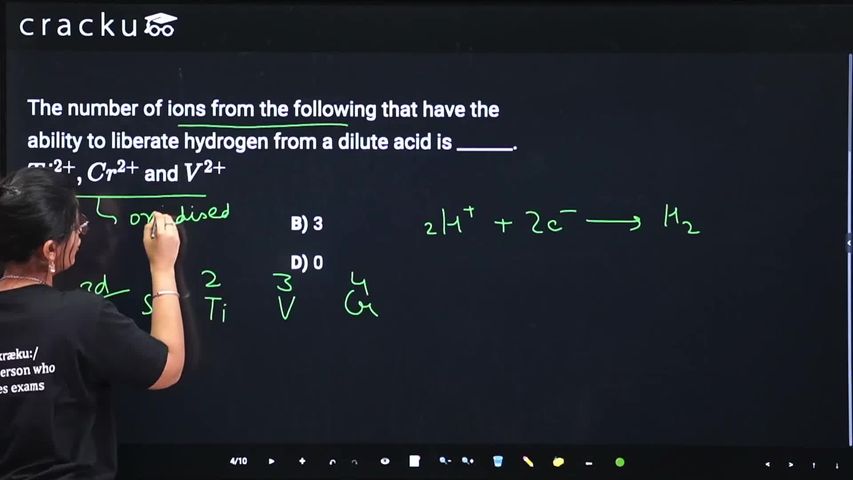
The number of ions from the following that have the ability to liberate hydrogen from a dilute acid is ______. $$Ti^{2+}, Cr^{2+}$$ and $$V^{2+}$$
We need to determine how many of the ions $$Ti^{2+}$$, $$Cr^{2+}$$, and $$V^{2+}$$ can liberate hydrogen from dilute acid.
Key concept: An ion can liberate hydrogen from dilute acid if it can be further oxidized, i.e., if it has a higher oxidation state available and the corresponding reduction potential is sufficiently negative (the ion acts as a reducing agent).
For an ion $$M^{2+}$$ to liberate $$H_2$$ from acid, the $$M^{3+}/M^{2+}$$ couple must have a reduction potential less than 0 V (so $$M^{2+}$$ can reduce $$H^+$$ to $$H_2$$ while being oxidized to $$M^{3+}$$).
$$Ti^{2+}$$: $$E^0(Ti^{3+}/Ti^{2+}) = -0.37$$ V. Since this is negative, $$Ti^{2+}$$ can reduce $$H^+$$ to $$H_2$$. $$Ti^{2+}$$ is a strong reducing agent.
V$$^{2+}$$: $$E^0(V^{3+}/V^{2+}) = -0.26$$ V. Since this is negative, $$V^{2+}$$ can reduce $$H^+$$ to $$H_2$$.
Cr$$^{2+}$$: $$E^0(Cr^{3+}/Cr^{2+}) = -0.41$$ V. Since this is negative, $$Cr^{2+}$$ can reduce $$H^+$$ to $$H_2$$.
All three ions — $$Ti^{2+}$$, $$Cr^{2+}$$, and $$V^{2+}$$ — have the ability to liberate hydrogen from dilute acid because their $$M^{3+}/M^{2+}$$ reduction potentials are all negative.
The correct answer is Option (2): 3.
Was this solution helpful?
Click on the Email ☝️ to Watch the Video Solution
Create a FREE account and get:
_1.webp)

Educational materials for JEE preparation

Ask our AI anything

AI can make mistakes. Please verify important information.
AI can make mistakes. Please verify important information.
