
Join Our JEE Preparation Group
Prep with like-minded aspirants; Get access to free daily tests and study material.
Sign in
Please select an account to continue using cracku.in
↓ →
Join Our JEE Preparation Group
Prep with like-minded aspirants; Get access to free daily tests and study material.
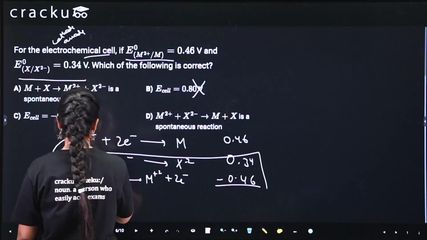
For the electrochemical cell, if $$E^0_{(M^{2+}/M)} = 0.46$$ V and $$E^0_{(X/X^{2-})} = 0.34$$ V. Which of the following is correct?
The standard reduction potentials are $$E^0_{(M^{2+}/M)} = 0.46$$ V for the half-reaction M^{2+} + 2e^- → M and $$E^0_{(X/X^{2-})} = 0.34$$ V for X + 2e^- → X^{2-}.
Considering the reaction $$M + X \rightarrow M^{2+} + X^{2-}$$, M is oxidized at the anode and X is reduced at the cathode. The cell potential is given by $$ E^0_{cell} = E^0_{cathode} - E^0_{anode} = E^0_{(X/X^{2-})} - E^0_{(M^{2+}/M)}, $$ which yields $$ E^0_{cell} = 0.34 - 0.46 = -0.12 \text{ V}. $$ Since this value is negative, the reaction is not spontaneous and option 1 is incorrect.
Next, for the reaction $$M^{2+} + X^{2-} \rightarrow M + X$$, M^{2+} is reduced at the cathode and X^{2-} is oxidized at the anode. The cell potential is $$ E^0_{cell} = E^0_{cathode} - E^0_{anode} = E^0_{(M^{2+}/M)} - E^0_{(X/X^{2-})}, $$ which gives $$ E^0_{cell} = 0.46 - 0.34 = 0.12 \text{ V}. $$ Because this value is positive, the reaction is spontaneous, confirming that option 4 is correct.
The potentials for options 2 and 3 would be ±0.80 V, which do not match ±0.12 V, so both are incorrect.
Therefore, the spontaneous reaction among the choices is $$M^{2+} + X^{2-} \rightarrow M + X$$ (option 4).
Was this solution helpful?
Click on the Email ☝️ to Watch the Video Solution
Create a FREE account and get:
_1.webp)

Educational materials for JEE preparation

Ask our AI anything

AI can make mistakes. Please verify important information.
AI can make mistakes. Please verify important information.
