
Join Our JEE Preparation Group
Prep with like-minded aspirants; Get access to free daily tests and study material.
Sign in
Please select an account to continue using cracku.in
↓ →
Join Our JEE Preparation Group
Prep with like-minded aspirants; Get access to free daily tests and study material.
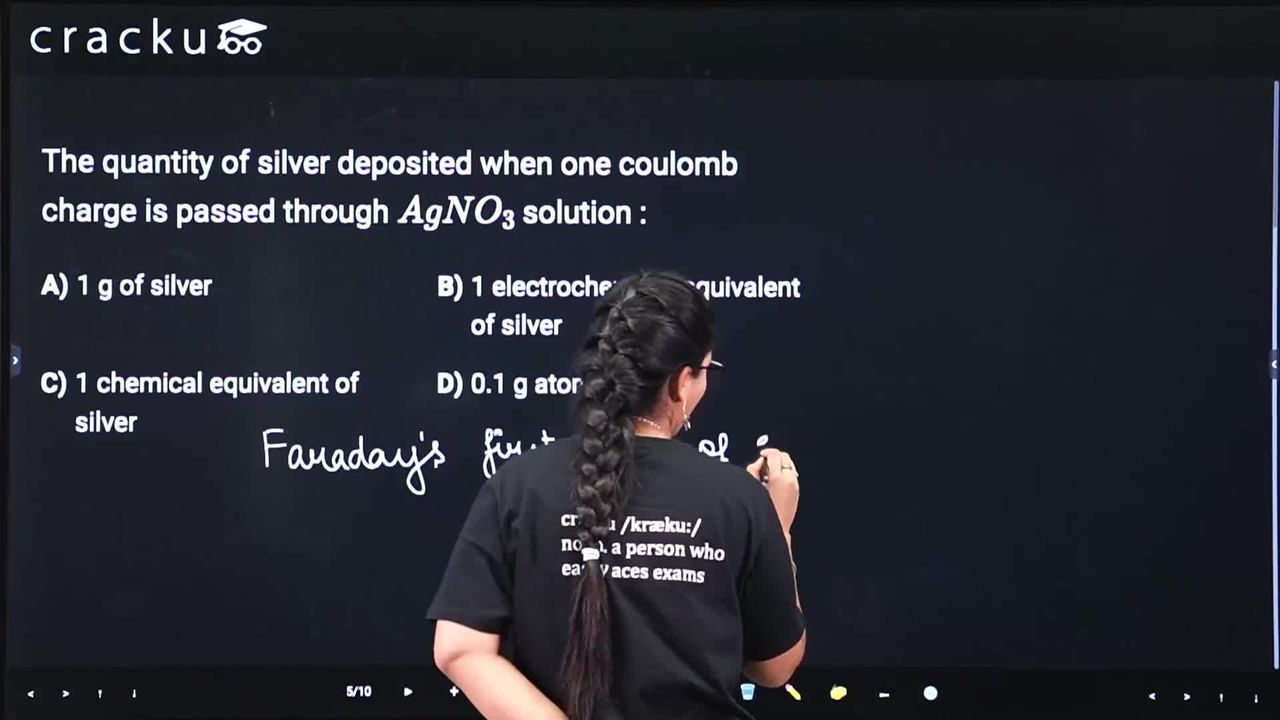
The quantity of silver deposited when one coulomb charge is passed through $$AgNO_3$$ solution :
We need to determine what quantity of silver is deposited when 1 coulomb of charge is passed through $$AgNO_3$$ solution. According to Faraday’s First Law of Electrolysis, the mass of a substance deposited at an electrode is directly proportional to the quantity of charge passed.
The mass deposited (m) is related to the charge (Q) by
$$ m = Z \times Q $$
where $$Z$$ is the electrochemical equivalent and $$Q$$ is the charge in coulombs. The electrochemical equivalent $$Z$$ is defined as the mass of a substance deposited when 1 coulomb of charge is passed through the solution.
Substituting $$Q = 1$$ coulomb gives
$$ m = Z \times 1 = Z $$
Therefore, the quantity of silver deposited is one electrochemical equivalent of silver.
Was this solution helpful?
Click on the Email ☝️ to Watch the Video Solution
Create a FREE account and get:
_1.webp)

Educational materials for JEE preparation

Ask our AI anything

AI can make mistakes. Please verify important information.
AI can make mistakes. Please verify important information.
