We start by collecting all the numerical data given in the question.
Mass of the planet: $$M = 8 \times 10^{22}\,\text{kg}$$
Radius of the planet: $$R = 2 \times 10^{6}\,\text{m}$$
Height of the circular orbit above the surface: $$h = 20\,\text{km} = 20 \times 10^{3}\,\text{m} = 2.0 \times 10^{4}\,\text{m}$$
Universal gravitational constant: $$G = 6.67 \times 10^{-11}\,\text{N\,m}^2/\text{kg}^2$$
The distance of the spaceship from the centre of the planet is the orbital radius
$$r = R + h = 2 \times 10^{6}\,\text{m} + 2 \times 10^{4}\,\text{m} = 2.02 \times 10^{6}\,\text{m}.$$
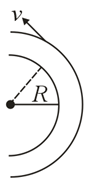
For a body in a circular orbit, the gravitational force supplies the required centripetal force. We write this fundamental equality explicitly:
$$\frac{G M m}{r^{2}} = \frac{m v^{2}}{r}.$$
Cancelling the common factor $$m$$ and one power of $$r$$, we obtain the orbital speed $$v$$:
$$v^{2} = \frac{G M}{r} \quad\Longrightarrow\quad v = \sqrt{\frac{G M}{r}}.$$
The time period $$T$$ of one revolution is the distance travelled in one orbit divided by the speed. The path length for one revolution is the circumference $$2\pi r$$, so
$$T = \frac{2\pi r}{v}.$$
Substituting the expression for $$v$$ that we just derived, we have
$$T = \frac{2\pi r}{\sqrt{\dfrac{G M}{r}}}
= 2\pi r \sqrt{\frac{r}{G M}}
= 2\pi \frac{r^{3/2}}{\sqrt{G M}}.$$
Now we evaluate each factor step by step.
First, compute $$r^{3}$$:
$$r = 2.02 \times 10^{6}\,\text{m},$$
$$r^{3} = (2.02 \times 10^{6})^{3}
= 2.02^{3} \times 10^{18}
= 8.244 \times 10^{18}\,\text{m}^{3}.$$
Taking the square root gives $$r^{3/2}$$:
$$r^{3/2} = \sqrt{r^{3}}
= \sqrt{8.244 \times 10^{18}}
= \sqrt{8.244}\,\times\,10^{9}
\approx 2.87 \times 10^{9}\,\text{m}^{3/2}.$$
Next, calculate $$G M$$:
$$G M = 6.67 \times 10^{-11}\,\text{N\,m}^{2}\!/\text{kg}^{2}\;
\times 8 \times 10^{22}\,\text{kg}
= 53.36 \times 10^{11}\,\text{m}^{3}\!/\text{s}^{2}
= 5.336 \times 10^{12}\,\text{m}^{3}\!/\text{s}^{2}.$$
We now need $$\sqrt{G M}$$:
$$\sqrt{G M} = \sqrt{5.336 \times 10^{12}}
= \sqrt{5.336}\,\times\,10^{6}
\approx 2.309 \times 10^{6}\,\text{m}^{3/2}\!/\text{s}.$$
With these two intermediate results, we substitute back into the formula for the period:
$$T = 2\pi\,\frac{r^{3/2}}{\sqrt{G M}}
= 2\pi\,\frac{2.87 \times 10^{9}}{2.309 \times 10^{6}}
= 2\pi\,\times\,1.243 \times 10^{3}
= 6.2832 \times 1.243 \times 10^{3}
\approx 7.81 \times 10^{3}\,\text{s}.$$
Thus one revolution takes approximately
$$T \approx 7.81 \times 10^{3}\,\text{s}
= 7810\,\text{s}.$$
We convert this period into hours for convenience:
$$1\,\text{hour} = 3600\,\text{s},\quad
T = \frac{7810}{3600}\,\text{h}
\approx 2.17\,\text{h}.$$
The spaceship completes one revolution in about 2.17 hours. The total time we are interested in is 24 hours, so the number of complete revolutions $$N$$ is
$$N = \frac{24\,\text{h}}{2.17\,\text{h}}
\approx 11.06.$$
Since only whole (complete) revolutions count, the spaceship makes 11 complete orbits in 24 hours.
Hence, the correct answer is Option D.