91- 6303239042
The resultant of two equal forces P making an angle $$\theta$$, is given by:
Sign in
Please select an account to continue using cracku.in
↓ →
The resultant of two equal forces P making an angle $$\theta$$, is given by:
A body weighs 98N on a spring balance on the north pole. The same body is shifted to the equator, the weight of the body at the equator on the same scale is: (Assume g = 9.8 m/sec$$^2$$ and radius of the earth = 6400 km)
Loading solution...
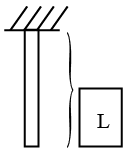
A uniform heavy rod of weight W, cross-sectional area A and length L and having Young’s Modulus E is hanging vertically from a fixed support. Neglecting lateral contraction, the elongation of the rod is given by:
Loading solution...
Two bars B1 and B2 of different materials and the same size are subjected to the same tensile force. If the bars have unit elongation in the ratio of 3:7 respectively, then the
ratio of modulus ofelasticity of the two bars B1 and B2 will be:
Loading solution...
The pressure at a point 6 m below the free surface of water is:
Loading solution...
A uniform body of 4 m long, 1 m wide and 1 m deep floats in water.If the depth of immersion is 0.6 m, then the weight of the body is:
Loading solution...
A jet of water discharging from a 6 cm diameter orifice has a diameter of 40 mm at its vena contracta. The coefficient of contraction is:
Loading solution...
A Pelton wheel develops 2000 kW under a head of 100 metres while running at 200 r.p.m. and discharging 3000 litres of water per second. The unit discharge of the wheel is:
Loading solution...
What Drag force is exerted at sea level by a 3.5m braking Parachute when the speed is 20 m/s $$C_d = 1.20$$ and this remains constant, $$\rho$$(sea level) = 1.225 kg/m$$^3$$
Loading solution...
To convert volumetric analysis to gravimetric analysis, the relative volume of each constituent of the flue gases is:
Loading solution...
A perfect gas at $$27^\circ C$$ is heated at constant pressure till its volume is double. The final temperature is:
Loading solution...
$$1 m^3$$ of air at a pressure of $$10 kg/cm^2$$ is allowed to expand freely to a volume of $$10 m^3$$. The work done will be:
Loading solution...
One reversible heat engine operates between 1400 K and $$T_2K$$ and another reversible heat engine operates between T2K and 600 K. If both the engines have the same heat input and output, then temperature $$T_2$$ is equal to:
Loading solution...
Carnot cycle consists of:
Loading solution...
The operating temperature of a cold storage is $$-4^\circ C$$. The heat leakage from the surrounding is 30 kW for the ambient temperature of $$35^\circ C$$. The actual C.O.P. of refrigeration plant used is one-fifth that of ideal plant working between the same temperatures. The power required to drive the plant is:
Loading solution...
The essential constituent of a hardened steel is:
Loading solution...
In a vibrating system, if the actual damping coefficient is 50 N/m/s and critical damping coefficient is 500 N/m/s, then logarithmic decrement is equal to:
Loading solution...
A block of mass 1.2 kg moving at a speed of 20 cm/s collides head on with a similar block | keptat rest, the coefficient of restitution is 3/5, the loss of kinetic energy during the collision is:
Loading solution...
Stage efficiency of a turbine is equal to:
Loading solution...
A pendulum bob has a speed of 3 m/s while passing throughits lowest position, the speed of the bob when it makes an angle of $$60^\circ$$ with the vertical is: (Assume g = 10 m/sec$$^2$$ and Length of pendulum is 0.5 m):
Loading solution...
Ina thin cylindrical shell subjected to an internal pressure p, the ratio of longitudinal stress to the hoop stress is:
Loading solution...
A hot plate transfers heat with a heat flux of 8000 W/m$$^2$$ into the ambientair at $$25^\circ C$$. if the surface of the hot plate is maintained at $$125^\circ C$$, calculate the heat transfer coefficient for the convection between the plate and the air:
Loading solution...
Water at $$50^\circ C$$ flows over a hot plate maintained at temperature $$150^\circ C$$. The plate has a width of 50 cm and length of 100 cm. If the heat transfer coefficient between the water and the plate is 2100 W/m?-K, the thermal resistance of convection is:
Loading solution...
An Aluminum sphere dipped into water at 10 degree centigrade, if temperature is increased, the force of bouncy will:
Loading solution...
According to Lami’s theorem:
Loading solution...
When a body of mass momentofinertia I (about a given axis) is rotated aboutthat axis with an angular velocity $$\omega$$, then the kinetic energy of rotation is:
Loading solution...
In a boiler, feed water supplied per hour is 225 kg while coal fired per hour is 25 kg. The net enthalpy rise per kg of water is 150 kJ. lf the calorific value of the coal is 2050 kJ/kg, then the boiler efficiency will be
Loading solution...
The metacentric height of a ship is 0.5 m and the radius of gyration is 6 m. The time of rolling of a ship is:
Loading solution...
For an irrotational flow the equation $$\frac{\partial^2 \phi}{\partial x^2} + \frac{\partial^2 \phi}{\partial y^2}$$ is known as,
Loading solution...
A Pelton Wheel develops 2500 kW under a head of 150 metres while running at 200 r.p.m. and discharging 200litres of water per second. The unit power of the wheel is:
Loading solution...
An Iron rod and a Copper rod lies side by side, as the temperature is changed, the difference in the length of the rods remains constant value of 10 cm. The lengths of Iron and Copper rods at zero degree centigrade shall be ---------- . (coefficient of Linear expansion of lron = $$1.1 \times 10^{-5}$$ per degree centigrade and coefficient of Linear expansion of
$$Cu = 1.7 \times 10^{-5}$$ per degree centigrade)
Loading solution...
The specific speed of a turbine is given by the equation:
Loading solution...
A furnace is made of a red brick wall of thickness 0.6 m and conductivity 0.8 W/m K. For the same heat loss and temperature drop, this can be replaced by diatomite earth of
conductivity 0.16 W/m K_ and thickness of --------
Loading solution...
An elevator weighing 500 kgis to be lifted up at a constant velocity of 0.20 m/s. The minimum horse power of the motor is: (assume $$g = 9.8 m/sec^2$$)
Loading solution...
An electric cable of aluminium conductor (k = 230 W/mk) is to be insulated with rubber (k = 0.18W/m K).The cable is to be located in air (h = 6 W/m$$^2$$ ).The critical thickness of insulation will be:
Loading solution...
A hotfluid enters the counter flow heat exchanger at $$120^\circ C$$ and leaves at $$80^\circ C$$. A cold fluid enters the heat exchanger at $$60^\circ C$$. The mean temperature difference between the two fluids is (Assume the values of fluid flow rates and specific heats in such a manner that the heat capacities of the two fluids are equal)
Loading solution...
In a psychrometric process, the sensible heat added is 40 kJ/s and the latent heat added is 30 kJ/s. The sensible heat factor for the process will be:
Loading solution...
When two refrigerants are mixed in the proper proportions, the mixture forms a third refrigerant called:
Loading solution...
A fixed gear having 300 teeth is in mesh with another gear having 60 teeth. The two gears are connected by an arm. The numbersof turns made by the smaller gear for one )
revolution of arm about the centre of bigger gear is:
Loading solution...
Nusselt numberis the ratio of
Loading solution...
A composite slab has twolayers of different materials with thermal conductivities $$k_1$$ and $$k_2$$. If each layer has the same thickness , then the equivalent thermal conductivity of the slab will be
Loading solution...
The period of the function $$\cos 3x + \sin 6x$$ is:
Loading solution...
If $$Y = \frac{(2^x - 1)}{x^{\frac{1}{2}}}$$ then $$\lim_{x \rightarrow 0} Y$$ is:
Loading solution...
Degree and Order of the following differential equation are:
$$\sqrt{\left\{\left[1 + \left(\frac{dy}{dx}\right)^2\right]^3\right\}} = \left[\frac{d^2y}{dx^2}\right]$$
Loading solution...
The straight line perpendicular to the line $$-2x + 3y + 4 = 0$$ is:
Loading solution...
The maximum value of $$f(x) = \frac{(\log x)}{(x)}$$ is $$\frac{1}{e}$$ at:
Loading solution...
If $$y = \sec^{-1} \left[\frac{(x + 1)}{(x - 1)}\right] + \sin^{-1} \left[\frac{(x - 1)}{(x + 1)}\right]$$ then $$\left(\frac{dy}{dx}\right)$$ is equal to:
Loading solution...
A small disc shaped earth Satellite, 1 m in diameter circles the earth at a distance of 300 km from the surface. The flat surface of the disc (with emissivity 0.3 and temperature (-) $$18^\circ C$$ is oriented tangential to the earth’s surface with view factor of 0.91. Average Earth temperature is $$~ 27^\circ C$$ while surrounding of satellite is 0 K. Net rate at which energy is leaving satellite is
Loading solution...
Consider the following two processes:
(A). A heat source at 1200K loses 2500kJ of heat to sink at 800K
(B). A heat source at 800K loses 2000k) of heat to sink at SOOK
Which of the following statements is TRUE?
Loading solution...
A fin has omm diameter and 100mm length. The thermal conductivity of fin material is 400 W m$$^{-1}$$ K$$^{-1}$$. One end of the fin is maintained at $$130^\circ C$$ and its remaining surface is exposed to ambient air at $$30^\circ C$$. if the convective heat transfer coefficient is 40 Wm$$^{-2}$$K$$^{-1}$$ the heat loss (in W) from the fin is
Loading solution...
A solar energy based heat engine which receives 80 kJ of heat at 100 deg Cand rejects 70 kJ of heat to the ambient at 30 deg Cis to be designed. The thermal efficiency of the heat engine is
Loading solution...
The temperature variation under steady heat conduction across a composite slab of two materials with thermal conductivities K1 and K2 is shown in Figure. Then, which one of the following statements holds?

Loading solution...
What is the value of the view factor for two inclined flats having common edge of equal width, and with an angle of 20 degrees?
Loading solution...
A 2 kW, 40 litre water heater is switched on for 20 minutes. The heat capacity $$C_p$$ for water is 4.2 kJ/kg-K. Assuming all the electrical energy has gone into heating the water, increase of the water temperature in degree centigrade is
Loading solution...
Heat is being transferred by convection from water at $$48^\circ C$$ to a glass plate whose surface that is exposed to the water is at 40°C. The thermal conductivity of water is 0.6 W/m-K and the thermal conductivity of glass is 1.2 W/m-K. The spatial gradient of temperature in the water at the water-glass interface is $$\frac{dT}{dy} = 1 \times 10^4 k/m$$

The value of the temperature gradient in the glass at the water-glass interface in K/m is:
Loading solution...
A p-v diagram has been obtained from a test on a reciprocating compressor. Which of the following represents that diagram?
Loading solution...
A small copper ball of 5 mm diameter at 500 K is dropped into an oil bath whose temperature is 300 K. the thermal conductivity of copper is 400 W/m-K, its density 9000 kg/m$$^3$$ and its specific heat 385 J/kg-K, if the heat transfer coefficient is 250 W/m$$^2$$-K and lumped analysis is assumedto be valid, the rate of fall of the temperature of the ball at
the beginning of cooling will be, in K/s,
Loading solution...
A Carnot cycle operates between the temperatures limits of 300 K and 2000 K, and produces 600 kW of net power. The rate of entropy change of the working fluid during the heat addition process is:
Loading solution...
Hot oil is cooled from 80 to $$50^\circ C$$ in an oil cooler which usesair as the coolant. The air temperature rises from 30 to $$40^\circ C$$. The designer uses a LMTD value of $$26^\circ C$$. The type of heat exchanger is
Loading solution...
Two bodies A and B having equal surface areas are maintained at 100 and 200. The thermal radiation emitted in a given time by A and B arein the ratio:
Loading solution...
Find the mass of the water vapour per cubic metre of air at temperature 300K and relative humidity 50%. The saturation vapour pressure at 300K is 3.6 kPa and gas constant R = 8.3 $$JK^{-1} mol^{-1}$$
Loading solution...
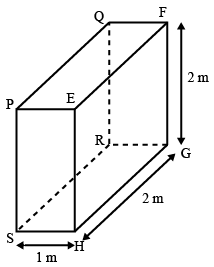
For the three dimensional object shown in figure below, five faces are insulated. The sixth face (PQRS), which is not insulated, interacts thermally with the ambient, with a convective heat transfer coefficient of 10 W/m$$^2$$-K. The ambient temperature is $$30^\circ C$$. Heat is uniformly generated inside the object at the rate of 100 W/m$$^3$$. Assuming the face PQRS to be at uniform temperature, its steady state temperature is
Loading solution...
Two walls of thicknesses $$d_1$$ and $$d_2$$ and thermal conductivities $$k_1$$ and $$k_2$$ are in contact. In the steady state, if the temperaturesat the outer surfaces are $$T_1$$ and $$T_2$$ the temperature at the common wall is
Loading solution...
A Carnotcycle refrigerator operates between 250 K and 300 K. Its coefficient of performance (C.O.P.) is:
Loading solution...
A 3 m$$^3$$ rigid tank contains nitrogen gas at 500 kPa and 300 K. Now heatis transferred to the nitrogen in the tank and the pressure of nitrogen rises to 800 kPa. The work done during this process is
Loading solution...
A solid cylinder (surface 2) is located at the centre of a hollow sphere (surface 1). The diameter of the sphere is 1m, while the cylinder has a diameter and length of 0.5 m each. The radiation configuration factor F11 is
Loading solution...
One kilogram of water at room temperature is broughtinto contact with a high temperature thermal reservoir. The entropy change of the universe is
Loading solution...
For specified limits for the maximum and minimum temperatures, the ideal cycle with the lowest thermal efficiency is:
Loading solution...
A refrigerator removes heat from a refrigerated space at $$-5^\circ C$$ atarate of 0.35 kJ/s and rejects it to an environment at $$20^\circ C$$. The minimum required power input is:
Loading solution...
A heat pump is absorbing heat from the cold outdoors at $$5^\circ C$$ and supplying heat to a house at $$22^\circ C$$ at a rate of 18,000 kJ/h. If the power consumed by the heat pump is 2.5 kW, the coefficient of performance (COP) of the heat pump is :
Loading solution...
If the inner and outer walls of a hollow sphere having surface areas of $$A_1$$ and $$A_2$$ and inner and outer radii $$r_1$$ and $$r_2$$ are Maintained at temperatures $$t_1$$ and $$t_2$$, then rate of heat flow will be
Loading solution...
Water is boiled at 1 atm pressure in a coffee maker equipped with an immersion-type electric heating element. The coffee maker initially contains 1 kg of water. Once boiling j
started, it is observed that half of the water in the coffee maker evaporated in 18 minutes. If the heat loss from the coffee maker is negligible, the power rating of the heating element is
Loading solution...
Ductility of steel is reduced by
Loading solution...
Machining of cast iron material is mostly performed
Loading solution...
Asine bar is used for the accurate measurement of
Loading solution...
The process used to improve fatigue resistance of the metal by setting up compressive stresses in its surface, is known as
Loading solution...
The instrument which has all the features of try-square, bevel protractor, rule and scriber is
Loading solution...
Vector C is perpendicular to vectors A and B both, then:
Loading solution...
An unbiased dice is tossed twice. Find the Probability of getting 4,5 or 6 on the first toss and a 1,2,3 or 4 on the second toss
Loading solution...
For the given characteristic matrix [A], determinethe Eigen Values :-
$$A = \begin{bmatrix}4 & 1 \\1 & 4 \end{bmatrix}$$
Loading solution...
Start your IIM journey with the right preparation and crack CAT 2026.

Educational materials for CAT preparation