- Efficiency * Total time taken = Total work
Assume the total work to be 1 unit.
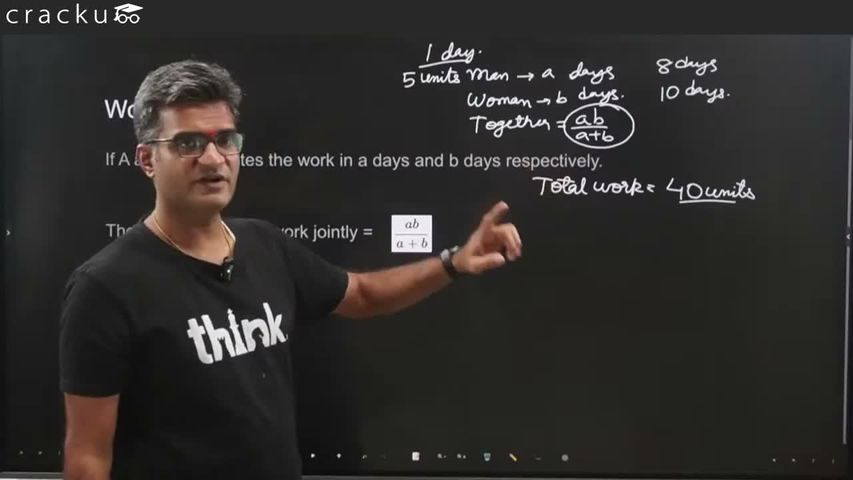
If X can do the work in 'n' days, the fraction of work(efficiency) X does in a day is $$\frac{1}{n}$$ units/day. - If X can do the work in 'x' days, and Y can do the work in 'y' days, the number of days taken by both of them together to do the work is $$\frac{x*y}{x+y}$$
- If $$A_1$$ men can do $$B_1$$ work in $$C_1$$ days and $$A_2$$ men can do $$B_2$$ work in $$C_2$$ days, then $$\frac{A_1 C_1}{B_1}$$ =$$\frac{A_2 C_2}{B_2}$$
Note:
To simplify calculations, we try to get efficiencies as integers. We assume the total work to be some integral multiple of the total time taken.
Example: If X can do a work in 15 days and Y can do it in 12 days. Find the total days required to complete the work if X and Y both are working together.
Sol. We assume the work to be LCM(15,12)=60 units to get the efficiencies of both X and Y in integers.
Efficiency of X$$=\dfrac{60}{15}=4$$ units/day.
Efficiency of Y$$=\dfrac{60}{12}=5$$ units/day.
So, when they work together the efficiencies would add up$$=4+5=9$$units/day.
Let the time required to complete the work by X and Y together$$=a$$.
So, $$9a=60$$. $$a=\dfrac{60}{9}$$ days.
Work - Efficiency
Very ImportantFormula Video
Question 1
A, B, C and D complete a job in 2, 4, 6 and 8 days respectively. They are divided into two groups and each group completes the task in X and Y days respectively (X>Y). What is the minimum possible value of X/Y?
Solution
1/A = 1/2 1/B = 1/4 1/C = 1/6 1/D = 1/8
The sum of all four together is 25/24 . It should be divided into two groups which are as close to each other as possible.
This happens when A is alone in the first group and takes 2 days to complete and B, C and D are in the second group and take 24/13 days to complete. Hence, the ratio of X:Y is 13:12
Question 2
A can complete a piece of work in 4 days. B takes double the time taken by A, C takes double that of B, and D takes double that of C to complete the same task. They are paired in groups of two each. One pair takes two-thirds the time needed by the second pair to complete the work. Which is the first pair?
Solution
A takes 4 days to complete the work.
So, B takes 8 days to complete the same work.
C takes 16 days to complete the work.
D takes 32 days to complete the same work.
In order to measure, let the total work be of 64 units. Hence, the speed of working of each of the four persons is given below.
A - 16 units/hr
B - 8 units/hr
C - 4 units/hr
D - 2 units/hr
From the given options, we need to find two pairs in such a way that their speeds are in the ratio 3:2. Note that A+D=18 while B+C=12 and the ratio is 3:2
Hence, the first pair is A and D and the second pair is B and C
Question 3
There’s a lot of work in preparing a birthday dinner. Even after the turkey is in the oven, there’s still the potatoes and gravy, yams, salad, and cranberries, not to mention setting the table.
Three friends — Asit, Arnold and Afzal — work together to get all of these chores done. The time it takes them to do the work together is 6 hr less than Asit would have taken working alone, 1 hr less than Arnold would have taken alone, and half the time Afzal would have taken working alone. How long did it take them to do these chores working together?
Solution
Let the time taken working together be t.
Time taken by Arnold = t+1
Time taken by Asit = t+6
Time taken by Afzal = 2t
Work done by each person in one day = $$\frac{1}{(t+1)}+\frac{1}{(t+6)}+\frac{1}{2t}$$
Total portion of workdone in one day $$=\frac{1}{t}$$
$$\frac{1}{(t+1)}+\frac{1}{(t+6)}+\frac{1}{2t}=\frac{1}{t}$$
$$\frac{1}{(t+1)}+\frac{1}{(t+6)}=\frac{2-1}{2t}$$
$$2t+7=\frac{(t+1)\cdot(t+6)}{2t}$$
$$3t^2-7t+6=0 \longrightarrow\ t=\frac{2}{3} $$or $$t=-3$$
Therefore total time = $$\frac{2}{3}$$hours = 40mins
Alternatively,
$$\frac{1}{(t+1)}+\frac{1}{(t+6)}+\frac{1}{2t}=\frac{1}{t}$$
From the options, if time $$= 40$$ min, that is, $$t = \frac{2}{3}$$
LHS = $$\frac{3}{5} + \frac{3}{20} + \frac{3}{4} = \frac{(12+3+15)}{20} = \frac{30}{20} = \frac{3}{2}$$
RHS = $$\frac{1}{t}=\frac{3}{2}$$
The equation is satisfied only in case of option C
Hence, C is correct
Log in to view all questions
Login| Name | Date Taken | Score | Status |
|---|---|---|---|
| Formula Test 1 | NA | NA | |
| Formula Test 2 | NA | NA | |
| Formula Test 3 | NA | NA | |
| Formula Test 4 | NA | NA | |
| Formula Test 5 | NA | NA | |
| Formula Test 6 | NA | NA | |
| Formula Test 7 | NA | NA | |
| Formula Test 8 | NA | NA | |
| Formula Test 9 | NA | NA | |
| Formula Test 10 | NA | NA | |
| Formula Test 11 | NA | NA | |
| Formula Test 12 | NA | NA | |
| Formula Test 13 | NA | NA | |
| Formula Test 14 | NA | NA | |
| Formula Test 15 | NA | NA | |
| Formula Test 16 | NA | NA | |
| Formula Test 17 | NA | NA | |
| Formula Test 18 | NA | NA | |
| Formula Test 19 | NA | NA | |
| Formula Test 20 | NA | NA | |
| Formula Test 21 | NA | NA | |
| Formula Test 22 | NA | NA | |
| Formula Test 23 | NA | NA |
Formula Test 1
Not attempted
Formula Test 2
Not attempted
Formula Test 3
Not attempted
Formula Test 4
Not attempted
Formula Test 5
Not attempted
Formula Test 6
Not attempted
Formula Test 7
Not attempted
Formula Test 8
Not attempted
Formula Test 9
Not attempted
Formula Test 10
Not attempted
Formula Test 11
Not attempted
Formula Test 12
Not attempted
Formula Test 13
Not attempted
Formula Test 14
Not attempted
Formula Test 15
Not attempted
Formula Test 16
Not attempted
Formula Test 17
Not attempted
Formula Test 18
Not attempted
Formula Test 19
Not attempted
Formula Test 20
Not attempted
Formula Test 21
Not attempted
Formula Test 22
Not attempted
Formula Test 23
Not attempted
Previous Year Stats
Work - Efficiency
17
questions from CAT exam over the past 5 years