CAT WhatsApp Group



Since the CAT exam is held in multiple slots with different question papers, the difficulty level can vary. To ensure no candidate is unfairly penalized or benefited by the slot they received, the IIM colleges use a process called Normalization or Scaling.
This blog post breaks down the complex process of CAT scaling into simple, understandable steps, explaining the core formulas and how they translate your Raw Score into the Scaled Score and ultimately, your Percentile.
CAT Raw Score vs. Scaled Score: The Essential Difference
Before scaling begins, you must understand the two main types of scores:
- Raw Score: This is your actual, absolute score based directly on the answers you marked. For every correct answer, you get +3 marks, and for every incorrect Multiple-Choice Question (MCQ), you get -1 mark. TITA (Type-In-The-Answer) questions have no negative marking.
- Scaled Score: This is your normalized score. It is the result of applying a statistical formula to your raw score, adjusting it based on the difficulty of your specific exam slot compared to all other slots. This is the score that actually appears on your CAT result.
The scaling process is done per section (Verbal Ability and Reading Comprehension - VARC, Data Interpretation and Logical Reasoning - DILR, and Quantitative Ability - QA) and individually for each exam slot.
For detailed explanation, Checkout the below video by Maruti Sir.
Also Read, CAT Answer Key
The Scaling Formula: A Linear Equation
At its core, the relationship between your Raw Score and Scaled Score within a single slot/section is linear. Think of it as a straight-line equation:

Where:
- Scaled Score is the final, adjusted score.
- Raw Score is the total mark you achieved in that section.
- K and K1 are Constants determined statistically for that specific section and slot.
Since K and K1 are the same for everyone who took that particular section in that particular slot, the only thing that changes is the individual Raw Score.
The Technical Scaling Formula Explained
The actual formula used by the examination body to calculate the Scaled Score (R̂) is more detailed, but it is still a form of the linear equation above. The goal is to standardize scores across different exam sessions.

Term | What it Represents | What it Measures |
R̂ | Scaled Score | Your final, adjusted score for the section. |
R | Raw Score | Your actual raw marks in the section. |
G1 | Slot-Specific Baseline | The Mean (average) plus the Standard Deviation (spread) of the Raw Scores of all candidates in your particular exam slot. |
G | Overall Baseline | The Mean (average) plus the Standard Deviation (spread) of the Raw Scores of all candidates across all exam slots. |
K | Scaling Constant | A constant that measures the difference in performance between the top 0.1% of candidates in your slot compared to the top 0.1% of candidates across all slots. |
The Core Idea: Comparing You to Your SlotThe term (R - G1) measures how much better or worse your raw score is compared to the average of your own slot.
- If your Raw Score (R) is close to the slot average (G1), then (R - G1) is close to zero, and the effect of scaling is minimal. Your Scaled Score (R̂) will be close to the Overall Average (G).
- If your Raw Score (R) is very high (or very low), meaning you are at the extremes, the term (R - G1) is large, and the effect of scaling is significant.
- The term K acts as a difficulty adjuster. It ensures that a high-performing score in a tougher slot gets a higher scaled score than the same raw score in an easier slot.
In simple terms, scaling asks: "How much better are you than the average person in your slot?"—and then adjusts that gap to be fair across all slots.

From Scaled Score to Percentile
Once the Scaled Score is determined for all three sections and the overall total, the final step is calculating the Percentile.
Your percentile is not a score; it's a rank. It tells you the percentage of candidates who scored equal to or less than you.
The formula for calculating the Percentile (P) for a given rank (r) among all test takers (N) is:
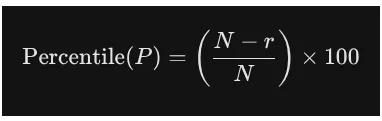
Where:
- N is the Total Number of Candidates who appeared in all slots.
- r is your Rank based on your Scaled Score among all N candidates.
For example, if you are ranked 3,000 out of 3,00,000 total test takers, your percentile is:

The percentile calculation is what ultimately determines your shortlisting eligibility for IIMs and other top B-schools.
Limited Estimates Makes CAT Score Calculator Accurate
For experts who create unofficial score calculators (like the one discussed in the video), the main challenge is to accurately estimate the constants (G1, G, and especially K).
- G1 and G (Mean and Standard Deviation): These are calculated by gathering a large number of response sheets (often tens of thousands). With a sufficient number of data points, these statistical values are highly accurate.
- K (The Scaling Constant): This requires estimating the performance of the top 0.1% of candidates in each slot. Since not all toppers upload their CAT response sheet, this involves a small, well-informed estimation of the ratio of toppers who uploaded their score to the total estimated toppers.
Because the process relies on statistical measures that are stable across large datasets and the estimation for K is minimized, the Scaled Score estimate is typically very accurate. The Percentile estimate is slightly more complex, as it relies on predicting the final total number of candidates and their rank distribution, which involves a larger estimate about the total test-taking population.
The CAT scaling process is a robust, fair, and transparent statistical method. While the formula may look complex, its core function is to ensure that your Scaled Score accurately reflects your performance relative to the competition in your specific exam slot, thereby eliminating any advantage or disadvantage due to variations in paper difficulty.
CAT Scaled Score and Normalisation Explained by Maruti Sir: Conclusion
CAT scaling and normalization make sure that every student is judged fairly, no matter which exam slot they wrote. Since each slot can have a different difficulty level, IIMs use a clear statistical method to convert your raw score into a scaled score. This method checks how you performed compared to others in your slot and then adjusts the score so that all slots become equal and fair.
Understanding how scaled scores and percentiles are calculated helps you get a better idea of your actual performance. When you know how averages, standard deviations, and the K constant work, it becomes easier to understand your estimated scores and percentile. In the end, CAT scaling ensures that your final result shows your true ability—not the difficulty of the paper you received.