
Join Our JEE Preparation Group
Prep with like-minded aspirants; Get access to free daily tests and study material.
Sign in
Please select an account to continue using cracku.in
↓ →
Join Our JEE Preparation Group
Prep with like-minded aspirants; Get access to free daily tests and study material.
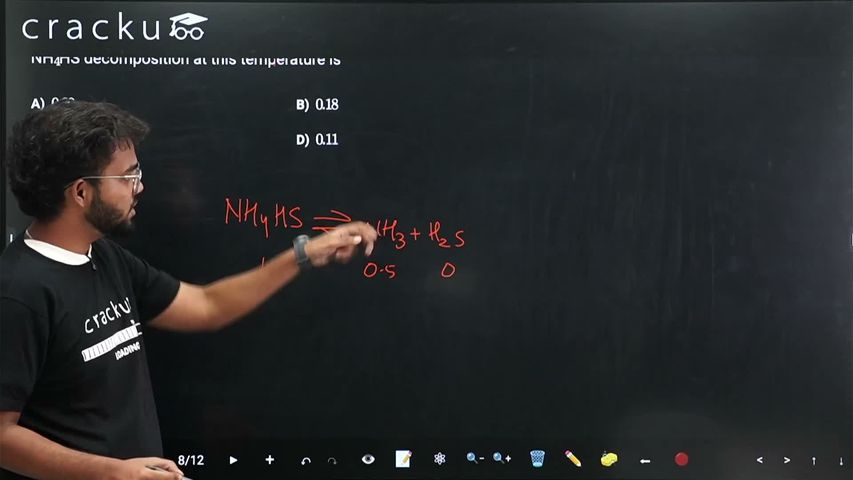
An amount of solid NH$$_4$$HS is placed in a flask already containing ammonia gas at a certain temperature and $$0.50$$ atm pressure. Ammonium hydrogen sulphide decomposes to yield NH$$_3$$ and H$$_2$$S gases in the flask. When the decomposition reaction reaches equilibrium, the total pressure in the flask rises to $$0.84$$ atm. The equilibrium constant for NH$$_4$$HS decomposition at this temperature is
The decomposition equilibrium is
$$NH_4HS(s)\; \rightleftharpoons \; NH_3(g) + H_2S(g)$$
Because the solid has unit activity, the equilibrium constant in pressure terms is
$$K_p = P_{NH_3}\, P_{H_2S}$$
Step 1 - Define the change in pressure.
Let $$x$$ atm be the pressure of each gas formed by decomposition.
Initial pressures: $$P_{NH_3}=0.50$$ atm, $$P_{H_2S}=0$$ atm.
At equilibrium:
$$P_{NH_3}=0.50 + x$$
$$P_{H_2S}=x$$
Step 2 - Use the total equilibrium pressure.
Given total pressure at equilibrium
$$P_{\text{total}} = 0.84\ \text{atm}$$
But
$$P_{\text{total}} = P_{NH_3}+P_{H_2S}= (0.50 + x) + x = 0.50 + 2x$$
Hence
$$0.50 + 2x = 0.84 \;\;\Longrightarrow\;\; 2x = 0.34 \;\;\Longrightarrow\;\; x = 0.17\ \text{atm}$$
Step 3 - Calculate individual partial pressures.
$$P_{NH_3}=0.50 + 0.17 = 0.67\ \text{atm}$$
$$P_{H_2S}=0.17\ \text{atm}$$
Step 4 - Compute the equilibrium constant.
$$K_p = P_{NH_3}\, P_{H_2S} = 0.67 \times 0.17 = 0.1139 \approx 0.11$$
Therefore, $$K_p \approx 0.11$$
Option D which is: $$0.11$$
Was this solution helpful?
Click on the Email ☝️ to Watch the Video Solution
Create a FREE account and get:
_1.webp)

Educational materials for JEE preparation

Ask our AI anything

AI can make mistakes. Please verify important information.
AI can make mistakes. Please verify important information.
