
Join Our JEE Preparation Group
Prep with like-minded aspirants; Get access to free daily tests and study material.
Sign in
Please select an account to continue using cracku.in
↓ →
Join Our JEE Preparation Group
Prep with like-minded aspirants; Get access to free daily tests and study material.
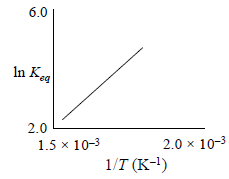
A schematic plot of $$\ln K_{eq}$$ versus inverse of temperature for a reaction is shown below. The reaction must be
The temperature-dependence of an equilibrium constant is governed by the van’t Hoff equation
$$\frac{d\ln K_{eq}}{d\left(1/T\right)} = -\frac{\Delta H^{\circ}}{R}\qquad -(1)$$
Here $$R$$ is the universal gas constant and $$\Delta H^{\circ}$$ is the standard enthalpy change of the reaction.
Equation $$(1)$$ shows that the slope of a plot of $$\ln K_{eq}$$ versus $$1/T$$ equals $$-\Delta H^{\circ}/R$$.
Interpretation of the slope:
• If the slope is positive $$(\;d\ln K_{eq}/d(1/T) \gt 0\;),$$ then $$-\Delta H^{\circ}/R \gt 0$$ which implies $$\Delta H^{\circ} \lt 0$$ (exothermic).
• If the slope is negative, $$\Delta H^{\circ} \gt 0$$ (endothermic).
• A slope nearly zero would correspond to $$\Delta H^{\circ} \approx 0$$.
The schematic plot in the question has an upward (positive) slope, so $$\ln K_{eq}$$ increases as $$1/T$$ increases (i.e., as temperature decreases). Consequently, $$\Delta H^{\circ}$$ must be negative.
Therefore, the reaction is exothermic.
Option A which is: exothermic
Was this solution helpful?
Create a FREE account and get:
_1.webp)

Educational materials for JEE preparation

Ask our AI anything

AI can make mistakes. Please verify important information.
AI can make mistakes. Please verify important information.
