
Join Our JEE Preparation Group
Prep with like-minded aspirants; Get access to free daily tests and study material.
Sign in
Please select an account to continue using cracku.in
↓ →
Join Our JEE Preparation Group
Prep with like-minded aspirants; Get access to free daily tests and study material.
Two masses $$m_1 = 5$$ kg and $$m_2 = 4.8$$ kg tied to a string are hanging over a light frictionless pulley. What is the acceleration of the masses when lift free to move $$(g = 9.8 \text{ m/s}^2)$$?
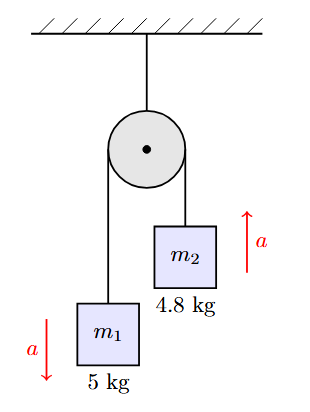
Let $$T$$ be the tension in the string and $$a$$ be the common acceleration of the system.
Since $$m_1 > m_2$$, the heavier mass $$m_1$$ will accelerate downwards, and the lighter mass $$m_2$$ will accelerate upwards.
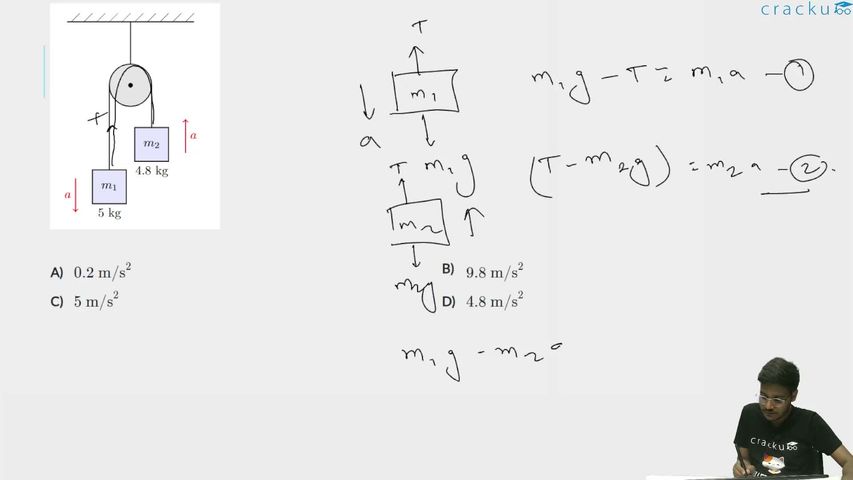
Applying Newton's Second Law ($$F_{net} = ma$$) to each mass, we get the following equations of motion:
For mass $$m_1$$ (accelerating downwards):
$$m_1 g - T = m_1 a \quad \text{--- (Equation 1)}$$
For mass $$m_2$$ (accelerating upwards):
$$T - m_2 g = m_2 a \quad \text{--- (Equation 2)}$$
To find the acceleration, we can add Equation 1 and Equation 2 to eliminate the tension variable $$T$$:
$$(m_1 g - T) + (T - m_2 g) = m_1 a + m_2 a$$
$$m_1 g - m_2 g = (m_1 + m_2) a$$
$$(m_1 - m_2) g = (m_1 + m_2) a$$
Now, rearrange the formula to solve for acceleration $$a$$:
$$a = \frac{m_1 - m_2}{m_1 + m_2} g$$
Substitute the given numerical values into the derived formula:
$$a = \frac{5 - 4.8}{5 + 4.8} \times 9.8$$
$$a = \frac{0.2}{9.8} \times 9.8$$
The $$9.8$$ in the numerator and denominator cancel out:
$$a = 0.2 \text{ m/s}^2$$
Was this solution helpful?
Click on the Email ☝️ to Watch the Video Solution
Create a FREE account and get:
_1.webp)

Educational materials for JEE preparation

Ask our AI anything

AI can make mistakes. Please verify important information.
AI can make mistakes. Please verify important information.
