
Join Our JEE Preparation Group
Prep with like-minded aspirants; Get access to free daily tests and study material.
Sign in
Please select an account to continue using cracku.in
↓ →
Join Our JEE Preparation Group
Prep with like-minded aspirants; Get access to free daily tests and study material.
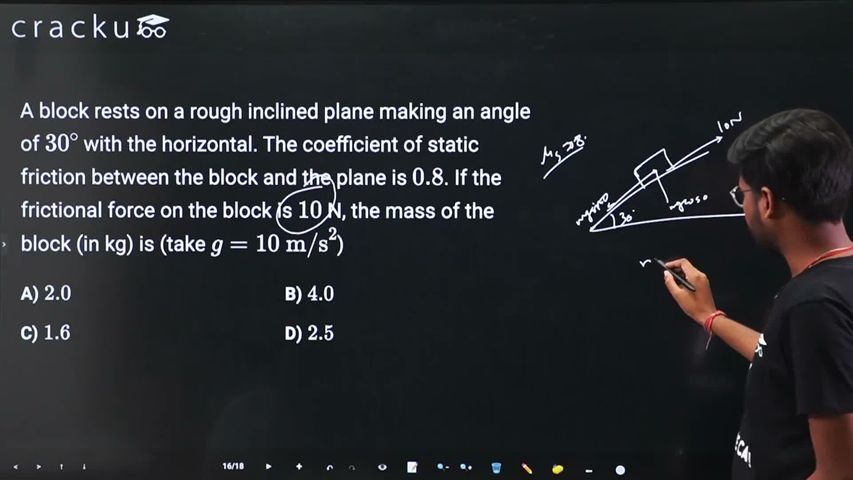
A block rests on a rough inclined plane making an angle of $$30^\circ$$ with the horizontal. The coefficient of static friction between the block and the plane is $$0.8$$. If the frictional force on the block is $$10$$ N, the mass of the block (in kg) is (take $$g = 10 \text{ m/s}^2$$)
When an object rests on an inclined surface, it experiences a downward gravitational force component parallel to the incline ($$mg \cdot \sin\theta$$). For the block to remain stationary ("rests"), a static friction force ($$f_s$$) must act upward along the incline to perfectly balance this component:
$$f_s = mg \cdot \sin\theta$$
Before using this equilibrium equation, we must verify whether the block is actually capable of remaining at rest by checking the maximum possible limit of static friction ($$f_{\text{max}} = \mu_s \cdot mg \cdot \cos\theta$$). The critical angle of repose ($$\theta_r$$) where sliding begins is given by:
$$\tan\theta_r = \mu_s = 0.8$$
$$\theta_r = \tan^{-1}(0.8) \approx 38.66^\circ$$
Since the actual angle of the incline ($$\theta = 30^\circ$$) is strictly less than the angle of repose ($$38.66^\circ$$), the block will not slide down. It remains completely stationary, and the static friction force acting on it is a self-adjusting force equal to the parallel component of gravity.
Equating the given static frictional force to the component of gravity pulling the block down the incline:
$$f_s = m \cdot g \cdot \sin\theta$$
We are given the following parameters from the problem statement:
Substituting these values into the equilibrium condition:
$$10 = m \cdot 10 \cdot \sin(30^\circ)$$
Since $$\sin(30^\circ) = \frac{1}{2}$$, substitute this into our equation:
$$10 = m \cdot 10 \cdot \left(\frac{1}{2}\right)$$
$$10 = m \cdot 5$$
Isolating the mass variable ($$m$$):
$$m = \frac{10}{5} = 2.0 \,\, \text{kg}$$
Concept Check: The coefficient of static friction ($$\mu_s = 0.8$$) represents the maximum threshold of grip available ($$f_{\text{max}} = 0.8 \cdot 2 \cdot 10 \cdot \cos 30^\circ \approx 13.86 \,\, \text{N}$$). Because the actual required keeping force ($$10 \,\, \text{N}$$) is lower than this maximum capability, the static friction perfectly limits itself to $$10 \,\, \text{N}$$ to keep the $$2.0 \,\, \text{kg}$$ mass from moving.
Correct Option Key: Option A ($$2.0$$)
Was this solution helpful?
Click on the Email ☝️ to Watch the Video Solution
Create a FREE account and get:
_1.webp)

Educational materials for JEE preparation

Ask our AI anything

AI can make mistakes. Please verify important information.
AI can make mistakes. Please verify important information.
