Sign in
Please select an account to continue using cracku.in
↓ →
 CAT WhatsApp Group
The passage below is accompanied by four questions. Based on the passage, choose the best answer for each question.
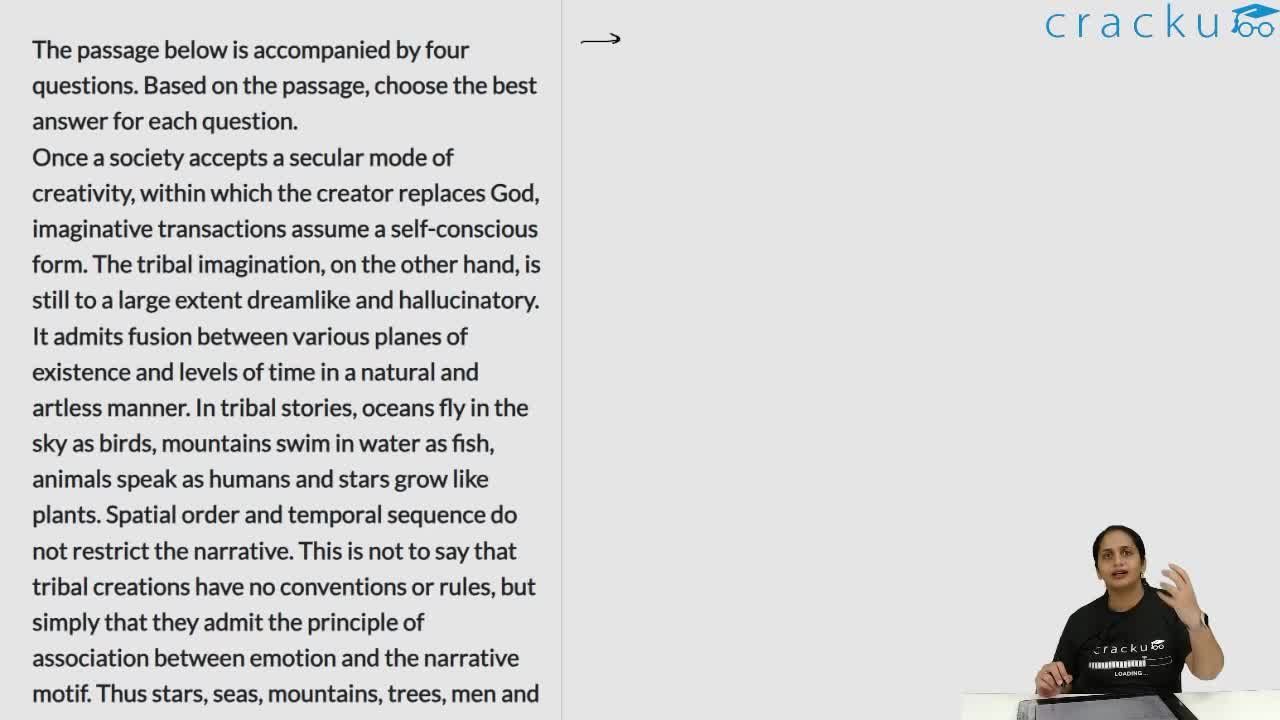
Once a society accepts a secular mode of creativity, within which the creator replaces God, imaginative transactions assume a self-conscious form. The tribal imagination, on the other hand, is still to a large extent dreamlike and hallucinatory. It admits fusion between various planes of existence and levels of time in a natural and artless manner. In tribal stories, oceans fly in the sky as birds, mountains swim in water as fish, animals speak as humans and stars grow like plants. Spatial order and temporal sequence do not restrict the narrative. This is not to say that tribal creations have no conventions or rules, but simply that they admit the principle of association between emotion and the narrative motif. Thus stars, seas, mountains, trees, men and animals can be angry, sad or happy.
It might be said that tribal artists work more on the basis of their racial and sensory memory than on the basis of a cultivated imagination. In order to understand this distinction, we must understand the difference between imagination and memory. In the animate world, consciousness meets two immediate material realities: space and time. We put meaning into space by perceiving it in terms of images. The image-making faculty is a genetic gift to the human mind—this power of imagination helps us understand the space that envelops us. With regard to time, we make connections with the help of memory; one remembers being the same person today as one was yesterday.
The tribal mind has a more acute sense of time than the sense of space. Somewhere along the history of human civilization, tribal communities seem to have realized that domination over territorial space was not their lot. Thus, they seem to have turned almost obsessively to gaining domination over time. This urge is substantiated in their ritual of conversing with their dead ancestors: year after year, tribals in many parts of India worship terracotta or carved-wood objects representing their ancestors, aspiring to enter a trance in which they can converse with the dead. Over the centuries, an amazingly sharp memory has helped tribals classify material and natural objects into a highly complex system of knowledge. . .
One of the main characteristics of the tribal arts is their distinct manner of constructing space and imagery, which might be described as 'hallucinatory'. In both oral and visual forms of representation, tribal artists seem to interpret verbal or pictorial space as demarcated by an extremely flexible 'frame'. The boundaries between art and non-art become almost invisible. A tribal epic can begin its narration from a trivial everyday event; tribal paintings merge with living space as if the two were one and the same. And within the narrative itself, or within the painted imagery, there is no deliberate attempt to follow a sequence. The episodes retold and the images created take on the apparently chaotic shapes of dreams. In a way, the syntax of language and the grammar of painting are the same, as if literature were painted words and painting were a song of images.
Non-human living forms exhibit human emotions in tribal narratives because tribal narratives:

The passage explains that tribal imagination naturally blends different planes of existence. It mentions that tribal stories “admit fusion between various planes of existence and levels of time in a natural and artless manner,” and that “stars, seas, mountains, trees, men and animals can be angry, sad or happy.” This means emotions are not limited to humans and can pass across boundaries between living forms. What explains non-human forms having human emotions is the acceptance of fluid boundaries between beings, time, and space. Hence, the correct answer is Option B.
Option A is not correct because the passage contrasts tribal imagination with secular creativity, which is described as “self-conscious.” Tribal stories are clearly not self-conscious. Option C is also wrong because the author says tribal creations do have conventions and rules. Option D is incorrect because the passage does not call tribal art undeveloped, but instead says it follows a different kind of imagination.
Click on the Email ☝️ to Watch the Video Solution
Create a FREE account and get:
Book Free CAT Mentorship
Get personalized CAT strategy from a 99%iler
500+ students mentored
OTP Verification
Enter the 6-digit code sent to your phone
Booking Summary
Enter OTP
Didn't receive the OTP?

Educational materials for CAT preparation

Ask our AI anything

AI can make mistakes. Please verify important information.
AI can make mistakes. Please verify important information.
 91- 6303239042