Sign in
Please select an account to continue using cracku.in
↓ →

Join Our JEE Preparation Group
Prep with like-minded aspirants; Get access to free daily tests and study material.
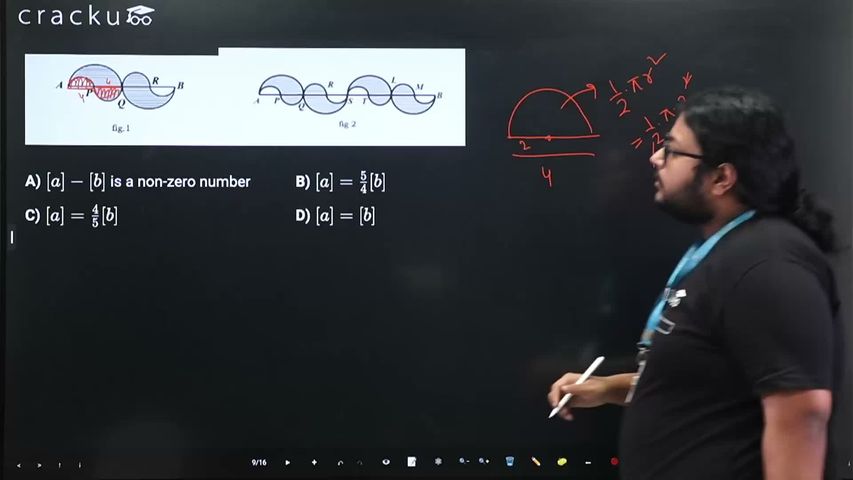
Consider the two figures shown here. $$AB=16\ \text{cm}$$ in both the figures. Points $$P,Q,R$$ divide $$AB$$ into equal lengths in figure $$1$$. Similarly, $$P,Q,R,S,T,L,M$$ divide $$AB$$ into equal lengths in figure $$2$$. All the curves are semicircles. If $$[a]$$ and $$[b]$$ are the areas of the shaded figures respectively in figure $$1$$ and figure $$2$$, then
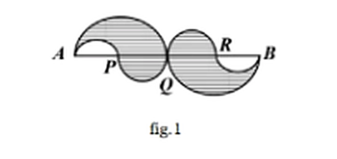
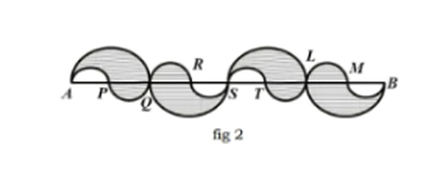
In figure $$1$$, the shaded parts combine to form one complete circle of radius $$4\ \text{cm}$$, so $$[a]=\pi(4)^2=16\pi$$. In figure $$2$$, they combine to form two complete circles of radius $$2\ \text{cm}$$, so $$[b]=2\pi(2)^2=8\pi$$. Thus $$[a]-[b]=8\pi$$, which is non-zero.
Was this solution helpful?
Click on the Email ☝️ to Watch the Video Solution
_1.webp)
Predict your JEE Main percentile, rank & performance in seconds

Educational materials for JEE preparation

Ask our AI anything

AI can make mistakes. Please verify important information.
AI can make mistakes. Please verify important information.
 91- 6303239042
