
Join Our JEE Preparation Group
Prep with like-minded aspirants; Get access to free daily tests and study material.
Sign in
Please select an account to continue using cracku.in
↓ →
Join Our JEE Preparation Group
Prep with like-minded aspirants; Get access to free daily tests and study material.
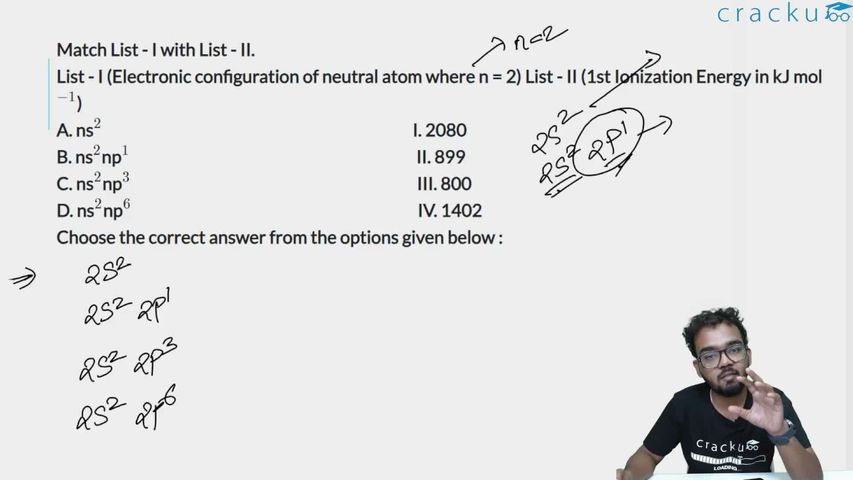
Match List - I with List - II.
List - I (Electronic configuration of neutral atom where n = 2) List - II (1st Ionization Energy in kJ mol$$^{-1}$$)
A. ns$$^2$$ I. 2080
B. ns$$^2$$np$$^1$$ II. 899
C. ns$$^2$$np$$^3$$ III. 800
D. ns$$^2$$np$$^6$$ IV. 1402
Choose the correct answer from the options given below :
As we move across a period from left to right in the periodic table, the first ionization energy generally increases due to an increase in effective nuclear charge and a decrease in atomic size.
Element given in List - I:
Using our periodic trends and stability rules, we can arrange these elements in increasing order of their first ionization energy:
$$\text{Boron (B)} < \text{Beryllium (Be)} < \text{Nitrogen (N)} < \text{Neon (Ne)}$$
A-II, B-III, C-IV, D-I (Option A)
Was this solution helpful?
Click on the Email ☝️ to Watch the Video Solution
_1.webp)

Educational materials for JEE preparation

Ask our AI anything

AI can make mistakes. Please verify important information.
AI can make mistakes. Please verify important information.