Sign in
Please select an account to continue using cracku.in
↓ →
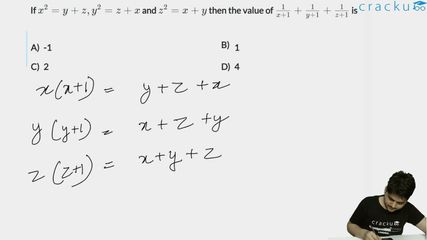
If $$x^2 = y + z , y^2 = z + x$$ and $$z^2 = x + y$$ then the value of $$\frac{1}{x + 1} + \frac{1}{y + 1} + \frac{1}{z + 1}$$ is
Given, $$x^2 = y + z$$
So, $$x^2+x=x+y+z$$
or, $$x\left(x+1\right)=x+y+z$$
or, $$\dfrac{1}{x+1}=\dfrac{x}{x+y+z}$$ --->(1)
Similarly, $$y^2 = x + z$$
Adding, $$y$$ to both sides,
$$y^2+y=y+x+z$$
or, $$y\left(y+1\right)=x+y+z$$
or, $$\dfrac{1}{y+1}=\dfrac{y}{x+y+z}$$ --->(2)
Similarly, $$z^2 = y + z$$
So, $$\dfrac{1}{z+1}=\dfrac{z}{x+y+z}$$ --->(3)
Now, adding (1), (2) and (3),
$$\dfrac{1}{x+1}+\dfrac{1}{y+1}+\dfrac{1}{z+1}=\dfrac{x}{x+y+z}+\dfrac{y}{x+y+z}+\dfrac{z}{x+y+z}=\dfrac{x+y+z}{x+y+z}=1$$
So, correct answer is option (B).
Click on the Email ☝️ to Watch the Video Solution
Create a FREE account and get:
Book Free CAT Mentorship
Get personalized CAT strategy from a 99%iler
500+ students mentored
OTP Verification
Enter the 6-digit code sent to your phone
Booking Summary
Enter OTP
Didn't receive the OTP?
Start your IIM journey with the right preparation and crack CAT 2026.

Educational materials for CAT preparation

Ask our AI anything

AI can make mistakes. Please verify important information.
AI can make mistakes. Please verify important information.
 91- 6303239042