
Join Our JEE Preparation Group
Prep with like-minded aspirants; Get access to free daily tests and study material.
Sign in
Please select an account to continue using cracku.in
↓ →
Join Our JEE Preparation Group
Prep with like-minded aspirants; Get access to free daily tests and study material.
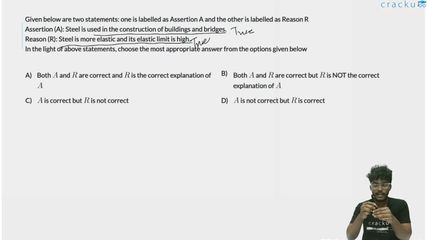
Given below are two statements: one is labelled as Assertion A and the other is labelled as Reason R
Assertion (A): Steel is used in the construction of buildings and bridges.
Reason (R): Steel is more elastic and its elastic limit is high.
In the light of above statements, choose the most appropriate answer from the options given below
Assertion (A): Steel is used in the construction of buildings and bridges.
Reason (R): Steel is more elastic and its elastic limit is high.
Analysis of Assertion (A):
Steel is indeed widely used in construction of buildings and bridges due to its structural properties.
Assertion A is correct.
Analysis of Reason (R):
Steel has a high Young's modulus (approximately 200 GPa), meaning it is highly elastic — it can withstand large stress with minimal strain. Steel also has a high elastic limit, meaning it can bear significant loads without undergoing permanent deformation.
Reason R is correct.
Connection: Steel is used in construction specifically BECAUSE it is more elastic (high Young's modulus) and has a high elastic limit, allowing structures to bear heavy loads safely. R is the correct explanation of A.
The correct answer is Option A: Both A and R are correct and R is the correct explanation of A.
Was this solution helpful?
Click on the Email ☝️ to Watch the Video Solution
Create a FREE account and get:
_1.webp)

Educational materials for JEE preparation

Ask our AI anything

AI can make mistakes. Please verify important information.
AI can make mistakes. Please verify important information.
