Join WhatsApp Icon JEE WhatsApp Group
Question 72

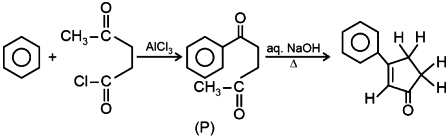
Consider the following reaction of benzene.

72

In compound (Q), the percentage of oxygen is ___ %. (Nearest integer)


Correct Answer: 10
image

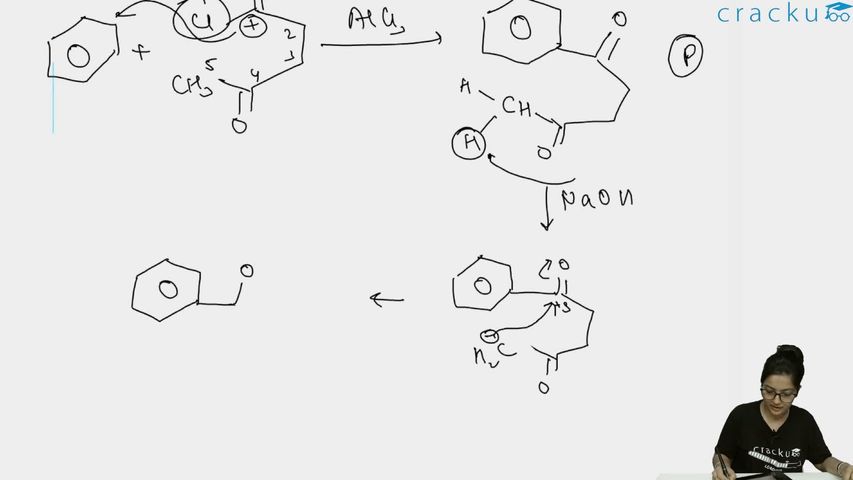
We need to determine the mass percentage of oxygen in compound (Q) obtained from the given reaction sequence starting with benzene.

1. Reaction Analysis:

  • Step 1: Friedel-Crafts Acylation (Formation of P)
    Benzene reacts with the acyl chloride end of the bifunctional reagent in the presence of anhydrous $$\text{AlCl}_3$$. The chlorine atom acts as a leaving group, forming an acylium ion intermediate that attacks the benzene ring.
    $$\text{P} = \text{1-phenylbutane-1,3-dione}$$ (as shown in the reaction scheme: a benzene ring substituted with a $$-\text{CO}-\text{CH}_2-\text{CO}-\text{CH}_3$$ chain).
  • Step 2: Intramolecular Aldol Condensation (Formation of Q)
    Treating the 1,3-dione (P) with aqueous $$\text{NaOH}$$ and heat ($$\Delta$$) drives an intramolecular aldol condensation. The base abstracts an acidic alpha-proton from the terminal methyl group ($$-\text{CO}-\text{CH}_3$$) to form a nucleophilic enolate ion. This ion attacks the benzylic carbonyl carbon to form a stable 5-membered ring. Subsequent dehydration ($$-\text{H}_2\text{O}$$) yields the final cyclic $$\alpha,\beta$$-unsaturated ketone product (Q) displayed in the diagram.
    $$\text{Q} = \text{3-phenylcyclopent-2-en-1-one}$$

2. Mass Percentage of Oxygen:

$$\text{Percentage of Oxygen} = \left( \frac{\text{Mass of Oxygen}}{\text{Total Molar Mass of Q}} \right) \times 100$$

$$\text{Percentage of Oxygen} = \left( \frac{16}{158} \right) \times 100 \approx 10\%$$

Answer: 10

Get AI Help

Video Solution

video

Create a FREE account and get:

  • Free JEE Mains Previous Papers PDF
  • Take JEE Mains paper tests

Free JEE Topicwise Questions

JEE Hydrocarbons - AlkenesJEE SolutionsJEE EquilibriumJEE Chemical Bonding & Molecular StructureJEE Quadratic EquationsJEE Electromagnetic WavesJEE Laws of ThermodynamicsJEE CirclesJEE StatisticsJEE Rotational MotionJEE Periodic Table & PeriodicityJEE BiomoleculesJEE Kinetic Theory of GasesJEE Electric Potential & CapacitanceJEE Laboratory Experiments - XIJEE Differential EquationsJEE Binomial TheoremJEE Carboxylic AcidsJEE Applications of DerivativesJEE Vector AlgebraJEE Alcohols, Phenols & EthersJEE Nitrogen-Containing CompoundsJEE Sets, Relations & FunctionsJEE Electronic DevicesJEE Work, Energy & PowerJEE Definite IntegrationJEE DeterminantsJEE d and f-Block ElementsJEE Complex NumbersJEE MatricesJEE Magnetism & Magnetic MaterialsJEE Number SystemJEE Indefinite IntegrationJEE Permutations & CombinationsJEE Fluid MechanicsJEE Sequences & SeriesJEE Inverse Trigonometric FunctionsJEE Three Dimensional GeometryJEE Aldehydes & KetonesJEE Basic Concepts in ChemistryJEE Alternating CurrentsJEE Kinematics - 2D MotionJEE Current & ResistanceJEE Hydrocarbons - AlkanesJEE Simple Harmonic MotionJEE Dual Nature of Matter & RadiationJEE ElectrochemistryJEE Electric Charges & FieldsJEE Magnetic Effects of CurrentJEE GravitationJEE Heat TransferJEE Atoms & NucleiJEE Redox ReactionsJEE Chemical ThermodynamicsJEE DifferentiationJEE Practical Organic ChemistryJEE Wave OpticsJEE Atomic StructureJEE Units & MeasurementsJEE Trigonometric FunctionsJEE WavesJEE Straight LinesJEE Basic Principles of Organic ChemistryJEE EMF & Circuit AnalysisJEE Hydrocarbons - AromaticJEE ProbabilityJEE Ray OpticsJEE Coordination CompoundsJEE p-Block Elements (Groups 13-18)JEE Organic Compounds with HalogensJEE Electromagnetic InductionJEE Surface TensionJEE Purification & CharacterisationJEE Conic SectionsJEE Continuity & DifferentiabilityJEE JEE 2D GeometryJEE Laws of MotionJEE LimitsJEE Kinematics - 1D MotionJEE Chemical KineticsJEE ElasticityJEE Hydrocarbons - Alkynes
Ask AI