
Join Our JEE Preparation Group
Prep with like-minded aspirants; Get access to free daily tests and study material.
Sign in
Please select an account to continue using cracku.in
↓ →
Join Our JEE Preparation Group
Prep with like-minded aspirants; Get access to free daily tests and study material.
$$X_2(g ) + Y_2(g ) \rightleftharpoons 2Z(g)$$
$$X_2(g )$$ and $$Y_2(g )$$ are added to a 1 L flask and it is found that the system attains the above equilibrium at T(K) with the number of moles of $$X_2(g ),\text{ } Y_2(g )$$ and $$Z(g)$$ being 3, 3 and 9 mol respectively (equilibrium moles). Under this condition of equilibrium, 10 mol of $$Z(g$$) is added to the flask and the temperature is maintained at $$T(K)$$. Then the number of moles of $$Z(g)$$ in the flask when the new equilibrium is established is __ . (Nearest integer)
Correct Answer: 15
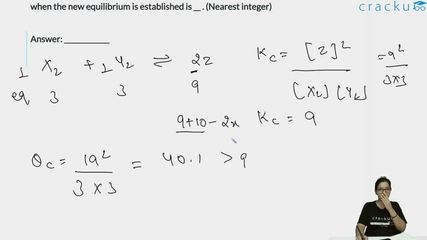
We have the equilibrium $$X_2 + Y_2 \rightleftharpoons 2Z$$ in a 1 L flask with equilibrium moles: $$[X_2] = 3$$, $$[Y_2] = 3$$, $$[Z] = 9$$ mol. Then 10 mol of Z is added and we need the new equilibrium moles of Z.
To begin, we calculate the equilibrium constant $$K_c$$.
Since the volume is 1 L, concentrations equal the number of moles:
$$ K_c = \frac{[Z]^2}{[X_2][Y_2]} = \frac{9^2}{3 \times 3} = \frac{81}{9} = 9 $$
Next, we set up the ICE table after adding 10 mol of Z.
After adding 10 mol Z, the initial (non-equilibrium) concentrations are:
$$[X_2] = 3$$, $$[Y_2] = 3$$, $$[Z] = 9 + 10 = 19$$ mol.
The reaction quotient $$Q = \frac{19^2}{3 \times 3} = \frac{361}{9} \approx 40.1 > K_c = 9$$.
Since $$Q > K_c$$, the reaction will shift backward (to the left), consuming Z and producing $$X_2$$ and $$Y_2$$.
| $$X_2$$ | $$Y_2$$ | $$Z$$ | |
| Initial: | 3 | 3 | 19 |
| Change: | $$+x$$ | $$+x$$ | $$-2x$$ |
| Equilibrium: | $$3+x$$ | $$3+x$$ | $$19-2x$$ |
We then apply the equilibrium condition.
$$ K_c = \frac{(19 - 2x)^2}{(3 + x)(3 + x)} = \frac{(19 - 2x)^2}{(3 + x)^2} = 9 $$
We solve the resulting equation.
Taking the square root of both sides (both numerator and denominator are positive):
$$ \frac{19 - 2x}{3 + x} = 3 $$
$$ 19 - 2x = 3(3 + x) = 9 + 3x $$
$$ 19 - 9 = 3x + 2x $$
$$ 10 = 5x $$
$$ x = 2 $$
Finally, we find the new equilibrium moles of Z.
$$ [Z] = 19 - 2x = 19 - 4 = 15 $$
The answer is 15.
Was this solution helpful?
Click on the Email ☝️ to Watch the Video Solution
Create a FREE account and get:
_1.webp)

Educational materials for JEE preparation

Ask our AI anything

AI can make mistakes. Please verify important information.
AI can make mistakes. Please verify important information.
