
Join Our JEE Preparation Group
Prep with like-minded aspirants; Get access to free daily tests and study material.
Sign in
Please select an account to continue using cracku.in
↓ →
Join Our JEE Preparation Group
Prep with like-minded aspirants; Get access to free daily tests and study material.
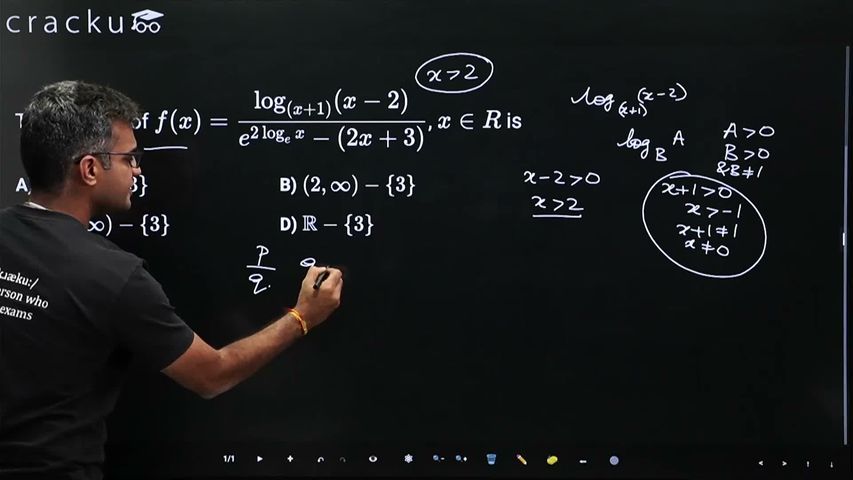
The domain of $$f(x) = \dfrac{\log_{(x+1)}(x-2)}{e^{2\log_e x} - (2x+3)}$$, $$x \in R$$ is
The function is:
$$f(x) = \frac{\log_{(x+1)}(x-2)}{e^{2\log_e x} - (2x+3)}$$
We need to evaluate the constraints for both the numerator and the denominator independently, and then find their intersection.
1. Constraints for the Numerator
For the logarithmic function $$\log_{(x+1)}(x-2)$$ to be defined, the following conditions must be met:
$$x - 2 > 0 \implies x > 2$$
$$x + 1 > 0 \implies x > -1$$
$$x + 1 \neq 1 \implies x \neq 0$$
Intersecting these three conditions for the numerator, we get $$x > 2$$.
2. Constraints for the Denominator
The denominator must not equal zero, and any functions within it must also be defined.
$$x > 0$$
$$e^{2\log_e x} - (2x+3) \neq 0$$
Using the logarithm power rule, $$2\log_e x = \log_e(x^2)$$. For $$x > 0$$, the expression simplifies using the property $$e^{\log_e(a)} = a$$:
$$e^{\log_e(x^2)} = x^2$$
Substitute this back into the denominator inequality:
$$x^2 - (2x + 3) \neq 0$$
$$x^2 - 2x - 3 \neq 0$$
Factoring the quadratic equation gives:
$$(x - 3)(x + 1) \neq 0$$
This means $$x \neq 3$$ and $$x \neq -1$$.
3. Final Domain
To find the domain of $$f(x)$$, we take the intersection of the valid sets for both the numerator and the denominator:
Combining these constraints, $$x$$ must be strictly greater than $$2$$, but it cannot equal $$3$$.
Therefore, the domain of $$f(x)$$ is:
$$x \in (2, 3) \cup (3, \infty)$$ or $$(2, \infty) \setminus \{3\}$$.
Was this solution helpful?
Click on the Email ☝️ to Watch the Video Solution
Create a FREE account and get:
_1.webp)

Educational materials for JEE preparation

Ask our AI anything

AI can make mistakes. Please verify important information.
AI can make mistakes. Please verify important information.
