
Join Our JEE Preparation Group
Prep with like-minded aspirants; Get access to free daily tests and study material.
Sign in
Please select an account to continue using cracku.in
↓ →
Join Our JEE Preparation Group
Prep with like-minded aspirants; Get access to free daily tests and study material.
Consider the following system of equations
$$\alpha x + 2y + z = 1$$
$$2\alpha x + 3y + z = 1$$
$$3x + \alpha y + 2z = \beta$$
For some $$\alpha, \beta \in \mathbb{R}$$. Then which of the following is NOT correct.
To determine which statement is not correct, we need to analyze the determinant of the coefficient matrix and the conditions for consistency.
The given system is:
$$\alpha x + 2y + z = 1$$
$$2\alpha x + 3y + z = 1$$
$$3x + \alpha y + 2z = \beta$$
Let A be the coefficient matrix of the system:
$$A = \begin{pmatrix} \alpha & 2 & 1 \\ 2\alpha & 3 & 1 \\ 3 & \alpha & 2 \end{pmatrix}$$
First, calculate the determinant of the coefficient matrix A.
$$|A| = \alpha(3(2) - 1(\alpha)) - 2(2\alpha(2) - 1(3)) + 1(2\alpha(\alpha) - 3(3))$$
$$|A| = \alpha(6 - \alpha) - 2(4\alpha - 3) + (2\alpha^2 - 9)$$
$$|A| = 6\alpha - \alpha^2 - 8\alpha + 6 + 2\alpha^2 - 9$$
$$|A| = \alpha^2 - 2\alpha - 3$$
$$|A| = (\alpha - 3)(\alpha + 1)$$
The system will not have a unique solution when the determinant is equal to zero, which happens when $$\alpha = 3$$ or $$\alpha = -1$$.
Next, let us check the case when $$\alpha = 3$$.
Substitute this into the original equations:
$$3x + 2y + z = 1$$ (Equation 1)
$$6x + 3y + z = 1$$ (Equation 2)
$$3x + 3y + 2z = \beta$$ (Equation 3)
Subtracting 2 times Equation 1 from Equation 2 gives:
$$-y - z = -1 \implies y + z = 1$$
Subtracting Equation 1 from Equation 3 gives:
$$y + z = \beta - 1$$
For the system to be consistent, the right sides must match:
$$1 = \beta - 1 \implies \beta = 2$$
Thus, if $$\alpha = 3$$, the system has infinitely many solutions if $$ \beta = 2 $$, and no solution if $$\beta \neq 2$$.
Now, let us check the case when $$\alpha = -1$$.
Substitute this into the original equations:
$$-x + 2y + z = 1$$ (Equation 1)
$$-2x + 3y + z = 1$$ (Equation 2)
$$3x - y + 2z = \beta$$ (Equation 3)
Subtracting 2 times Equation 1 from Equation 2 gives:
$$-y - z = -1 \implies y + z = 1$$
Multiplying Equation 1 by 3 and adding it to Equation 3 gives:
$$5y + 5z = \beta + 3 \implies 5(y + z) = \beta + 3$$
Substituting $$y + z = 1$$ into this equation yields:
$$5(1) = \beta + 3 \implies \beta = 2$$
Thus, if $$ \alpha = -1 $$, the system has infinitely many solutions if $$ \beta = 2 $$, and no solution if $$\beta \neq 2$$.
Therefore, the statement that is NOT correct is:
It has no solution for $$\alpha = -1$$ and for all $$\beta \in \mathbb{R}$$
Was this solution helpful?
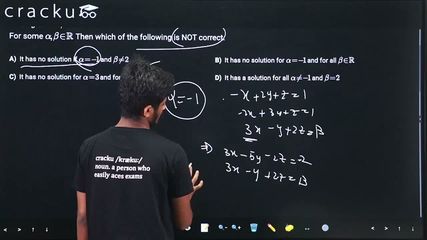
Click on the Email ☝️ to Watch the Video Solution
Create a FREE account and get:
_1.webp)

Educational materials for JEE preparation

Ask our AI anything

AI can make mistakes. Please verify important information.
AI can make mistakes. Please verify important information.
