
Join Our JEE Preparation Group
Prep with like-minded aspirants; Get access to free daily tests and study material.
Sign in
Please select an account to continue using cracku.in
↓ →
Join Our JEE Preparation Group
Prep with like-minded aspirants; Get access to free daily tests and study material.
The reactions which cannot be applied to prepare an alkene by elimination, are
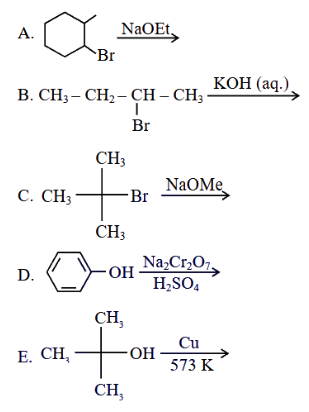
Choose the correct answer from the options given below :
An alkene is obtained by an elimination reaction when two atoms / groups are removed from neighbouring carbon atoms, generating a $$C=C$$ double bond. Typical eliminations are:
• Dehydrohalogenation of an alkyl halide with alcoholic $$KOH$$.
• Dehydration of an alcohol with conc. $$H_2SO_4$$ or heated $$Al_2O_3$$.
• Dehalogenation of a vicinal dihalide with $$Zn$$ (or $$Mg$$).
Let us inspect each of the five reactions listed in the problem.
Reaction A: $$RCH_2CH_2Br \xrightarrow[\text{heat}]{alc.\;KOH} RCH=CH_2$$
Removal of $$HBr$$ from adjacent carbon atoms is a dehydrohalogenation - an elimination step that does give an alkene.
Reaction B: $$RCH_2CH_2OH \xrightarrow{[O]} RCH_2COOH$$
This is an oxidation of a primary alcohol to a carboxylic acid. No pair of groups is simultaneously lost from neighbouring carbons, and no double bond is formed. Hence it is not an elimination and cannot be used to synthesise an alkene.
Reaction C: $$RCH_2CH_2OH \xrightarrow[\;443\,K\;]{conc.\;H_2SO_4} RCH=CH_2$$
Here water is eliminated (dehydration of an alcohol), producing an alkene. Therefore reaction C is suitable.
Reaction D: $$2\,RCH_2Cl + 2\,Na \xrightarrow[\;\;]{dry\,ether} RCH_2CH_2R + 2\,NaCl$$
This is the Wurtz coupling, which links two alkyl halide molecules to yield a higher alkane, not an alkene. No elimination across adjacent carbons occurs, so reaction D cannot be used.
Reaction E: $$RCHCl\text{-}CHClR' + Zn \rightarrow RCH=CHR' + ZnCl_2$$
Zinc removes the two halogen atoms (dehalogenation of a vicinal dihalide). The two atoms are lost from neighbouring carbons, fulfilling the elimination criterion and furnishing an alkene. Hence reaction E is applicable.
Collecting the inapplicable cases:
• Reaction B - oxidation, not elimination.
• Reaction D - Wurtz coupling, produces an alkane.
No other listed reaction is disqualified. Therefore, the reactions which cannot be applied to prepare an alkene by elimination are B and D only.
Option D which is: B & D Only
Was this solution helpful?
Create a FREE account and get:
_1.webp)

Educational materials for JEE preparation

Ask our AI anything

AI can make mistakes. Please verify important information.
AI can make mistakes. Please verify important information.
