
Join Our JEE Preparation Group
Prep with like-minded aspirants; Get access to free daily tests and study material.
Sign in
Please select an account to continue using cracku.in
↓ →
Join Our JEE Preparation Group
Prep with like-minded aspirants; Get access to free daily tests and study material.
Match the List I with List II:
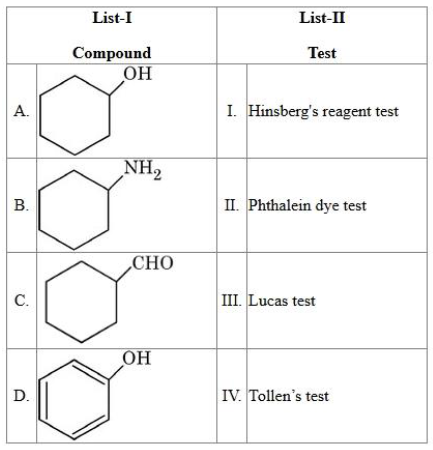
choose the correct answer from the options given below
The four qualitative tests named in the column on the right are routinely used for the following specific functional groups:
• Lucas test — used to distinguish primary, secondary and tertiary alcohols (appearance of turbidity).
• Hinsberg’s test — used to distinguish primary, secondary and tertiary amines (formation or non-formation of sulphonamide that dissolves in alkali).
• Tollen’s test — used to confirm the presence of an aldehyde group (formation of silver mirror/black precipitate of $$Ag$$).
• Phthalein dye test — used for phenols; phenol reacts with phthalic anhydride in the presence of conc. $$H_2SO_4$$ to give coloured phthalein dyes.
Now match each compound with the appropriate test:
Case A: Cyclohexanol contains the $$-OH$$ group on a secondary carbon, so it is identified by the Lucas test. Hence A → III.
Case B: Cyclohexylamine is a primary amine; primary amines respond to Hinsberg’s test. Hence B → I.
Case C: Cyclohexanecarbaldehyde has an aldehyde group, so it gives a positive Tollen’s test. Hence C → IV.
Case D: Phenol gives the phthalein dye (phenolphthalein) on reaction with phthalic anhydride and conc. $$H_2SO_4$$. Hence D → II.
Therefore the correct matching is:
A-III, B-I, C-IV, D-II.
Option A $$\longrightarrow\ $$A-III, B-I, C-IV, D-II
Was this solution helpful?
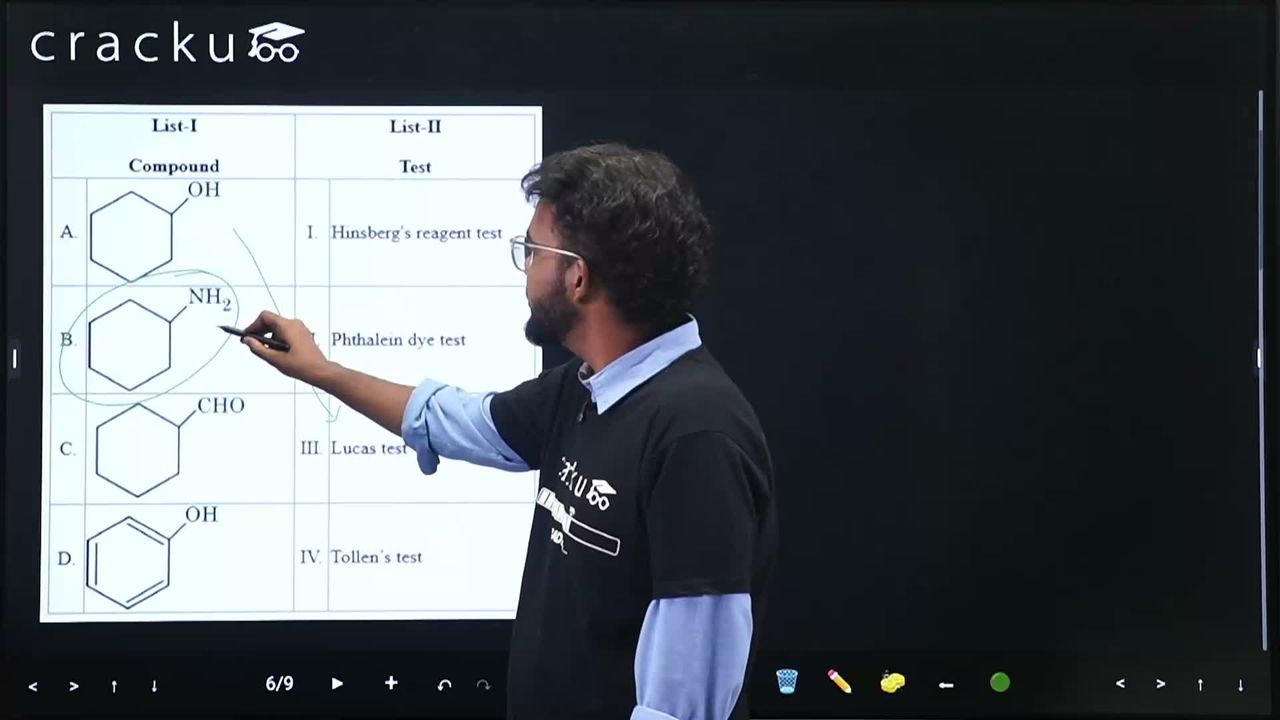
Click on the Email ☝️ to Watch the Video Solution
Create a FREE account and get:
_1.webp)

Educational materials for JEE preparation

Ask our AI anything

AI can make mistakes. Please verify important information.
AI can make mistakes. Please verify important information.


