
Join Our JEE Preparation Group
Prep with like-minded aspirants; Get access to free daily tests and study material.
Sign in
Please select an account to continue using cracku.in
↓ →
Join Our JEE Preparation Group
Prep with like-minded aspirants; Get access to free daily tests and study material.
Among Fe$$^{3+}$$, Pb$$^{2+}$$, Cu$$^{2+}$$ and Mn$$^{2+}$$, identify the one that gets precipitated out while passing H$$_2$$S in presence of NH$$_4$$OH as group reagent. The highest possible oxidation state of the corresponding metal is
The classical qualitative analysis scheme for basic radicals (cations) divides them into groups according to the reagent that first precipitates them.
Recollection of the relevant groups
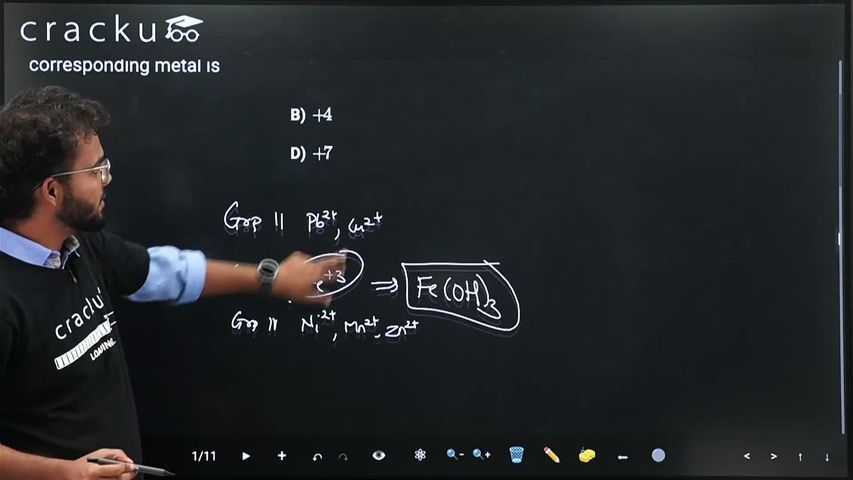
Group II cations (e.g., $$Pb^{2+}, Cu^{2+}$$) give sulphide precipitates with $$H_2S$$ in an acidic medium.
Group III cations (e.g., $$Fe^{3+}$$) are precipitated as hydroxides with $$NH_4OH$$ in the presence of $$NH_4Cl$$; they are no longer present when $$H_2S$$ is later passed through the basic medium.
Group IV cations (e.g., $$Co^{2+}, Ni^{2+}, Zn^{2+}, Mn^{2+}$$) are not precipitated in acid, but they do give sulphide precipitates when $$H_2S$$ is passed through an ammoniacal (basic) solution containing $$NH_4OH/NH_4Cl$$.
Now compare the given ions:
• $$Fe^{3+}$$ → Group III → precipitates earlier as $$Fe(OH)_3$$; it will not appear when $$H_2S$$ is passed in base.
• $$Pb^{2+}$$, $$Cu^{2+}$$ → Group II → already removed as $$PbS$$, $$CuS$$ in acidic medium.
• $$Mn^{2+}$$ → Group IV → remains in solution until the ammoniacal stage and then precipitates as $$MnS$$ with $$H_2S$$.
Hence, the only ion that precipitates with $$H_2S$$ in the presence of $$NH_4OH$$ is $$Mn^{2+}$$.
The question then asks for the highest oxidation state of this corresponding metal, i.e., of manganese.
Manganese exhibits oxidation states from $$+2$$ up to $$+7$$; the highest, $$+7$$, is found in compounds like $$KMnO_4$$ and $$Mn_2O_7$$.
Therefore, the required highest oxidation state is $$+7$$.
Option D which is: $$+7$$
Was this solution helpful?
Click on the Email ☝️ to Watch the Video Solution
Create a FREE account and get:
_1.webp)

Educational materials for JEE preparation

Ask our AI anything

AI can make mistakes. Please verify important information.
AI can make mistakes. Please verify important information.


