
Join Our JEE Preparation Group
Prep with like-minded aspirants; Get access to free daily tests and study material.
Sign in
Please select an account to continue using cracku.in
↓ →
Join Our JEE Preparation Group
Prep with like-minded aspirants; Get access to free daily tests and study material.
A D-aldotetrose on oxidation with concentrated HNO$$_3$$ resulted in optically inactive dicarboxylic acid. The structure of the D-aldotetrose is:
Aldotetroses contain two chiral centres (at C-2 and C-3). Hence each D-aldotetrose has a Fischer projection of the type
$$\begin{array}{c} \mathrm{CHO}\\ \mathrm{C_2:}\;H\;|\;OH\\ \mathrm{C_3:}\;H\;|\;OH\\ \mathrm{CH_2OH} \end{array}$$
The two possible D-isomers are
$$\textbf{D-erythrose}:\;HO{-}CH{-}CH{-}OH $$ (OH groups on the same side)
$$\textbf{D-threose}:\;HO{-}CH{-}CH{-}OH $$ (OH groups on opposite sides)
Hot concentrated $$\text{HNO}_3$$ is a strong oxidising agent; it converts the aldehyde group at C-1 and the primary alcohol at C-4 into carboxylic groups, giving the corresponding aldaric acid (a dicarboxylic acid).
$$\mathrm{HOOC{-}(CHOH)_2{-}COOH}$$
After oxidation:
Case 1: Starting from D-erythrose, both chiral centres retain the original (R,S) configuration. The product is $$\textbf{meso-tartaric acid}$$, which possesses an internal plane of symmetry. Because of this internal compensation it is optically inactive.
Case 2: Starting from D-threose, the configurations become (R,R). The product is $$\mathbf{d\!-\!tartaric\;acid}$$, which has no plane of symmetry and therefore is optically active.
The question states that the dicarboxylic acid obtained is optically inactive, so the parent aldotetrose must be the one that furnishes meso-tartaric acid, namely $$\textbf{D-erythrose}$$.
Among the given figures, Option (c) corresponds to the Fischer projection of D-erythrose (OH on the right at both C-2 and C-3).
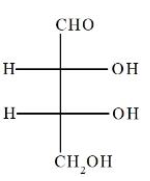
Hence the required structure is furnished by
Option C which is: Option (c)
Was this solution helpful?
Create a FREE account and get:
_1.webp)

Educational materials for JEE preparation

Ask our AI anything

AI can make mistakes. Please verify important information.
AI can make mistakes. Please verify important information.


