
Join Our JEE Preparation Group
Prep with like-minded aspirants; Get access to free daily tests and study material.
Sign in
Please select an account to continue using cracku.in
↓ →
Join Our JEE Preparation Group
Prep with like-minded aspirants; Get access to free daily tests and study material.
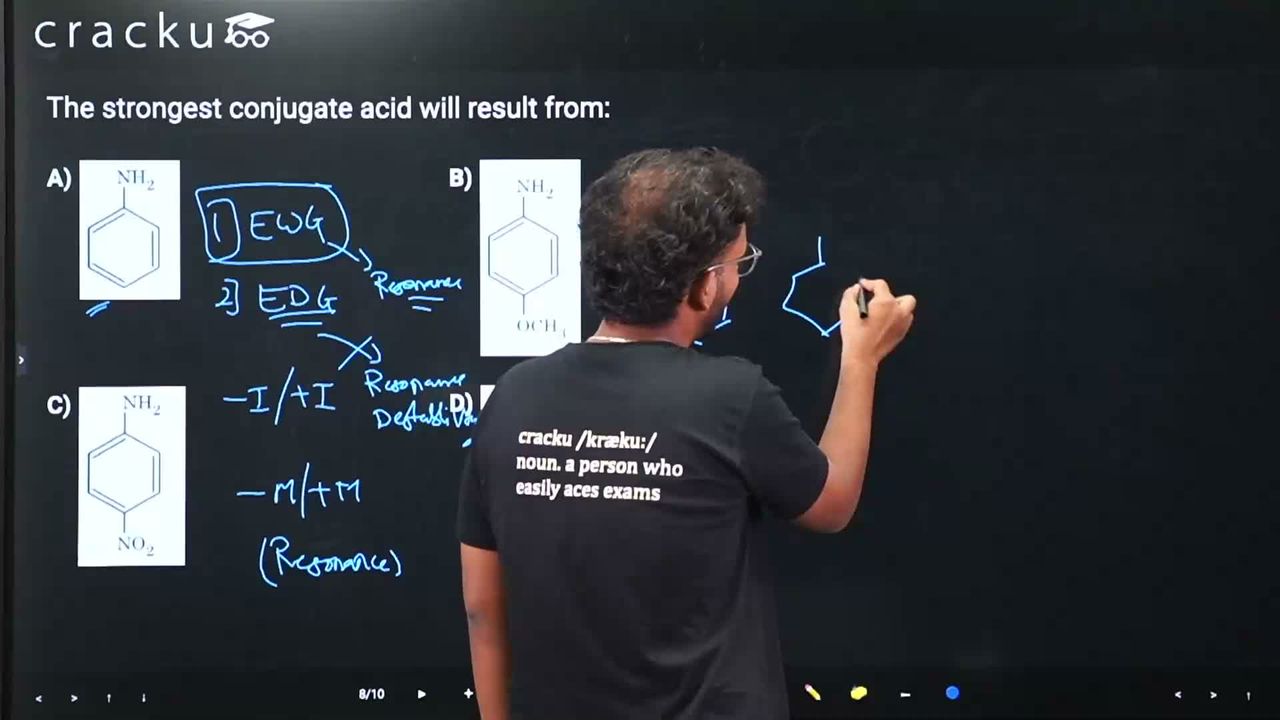
For substituted anilines, two electronic effects decide the stability of the protonated form (the anilinium ion):
1. Inductive effect (−I or +I): An electron-withdrawing (−I) group pulls electron density away from the positively charged nitrogen, dispersing the charge and stabilising the cation.
2. Resonance (−M or +M): A group that can withdraw electrons by resonance (−M) also delocalises and stabilises the positive charge.
Let us examine each substituent in the para position:
Case A: Aniline (no substituent)
No extra stabilising effect beyond the benzene ring. So its conjugate acid serves as the reference.
Case B: p-Methoxyaniline (−OCH3)
−OCH3 has a strong +M (electron-donating) effect, pushing electron density toward the ring. This increases electron density on nitrogen in the neutral base; once the base is protonated, that extra electron density destabilises the positive charge. Hence the conjugate acid is weaker than that of aniline.
Case C: p-Nitroaniline (−NO2)
−NO2 is a very powerful −I and −M group. Both effects withdraw electron density from the ring and ultimately from the protonated nitrogen. This delocalises and stabilises the positive charge on nitrogen, making the conjugate acid highly stabilised and therefore very strong.
Case D: p-Methylaniline (−CH3)
−CH3 is weakly +I and weakly +M (hyperconjugation). These donating effects slightly increase electron density, which destabilises the cation relative to aniline. So its conjugate acid is weaker.
Comparing all four, the conjugate acid of p-nitroaniline receives the maximum stabilisation due to the strong −I and −M effects of the nitro group. Hence it is the strongest conjugate acid among the given options.
Therefore, the correct choice is:
Option C which is: p-Nitroaniline
Was this solution helpful?
Click on the Email ☝️ to Watch the Video Solution
Create a FREE account and get:
_1.webp)

Educational materials for JEE preparation

Ask our AI anything

AI can make mistakes. Please verify important information.
AI can make mistakes. Please verify important information.


