
Join Our JEE Preparation Group
Prep with like-minded aspirants; Get access to free daily tests and study material.
Sign in
Please select an account to continue using cracku.in
↓ →
Join Our JEE Preparation Group
Prep with like-minded aspirants; Get access to free daily tests and study material.
Given below are two statements: one is labelled as Assertion A and the other is labelled as Reason R
Assertion A: When you squeeze one end of a tube to get toothpaste out from the other end, Pascal's principle is observed.
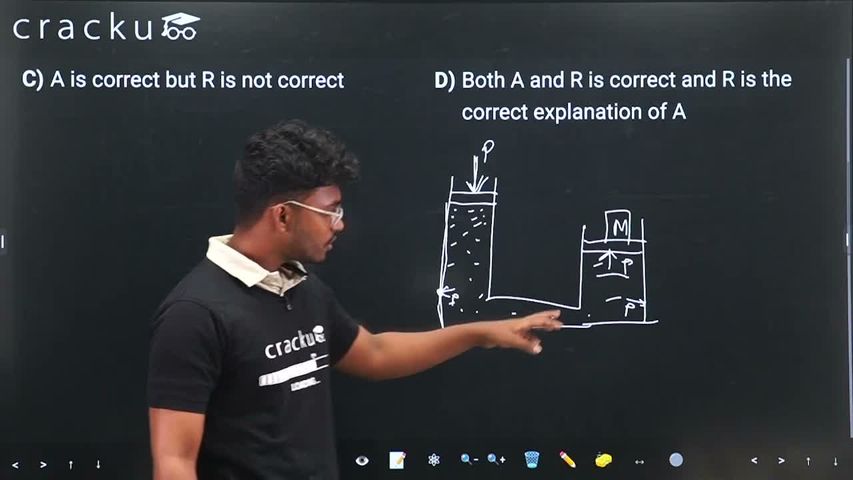
Reason R: A change in the pressure applied to an enclosed incompressible fluid is transmitted undiminished to every portion of the fluid and to the walls of its container.
Assertion A: When you squeeze one end of a tube to get toothpaste out from the other end, Pascal's principle is observed.
This is correct. The pressure applied at one end is transmitted through the toothpaste (which behaves approximately as a fluid) to the other end, pushing it out.
Reason R: A change in the pressure applied to an enclosed incompressible fluid is transmitted undiminished to every portion of the fluid and to the walls of its container.
This is correct. This is the statement of Pascal's law/principle.
R correctly explains A: the toothpaste comes out because the pressure applied by squeezing is transmitted undiminished throughout the enclosed paste (acting as a fluid), which is exactly Pascal's principle.
The correct answer is Both A and R are correct and R is the correct explanation of A.
Was this solution helpful?
Click on the Email ☝️ to Watch the Video Solution
Create a FREE account and get:
_1.webp)

Educational materials for JEE preparation

Ask our AI anything

AI can make mistakes. Please verify important information.
AI can make mistakes. Please verify important information.


