
Join Our JEE Preparation Group
Prep with like-minded aspirants; Get access to free daily tests and study material.
Sign in
Please select an account to continue using cracku.in
↓ →
Join Our JEE Preparation Group
Prep with like-minded aspirants; Get access to free daily tests and study material.
We need to identify the incorrect statement from the given options.
Option A: The speed of satellite in a given circular orbit remains constant.
This is correct. In a circular orbit, the gravitational force is always perpendicular to the velocity, so it only changes the direction, not the magnitude of velocity. The speed remains constant.
Option B: For a planet revolving around the sun in an elliptical orbit, the total energy of the planet remains constant.
This is correct. The gravitational force is conservative, so the total mechanical energy (kinetic + potential) is conserved in any orbit.
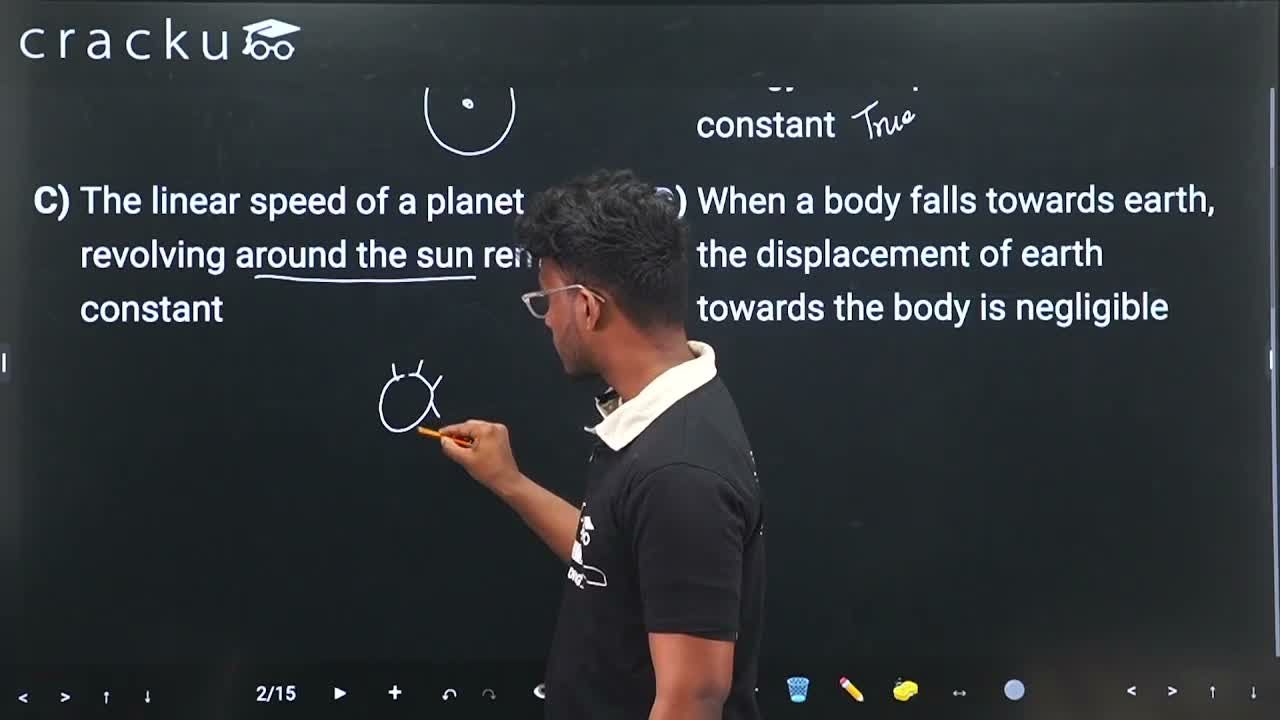
Option C: The linear speed of a planet revolving around the sun remains constant.
This is INCORRECT. A planet moves in an elliptical orbit (Kepler's First Law). By Kepler's Second Law (equal areas in equal times), the planet moves faster at perihelion (closest to the sun) and slower at aphelion (farthest from the sun). The linear speed varies throughout the orbit.
Option D: When a body falls towards earth, the displacement of earth towards the body is negligible.
This is correct. By Newton's Third Law, the earth also accelerates toward the body, but since the earth's mass is enormous, its acceleration (and hence displacement) is negligibly small.
The incorrect statement is Option C.
Was this solution helpful?
Click on the Email ☝️ to Watch the Video Solution
Create a FREE account and get:
_1.webp)

Educational materials for JEE preparation

Ask our AI anything

AI can make mistakes. Please verify important information.
AI can make mistakes. Please verify important information.


