
Join Our JEE Preparation Group
Prep with like-minded aspirants; Get access to free daily tests and study material.
Sign in
Please select an account to continue using cracku.in
↓ →
Join Our JEE Preparation Group
Prep with like-minded aspirants; Get access to free daily tests and study material.
Match List-I with List-II.
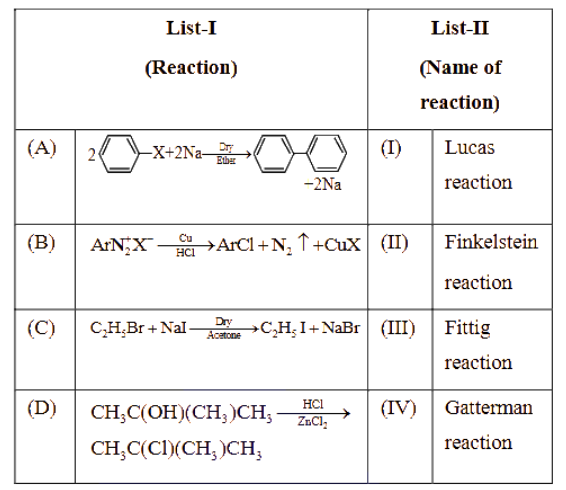
Choose the correct answer from the options given below :
To match the reactions in List-I with their corresponding names in List-II, let us analyze each reaction individually.
For reaction (A),
$$2\text{C}_6\text{H}_5\text{-X}+2\text{Na}\xrightarrow{\text{Dry Ether}}\text{C}_6\text{H}_5\text{-C}_6\text{H}_5+2\text{NaX},$$
two molecules of an aryl halide react with sodium metal in dry ether to produce a biaryl compound (biphenyl). This coupling reaction is known as the Fittig reaction.
Hence,
$$\boxed{(A)\rightarrow(III).}$$
For reaction (B),
$$\text{ArN}_2^+\text{X}^-\xrightarrow{\text{Cu}/\text{HCl}}\text{ArCl}+\text{N}_2+\text{CuX},$$
an aryldiazonium salt is treated with copper powder and hydrochloric acid to form an aryl chloride. The use of copper powder instead of cuprous halide identifies this transformation as the Gatterman reaction.
Hence,
$$\boxed{(B)\rightarrow(IV).}$$
For reaction (C),
$$\text{C}_2\text{H}_5\text{Br}+\text{NaI}\xrightarrow{\text{Dry Acetone}}\text{C}_2\text{H}_5\text{I}+\text{NaBr},$$
an alkyl bromide is converted into an alkyl iodide using sodium iodide in dry acetone. This halogen exchange reaction is known as the Finkelstein reaction.
Hence,
$$\boxed{(C)\rightarrow(II).}$$
For reaction (D),
$$\text{CH}_3\text{C(OH)(CH}_3\text{)CH}_3\xrightarrow{\text{HCl}/\text{ZnCl}_2}\text{CH}_3\text{C(Cl)(CH}_3\text{)CH}_3,$$
a tertiary alcohol is converted into the corresponding alkyl chloride using concentrated hydrochloric acid and anhydrous zinc chloride. This reaction is known as the Lucas reaction.
Hence,
$$\boxed{(D)\rightarrow(I).}$$
Therefore, the correct matching is
$$\boxed{(A)\rightarrow(III),\ (B)\rightarrow(IV),\ (C)\rightarrow(II),\ (D)\rightarrow(I).}$$
Thus, the correct answer is
$$\boxed{\text{Option (2).}}$$
Was this solution helpful?
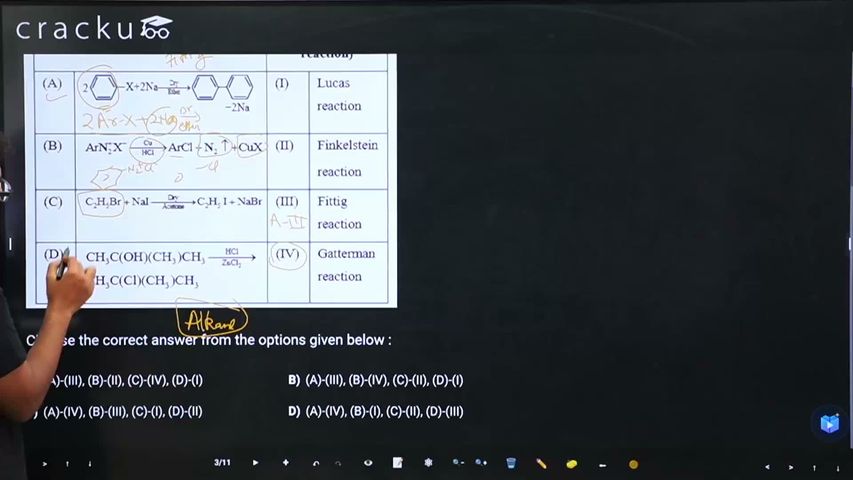
Click on the Email ☝️ to Watch the Video Solution
Create a FREE account and get:
_1.webp)

Educational materials for JEE preparation

Ask our AI anything

AI can make mistakes. Please verify important information.
AI can make mistakes. Please verify important information.


