
Join Our JEE Preparation Group
Prep with like-minded aspirants; Get access to free daily tests and study material.
Sign in
Please select an account to continue using cracku.in
↓ →
Join Our JEE Preparation Group
Prep with like-minded aspirants; Get access to free daily tests and study material.
Let $$a_1, a_2, a_3, \ldots$$ be a G.P. of increasing positive numbers. Let the sum of its 6$$^{th}$$ and 8$$^{th}$$ terms be 2 and the product of its 3$$^{rd}$$ and 5$$^{th}$$ terms be $$\frac{1}{9}$$. Then $$6(a_2 + a_4)(a_4 + a_6)$$ is equal to
Let the first term of the geometric progression be $$a$$ and the common ratio be $$r$$.
Since the sequence consists of increasing positive numbers, $$a > 0$$ and $$r > 1$$.
Given that the product of the third and fifth terms is $$\frac{1}{9}$$:
$$a_3 \cdot a_5 = \frac{1}{9}$$
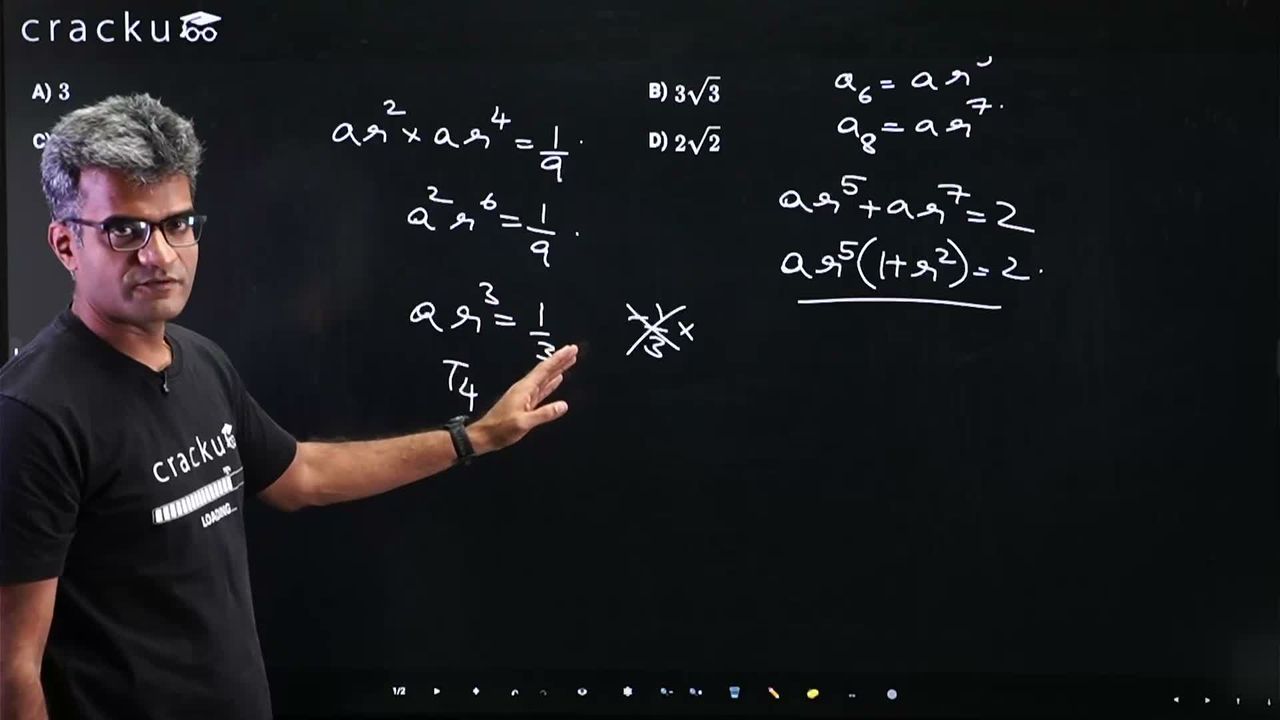
$$(ar^2)(ar^4) = \frac{1}{9}$$
$$a^2r^6 = \frac{1}{9}$$
Taking the positive square root: $$ar^3 = \frac{1}{3}$$
Given that the sum of the sixth and eighth terms is 2:
$$a_6 + a_8 = 2$$
$$ar^5 + ar^7 = 2$$
$$ar^5(1 + r^2) = 2$$
We can rewrite $$ar^5$$ as $$(ar^3)r^2$$:
$$(ar^3)r^2(1 + r^2) = 2$$
Substitute $$ar^3 = \frac{1}{3}$$:
$$\frac{1}{3}r^2(1 + r^2) = 2$$
$$r^2(1 + r^2) = 6$$
Let $$r^2 = t$$.
The equation becomes:
$$t(t + 1) = 6$$
$$t^2 + t - 6 = 0$$
$$(t + 3)(t - 2) = 0$$
Since $$r > 1$$, $$r^2$$ must be positive, which gives $$t = 2$$.Thus $$r^2 = 2$$.
Substitute $$r^2 = 2$$ back into $$a^2r^6 = \frac{1}{9}$$:
$$a^2(2)^3 = \frac{1}{9}$$
$$8a^2 = \frac{1}{9}$$
$$a^2 = \frac{1}{72}$$
We need to evaluate the expression $$6(a_2 + a_4)(a_4 + a_6)$$.
Expressing this in terms of $$a$$ and $$r$$:
$$E = 6(ar + ar^3)(ar^3 + ar^5)$$
$$E = 6[ar(1 + r^2)][ar^3(1 + r^2)]$$
$$E = 6a^2r^4(1 + r^2)^2$$
Substitute $$a^2 = \frac{1}{72}$$ and $$r^2 = 2$$:
$$E = 6 \left(\frac{1}{72}\right) (2)^2 (1 + 2)^2$$
$$E = \frac{6}{72} \times 4 \times 9$$
$$E = \frac{1}{12} \times 36$$
$$E = 3$$
Hence the correct option is A.
Was this solution helpful?
Click on the Email ☝️ to Watch the Video Solution
Create a FREE account and get:
_1.webp)

Educational materials for JEE preparation

Ask our AI anything

AI can make mistakes. Please verify important information.
AI can make mistakes. Please verify important information.
