
Join Our JEE Preparation Group
Prep with like-minded aspirants; Get access to free daily tests and study material.
Sign in
Please select an account to continue using cracku.in
↓ →
Join Our JEE Preparation Group
Prep with like-minded aspirants; Get access to free daily tests and study material.
Given below are two statements :
Statement (I) :1,2,3-Trihydroxypropane can be separated from water by simple distillation.
Statement (II) :An azeotropic mixture cannot be separated by fractional distillation.
In the light of the above statements, choose the correct answer from the options given below :
The compound 1,2,3-trihydroxypropane is commonly called glycerol.
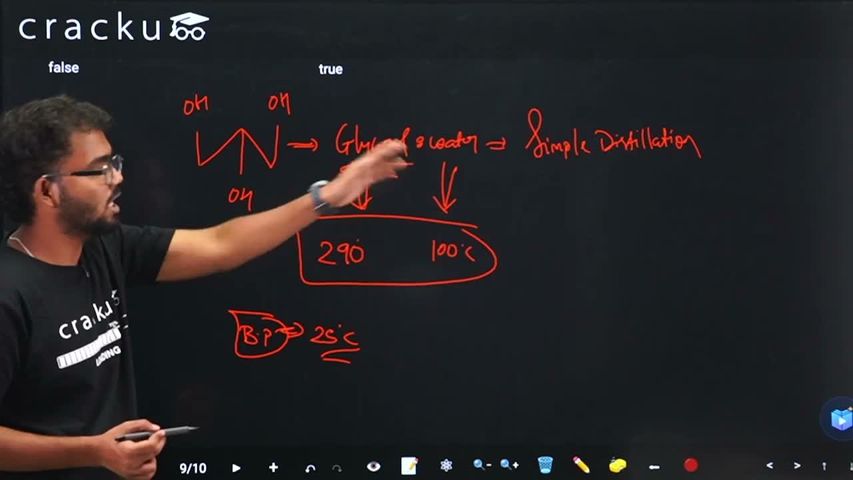
Boiling points
• Water : $$373\ \text{K} \ (100^{\circ}\text{C})$$
• Glycerol : $$563\ \text{K} \ (290^{\circ}\text{C})$$
For separation by simple distillation two conditions must be satisfied: (i) the components should be non-reactive and miscible, and (ii) their boiling points should differ by more than about $$25\ ^{\circ}\text{C}$$. The difference here is nearly $$190^{\circ}\text{C}$$, far exceeding the required gap. During heating, water vapourises at $$100^{\circ}\text{C}$$ and is collected; glycerol, with a very high boiling point, remains in the distillation flask. Hence glycerol (1,2,3-trihydroxypropane) can indeed be separated from water by simple distillation. Therefore, Statement (I) is true.
An azeotropic mixture boils at a fixed temperature without any change in composition because both the liquid and its vapour have identical compositions at the boiling point. Since fractional distillation works on the principle that vapour is richer in the more volatile component, it fails when this condition is absent. Consequently, an azeotrope cannot be resolved into its components by ordinary fractional distillation (special techniques such as azeotropic or pressure-swing distillation are required). Hence, Statement (II) is also true.
Both statements are correct, so the appropriate choice is:
Option A which is: Both Statement I and Statement II are true
Was this solution helpful?
Click on the Email ☝️ to Watch the Video Solution
Create a FREE account and get:
_1.webp)

Educational materials for JEE preparation

Ask our AI anything

AI can make mistakes. Please verify important information.
AI can make mistakes. Please verify important information.
