
Join Our JEE Preparation Group
Prep with like-minded aspirants; Get access to free daily tests and study material.
Sign in
Please select an account to continue using cracku.in
↓ →
Join Our JEE Preparation Group
Prep with like-minded aspirants; Get access to free daily tests and study material.
Match List - I with List - II.
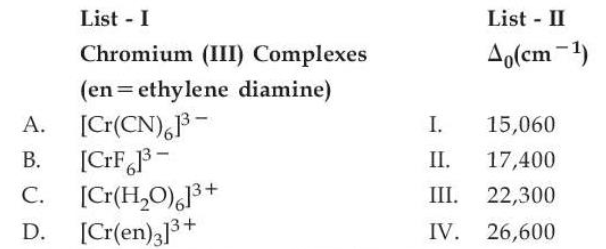
Choose the correct answer from the options given below :
For all the complexes in List-I the metal ion is $$Cr^{3+}$$, which has the electronic configuration $$[Ar]\,3d^{3}$$.
Since the oxidation state and the geometry (octahedral) are the same for every complex, the value of the octahedral crystal-field splitting $$\Delta_0$$ depends only on the position of the ligands in the spectrochemical series.
Spectrochemical series (selected ligands, increasing field strength):
$$F^- \lt H_2O \lt en \lt CN^-$$
The stronger the field strength of the ligand, the larger the value of $$\Delta_0$$. Hence the order of $$\Delta_0$$ for the given complexes must follow the reverse of the above sequence:
$$\Delta_0([Cr(CN)_6]^{3-}) \gt \Delta_0([Cr(en)_3]^{3+}) \gt \Delta_0([Cr(H_2O)_6]^{3+}) \gt \Delta_0([CrF_6]^{3-})$$
Comparing with the numerical values supplied in List-II:
26 600 cm⁻¹ > 22 300 cm⁻¹ > 17 400 cm⁻¹ > 15 060 cm⁻¹
We therefore match each complex with the corresponding splitting energy:
A. $$[Cr(CN)_6]^{3-}$$ → 26 600 cm⁻¹ (IV)
B. $$[CrF_6]^{3-}$$ → 15 060 cm⁻¹ (I)
C. $$[Cr(H_2O)_6]^{3+}$$ → 17 400 cm⁻¹ (II)
D. $$[Cr(en)_3]^{3+}$$ → 22 300 cm⁻¹ (III)
Thus the correct set of matches is: A-IV, B-I, C-II, D-III.
Option D which is: A-IV, B-I, C-II, D-III
Was this solution helpful?
Click on the Email ☝️ to Watch the Video Solution
Create a FREE account and get:
_1.webp)

Educational materials for JEE preparation

Ask our AI anything

AI can make mistakes. Please verify important information.
AI can make mistakes. Please verify important information.
