
Join Our JEE Preparation Group
Prep with like-minded aspirants; Get access to free daily tests and study material.
Sign in
Please select an account to continue using cracku.in
↓ →
Join Our JEE Preparation Group
Prep with like-minded aspirants; Get access to free daily tests and study material.
Given below are two statements :
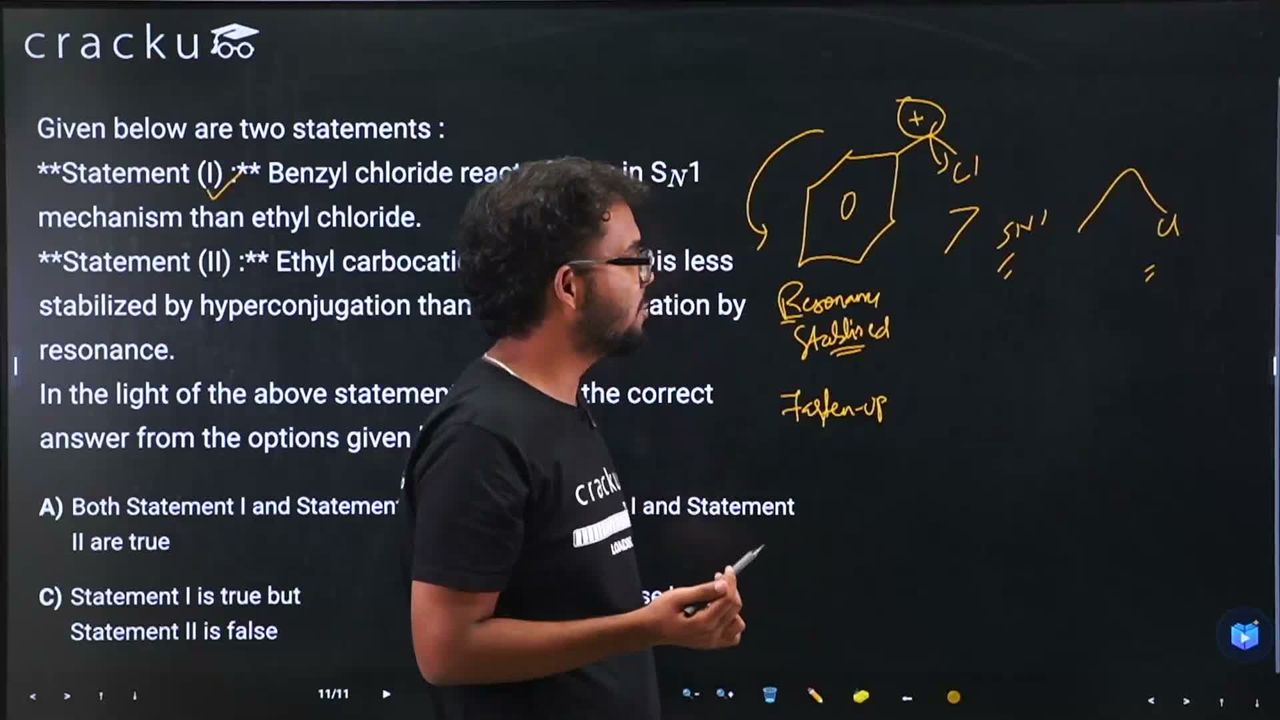
**Statement (I) :** Benzyl chloride reacts faster in S$$_N$$1 mechanism than ethyl chloride.
**Statement (II) :** Ethyl carbocation intermediate is less stabilized by hyperconjugation than benzyl carbocation by resonance.
In the light of the above statements, choose the correct answer from the options given below :
In an $$S_N1$$ mechanism the slow, rate-determining step is the heterolytic cleavage of the C-Cl bond:
$$R{-}Cl \;\xrightarrow{k_{\text{slow}}}\; R^{+} + Cl^{-}$$
Hence the rate law is $$\text{rate} = k[R{-}Cl]$$. The more stable the carbocation $$R^{+}$$ that is produced, the Smaller is the activation energy and the faster is the reaction.
Stability of the two carbocations
• Benzyl chloride $$C_6H_5CH_2Cl$$ gives the benzyl carbocation $$C_6H_5CH_2^{+}$$.
This cation is delocalised over the aromatic ring through resonance:
$$C_6H_5CH_2^{+} \;\longleftrightarrow\; C_6H_5^{+}{-}CH_2$$ and several other canonical forms.
The resonance disperses the positive charge over the entire ring and provides very high stabilisation.
• Ethyl chloride $$CH_3CH_2Cl$$ gives the ethyl carbocation $$CH_3CH_2^{+}$$.
It is a primary carbocation and can be stabilised only by hyperconjugation of three $$\sigma$$-C-H bonds with the empty $$p$$ orbital. Hyperconjugation is a relatively weak effect compared with resonance.
Comparing the reaction rates
Because the benzyl carbocation is far more stabilised than the ethyl carbocation, benzyl chloride ionises much more readily. Therefore benzyl chloride reacts faster than ethyl chloride in an $$S_N1$$ reaction. Statement (I) is true.
Evaluating the second statement
Statement (II) says: “Ethyl carbocation intermediate is less stabilised by hyperconjugation than benzyl carbocation by resonance.”
Resonance (delocalisation over several atoms) indeed provides greater stabilisation than the few hyperconjugative structures available to a primary carbocation. Hence Statement (II) is also true.
Final selection
Both statements are correct, and Statement (II) explains the reason behind Statement (I).
Option A which is: Both Statement I and Statement II are true
Was this solution helpful?
Click on the Email ☝️ to Watch the Video Solution
Create a FREE account and get:
_1.webp)

Educational materials for JEE preparation

Ask our AI anything

AI can make mistakes. Please verify important information.
AI can make mistakes. Please verify important information.
