
Join Our JEE Preparation Group
Prep with like-minded aspirants; Get access to free daily tests and study material.
Sign in
Please select an account to continue using cracku.in
↓ →
Join Our JEE Preparation Group
Prep with like-minded aspirants; Get access to free daily tests and study material.
Match List-I with List-II.
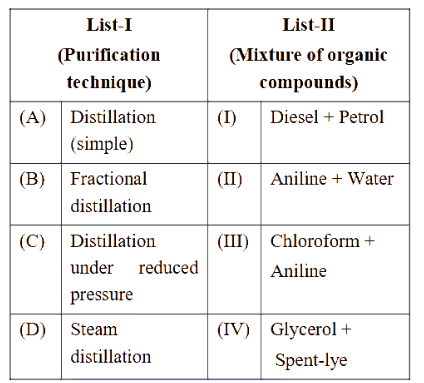
Choose the correct answer from the options given below :
Case A : Simple distillation
Simple (ordinary) distillation is used when the two liquids are completely miscible and their boiling points differ by more than about $$25^{\circ}\text{C}$$.
Chloroform boils at $$61^{\circ}\text{C}$$ while aniline boils at $$184^{\circ}\text{C}$$, a difference of $$123^{\circ}\text{C}$$.
Therefore the pair chloroform + aniline can be separated by ordinary distillation.
Hence (A) → (III).
Case B : Fractional distillation
Fractional distillation is chosen for mixtures whose components are miscible and have boiling points that are close to each other (difference less than about $$25^{\circ}\text{C}$$).
Petrol and diesel are overlapping fractions of petroleum whose components possess closely spaced boiling ranges; they are separated industrially in a fractionating tower.
Hence (B) → (I).
Case C : Distillation under reduced pressure (vacuum distillation)
When a liquid has a very high boiling point and tends to decompose at its normal boiling point, it is distilled at a lowered external pressure so that it boils at a lower temperature.
Glycerol (bp $$\approx 563\ \text{K}$$) is separated from spent-lye (the residual liquor in soap manufacture) by vacuum distillation to avoid its decomposition.
Hence (C) → (IV).
Case D : Steam distillation
Steam distillation is applicable to compounds that are volatile in steam, immiscible with water, and possess high boiling points.
Aniline is immiscible with water and forms a separate layer; it distils along with steam at a temperature much lower than its normal boiling point, allowing its separation from water.
Hence (D) → (II).
Collecting all matches:
(A) - (III), (B) - (I), (C) - (IV), (D) - (II).
This correspondence is provided by Option D.
Was this solution helpful?
Click on the Email ☝️ to Watch the Video Solution
Create a FREE account and get:
_1.webp)

Educational materials for JEE preparation

Ask our AI anything

AI can make mistakes. Please verify important information.
AI can make mistakes. Please verify important information.


