
Join Our JEE Preparation Group
Prep with like-minded aspirants; Get access to free daily tests and study material.
Sign in
Please select an account to continue using cracku.in
↓ →
Join Our JEE Preparation Group
Prep with like-minded aspirants; Get access to free daily tests and study material.
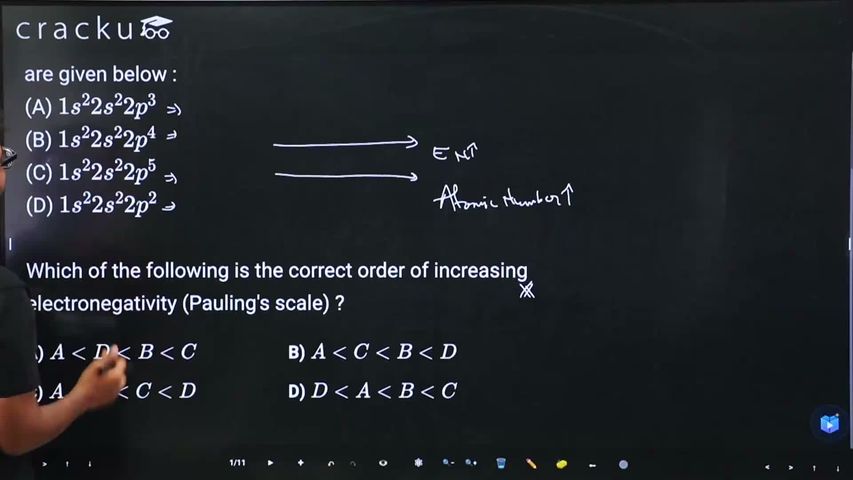
Electronic configuration of four elements A, B, C and D are given below :
(A) $$1s^2 2s^2 2p^3$$
(B) $$1s^2 2s^2 2p^4$$
(C) $$1s^2 2s^2 2p^5$$
(D) $$1s^2 2s^2 2p^2$$
Which of the following is the correct order of increasing electronegativity (Pauling's scale) ?
The electronic configurations correspond to atomic numbers as follows:
$$A: 1s^2\,2s^2\,2p^3 \;\;\Rightarrow\;\; Z=7 \;(\text{Nitrogen, }N)$$
$$B: 1s^2\,2s^2\,2p^4 \;\;\Rightarrow\;\; Z=8 \;(\text{Oxygen, }O)$$
$$C: 1s^2\,2s^2\,2p^5 \;\;\Rightarrow\;\; Z=9 \;(\text{Fluorine, }F)$$
$$D: 1s^2\,2s^2\,2p^2 \;\;\Rightarrow\;\; Z=6 \;(\text{Carbon, }C)$$
All four elements lie in Period 2 of the periodic table in the order
$$C\;(Z=6) \;\lt\; N\;(Z=7) \;\lt\; O\;(Z=8) \;\lt\; F\;(Z=9)$$ from left to right.
Pauling’s electronegativity increases left → right across a period because nuclear charge increases while shielding remains nearly constant. Hence
$$\chi_{C} \;\lt\; \chi_{N} \;\lt\; \chi_{O} \;\lt\; \chi_{F}$$
Translating this trend back to the given symbols:
$$D\;(C) \;\lt\; A\;(N) \;\lt\; B\;(O) \;\lt\; C\;(F)$$
Correct order of increasing electronegativity: $$D \lt A \lt B \lt C$$
Therefore, the correct option is Option D.
Was this solution helpful?
Click on the Email ☝️ to Watch the Video Solution
Create a FREE account and get:
_1.webp)

Educational materials for JEE preparation

Ask our AI anything

AI can make mistakes. Please verify important information.
AI can make mistakes. Please verify important information.


