
Join Our JEE Preparation Group
Prep with like-minded aspirants; Get access to free daily tests and study material.
Sign in
Please select an account to continue using cracku.in
↓ →
Join Our JEE Preparation Group
Prep with like-minded aspirants; Get access to free daily tests and study material.
Consider the following reactions. From these reactions which reaction will give carboxylic acid as a major product ?
(A) $$R-C \equiv N \xrightarrow[\text{mild condition}]{(i) H^+/H_2O}$$
(B) $$R-MgX \xrightarrow[(ii) H_3O^+]{(i) CO_2}$$
(C) $$R-C \equiv N \xrightarrow[(ii) H_3O^+]{(i) SnCl_2/HCl}$$
(D) $$R-CH_2-OH \xrightarrow{PCC}$$
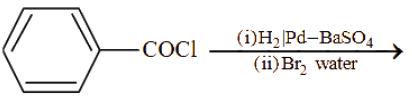
(E)
Choose the correct answer from the options given below :
Reaction (A) involves the hydrolysis of a nitrile. Under mild conditions, the hydrolysis does not proceed to completion and stops at the amide stage.
$$\mathrm{R-C\equiv N \xrightarrow[\text{mild conditions}]{H^+/H_2O} R-CONH_2}$$
Therefore, the major product is an amide, not a carboxylic acid.
Reaction (B) is the carboxylation of a Grignard reagent. The Grignard reagent reacts with carbon dioxide to form a magnesium carboxylate, which upon acidic hydrolysis gives a carboxylic acid.
$$\mathrm{R-MgX + CO_2 \rightarrow RCOO^-MgX^+ \xrightarrow{H_3O^+} RCOOH}$$
Hence, reaction (B) produces a carboxylic acid.
Reaction (C) is the Stephen reduction of a nitrile. Treatment with $$\mathrm{SnCl_2/HCl}$$ followed by hydrolysis converts the nitrile into an aldehyde.
$$\mathrm{R-C\equiv N \xrightarrow{SnCl_2/HCl} \xrightarrow{H_3O^+} R-CHO}$$
Therefore, the major product is an aldehyde, not a carboxylic acid.
Reaction (D) involves oxidation of a primary alcohol using PCC. Since PCC is a mild oxidizing agent, it converts primary alcohols only into aldehydes.
$$\mathrm{R-CH_2OH \xrightarrow{PCC} R-CHO}$$
Thus, no carboxylic acid is formed.
In reaction (E), benzoyl chloride first undergoes Rosenmund reduction to form benzaldehyde.
$$\mathrm{Ph-COCl \xrightarrow{H_2/Pd-BaSO_4} Ph-CHO}$$
The benzaldehyde is then oxidized by bromine water to give benzoic acid.
$$\mathrm{Ph-CHO \xrightarrow{Br_2/H_2O} Ph-COOH}$$
Therefore, reaction (E) also produces a carboxylic acid.
Hence, only reactions (B) and (E) yield a carboxylic acid as the major product.
Therefore, the correct answer is B and E only, which corresponds to option D.
Was this solution helpful?
Click on the Email ☝️ to Watch the Video Solution
Create a FREE account and get:
_1.webp)

Educational materials for JEE preparation

Ask our AI anything

AI can make mistakes. Please verify important information.
AI can make mistakes. Please verify important information.


