
Join Our JEE Preparation Group
Prep with like-minded aspirants; Get access to free daily tests and study material.
Sign in
Please select an account to continue using cracku.in
↓ →
Join Our JEE Preparation Group
Prep with like-minded aspirants; Get access to free daily tests and study material.
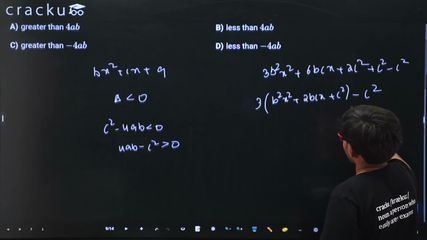
If the roots of the equation $$bx^2 + cx + a = 0$$ be imaginary, then for all real values of $$x$$, the expression $$3b^2x^2 + 6bcx + 2c^2$$ is
The quadratic $$bx^{2}+cx+a=0$$ has imaginary (non-real) roots.
This happens exactly when its discriminant is negative:
$$\Delta = c^{2}-4ab \lt 0 \quad\Longrightarrow\quad 4ab-c^{2} \gt 0$$
Now consider the required expression
$$E(x)=3b^{2}x^{2}+6bcx+2c^{2}$$
Rewrite it by completing the square:
$$\begin{aligned} E(x) &= 3\Bigl(b^{2}x^{2}+2bcx+c^{2}\Bigr)-c^{2} \\ &= 3\,(bx+c)^{2}-c^{2}. \end{aligned}$$
Add and subtract $$4ab$$ so that the positive quantity $$4ab-c^{2}$$ appears:
$$\begin{aligned} E(x) &= 3\,(bx+c)^{2}-c^{2}+4ab-4ab \\ &= 3\,(bx+c)^{2}+\bigl(4ab-c^{2}\bigr)-4ab. \end{aligned}$$
Hence
$$E(x)+4ab = 3\,(bx+c)^{2}+\bigl(4ab-c^{2}\bigr).$$
The first term $$3\,(bx+c)^{2}$$ is $$\ge 0$$ for every real $$x$$, and the second term $$4ab-c^{2}$$ is strictly positive from the discriminant condition. Therefore
$$E(x)+4ab \gt 0 \quad\text{for all real } x.$$
This inequality rearranges to
$$E(x) \gt -4ab \quad\text{for all real } x.$$
Thus the expression $$3b^{2}x^{2}+6bcx+2c^{2}$$ is always greater than $$-4ab$$.
Option C which is: greater than $$-4ab$$
Was this solution helpful?
Click on the Email ☝️ to Watch the Video Solution
Create a FREE account and get:
_1.webp)

Educational materials for JEE preparation

Ask our AI anything

AI can make mistakes. Please verify important information.
AI can make mistakes. Please verify important information.
