Join Our JEE Preparation Group
Prep with like-minded aspirants; Get access to free daily tests and study material.
Sign in
Please select an account to continue using cracku.in
↓ →
Join Our JEE Preparation Group
Prep with like-minded aspirants; Get access to free daily tests and study material.
In Item I the three organic compounds are:
$$\text{(A) Phenol, } \quad \text{(B) Aniline, } \quad \text{(C) Benzoic acid}$$
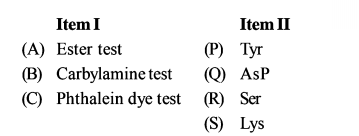
Item II lists four characteristic qualitative tests:
$$\text{(P) Brisk effervescence with } NaHCO_3$$ (carboxylic ‑COOH group)
$$\text{(Q) Violet colour with } FeCl_3$$ (phenolic -OH group)
$$\text{(R) White ppt. of } 2,4,6\text{-tribromophenol on } Br_2/H_2O$$ (highly activated phenolic ring)
$$\text{(S) Foul-smelling isothiocyanate in the carbylamine test}$$ (primary aromatic amine (-NH2))
We now match each compound from Item I with the test(s) it answers in Item II.
Case 1: Phenol (A)Collecting all the matches:
$$\boxed{\text{(A) → (Q, R); (B) → (S); (C) → (P)}}$$
This corresponds to Option A.
Therefore, the correct answer is:
Option A which is: (A) → (Q,R); (B) → (S); (C) → (P)
Was this solution helpful?
Create a FREE account and get:
_1.webp)

Educational materials for JEE preparation

Ask our AI anything

AI can make mistakes. Please verify important information.
AI can make mistakes. Please verify important information.