
Join Our JEE Preparation Group
Prep with like-minded aspirants; Get access to free daily tests and study material.
Sign in
Please select an account to continue using cracku.in
↓ →
Join Our JEE Preparation Group
Prep with like-minded aspirants; Get access to free daily tests and study material.
Let $$\alpha$$ and $$\beta$$ be the roots of the quadratic equation $$x^2 \sin\theta - x(\sin\theta \cos\theta + 1) + \cos\theta = 0$$ $$(0 < \theta < 45°)$$, and $$\alpha < \beta$$. Then $$\sum_{n=0}^{\infty}\left(\alpha^n + \frac{(-1)^n}{\beta^n}\right)$$ is equal to:
We start with the quadratic equation
$$x^{2}\sin\theta \;-\;x\bigl(\sin\theta\cos\theta+1\bigr)\;+\;\cos\theta \;=\;0,$$
whose roots are denoted by $$\alpha$$ and $$\beta$$ with $$\alpha<\beta.$$ For a quadratic $$ax^{2}+bx+c=0$$ having roots $$\alpha,\beta,$$ the standard relations
$$\alpha+\beta = -\dfrac{b}{a},\qquad \alpha\beta = \dfrac{c}{a}$$
hold. Comparing term by term we identify
$$a=\sin\theta,$$ $$b=-\bigl(\sin\theta\cos\theta+1\bigr),$$ $$c=\cos\theta.$$
Hence
$$\alpha+\beta =-\dfrac{b}{a} =-\dfrac{-\bigl(\sin\theta\cos\theta+1\bigr)}{\sin\theta} =\dfrac{\sin\theta\cos\theta+1}{\sin\theta} =\cos\theta+\dfrac{1}{\sin\theta},$$
and
$$\alpha\beta =\dfrac{c}{a} =\dfrac{\cos\theta}{\sin\theta} =\cot\theta.$$ Because $$0<\theta<45^\circ,$$ we have $$\cot\theta>1,$$ so $$\alpha\beta>1.$$ That makes one root less than 1 (this will be $$\alpha$$) and the other greater than 1 (this will be $$\beta$$). This fact guarantees the convergence of the two infinite series that will appear next.
We are asked to find
$$S=\sum_{n=0}^{\infty} \left(\alpha^{n}+\dfrac{(-1)^{n}}{\beta^{n}}\right) =\sum_{n=0}^{\infty}\alpha^{n} +\sum_{n=0}^{\infty}\left(\dfrac{-1}{\beta}\right)^{n}.$$ Because $$|\alpha|<1$$ and $$\left|\dfrac{-1}{\beta}\right|<1,$$ each sum is a geometric progression. For a geometric series $$1+r+r^{2}+\dots$$ with common ratio $$|r|<1,$$ the sum is $$\dfrac{1}{1-r}.$$ Applying this formula separately we obtain
$$\sum_{n=0}^{\infty}\alpha^{n} =\dfrac{1}{1-\alpha},$$
and
$$\sum_{n=0}^{\infty}\left(\dfrac{-1}{\beta}\right)^{n} =\dfrac{1}{1-\left(\dfrac{-1}{\beta}\right)} =\dfrac{1}{1+\dfrac{1}{\beta}} =\dfrac{\beta}{\beta+1}.$$
Therefore
$$S =\dfrac{1}{1-\alpha}+\dfrac{\beta}{\beta+1} =\dfrac{1}{1-\alpha}+1-\dfrac{1}{\beta+1}.$$ Re-expressing in a single fraction gives
$$S =1+\left[\dfrac{1}{1-\alpha}-\dfrac{1}{\beta+1}\right] =1+\dfrac{(\beta+1)-(1-\alpha)}{(1-\alpha)(\beta+1)} =1+\dfrac{\alpha+\beta}{(1-\alpha)(\beta+1)}.$$
We now translate everything in the denominator into the symmetric sums already found.
First, compute
$$\bigl(1-\alpha\bigr)\bigl(\beta+1\bigr) =\beta+1-\alpha\beta-\alpha =(\beta-\alpha)+(1-\alpha\beta).$$
To evaluate $$\beta-\alpha$$ we use the difference-of-roots formula
$$\beta-\alpha=\sqrt{(\alpha+\beta)^{2}-4\alpha\beta}.$$
Substituting $$\alpha+\beta=\cos\theta+\dfrac{1}{\sin\theta}$$ and $$\alpha\beta=\dfrac{\cos\theta}{\sin\theta},$$ we have
$$\beta-\alpha =\sqrt{\left(\cos\theta+\dfrac{1}{\sin\theta}\right)^{2} -4\dfrac{\cos\theta}{\sin\theta}} =\sqrt{\cos^{2}\theta+\dfrac{2\cos\theta}{\sin\theta} +\dfrac{1}{\sin^{2}\theta}-\dfrac{4\cos\theta}{\sin\theta}}$$
$$=\sqrt{\cos^{2}\theta -\dfrac{2\cos\theta}{\sin\theta} +\dfrac{1}{\sin^{2}\theta}} =\sqrt{\left(\cos\theta-\dfrac{1}{\sin\theta}\right)^{2}} =\left|\dfrac{1}{\sin\theta}-\cos\theta\right| =\dfrac{1}{\sin\theta}-\cos\theta,$$ since the quantity is positive for $$0<\theta<45^\circ.$$
Also
$$1-\alpha\beta =1-\dfrac{\cos\theta}{\sin\theta} =\dfrac{\sin\theta-\cos\theta}{\sin\theta}.$$
Hence
$$(1-\alpha)(\beta+1) =(\beta-\alpha)+(1-\alpha\beta) =\left(\dfrac{1}{\sin\theta}-\cos\theta\right) +\left(\dfrac{\sin\theta-\cos\theta}{\sin\theta}\right)$$
$$=\dfrac{1-\cos\theta\sin\theta+\sin\theta-\cos\theta}{\sin\theta} =\dfrac{1-\cos\theta\sin\theta+\sin\theta-\cos\theta}{\sin\theta}.$$
For brevity denote this denominator by $$D,$$ so that
$$D =(1-\alpha)(\beta+1) =1-\cos\theta\sin\theta+\sin\theta-\cos\theta.$$
Now the numerator already found is
$$\alpha+\beta =\cos\theta+\dfrac{1}{\sin\theta} =\dfrac{\cos\theta\sin\theta+1}{\sin\theta}.$$
Therefore
$$\dfrac{\alpha+\beta}{(1-\alpha)(\beta+1)} =\dfrac{\dfrac{\cos\theta\sin\theta+1}{\sin\theta}} {1-\cos\theta\sin\theta+\sin\theta-\cos\theta} =\dfrac{\cos\theta\sin\theta+1} {\;1-\cos\theta\sin\theta+\sin\theta-\cos\theta\;}.$$
Adding the 1 that was left outside, we finally get
$$S =1+\dfrac{\cos\theta\sin\theta+1} {1-\cos\theta\sin\theta+\sin\theta-\cos\theta}.$$
To recognise this in the given options, write the right-hand side of Option C, namely $$\dfrac{1}{1-\cos\theta}+\dfrac{1}{1+\sin\theta},$$ as a single fraction:
$$\dfrac{1}{1-\cos\theta}+\dfrac{1}{1+\sin\theta} =\dfrac{(1+\sin\theta)+(1-\cos\theta)} {(1-\cos\theta)(1+\sin\theta)} =\dfrac{2+\sin\theta-\cos\theta} {1-\cos\theta\sin\theta+\sin\theta-\cos\theta}.$$
Observe that
$$1+\dfrac{\cos\theta\sin\theta+1} {1-\cos\theta\sin\theta+\sin\theta-\cos\theta} =\dfrac{\bigl(1-\cos\theta\sin\theta+\sin\theta-\cos\theta\bigr) +\bigl(\cos\theta\sin\theta+1\bigr)} {1-\cos\theta\sin\theta+\sin\theta-\cos\theta} =\dfrac{2+\sin\theta-\cos\theta} {1-\cos\theta\sin\theta+\sin\theta-\cos\theta},$$
exactly the same expression obtained for Option C. Hence the two are identical, so the required infinite sum equals Option C.
Hence, the correct answer is Option 3.
Was this solution helpful?
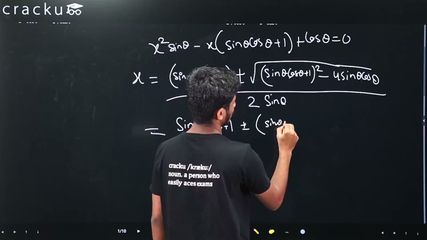
Click on the Email ☝️ to Watch the Video Solution
Create a FREE account and get:
_1.webp)

Educational materials for JEE preparation

Ask our AI anything

AI can make mistakes. Please verify important information.
AI can make mistakes. Please verify important information.


