
Join Our JEE Preparation Group
Prep with like-minded aspirants; Get access to free daily tests and study material.
Sign in
Please select an account to continue using cracku.in
↓ →
Join Our JEE Preparation Group
Prep with like-minded aspirants; Get access to free daily tests and study material.
Let z be a complex number such that $$|z| + z = 3 + i$$ (where $$i = \sqrt{-1}$$). Then $$|z|$$ is equal to:
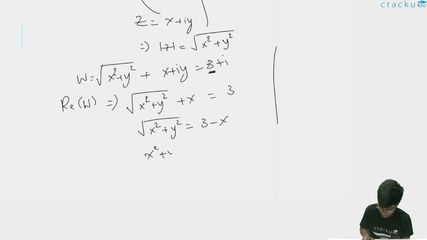
We are told that the complex number $$z$$ satisfies the relation $$|z| + z = 3 + i$$, where $$i = \sqrt{-1}$$. In order to unravel this condition, we first express $$z$$ in the usual Cartesian form $$z = x + iy$$ with real numbers $$x$$ and $$y$$.
Using the definition of the modulus of a complex number, we have the well-known identity $$|z| = \sqrt{x^{2} + y^{2}}$$. Substituting $$z = x + iy$$ and $$|z| = \sqrt{x^{2} + y^{2}}$$ into the given equation, we obtain
$$\sqrt{x^{2} + y^{2}} + (x + iy) = 3 + i.$$
Now we separate the real and imaginary parts on both sides. The real part on the left is $$\sqrt{x^{2} + y^{2}} + x$$, and the imaginary part is $$y$$. The right-hand side has real part $$3$$ and imaginary part $$1$$. Therefore we must have
$$\sqrt{x^{2} + y^{2}} + x = 3 \qquad\text{and}\qquad y = 1.$$
From the second equation we immediately obtain $$y = 1$$. We now insert this value into the first equation. Doing so gives
$$\sqrt{x^{2} + 1^{2}} + x = 3,$$
which simplifies to
$$\sqrt{x^{2} + 1} = 3 - x.$$
Because the square-root expression is always non-negative, we must have $$3 - x \ge 0$$, implying $$x \le 3$$, which will be automatically checked once we find $$x$$. Next, to eliminate the square root, we square both sides. The algebraic step is
$$x^{2} + 1 = (3 - x)^{2}.$$
Expanding the right-hand side gives
$$x^{2} + 1 = 9 - 6x + x^{2}.$$
Both sides contain the term $$x^{2}$$, so we subtract $$x^{2}$$ from each side, leaving
$$1 = 9 - 6x.$$
Rearranging for $$x$$, we first subtract $$9$$ from both sides to obtain $$1 - 9 = -6x$$, i.e.
$$-8 = -6x.$$
Dividing by $$-6$$, we get
$$x = \frac{-8}{-6} = \frac{4}{3}.$$
This value satisfies $$x \le 3$$, so it is consistent. We now compute the modulus $$|z|$$ itself. Using $$x = \dfrac{4}{3}$$ and $$y = 1$$, we have
$$|z| = \sqrt{x^{2} + y^{2}} = \sqrt{\left(\frac{4}{3}\right)^{2} + 1^{2}} = \sqrt{\frac{16}{9} + \frac{9}{9}} = \sqrt{\frac{25}{9}} = \frac{5}{3}.$$
Hence, the correct answer is Option B.
Was this solution helpful?
Click on the Email ☝️ to Watch the Video Solution
Create a FREE account and get:
_1.webp)

Educational materials for JEE preparation

Ask our AI anything

AI can make mistakes. Please verify important information.
AI can make mistakes. Please verify important information.


