
Join Our JEE Preparation Group
Prep with like-minded aspirants; Get access to free daily tests and study material.
Sign in
Please select an account to continue using cracku.in
↓ →
Join Our JEE Preparation Group
Prep with like-minded aspirants; Get access to free daily tests and study material.
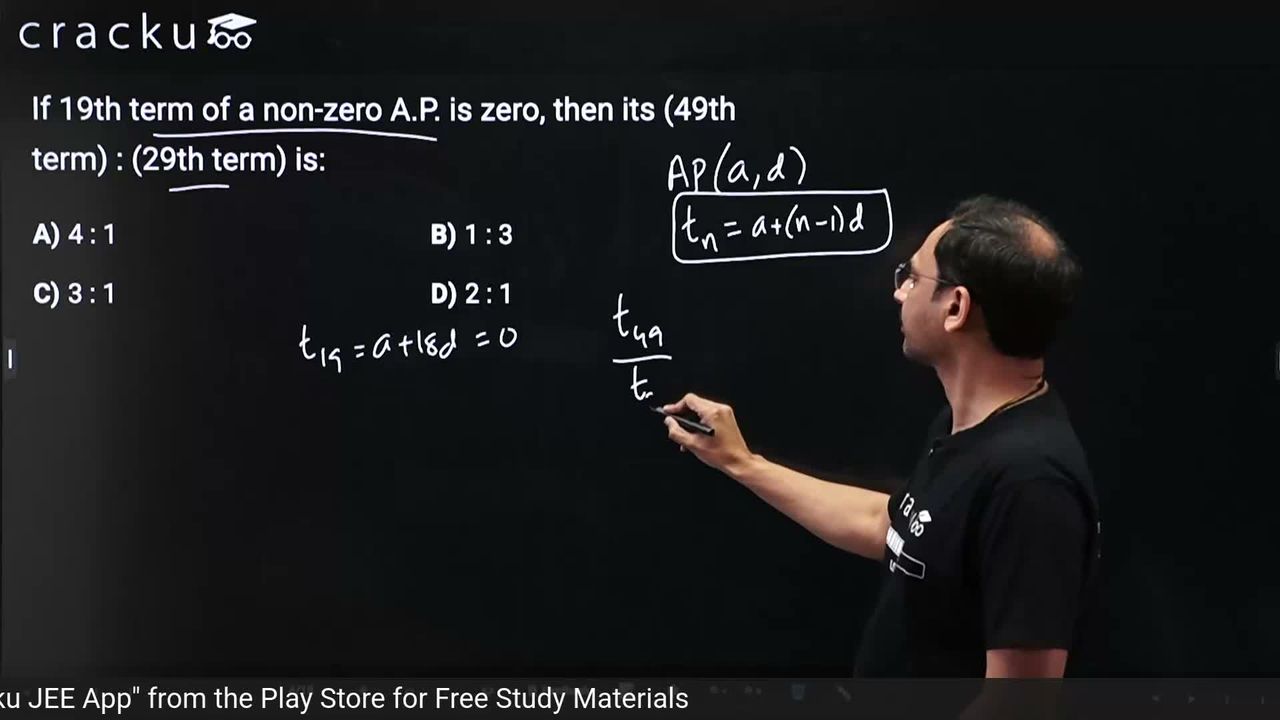
We consider an arithmetic progression (A.P.) whose first term is denoted by $$a$$ and common difference by $$d$$. For any A.P., the formula for the $$n^{\text{th}}$$ term is
$$T_n = a + (n-1)d.$$
We are told that the nineteenth term is zero. Putting $$n = 19$$ in the formula, we obtain
$$T_{19} = a + (19-1)d = a + 18d = 0.$$
Solving this linear equation for $$a$$ gives
$$a = -18d.$$
Now we calculate the forty-ninth term. Substituting $$n = 49$$ in the general term formula, we get
$$T_{49} = a + (49-1)d = a + 48d.$$
Replacing $$a$$ by $$-18d$$, we find
$$T_{49} = -18d + 48d = 30d.$$
Next, we compute the twenty-ninth term. Putting $$n = 29$$ gives
$$T_{29} = a + (29-1)d = a + 28d.$$
Again substituting $$a = -18d$$, we obtain
$$T_{29} = -18d + 28d = 10d.$$
We are asked to find the ratio of the forty-ninth term to the twenty-ninth term. Using the values just found, we have
$$\frac{T_{49}}{T_{29}} = \frac{30d}{10d}.$$
The factor $$d$$ cancels, and the numerical ratio simplifies to
$$\frac{30}{10} = 3.$$
Therefore,
$$(49\text{th term}) : (29\text{th term}) = 3 : 1.$$
Hence, the correct answer is Option C.
Was this solution helpful?
Click on the Email ☝️ to Watch the Video Solution
Create a FREE account and get:
_1.webp)

Educational materials for JEE preparation

Ask our AI anything

AI can make mistakes. Please verify important information.
AI can make mistakes. Please verify important information.


