
Join Our JEE Preparation Group
Prep with like-minded aspirants; Get access to free daily tests and study material.
Sign in
Please select an account to continue using cracku.in
↓ →
Join Our JEE Preparation Group
Prep with like-minded aspirants; Get access to free daily tests and study material.
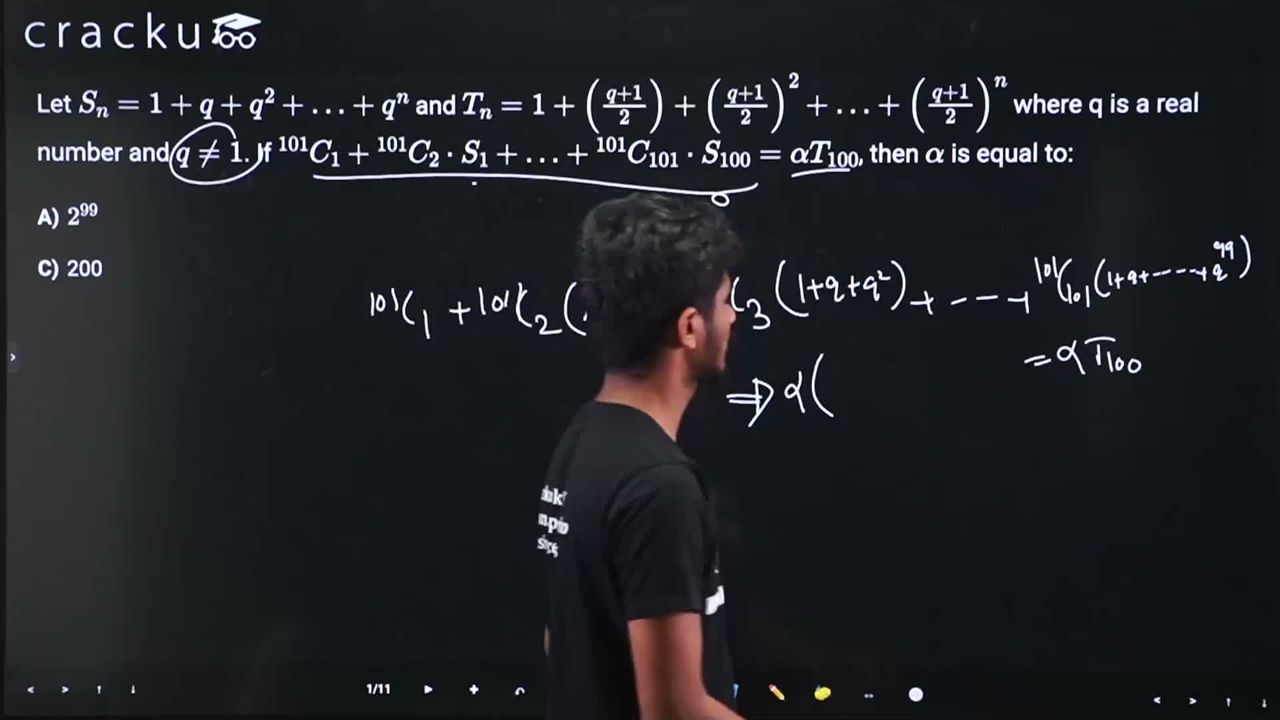
Let $$S_n = 1 + q + q^2 + \ldots + q^n$$ and $$T_n = 1 + \left(\frac{q+1}{2}\right) + \left(\frac{q+1}{2}\right)^2 + \ldots + \left(\frac{q+1}{2}\right)^n$$ where q is a real number and $$q \neq 1$$. If $${}^{101}C_1 + {}^{101}C_2 \cdot S_1 + \ldots + {}^{101}C_{101} \cdot S_{100} = \alpha T_{100}$$, then $$\alpha$$ is equal to:
We have been given two geometric sums
$$S_n \;=\;1+q+q^2+\ldots+q^n$$
$$T_n \;=\;1+\left(\dfrac{q+1}{2}\right)+\left(\dfrac{q+1}{2}\right)^2+\ldots+\left(\dfrac{q+1}{2}\right)^n$$
together with the relation
$$^{101}C_1+^{101}C_2\;S_1+\ldots+{}^{101}C_{101}\;S_{100}\;=\;\alpha\,T_{100}.$$
We first convert the finite geometric progression $$S_n$$ into its closed form. For a common ratio $$r\neq1$$ we know the formula
$$1+r+r^2+\ldots+r^n=\dfrac{r^{\,n+1}-1}{r-1}.$$
Using $$r=q$$ we get
$$S_{r-1}=\dfrac{q^{\,r}-1}{q-1}.$$
The left hand side of our given equation is therefore
$$\sum_{r=1}^{101}\,^{101}C_r\,S_{r-1} \;=\; \sum_{r=1}^{101}\,^{101}C_r\;\dfrac{q^{\,r}-1}{q-1} \;=\;\dfrac{1}{q-1}\Bigg(\sum_{r=1}^{101}\,^{101}C_r\,q^{\,r} -\sum_{r=1}^{101}\,^{101}C_r\Bigg).$$
By the Binomial Theorem we have
$$\sum_{r=0}^{101}\,^{101}C_r\,q^{\,r}=(1+q)^{101},$$
so that
$$\sum_{r=1}^{101}\,^{101}C_r\,q^{\,r}=(1+q)^{101}-1.$$ Similarly, $$\sum_{r=1}^{101}\,^{101}C_r=(1+1)^{101}-1=2^{101}-1.$$
Substituting both results we arrive at
$$\sum_{r=1}^{101}\,^{101}C_r\,S_{r-1} =\dfrac{(1+q)^{101}-1-(2^{101}-1)}{q-1} =\dfrac{(1+q)^{101}-2^{101}}{q-1}.$$
Next we simplify $$T_{100}$$. Applying the same finite-GP formula to the ratio $$\dfrac{q+1}{2}$$ we obtain
$$T_{100}= \dfrac{\left(\dfrac{q+1}{2}\right)^{101}-1}{\dfrac{q+1}{2}-1} =\dfrac{\left(\dfrac{q+1}{2}\right)^{101}-1}{\dfrac{q-1}{2}} =2\,\dfrac{\left(\dfrac{q+1}{2}\right)^{101}-1}{q-1}.$$
Because $$\left(\dfrac{q+1}{2}\right)^{101}=\dfrac{(1+q)^{101}}{2^{101}},$$ we can rewrite
$$T_{100}=2\,\dfrac{\dfrac{(1+q)^{101}}{2^{101}}-1}{q-1} =\dfrac{(1+q)^{101}-2^{101}}{2^{100}(q-1)}.$$
Now the given equality $$\sum_{r=1}^{101}\,^{101}C_r\,S_{r-1}=\alpha\,T_{100}$$ becomes, after substituting the two expressions that we have just found,
$$\dfrac{(1+q)^{101}-2^{101}}{q-1} =\alpha\; \dfrac{(1+q)^{101}-2^{101}}{2^{100}(q-1)}.$$
The factor $$(1+q)^{101}-2^{101}$$ as well as the denominator $$q-1$$ are common to both sides and may be cancelled (recall $$q\neq1$$), leaving
$$1=\alpha\;\dfrac{1}{2^{100}}.$$
Thus
$$\alpha=2^{100}.$$
Hence, the correct answer is Option 4.
Was this solution helpful?
Click on the Email ☝️ to Watch the Video Solution
Create a FREE account and get:
_1.webp)

Educational materials for JEE preparation

Ask our AI anything

AI can make mistakes. Please verify important information.
AI can make mistakes. Please verify important information.


