
Join Our JEE Preparation Group
Prep with like-minded aspirants; Get access to free daily tests and study material.
Sign in
Please select an account to continue using cracku.in
↓ →
Join Our JEE Preparation Group
Prep with like-minded aspirants; Get access to free daily tests and study material.
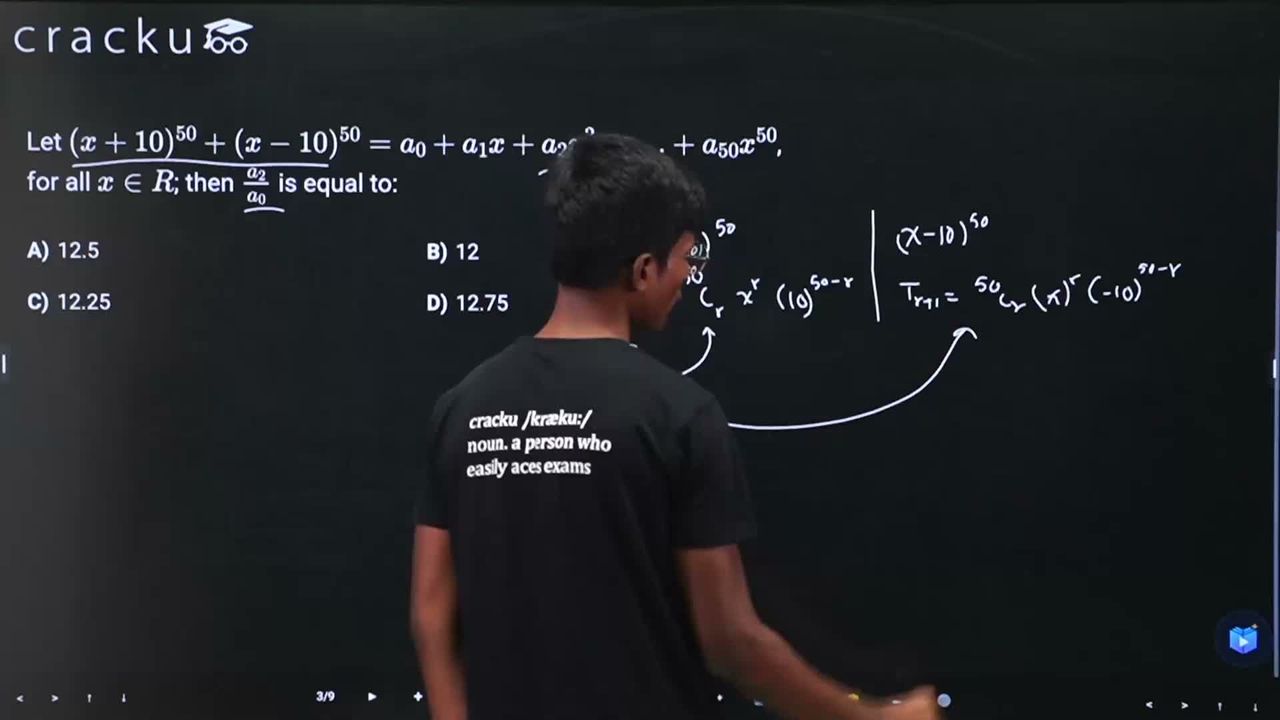
Let $$(x + 10)^{50} + (x - 10)^{50} = a_0 + a_1 x + a_2 x^2 + \ldots + a_{50} x^{50}$$, for all $$x \in R$$; then $$\frac{a_2}{a_0}$$ is equal to:
We begin with the expression
$$ (x + 10)^{50} + (x - 10)^{50}. $$
To expand a power of a binomial we recall the Binomial Theorem, stated as
$$ (a + b)^n \;=\; \sum_{k=0}^{n} \binom{n}{k}\, a^{\,n-k}\, b^{\,k}. $$
First we apply the theorem to each of the two terms separately, taking $$a = x$$ and $$b = 10$$ for the first term and $$b = -10$$ for the second:
$$ (x + 10)^{50} \;=\; \sum_{k=0}^{50} \binom{50}{k}\, x^{50-k}\, 10^{\,k}, $$
$$ (x - 10)^{50} \;=\; \sum_{k=0}^{50} \binom{50}{k}\, x^{50-k}\, (-10)^{\,k}. $$
Adding the two series we obtain
$$ (x + 10)^{50} + (x - 10)^{50} \;=\; \sum_{k=0}^{50} \binom{50}{k}\, x^{50-k}\,\bigl(10^{\,k} + (-10)^{\,k}\bigr). $$
Notice that when $$k$$ is odd, the two quantities $$10^{\,k}$$ and $$(-10)^{\,k}$$ have opposite signs, so their sum is zero. When $$k$$ is even, the signs are the same and their sum is simply twice the positive value. Therefore only the even values of $$k$$ survive, each with an extra factor of $$2$$:
$$ (x + 10)^{50} + (x - 10)^{50} \;=\; \sum_{\substack{k = 0 \\ k \text{ even}}}^{50} 2\,\binom{50}{k}\, x^{50-k}\, 10^{\,k}. $$
We compare this with the required form
$$ a_0 + a_1 x + a_2 x^2 + \dots + a_{50} x^{50}, $$
and identify each coefficient $$a_r$$ with the term in which the power of $$x$$ is $$r$$. Remember that the power of $$x$$ is $$50 - k$$. We now compute the two specific coefficients we need.
Constant term $$a_0$$: For the constant term the power of $$x$$ must be $$0$$. Setting $$50 - k = 0$$ gives $$k = 50$$, which is indeed even. Substituting $$k = 50$$ in the general term, we obtain
$$ a_0 \;=\; 2 \,\binom{50}{50}\,10^{50}. $$
Since $$\binom{50}{50} = 1$$, this simplifies to
$$ a_0 \;=\; 2 \times 10^{50}. $$
Coefficient $$a_2$$ of $$x^2$$: Here we need the power of $$x$$ to be $$2$$. Setting $$50 - k = 2$$ gives $$k = 48$$, which is also even. Substituting $$k = 48$$ gives
$$ a_2 \;=\; 2 \,\binom{50}{48}\,10^{48}. $$
Because of the symmetry of binomial coefficients, we have $$\binom{50}{48} = \binom{50}{2}$$. Using
$$ \binom{50}{2} \;=\; \frac{50 \times 49}{2} \;=\; 1225, $$
we obtain
$$ a_2 \;=\; 2 \times 1225 \times 10^{48}. $$
The desired ratio $$\dfrac{a_2}{a_0}$$:
$$ \frac{a_2}{a_0} \;=\; \frac{2 \times 1225 \times 10^{48}}{2 \times 10^{50}} \;=\; \frac{1225 \times 10^{48}}{10^{50}} \;=\; \frac{1225}{10^{2}} \;=\; \frac{1225}{100} \;=\; 12.25. $$
Hence, the correct answer is Option C.
Was this solution helpful?
Click on the Email ☝️ to Watch the Video Solution
Create a FREE account and get:
_1.webp)

Educational materials for JEE preparation

Ask our AI anything

AI can make mistakes. Please verify important information.
AI can make mistakes. Please verify important information.


