
Join Our JEE Preparation Group
Prep with like-minded aspirants; Get access to free daily tests and study material.
Sign in
Please select an account to continue using cracku.in
↓ →
Join Our JEE Preparation Group
Prep with like-minded aspirants; Get access to free daily tests and study material.
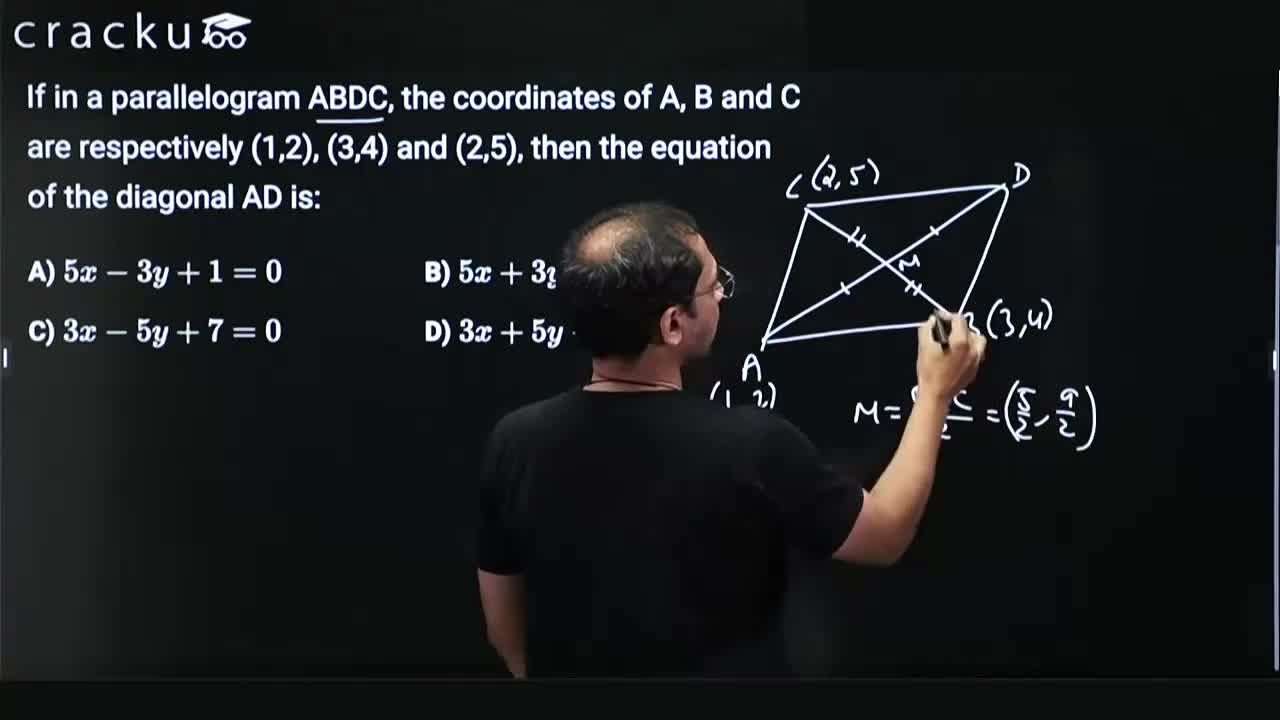
If in a parallelogram ABDC, the coordinates of A, B and C are respectively (1,2), (3,4) and (2,5), then the equation of the diagonal AD is:
We are told that ABDC is a parallelogram and that the coordinates of the three known vertices are $$A(1,2),\; B(3,4),\; C(2,5).$$ The fourth vertex $$D(x,y)$$ is not given. Our goal is to find the equation of the diagonal $$AD\;.$$
In any parallelogram, a very important fact is that the diagonals bisect each other. Stating this property mathematically: if the diagonals join the opposite vertices $$A\text{ to }D$$ and $$B\text{ to }C,$$ then the mid-point of $$AD$$ is exactly the same as the mid-point of $$BC$$.
First we write the co-ordinates of the mid-point of $$AD$$ in terms of the unknown co-ordinates of $$D(x,y).$$ By the mid-point formula, $$\text{Mid-point of }AD = \left(\frac{1+x}{2},\; \frac{2+y}{2}\right).$$
Next we find the mid-point of the completely known diagonal $$BC.$$ Again, using the mid-point formula, $$\text{Mid-point of }BC = \left(\frac{3+2}{2},\; \frac{4+5}{2}\right) = \left(\frac{5}{2},\; \frac{9}{2}\right).$$
Because the two mid-points are equal, we can equate the corresponding co-ordinates:
$$\frac{1+x}{2} = \frac{5}{2} \quad\text{and}\quad \frac{2+y}{2} = \frac{9}{2}.$$
Multiplying both equations by $$2$$ to clear the denominators, we get
$$1 + x = 5 \quad\text{and}\quad 2 + y = 9.$$
Now we solve for $$x$$ and $$y$$ separately:
$$x = 5 - 1 = 4,$$ $$y = 9 - 2 = 7.$$
So we have located the fourth vertex: $$D(4,7).$$
With both end-points of the required diagonal $$AD$$ known as $$A(1,2)\; \text{and}\; D(4,7),$$ we now find the equation of the straight line passing through these two points.
First calculate the slope. The slope (or gradient) formula is $$m = \frac{y_2 - y_1}{x_2 - x_1}.$$ Substituting $$A(1,2)$$ as $$(x_1,y_1)$$ and $$D(4,7)$$ as $$(x_2,y_2)$$ gives
$$m = \frac{7 - 2}{4 - 1} = \frac{5}{3}.$$
Next we use the point-slope form of the equation of a line, $$y - y_1 = m(x - x_1).$$ Choosing the point $$A(1,2),$$ we substitute:
$$y - 2 = \frac{5}{3}\,(x - 1).$$
To eliminate the fraction, multiply every term by $$3$$:
$$3(y - 2) = 5(x - 1).$$
Expand both sides:
$$3y - 6 = 5x - 5.$$
Now bring all terms to one side to obtain the standard linear form:
$$5x - 5 - 3y + 6 = 0,$$
$$5x - 3y + 1 = 0.$$
This is already simplified, and it exactly matches Option A.
Hence, the correct answer is Option A.
Was this solution helpful?
Click on the Email ☝️ to Watch the Video Solution
Create a FREE account and get:
_1.webp)

Educational materials for JEE preparation

Ask our AI anything

AI can make mistakes. Please verify important information.
AI can make mistakes. Please verify important information.


