Sign in
Please select an account to continue using cracku.in
↓ →

Join Our JEE Preparation Group
Prep with like-minded aspirants; Get access to free daily tests and study material.
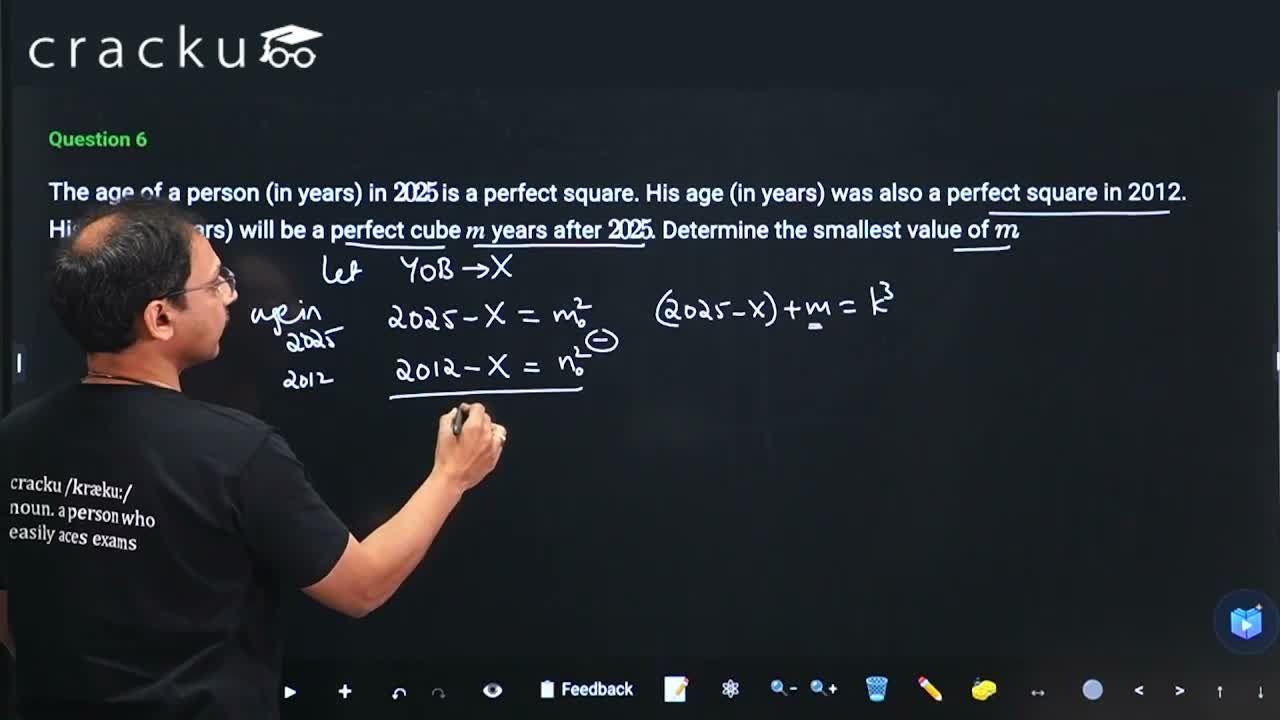
The age of a person (in years) in $$2025$$ is a perfect square. His age (in years) was also a perfect square in 2012.
His age (in years) will be a perfect cube 𝑚 years after $$2025$$. Determine the smallest value of $$m$$.
Correct Answer: 15
Let the person’s age in the year $$2012$$ be $$n^2$$ years, where $$n$$ is a positive integer.
Thirteen years later, in $$2025$$, the age becomes $$n^2+13$$. We are told this is also a perfect square, say $$k^2$$. Hence
$$k^2 - n^2 = 13 \quad -(1)$$
Factorising the left side using the identity $$k^2-n^2=(k-n)(k+n)$$ gives
$$(k-n)(k+n)=13 \quad -(2)$$
Because $$13$$ is prime, the only pair of positive integers whose product is $$13$$ is $$1$$ and $$13$$. Thus
$$k-n = 1 \quad\text{and}\quad k+n = 13$$
Adding the two equations: $$2k = 14 \;\Longrightarrow\; k = 7$$.
Substituting back: $$n = k-1 = 6$$.
Therefore
Age in $$2012 = n^2 = 6^2 = 36 \text{ years}$$
Age in $$2025 = k^2 = 7^2 = 49 \text{ years}$$.
Let $$m$$ be the number of years after $$2025$$ when the age first becomes a perfect cube. We require
$$49 + m = p^3$$ for some integer $$p$$, with $$m \gt 0$$ and as small as possible.
The cubes just above $$49$$ are
$$4^3 = 64,\quad 5^3 = 125, \ldots$$
The first one that exceeds $$49$$ is $$64$$, and
$$64 - 49 = 15$$.
Thus the earliest perfect-cube age is $$64$$ years, reached $$m = 15$$ years after $$2025$$.
Smallest value of $$m = 15$$.
Answer: 15
Was this solution helpful?
Click on the Email ☝️ to Watch the Video Solution
Book Free CAT Mentorship
Get personalized CAT strategy from a 99%iler
500+ students mentored
OTP Verification
Enter the 6-digit code sent to your phone
Booking Summary
Enter OTP
Didn't receive the OTP?
_1.webp)

Predict your JEE Main percentile, rank & performance in seconds

Educational materials for JEE preparation

Ask our AI anything

AI can make mistakes. Please verify important information.
AI can make mistakes. Please verify important information.
 91- 6303239042

