
Join Our JEE Preparation Group
Prep with like-minded aspirants; Get access to free daily tests and study material.
Sign in
Please select an account to continue using cracku.in
↓ →
Join Our JEE Preparation Group
Prep with like-minded aspirants; Get access to free daily tests and study material.
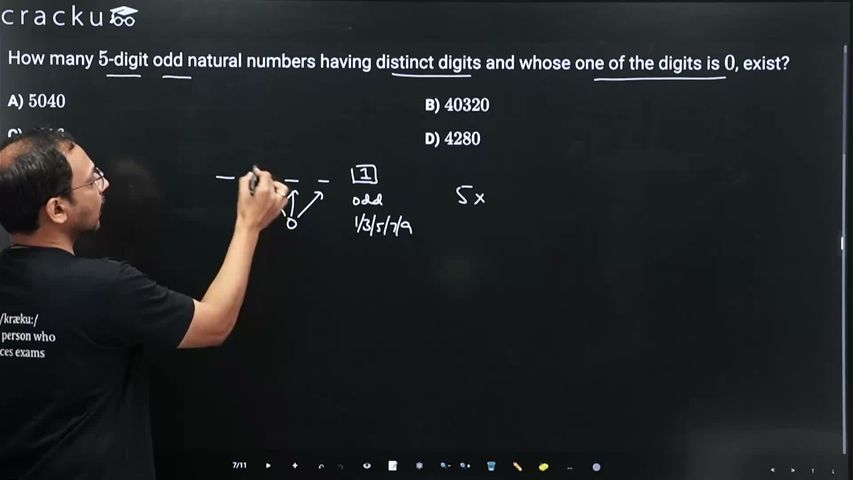
How many $$5$$-digit odd natural numbers having distinct digits and whose one of the digits is $$0$$, exist?
To find the total number of five-digit odd natural numbers having distinct digits and containing the digit zero, we can use the principle of counting by finding the difference between all such odd numbers and those that do not contain zero.
First, let us find the total number of five-digit odd numbers with distinct digits using the digits from zero to nine.
A number is odd if its units place is filled by an odd digit.
The available odd digits are one, three, five, seven, and nine, giving five choices for the units place.
The ten-thousands place cannot be zero and cannot be the digit already used in the units place, so it has eight choices.
The thousands place can now include zero, leaving eight choices from the remaining available digits.
The hundreds place has seven choices.
The tens place has six choices.
Thus, the total number of five-digit odd numbers with distinct digits is given by the product:
$$8 \times 8 \times 7 \times 6 \times 5 = 13440$$
Next, let us find the number of five-digit odd numbers with distinct digits that do not contain the digit zero.
In this case, we use the nine non-zero digits from one to nine.
The units place must be odd, giving five choices.
The remaining four positions are filled by choosing four digits from the remaining eight non-zero digits.
The number of ways to arrange the remaining positions is:
$$8 \times 7 \times 6 \times 5 = 1680$$
Multiplying this by the five choices for the units place gives:
$$1680 \times 5 = 8400$$
Finally, subtracting the numbers that do not contain zero from the total number of five-digit odd numbers gives:
$$13440 - 8400 = 5040$$
The correct option is A.
Was this solution helpful?
Click on the Email ☝️ to Watch the Video Solution
Create a FREE account and get:
_1.webp)

Educational materials for JEE preparation

Ask our AI anything

AI can make mistakes. Please verify important information.
AI can make mistakes. Please verify important information.
