
Join Our JEE Preparation Group
Prep with like-minded aspirants; Get access to free daily tests and study material.
Sign in
Please select an account to continue using cracku.in
↓ →
Join Our JEE Preparation Group
Prep with like-minded aspirants; Get access to free daily tests and study material.
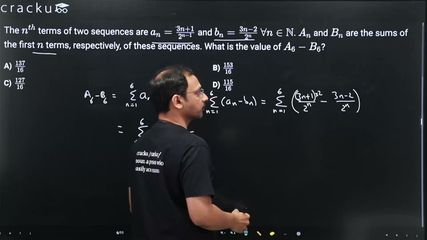
The $$n^{th}$$ terms of two sequences are $$a_n=\frac{3n+1}{2^{n-1}}$$ and $$b_n=\frac{3n-2}{2^n}$$ $$\forall n\in\mathbb{N}$$. $$A_n$$ and $$B_n$$ are the sums of the first $$n$$ terms, respectively, of these sequences. What is the value of $$A_6-B_6$$?
To find the value of $$A_6 - B_6$$, we first analyze the general terms of the two given sequences, $$a_n$$ and $$b_n$$.
The $$n^{\text{th}}$$ terms are given by:
$$a_n = \frac{3n + 1}{2^{n-1}}$$
$$b_n = \frac{3n - 2}{2^n}$$
Since $$A_n$$ and $$B_n$$ represent the sums of the first $$n$$ terms of their respective sequences, the difference $$A_n - B_n$$ can be expressed as the sum of the differences of their general terms:
$$A_n - B_n = \sum_{k=1}^{n} (a_k - b_k)$$
Let us simplify the general term $$a_k - b_k$$:
$$a_k - b_k = \frac{3k + 1}{2^{k-1}} - \frac{3k - 2}{2^k}$$
Taking $$2^k$$ as the common denominator:
$$a_k - b_k = \frac{2(3k + 1) - (3k - 2)}{2^k}$$
$$a_k - b_k = \frac{6k + 2 - 3k + 2}{2^k} = \frac{3k + 4}{2^k}$$
Thus, the sum $$S_n = A_n - B_n$$ becomes an arithmetico-geometric progression (AGP):
$$S_n = \sum_{k=1}^{n} \frac{3k + 4}{2^k} = \frac{7}{2^1} + \frac{10}{2^2} + \frac{13}{2^3} + \dots + \frac{3n + 4}{2^n}$$
To sum this AGP, multiply both sides by the common ratio $$\frac{1}{2}$$:
$$\frac{1}{2} S_n = \frac{7}{2^2} + \frac{10}{2^3} + \dots + \frac{3n - 2}{2^n} + \frac{3n + 4}{2^{n+1}}$$
Subtracting the second equation from the first:
$$\frac{1}{2} S_n = \frac{7}{2} + \left( \frac{3}{2^2} + \frac{3}{2^3} + \dots + \frac{3}{2^n} \right) - \frac{3n + 4}{2^{n+1}}$$
The expression inside the parentheses is a finite geometric series with $$n-1$$ terms, a first term of $$\frac{3}{4}$$, and a common ratio of $$\frac{1}{2}$$:
$$\frac{3}{2^2} + \frac{3}{2^3} + \dots + \frac{3}{2^n} = \frac{\frac{3}{4} \left(1 - \frac{1}{2^{n-1}}\right)}{1 - \frac{1}{2}} = \frac{3}{2} \left(1 - \frac{1}{2^{n-1}}\right)$$
Substituting this back into our expression for $$\frac{1}{2} S_n$$:
$$\frac{1}{2} S_n = \frac{7}{2} + \frac{3}{2} - \frac{3}{2^n} - \frac{3n + 4}{2^{n+1}}$$
$$\frac{1}{2} S_n = 5 - \frac{3}{2^n} - \frac{3n + 4}{2^{n+1}}$$
Multiplying the entire equation by 2 gives the general sum $$S_n$$:
$$S_n = 10 - \frac{6}{2^n} - \frac{3n + 4}{2^n} = 10 - \frac{3n + 10}{2^n}$$
Now, substituting $$n = 6$$ to find $$A_6 - B_6$$:
$$S_6 = 10 - \frac{3(6) + 10}{2^6}$$
$$S_6 = 10 - \frac{18 + 10}{64}$$
$$S_6 = 10 - \frac{28}{64}$$
Simplifying the fraction by dividing the numerator and denominator by 4:
$$S_6 = 10 - \frac{7}{16} = \frac{160 - 7}{16} = \frac{153}{16}$$
The correct option is B.
Was this solution helpful?
Click on the Email ☝️ to Watch the Video Solution
Create a FREE account and get:
_1.webp)

Educational materials for JEE preparation

Ask our AI anything

AI can make mistakes. Please verify important information.
AI can make mistakes. Please verify important information.
