Sign in
Please select an account to continue using cracku.in
↓ →
 CAT WhatsApp Group
The passage below is accompanied by four questions. Based on the passage, choose the best answer for each question.
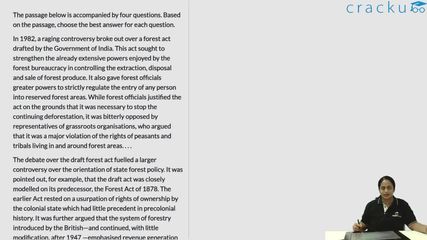
In 1982, a raging controversy broke out over a forest act drafted by the Government of India. This act sought to strengthen the already extensive powers enjoyed by the forest bureaucracy in controlling the extraction, disposal and sale of forest produce. It also gave forest officials greater powers to strictly regulate the entry of any person into reserved forest areas. While forest officials justified the act on the grounds that it was necessary to stop the continuing deforestation, it was bitterly opposed by representatives of grassroots organisations, who argued that it was a major violation of the rights of peasants and tribals living in and around forest areas. . . .
The debate over the draft forest act fuelled a larger controversy over the orientation of state forest policy. It was pointed out, for example, that the draft act was closely modelled on its predecessor, the Forest Act of 1878. The earlier Act rested on a usurpation of rights of ownership by the colonial state which had little precedent in precolonial history. It was further argued that the system of forestry introduced by the British—and continued, with little modification, after 1947 —emphasised revenue generation and commercial exploitation, while its policing orientation excluded villagers who had the most longstanding claim on forest resources. Critics called for a complete overhaul of forest administration, pressing the government to formulate policy and legislation more appropriate to present needs. . . .
That debate is not over yet. The draft act was shelved, though it has not as yet been formally withdrawn. Meanwhile, the 1878 Act (as modified by an amendment in 1927) continues to be in operation. In response to its critics, the government has made some important changes in forest policy, e.g., no longer treating forests as a source of revenue, and stopping ecologically hazardous practices such as the clearfelling of natural forests. At the same time, it has shown little inclination to meet the major demand of the critics of forest policy—namely, abandoning the principle of state monopoly over forest land by handing over areas of degraded forests to
individuals and communities for afforestation.
. . . [The] 1878 Forest Act itself was passed only after a bitter and prolonged debate within the colonial bureaucracy, in which protagonists put forward arguments strikingly similar to those being advanced today. As is well known, the Indian Forest Department owes its origin to the requirements of railway companies. The early years of the expansion of the railway network, c. 1853 onwards, led to tremendous deforestation in peninsular India owing to the railway's requirements of fuelwood and construction timber. Huge quantities of durable timbers were also needed for use as sleepers across the newly laid tracks. Inexperienced in forestry, the British called in German experts to commence systematic forest management. The Indian Forest Department was started in 1864, with Dietrich Brandis, formerly a Lecturer at Bonn, as the first Inspector General of Forests. The new department needed legislative backing to function effectively, and in the following year, 1865, the first forest act was passed. . . .
According to the passage, which one of the following reforms is yet to happen in India’s forest policies?

The passage indicates that some reforms in forest policy have already taken place. It notes that the government no longer treats forests as a source of revenue and has stopped “ecologically hazardous practices such as the clearfelling of natural forests,” which rules out option (C) since ecological concerns are clearly being recognised. The continued operation of the 1878 Act and the government’s reluctance to abandon state control show that the state’s claim to forest land remains recognised, ruling out option (A). There is also no mention of a complete ban on deforestation; rather, the focus is on regulating harmful practices, so option (B) does not fit either.What the passage emphasises as still missing is the government’s refusal to accept the main demand of critics: “handing over areas of degraded forests to individuals and communities for afforestation.” This directly points to the continued exclusion of local people from forest cultivation and management. Hence, the reform yet to occur is option (D), involving local people in forest cultivation.
Click on the Email ☝️ to Watch the Video Solution
Create a FREE account and get:
Book Free CAT Mentorship
Get personalized CAT strategy from a 99%iler
500+ students mentored
OTP Verification
Enter the 6-digit code sent to your phone
Booking Summary
Enter OTP
Didn't receive the OTP?

Educational materials for CAT preparation

Ask our AI anything

AI can make mistakes. Please verify important information.
AI can make mistakes. Please verify important information.
 91- 6303239042


