
Join Our JEE Preparation Group
Prep with like-minded aspirants; Get access to free daily tests and study material.
Sign in
Please select an account to continue using cracku.in
↓ →
Join Our JEE Preparation Group
Prep with like-minded aspirants; Get access to free daily tests and study material.
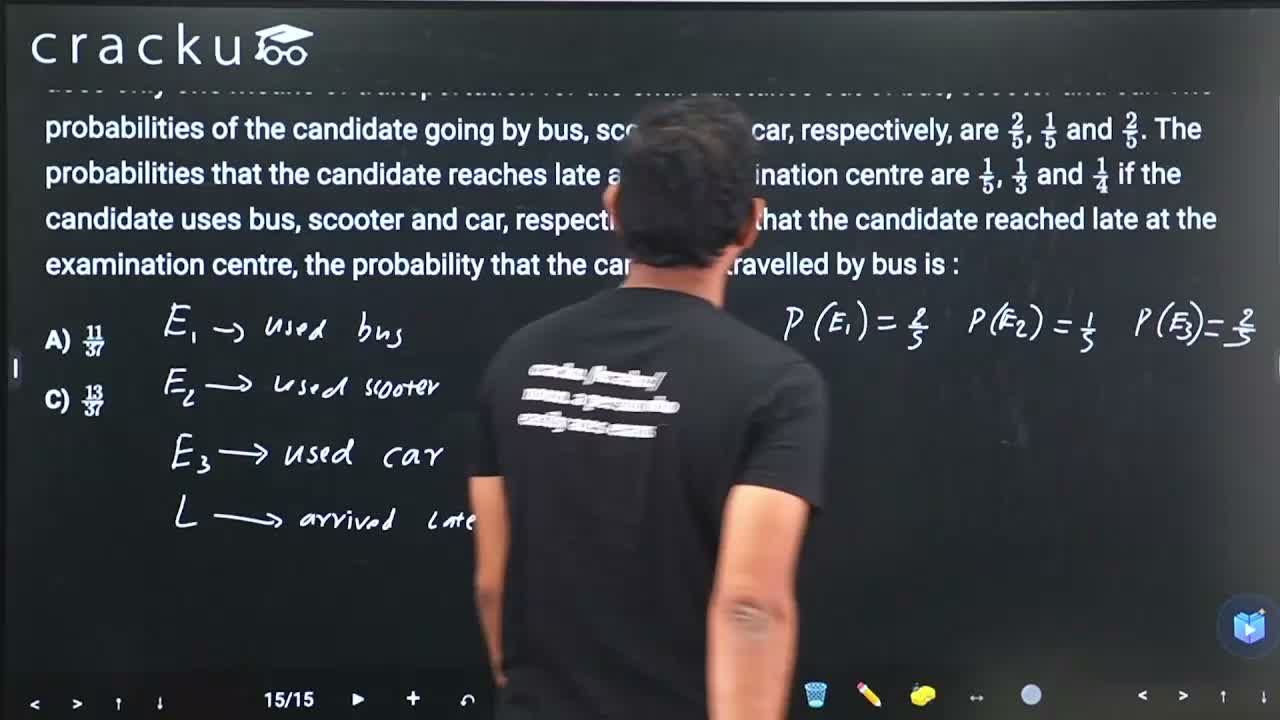
A candidate has to go to the examination centre to appear in an examination. The candidate uses only one means of transportation for the entire distance out of bus, scooter and car. The probabilities of the candidate going by bus, scooter and car, respectively, are $$\frac{2}{5}$$, $$\frac{1}{5}$$ and $$\frac{2}{5}$$. The probabilities that the candidate reaches late at the examination centre are $$\frac{1}{5}$$, $$\frac{1}{3}$$ and $$\frac{1}{4}$$ if the candidate uses bus, scooter and car, respectively. Given that the candidate reached late at the examination centre, the probability that the candidate travelled by bus is :
The probability that the candidate travelled by bus given that they arrived late is:
$$P(E_1|L) = \frac{P(E_1) \cdot P(L|E_1)}{P(E_1) \cdot P(L|E_1) + P(E_2) \cdot P(L|E_2) + P(E_3) \cdot P(L|E_3)}$$
$$P(E_1) = \frac{2}{5}, \quad P(E_2) = \frac{1}{5}, \quad P(E_3) = \frac{2}{5}$$ (Travel probabilities)
$$P(L|E_1) = \frac{1}{5}, \quad P(L|E_2) = \frac{1}{3}, \quad P(L|E_3) = \frac{1}{4}$$ (Conditional probabilities of being late)
For Bus: $$P(E_1) \cdot P(L|E_1) = \frac{2}{5} \times \frac{1}{5} = \frac{2}{25}$$
For Scooter: $$P(E_2) \cdot P(L|E_2) = \frac{1}{5} \times \frac{1}{3} = \frac{1}{15}$$
For Car: $$P(E_3) \cdot P(L|E_3) = \frac{2}{5} \times \frac{1}{4} = \frac{2}{20} = \frac{1}{10}$$
$$P(L) = \frac{2}{25} + \frac{1}{15} + \frac{1}{10}$$
$$P(L) = \frac{24}{300} + \frac{20}{300} + \frac{30}{300} = \frac{24 + 20 + 30}{300} = \frac{74}{300}$$
$$P(E_1|L) = \frac{\frac{24}{300}}{\frac{74}{300}} = \frac{24}{74} = \frac{12}{37}$$
Was this solution helpful?
Click on the Email ☝️ to Watch the Video Solution
Create a FREE account and get:
_1.webp)

Educational materials for JEE preparation

Ask our AI anything

AI can make mistakes. Please verify important information.
AI can make mistakes. Please verify important information.
