
Join Our JEE Preparation Group
Prep with like-minded aspirants; Get access to free daily tests and study material.
Sign in
Please select an account to continue using cracku.in
↓ →
Join Our JEE Preparation Group
Prep with like-minded aspirants; Get access to free daily tests and study material.
Maximum number of isomeric monochloro derivatives which can be obtained from 2,2,5,5-tetramethylhexane by chlorination is _____
Correct Answer: 3
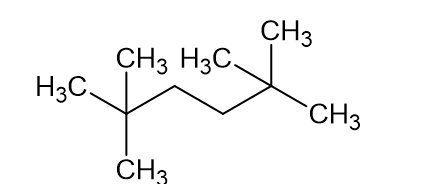
The structural formula of 2,2,5,5-tetramethylhexane can be written as:
$$\text{(CH}_3)_3\text{C} - \text{CH}_2 - \text{CH}_2 - \text{C(CH}_3)_3$$
This molecule is highly symmetrical, with a plane of symmetry right down the middle of the C3-C4 bond.
There are only two positions containing hydrogen atoms where chlorination can occur:
Chlorination at Position A (Methyl Groups)
Substituting one hydrogen from any of the methyl groups gives:
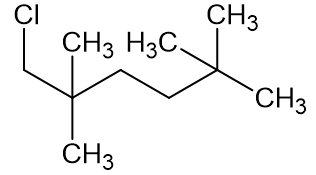
$$\text{Cl-CH}_2 - \text{C(CH}_3)_2 - \text{CH}_2 - \text{CH}_2 - \text{C(CH}_3)_3$$
Chlorination at Position B (Methylene Groups)
Substituting one hydrogen from either C3 or C4 gives:
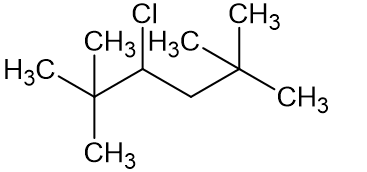
$$\text{(CH}_3)_3\text{C} - \text{CH(Cl)} - \text{CH}_2 - \text{C(CH}_3)_3$$
Since all 4 groups attached to C3 are completely different, C3 is a chiral (asymmetric) carbon center.
$$\text{Total Isomeric Monochloro Derivatives} = 1 \text{ (achiral)} + 2 \text{ (enantiomers)} = \mathbf{3}$$
Was this solution helpful?
Click on the Email ☝️ to Watch the Video Solution
Create a FREE account and get:
_1.webp)

Educational materials for JEE preparation

Ask our AI anything

AI can make mistakes. Please verify important information.
AI can make mistakes. Please verify important information.
